
During an evening on the beach with friends this week, I lamented my lack of producing a video for today’s Everyday Spirituality essay. I’ve been immersed in family visits and a bicycle trip with friends, plus taking a class in producing vertical videos. My friend Susan said, “Well, isn’t learning a form of spirituality?”
“Brilliant, and true,” I thought.
First, the video I do have, you can view below. It’s my submission for a class on how to produce vertical videos for news organizations. Yes, I’m honing my journalistic skills. The video has nothing to do with spirituality, unless you consider recycling a spiritual practice. I’ll be back next week with a video that ties more directly to Everyday Spirituality
But the larger point Susan made rings true. Being a curious person, one who seeks to learn new things or how to improve old practices, is without a doubt an expression of everyday spirituality.
The school of developmental psychology, founded by Erik Erikson, presents a theory that humans move through a series of phases or stages of life by facing a series of identity crises at the meeting point of our inner selves and the surrounding culture. How we move through those phases is critical to our maturing as people.
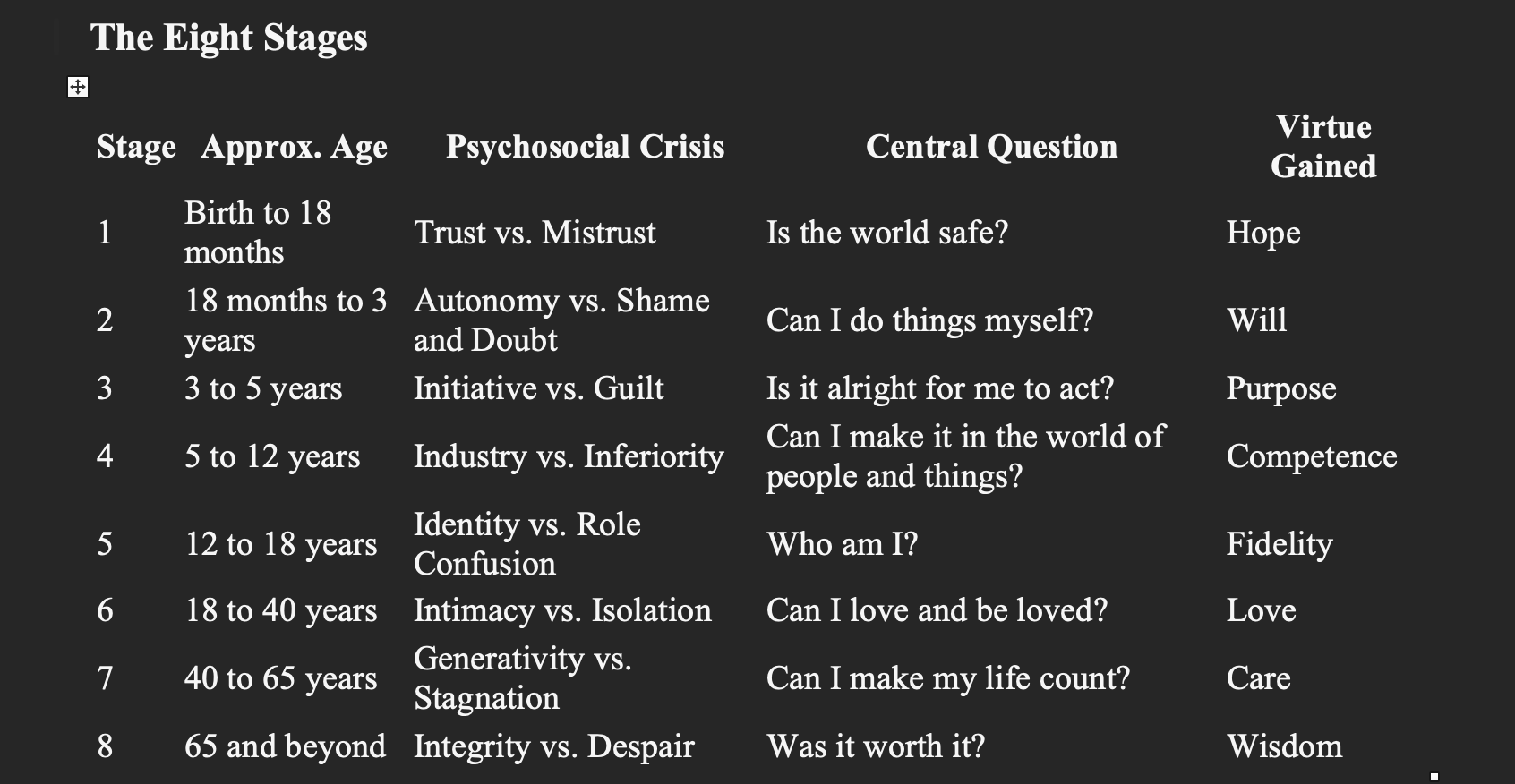
Erikson’s development theory is based on the epigenetic principle that each stage occurs in sequence, with a tension to resolve before moving on. These moments of transition are pivotal. Obviously, no one does this perfectly, and the stages are more fluid in the lived experience than any chart can capture. But the basic idea is sound. We move forward cultivating hope and wisdom, while carrying the load of disappointments and conflicts.
You’ll note that learning, growth, wonder, and curiosity are essential throughout a person’s life. The alternative is stagnation and calcification. Just think about two hypothetical retirees. One concludes their time of paid employment, moves to a warm-weather state, and plays golf every day with their spouse. They choose not to interact with neighbors, eat the same foods they have for decades, watch the same TV programs, and never travel. In contrast, the other retiree moves to a new location, joins a bowling league with the goal of meeting new friends, volunteers at a local history museum as a docent, and travels annually to new places. Obviously, these are caricatures and overly simplistic, but you get the idea.
The eighth and final stage is Integrity versus Despair, where your “old grumpy person” truly resides. Erikson defined integrity as accepting one’s unique life cycle as something that had to be and cannot be replaced, a beautiful yet challenging idea. It involves making peace with missed opportunities, harm done and received, and life’s everyday chaos. Despair rejects that peace, showing through contempt, chronic complaints, bitterness toward the young, and the feeling that time has run out and nothing can be fixed. These two stages are closely linked because generativity provides a strong foundation for integrity. Those who spent their middle age caring for something beyond themselves leave a legacy beyond personal gain.
All of this is to point out that learning is a vehicle, maybe the vehicle for maturing as a human being. And in my mind, that leads to spiritual maturity and wisdom.
Be curious, my friends.

James Hazelwood is a writer and photographer learning new things in this new phase of life. www.jameshazelwoodphoto.com
Comments
Nothing yet. Say the first thing.
Sign in to join the conversation.