
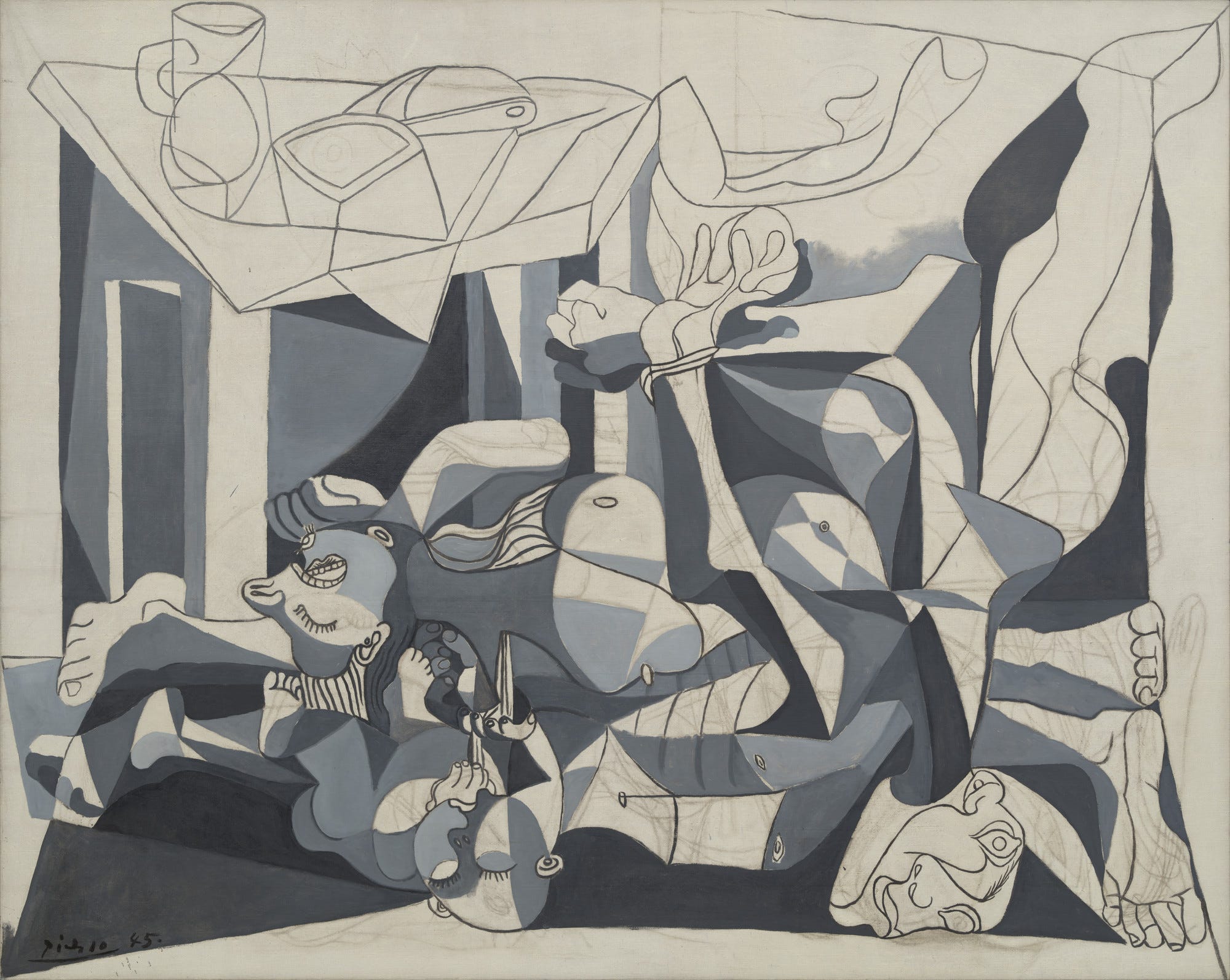
There is something futile in undertakings such as Picasso’s Guernica and Schoenberg’s Survivor from Warsaw. Both of these artists, who are nearly the only ones left, register the impossibility of an art that would continue to “develop” without reacting to the horror; the nullity of art, its objective transition into Kunstgewerbe. But can art actually react to the horror as it wants? Art presupposes a certain spiritualization of all material and freedom of the subject—it is essentially a spiritual affair. But this entails a proportion between subject and object, a proportion which has been destroyed. The object, as the Surrealists correctly innervated from the start, has grown so monstrous, so overpowerful, that it no longer permits of spiritualization—that the mere claim to, to render the object one commensurable, experienceable, even and especially through the wildest presentation, is to ideologize. The frivolity that emerges in a “Kunstwerk”1 about the Warsaw Ghetto in truth affects all art today, and does so all the more the more the work of art seals itself off. If the work does not, however, then it is no art at all, but rather its de-spiritualized, positivistic surrogate, lacking its raison d’être. This is likely the reason for the rapid decline of all art and philosophy today, which can be expressed but hardly “overcome.” All that is spiritual has taken on something of the involuntary movements of reflex. The Urbild of culture today lies in the ruins of destroyed cities, in whose midst houses, apartment buildings remain standing upright, unscathed—as ghosts.
—Adorno. From A “Scribble-In” Book. Los Angeles, ca. November 1948.2
The “aesthetic” in Spengler’s and indeed even Nietzsche’s conception of history—the view and veneration of history as a tragic spectacle of great men, great deeds, great peoples—is connected with the object, the futility of all history to date. The “heroic” effort to dominate nature, which enthrones this domination as an end-in-itself and thereby forgets and finally sacrifices human ends, gives rise to the sort of semblance [Anschein] that corresponds to the historical image of children (N.B. Nietzsche’s naiveté!): that all of this really happens ut aliquid fieri videatur, for the sake of great lives, achievements, deeds in themselves. The failure of history, the substitution of means for ends, the irrational fetishizing of effort precisely to the extent it does not liberate—all of this produces the illusion of an aesthetic purposiveness without purpose. The aesthetic aspect of history is the scar left by the wound of its failure in proportion to the effort expended. This fetishism is especially tied to categories such as that of the nation.
—Spring 1948; “Scribble-In Book,” pp. 89f.3
“Kunstwerk” in quotations in source text.
T.W. Adorno, from the frontmatter in Frankfurter Adorno Blätter VII, ed. R. Tiedemann (edition text + kritik, 2001), 7. Author’s translation. Title added.
T.W. Adorno, from “Graeculus (II)” in Frankfurter Adorno Blätter VIII, ed. R. Tiedemann (edition text + kritik, 2003), 11. Author’s translation. Title added.
No posts
Comments
Nothing yet. Say the first thing.
Sign in to join the conversation.