
Much of Revelation’s theology is conveyed by means of numbers and patterns, which are important for us to spot. Below, by way of illustration, I’d like to consider a particular type of list that occurs in Revelation.
The book of Revelation contains several ‘language-people-and-nation’-based lists, which are shown in the grid below.
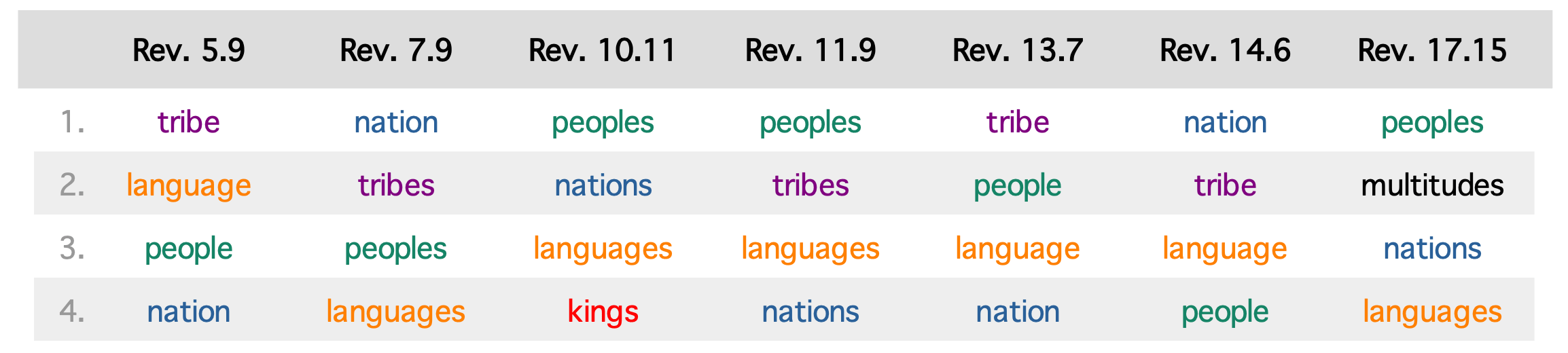
These lists continue a pattern that begins in Daniel, and extend it to its sevenfold conclusion.
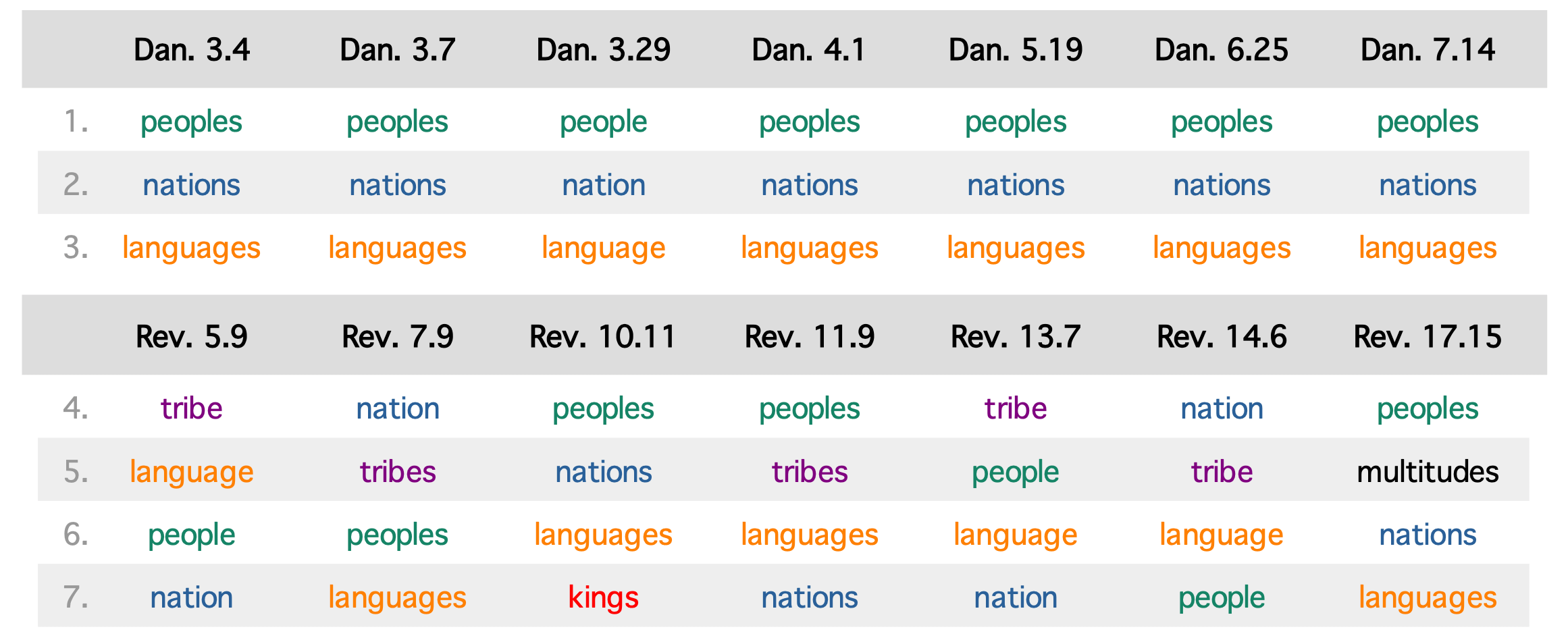
The basic purpose of Revelation’s ‘nation-lists’ is obvious—to denote the inhabitants of the entire earth. The lists also, however, have less basic and less obvious purposes.
For one thing, they help us develop a picture of the typology of particular numbers. Revelation contains a total of seven nation-lists. Each list has four members. And interspersed among the lists are five references to ‘tribes’—a word that almost always denotes Israelite people-groups. This pattern is significant for at least a couple of reasons.
First, it associates the numbers four and seven with ‘the fullness of the earth’ (Psa. 24.1, 89.11), which seems natural given that:
Scripture often describes the world as a whole via phrases like ‘the four winds/corners of the earth/heavens’ (e.g., Isa. 11.12, Dan. 11.4, Zech. 2.6, Rev. 7.1 [Acts 10.11]);
Revelation standardly refers to the world in terms of four distinct realms—the earth, sea, rivers/springs, and skies (sun, moon, and stars)—, which are judged in this order in the first four trumpet judgments and the first four bowl judgments (Rev. 8.6–13, 14.7, 16.1–9) (as Richard Bauckham has noted);
Scripture standardly represents Canaan’s inhabitants by means of a sixfold list, which becomes a sevenfold list when Israel enters the land of Canaan (Exod. 3.8, 3.17, 23.23, 33.2, Deut. 20.17, Josh. 9.1, 12.8); and
Revelation has seven distinct terms for the earth’s people-groups: the six found in the grid above together with the term ‘earth-dwellers’ (e.g., Rev. 6.10, 8.13, 11.10, 13.8).
Second, it associates the number five with Israel, which seems equally natural given that the Mosaic covenant is grounded in the five books of Moses and, more specifically, in the ten commandments (2x5) (Deut. 4.13, 10.4). Revelation’s language-people-nation lists shouldn’t, therefore, be equated with ‘the Gentile world’ per se. They denote the nations in their entirety, Israel included. Indeed, just as the ‘tribes’ of Israel are dispersed throughout Revelation’s nation-lists, so the tribes are Israel are (currently) dispersed throughout the nations. And God will redeem these tribes by redeeming the whole earth. The Gentiles’ fullness will be their fullness—and vice-versa (Rom. 11.12, 25). Israel are ‘a particular treasure’ hidden in a field, and Jesus has bought that entire field in order to redeem them (Matt. 13.44).
Other uses of the numbers four, five, and seven in Scripture confirm their association with the fullness of the earth.
For starters, consider the events recorded in Mark 6.30–8.10. Jesus feeds the 5,000, declares all foods clean, finds faith in a Gentile woman (who wants to gather up the crumb’s from beneath Israel’s table), and then feeds the 4,000 on the far side of the Sea of Galilee. (For the association of the 4,000 with the far side of Galilee, see Mark 7.31ff. and Matt. 15.21–39.) In the aftermath of these events, Jesus draws his disciples’ attention to their numerical significance. Jesus’ ministry in Israel was associated with the numbers five and twelve—5,000 men, 5 loaves, 12 basketfuls left over. Meanwhile, his ministry in the more Gentile-inhabited regions of Galilee was associated with four and seven, and hence with fullness—4,000 men, 7 loaves, 7 basketfuls left over (Mark 8.19–21). By implication, then, five and twelve are Israel’s numbers, while four and seven are the-fullness-of-the-world numbers.
That four and seven are associated with the fullness of the earth is confirmed by other features of Revelation’s composition. Recall our seven nation-lists. Three of the lists are distinctly redemptive in nature. One is the sixth list, which describes the people to whom ‘the eternal gospel’ is proclaimed—‘Fear God and give him glory, for the time has come…’ (Rev. 14.6–7). This call consists of 28 words. It goes out across the earth in Revelation’s central section—i.e., the fourth of Revelation’s seven sections (12.1–15.3)—, and is introduced by the fourth of this section’s seven ‘And-I-saw’ statements. In essence, it’s a repeat of Jesus’ gospel call—‘The time is fulfilled; the kingdom of God is at hand; repent and believe the gospel!’ (Mark 1.15)—, calling the world to repent and be saved.
The first two nation-lists are also distinctly redemptive. They describe the individuals whom Jesus has in fact redeemed out of the world’s nations (i.e., those who have obeyed the eternal gospel). The first is an excerpt from heaven’s post-ascension song, where it’s announced that the Lamb has redeemed men and women from ‘every tribe, language, people, and nation’ (Rev. 5.9), and the second describes the ‘multitude’ that is amassing in heaven as a result of the Lamb’s sacrifice, composed of people from ‘every nation, tribe, people, and language’ (7.9).
Considered as a whole, then, these three fourfold nation-lists describe a twelve-fold redeemed people (3x4)—purchased (5.9), called (14.6), clothed in white (7.9, 19.14, Exod. 39.27ff.). And, significantly, this people is described as a ‘kingdom of priests’ (Exod. 19.6). Typologically, therefore, it is Israel. But it’s an Israel with a difference (as Peter Leithart has noted). Whereas Moses’s Israel was a single nation chosen out from the midst of many nations (Exod. 19.5), the Lamb’s Israel is composed of individuals chosen out from the midst of every nation.1
Confirmation of this analysis is provided by the details of Revelation 5’s ascension scene. First we see the risen Lamb, who’s said to have ‘seven horns’ that signify his power over the kings of the earth (Rev. 5.6). Next we hear a song announcing the redemption of individuals from ‘every tribe, language, people, and nation’, which is sung by a 28-strong choir (4x7) (i.e., the four creatures around the throne together with the twenty-four elders). Afterwards a sevenfold roar of praise goes up—‘Worthy is the Lamb…to receive power and wealth and wisdom and might and honour and glory and blessing!’ (5.12). And finally, in answer, a fourfold cry resounds from a fourfold creation (heaven, earth, under-the-earth, sea), namely, ‘To the Lamb be blessing and honour and glory and might!’ (5.13), this Lamb being referred to as such 28 times (4x7) in the book of Revelation.2
The earthly effects of all this are filled out by Revelation’s uses of basileu- words, i.e., ‘king’ (basileus) and ‘reign’ (basileuo).
Revelation contains 28 (4x7) -basileus- words. It contains 21 (3x7) occurrences of the noun ‘king’ (basileus), and seven of the verb ‘reign’ (all of which contain the string -basileus-).3
The phrase ‘kings of the earth’ occurs eight times (2x4). Its first occurrence describes Jesus as ‘the ruler of the kings of the earth’ (1.5). The next six describe the sin and judgment of ‘the kings of the earth’. And the eighth describes these kings’ subjugation in the new heaven and earth (21.26), which is apt in that eight is the number of new creation.4
All seven occurrences of the verb ‘reign’ describe the reign of God and his people.
And seven of the book’s occurrences of the noun ‘king(s)’ either occur in the context of divine titles or describe the redeemed ‘kings of the earth’ (1.5, 15.3, 17.14 [2x], 19.16 [2x], 21.24).
In sum, then, the book of Revelation’s nation-lists tell a story that reflects the establishment of heaven’s reign on the earth. The Lamb is exalted in heaven’s throne-room, where he is crowned with blessings, honour, glory, and power. In and through his seven churches (ignited by the sevenfold Spirit), the world’s kings and kingdoms are overcome. And at the climax of four sevenfold judgments (the seals, trumpets, thunders, and bowls), the Lamb descends along with his church to establish his throne on the earth.
Text within this block will maintain its original spacing when published
When God originally called Israel forth, he did so as an expression of his sovereignty over all creation: ‘You shall be my treasured possession among all peoples, for all the earth is mine’ (Exod. 19.5). The Church that’s formed in Revelation is a different expression of that same sovereignty.
In 13.11, the word ‘lamb’ refers to the beast’s sidekick (the false prophet), who’s certainly no lamb. He’s merely ‘like a lamb’. Note: The standard word for the Passover lamb (Hebrew seh) occurs 28 times in the Pentateuch.
‘King’ (4x) (9.11, 15.3, 17.14, 19.16), ‘kings’ (17x) (1.5, 6.15, 10.11, 16.12, 16.14, 17.2, 17.10, 17.12 [x2], 17.14, 17.18, 18.3, 18.9, 19.16, 19.18, 19.19, 21.24), ‘reign’ (7x) (5.10, 11.15, 11.17, 19.6, 20.4, 20.6, 22.5).
For instance, eight people were preserved through the flood (Gen. 7.13, I Pet. 3.20), circumcision takes place on the eighth day of a child’s life (Gen. 17.12), lepers are restored on an eighth day (Lev. 14), Jesus rose on ‘the first day of the week’ (an eighth day) and revealed himself to the disciples ‘eight days later’ (John 20.1, 26), etc.
No posts
Comments
Nothing yet. Say the first thing.
Sign in to join the conversation.