
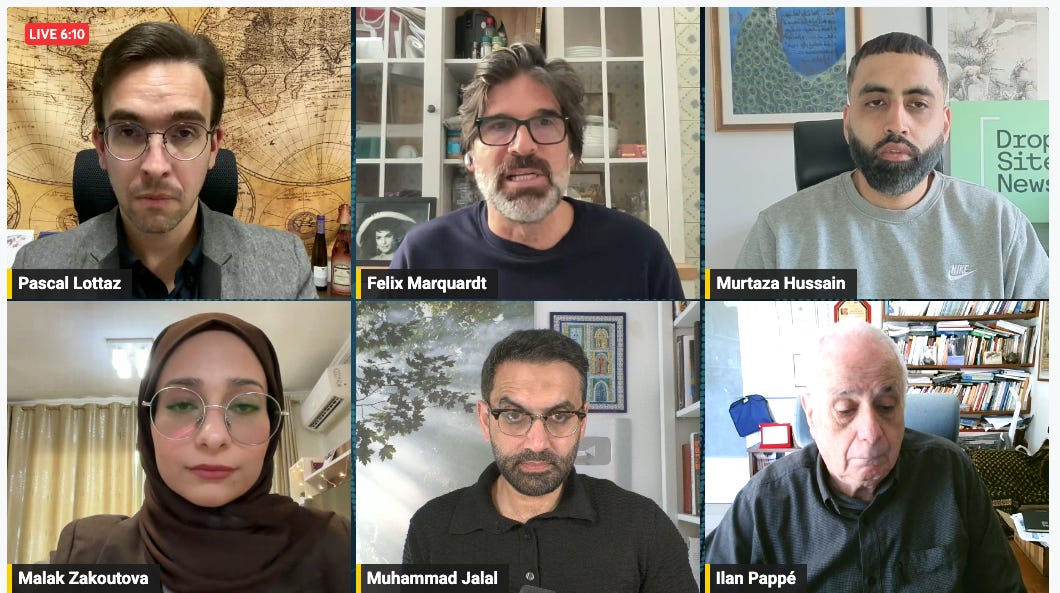
Earlier today, I was asked a question on a live show, that at first glance appears straightforward, but on closer inspection reveals a set of deeper assumptions that need to be challenged:
*Are the Gaza genocide and the war on Iran more the products of Zionism, American empire, or Western modernity?*
The instinct behind the question is understandable. We are trying to locate responsibility, to identify the primary driver. But the problem is that the question itself imposes a false separation. These are not competing explanations. They are layered, interconnected, and mutually reinforcing. What we are witnessing is not the outcome of a single force, but the convergence of several.
To understand this properly, we need to think less in terms of alternatives and more in terms of a hierarchy, a kind of civilisational stack.
At the most immediate level, Zionism functions as the proximate driver. In Gaza especially, it is the ideological engine shaping events on the ground. It is not simply a political movement; it is a settler-colonial project with its own internal logic, expansion, demographic control, and the management, or elimination, of an indigenous population. What we are seeing in Gaza is not an aberration. It is the logical culmination of a project that cannot ultimately accommodate Palestinian sovereignty.
When it comes to Iran, Zionism operates somewhat differently. Here, it acts less as the direct executor and more as a strategic instigator, pushing consistently for the neutralisation of any regional power capable of mounting meaningful resistance or deterrence. But Zionism alone does not possess the capacity to prosecute a regional war on this scale. It requires something else.
That brings us to American power.
The United States provides the material and strategic infrastructure that makes both Gaza and a broader regional confrontation possible. This includes military aid, intelligence sharing, diplomatic shielding, and the ability to escalate conflict across multiple theatres. What we are seeing is characteristic of a late-stage empire, overextended, often incoherent in its long-term vision, but still capable of immense and disproportionate violence.
The war on Iran, in particular, fits into a recognisable imperial pattern: preemptive action framed as defensive necessity, regime change as an implicit or explicit goal, and the securing of strategic geography, energy corridors, chokepoints, and regional dominance. Importantly, this is not simply a case of the United States being manipulated or dragged into conflict. There is a structural alignment between American strategic interests and Israeli objectives, shaped by decades of shared commitments and overlapping worldviews.
But even this is not the deepest layer.
Beneath both Zionism and American empire lies something more foundational: Western modernity itself. This is not about geography, but about a particular civilisational logic, a way of organising power, knowledge, and legitimacy.
Western modernity provides the moral and intellectual grammar through which these wars are understood and justified. It offers the language of civilisation versus barbarism, security versus terror, order versus chaos. It normalises forms of violence that would otherwise be intolerable: industrial-scale destruction, bureaucratised killing, and the use of advanced technology to render death both efficient and impersonal.
It also embeds hierarchies, of whose lives are grievable, whose suffering is visible, and whose destruction can be rationalised. This is why outrage appears selective. It is not merely hypocrisy; it is systemic. The framework itself is structured in such a way that some forms of violence are legible and others are not.
When you put all of this together, a clearer picture emerges.
Zionism generates the immediate conflict.
American empire scales and sustains it.
Western modernity legitimises and normalises it.
Each layer depends on the others. Remove one, and the configuration changes fundamentally. Without Zionism, you do not have Gaza in its current form. Without American backing, you do not have the capacity to sustain or regionalise the conflict. Without the deeper logic of Western modernity, you do not have a global environment that tolerates, justifies, or obscures what is taking place.
There are, of course, differences in emphasis depending on the theatre. Gaza is more directly shaped by Zionist imperatives, enabled by American support. The confrontation with Iran reflects more clearly the dynamics of imperial power, with Zionism acting as a catalyst and beneficiary rather than the sole driver.
But the overarching point remains.
This is not an either/or question. It is a layered system. And unless we are prepared to interrogate that entire system, its ideologies, its structures, and its underlying assumptions, we risk misdiagnosing the problem.
And if we misdiagnose the problem, we will inevitably misunderstand what it would take to bring any of this to an end.
No posts
Comments
Nothing yet. Say the first thing.
Sign in to join the conversation.