
Something I have noticed for several years is the constant stream of good news coming out of Ukraine. Naturally, this pleases me. But is the information reliable? Really, if Ukraine is winning so much, why has the war dragged on for over four years? Considering all the good news I have read, why haven’t the Ukrainians marched into Moscow? Or all the way to Kamchatka? The steady stream of good news is especially strange since the front line has been stuck in a World War I-stalemate since late 2022, spiced up with drones.
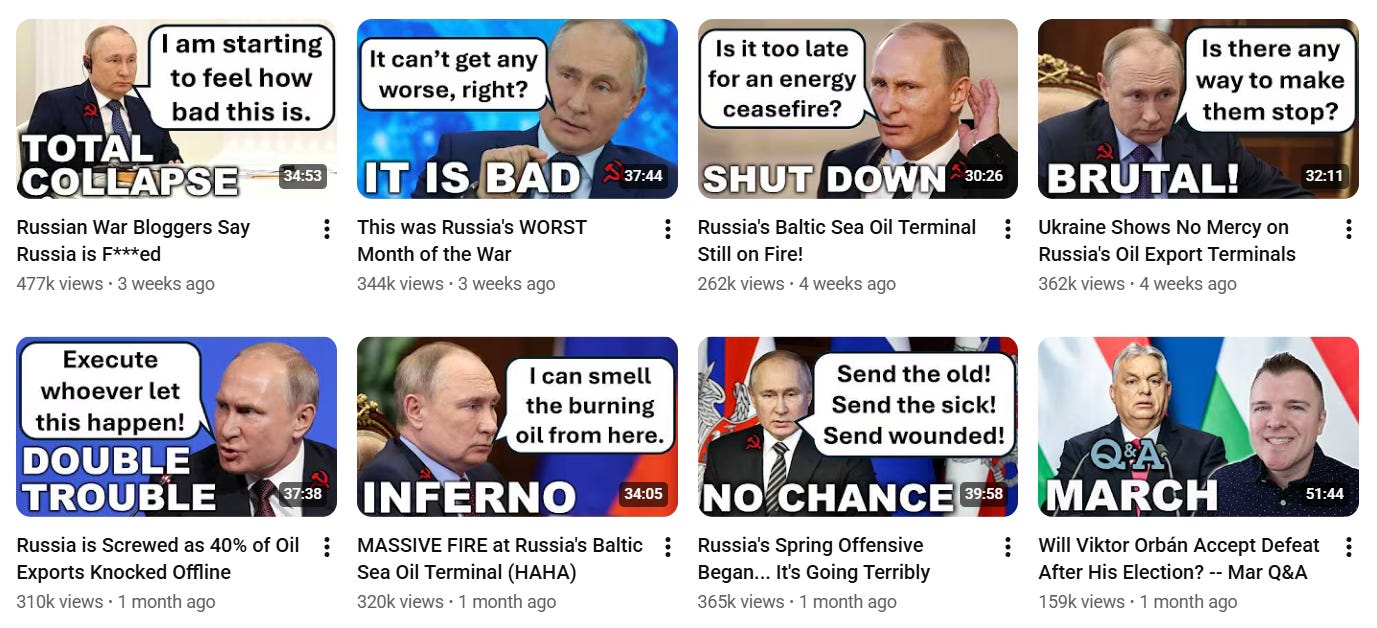
The most easily identifiable example of this flood of good news is YouTube. The site has many large and active pro-Ukrainian channels. I am thinking of Jake Broe, Denis Davydov, to some extent the British tabloid the Sun, Paul Warburg, Preston Stewart and, especially, The Military Show with its over two million subscribers.
Go to any of these channels and look at their list of videos, and you will be greeted with dramatic battle maps, explosions, smiling Zelenskyys, despairing Putins and bold print letters saying things like: “Ukraine is HIDING the Most TERRIFYING WEAPON That Will Win the War”, “Ukraine just Found a Way to DESTROY Russia for PENNIES”, Still Think Russia is Winning? WATCH THIS Before you speak again”, “Analyzing Russia’s Massive Failures in War Against Ukraine”,” Russian Soldiers Keep surrendering for Cash and Socks”, “This could become Putin’s Stalingrad”, Ukraine just Humiliated Russia in the Best Possible Way”.
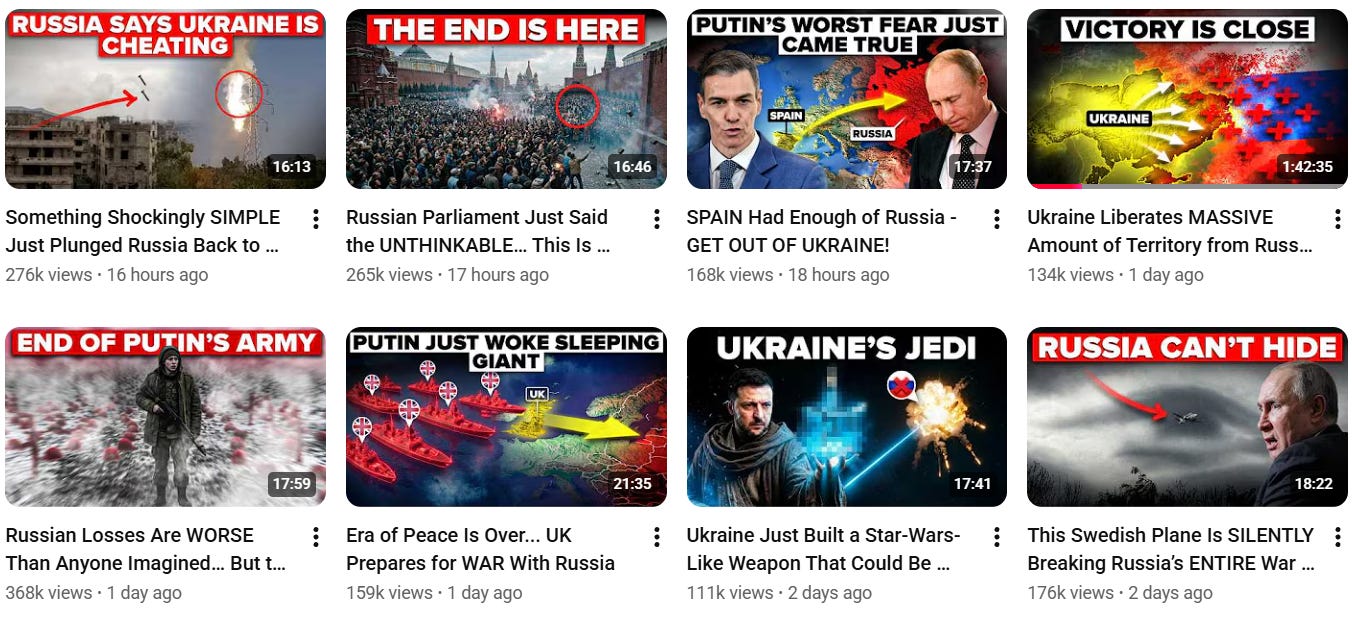
(Note that videos like these have been posted for years. Therefore, they cannot be explained by the genuine Ukrainian successes in 2026, related to Star Link, new drone types, strikes on Russian refineries, and Russian economic troubles).
One might think that these videos are just propaganda, but that isn’t quite true. Click on them, and you will get surprisingly good information. Though it is all clearly pro-Ukrainian, the thumbnail is typically by far the most radical part of the video. Welcome to the internet.
The business model appears to be to draw people in with clickbait and then keep them coming back with high energy and positive but still reasonably reliable information about the viewer’s favorite team – Ukraine. I can’t deny that I find it enjoyable. There are always nuggets of truth behind the thumbnail.

But it takes more than that to win a war. This creates an apparent contradiction – a constant stream of good news but a stalemate at the front. How can this be explained?
Firstly, such partial news reporting ignores Russian victories and Ukrainian defeats. Secondly, the war in Ukraine is a huge affair. It involves two large countries, hundreds of billions of dollars every year, millions of soldiers, soon almost two million casualties, a thousand-kilometer frontline and a global political landscape. In such a titanic struggle, there can be huge victories and vast tragedies and remarkable heroics to report on that are still just another grain of sand on the beach.
The sheer size of the conflict means that numbers that seem impressive are evened out. A hundred deaths are in most cases an enormous tragedy, but in Ukraine it is just another Tuesday. Similarly, a hundred captured square kilometers sounds impressive, but on a map of Ukraine with its 600 000 square kilometers, you can barely see it. Still, it can be used to motivate thumbnails like “Ukraine liberates MASSIVE area!”.
There is also the problem that good news can be repeated indefinitely if it is not weighed against losses. For instance, Ukraine may capture 100 villages, and if you hear about that over several months it may sound like things are going great. But if the Russians also capture 100 villages, the result is a stalemate. Especially if we also consider that the 100 captured villages may actually be the same village captured and lost 100 times. Or at least the ruins of said village.
Is such warped news-reporting a problem? After all, most of us are not military commanders and have no direct influence on the war. Arguably, the reporting gives harmless entertainment and hope, and may encourage serious studies and support later.
On the other hand, losing touch with reality is rarely a good thing. In extreme cases, it may even lead to a shock if a war is “suddenly” lost. Remember “Baghdad Bob” talking about American defeat in Iraq in 2003 while bombs were falling around him. Similarly, parts of the migrant Japanese community in Brazil refused to accept that Japan had lost World War II. Some even sold their farms and gathered at the docks, awaiting the arrival of the Japanese Navy.

Bad news can lead to bitterness, disappointment, and conspiracy theories. An explanation for the failure must be found. This can lead to “Stab-in-the-back myths”. The most famous example is Germany after World War I. There, politicians and Jews were blamed for the defeat, rather than the complete exhaustion of the country after four years of war and the arrival of American reinforcements.
Are we being deceived by good news? Yes. But we should not be too quick to try to find someone to blame. Or more precisely, we should realize that the person to blame is ourselves. Good news is addictive. We seek it out, and the market responds.
We deceive ourselves because we want to. The fog of war is thick in part because we want it to be.
Jakob Sjölander
Share to support MASSIVE BREAKTHROUGH in Ukraine!!!
No posts
Comments
Nothing yet. Say the first thing.
Sign in to join the conversation.