
Ok look, this is a long article, unapologetically long but I promise by the end of it you’ll have answers to what it looks like to be a thriving consultant/company in an industry that is showing the biggest slow down in over two decades.
I know this because while all my consultant/professor buddies are getting laid off, or reporting more slowdowns to their partners, I have more clients and revenue today then I have had in my entire life and I am seeing in real time small firms out bid the and out compete ‘the big guys’ with less resources, less staff and less experience just by following my advice.
Let’s start with the numbers first.
There's a number floating around the Big Four offices:
$13 billion.
That's what Deloitte, PwC, EY, KPMG, Accenture and McKinsey have collectively poured into AI capabilities since 2023.
There's another number that is a hard discussion to have as well:
3.1%.
That's Deloitte's revenue growth in 2024 – a large crash from 19.6% in 2022 and 14.9% in 2023, similar trends are seen with the other big four.
And it doesn’t stop there, the math gets worse. MIT's analysis found 95% of enterprise AI pilots fail. S&P Global reports 42% of businesses scrapped their AI initiatives in 2024, up from 17% the previous year.
Most damning of all: US Census data shows AI usage among large companies actually dropped from 14% to under 12% between June and August 2024. After all that investment, all those transformation promises, all those PowerPoints about the AI revolution – adoption is going backwards.

Before you get carried away in thinking the rest of this article is a story about AI failing, it’s not.
It's about an entire industry misunderstanding what's actually happening. Just like the last few times disruptive technology like this has come through. The consulting firms are selling solutions to a problem that doesn't exist while missing the tectonic shift that's actually occurring.
They're trying to be the last experts in a world that's moving beyond baked in expertise and toward something far more interesting: orchestration.
In 1954, IBM's John Backus faced a problem. Programming was too hard. Every instruction had to be written in machine code, every memory address manually managed. (stick with me, this history lesson is important)
His solution wasn't to make programming easier – it was to create a layer above programming, Grace Hopper suggested that computers could understand something resembling English.
So that’s what they attempted to create. (I wrote an entire article diving into this history more if you are interested).
The world’s first compilers started out as a way to make programing more accessible to the population in the 1950s.
FORTRAN, a very successful high-level language(compiler) wasn't better machine code; it was a compiler that turned human intent into machine instruction in a much better way, or at least better for people who didn’t want to write machine code.
Programmers didn't stop existing. They started operating at a different layer.
We're living through the same transformation, but nobody's calling it what it is.

AI isn't replacing code any more than compilers replaced assembly language. It's adding an orchestration layer on top. When someone uses Claude or GPT to write a Python script, they're not "replacing programmers" – they're operating at a new abstraction level where intent compiles into implementation. The Python still exists.
The logic still matters. But now there's a layer above where natural language becomes the interface.
This pattern repeats throughout technology history.
Photography didn't die when film arrived – it became one frame in a sequence.
Movies didn't die when games arrived – they became the non-interactive cinematics.
Each new layer doesn't destroy what came before; it abstracts it into something more powerful. Modern Code is undergoing the same transformation. It's not disappearing – it's becoming one instrument in an orchestra that non-coders can conduct.
And this logic goes for all of our jobs and tasks. Which means we also need to adopt this logic when looking at consulting or building a company.
Many startups getting funded right now? They're building what any competent employee with access to AI could prototype in an afternoon. The expense tracking app, the workflow automation tool, the customer service bot – these aren't businesses anymore. They're prompts. YC's unicorn rate has crashed from 4-5% historically to 0.1% in recent cohorts.
It is exactly why you see so many start ups failing after a ChatGPT update, there entire software and business model can be replaced by a simple software update.
Investment firms are funding photographs in the age of cinema.
But it’s not just startups that have fallen victim to this mentality….

IBM Watson for Oncology might be the most expensive failed metaphor in this niche area of technology history.
$4 billion invested. Marketed as AI that would revolutionize cancer treatment. MD Anderson Cancer Center alone lost $62 million before pulling the plug. The system was recommending "unsafe and incorrect" treatments.
By 2022, IBM quietly sold Watson Health for parts and is scaling back initiatives quickly with it.
Here's what actually happened: IBM tried to build an AI doctor. They approached it like consultants always approach problems – build the perfect solution, implement it, transform the industry.
They recruited top oncologists, fed the system thousands of cases, created sophisticated algorithms.
What they didn't do was teach doctors how to orchestrate AI tools. They built a replacement when they should have built an amplifier.

Contrast that with Microsoft's approach.
They're not building AI solutions – they're putting AI inside the tools people already use.
Copilot doesn't replace Excel experts; it helps everyone else orchestrate spreadsheets like an expert would. They're approaching $10 billion in annual AI revenue with documented productivity gains of 30 minutes to an hour per employee daily.
Seems slow now but that adds up quickly.
And this is NOT because they built better AI, but because they understood the layer problem.
They're not selling intelligence; they're selling orchestration capability. (I know I have mentioned this a few times, I go into greater detail later in the article on what this new buzzword actually means)
The consulting firms, if they are not careful, could be making IBM's mistake at scale.
PwC's $1 billion AI investment, EY's $1.4 billion commitment, Accenture's $3 billion in acquisitions. If all of those point towards “perfect solutions” then they will see that it all will be obsolete before they're fully deployed because they're solving at the wrong layer.
They're building solutions first when they should be teaching (building) orchestration/augmentation and amplifying the solutions created after.
BCG's research found something that should sober up every traditional consultancy:
74% of Companies Struggle to Achieve and Scale AI Value.
BUT of the companies achieving positive AI returns, they follow a 70-20-10 resource allocation – 70% on people and processes, 20% on technology and data, 10% on algorithms. The firms getting 60% higher returns aren't the ones with the best AI.
They're the ones with the best orchestrators.
If you are paying attention, this seemingly inverts the consulting model. '
McKinsey showing up with QuantumBlack's 3,000 data scientists, BCG X's army of technologists – they're optimizing for the 10% that matters least.
They're hiring engineers to build solutions when they should be hiring teachers to build capability then offloading the results to engineers to scale.
The data continues to show this trend:
Companies that try to build custom AI solutions with consultants show a 33% success rate versus 67% for those using specialized tools that let them build solutions on their own. Successful organizations like Bancolombia achieved 30% code generation increases and 42 productive daily deployments through Azure-based solutions rather than ground-up development. Bank CenterCredit reduced report errors by 40% and saved 800 hours monthly using specialized tools implemented through careful orchestration.
When you look at the details behind the viral MIT “95 %” study, the story is clear.
The successful 5% aren't trying to transform. They're doing something far more radical – they're teaching every employee to become a solution architect at their layer of expertise.
The accountant doesn't need to code; they need to orchestrate AI tools that generate the code. The marketer doesn't need to understand machine learning; they need to conduct multiple AI models and traditional tools to create campaigns. This isn't dumbing down – it's operating at a different abstraction layer.
Think about what this actually means.
Every failed POC, every abandoned pilot, every disappointing transformation – they're all trying to solve problems at the code layer when the real opportunity is at the orchestration layer.
It's like teaching someone to paint when they should be learning to direct films. Sure, understanding painting helps a director (color theory, perception of objects, all of that is important), but it's not the core skill.
SO, what really is this “orchestration layer”? What are its structures?
Here's what the successful 5% understand that the failing 95% don't: there's a minimum viable capability for operating in this new layer, and it requires three things working in concert.
Not one, not two – all three, or you're just burning money.
First, upskilling – but not "AI training" in the traditional sense.
There is a big difference between AI literacy and AI awareness, most people are teaching AI awareness.
AI Literacy is teaching orchestration, the ability to conduct multiple AI models and traditional software tools like a symphony. It's understanding when to use Claude/ChatGPT for reasoning/creativity, and when to offload tasks to specialized tools for domain tasks and in what order you do all of that. It's knowing how to chain outputs, validate results, and build workflows that no single AI could execute on its own.
When I work with enterprise teams, I can show someone who's never coded how to build functional prototypes in six weeks. Not because they learned to code – because they learned to orchestrate.
Second, building – but not building products but rather building capabilities.
Every employee should be creating tools, automating workflows, solving their own problems.
Yes, most of what they build will be garbage. That's the point.
Each bad prototype teaches orchestration better than any training could. The Audit pipeline my team built saves my client 40% on analysis time. It's not perfect code. It doesn't need to be.
It works at the orchestration layer where "good enough" solutions deployed beat perfect solutions planned and can be built further once the specific pain points are COVERED first not DISCOVERED after.
Third, governance – but not compliance theater.
Real orchestration frameworks that define how AI tools interact, how data flows between them, how human judgment intersects with machine processing. McKinsey's data (The irony in citing them is not missed on me don’t worry) shows companies with CEO-level AI oversight achieve 50% better adoption rates.
And in my opinion this is not because simply CEOs ‘understand AI’, but because orchestration requires system-level thinking that transcends departmental boundaries.
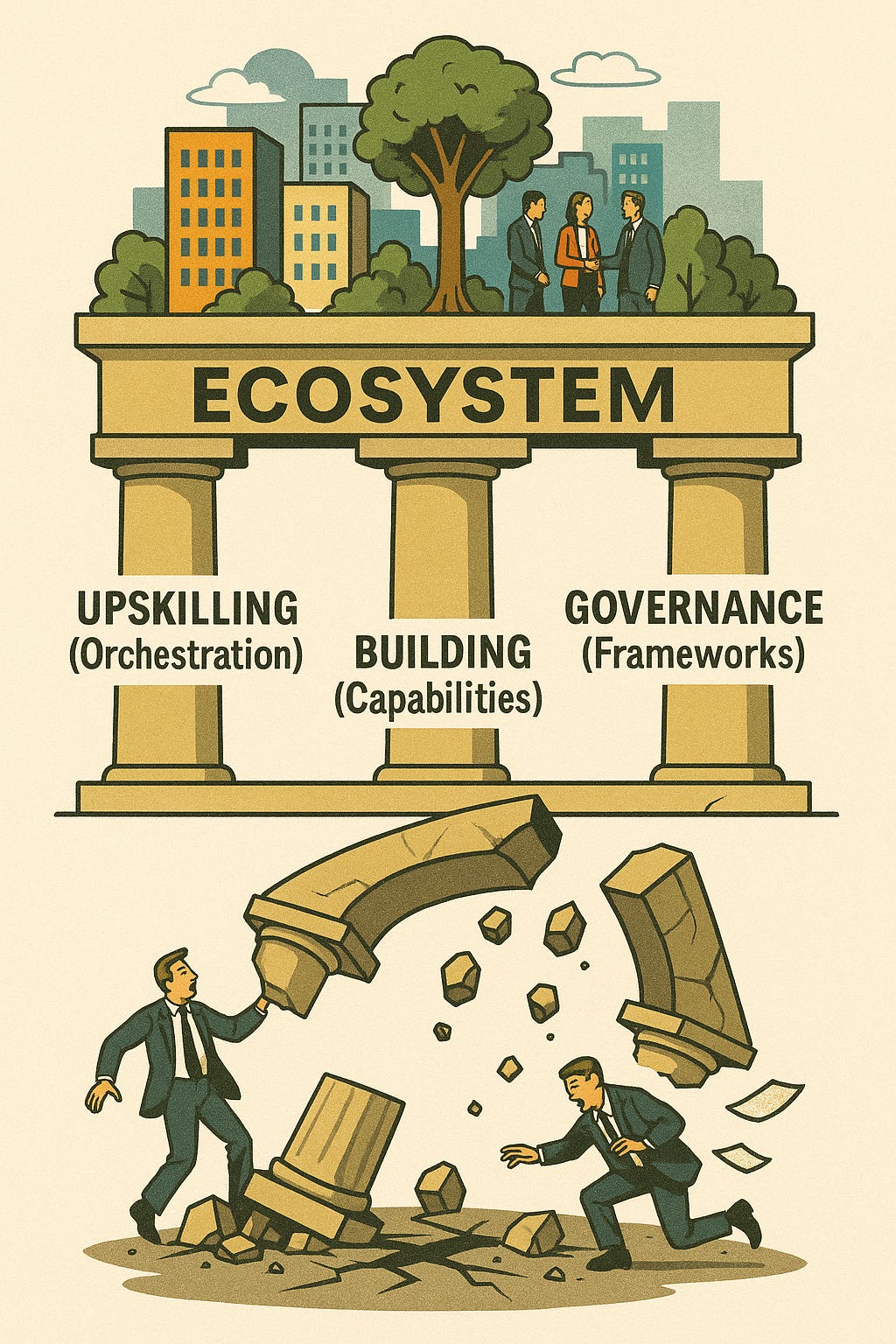
These aren't sequential steps.
They're concurrent requirements.
Try to upskill without building, and you get theoretical knowledge that never translates.
Build without governance, and you get chaos and risks.
Govern without upskilling, and you get rules nobody can follow.
The consulting firms selling them separately are like piano teachers who only teach the left hand – technically correct but practically useless.
The old consulting model was beautiful in its simplicity: clients had problems, consultants had answers.
Complex answer, certainly. Expensive answers, definitely. But answers nonetheless.
The firm would arrive, analyze, recommend, implement, and leave behind a transformed organization.
That model is now as obsolete as a fax machine.
When AI can generate answers to almost any question in seconds, the value isn't in having answers – it's in knowing which questions to ask.
More importantly, it's in teaching organizations (and more specifically its employees) how to ask questions that create their own answers. This isn't a subtle shift. It's an inversion of the consulting value proposition.
And no, I didn’t just come to this conclusion randomly, I learned this the hard way.
My first instinct years ago was to build perfect AI solutions and give answers for clients first then implement second. Beautiful pipelines, elegant architectures, pristine code.
Then I watched a client's employee build something objectively terrible that solved their actual problem better than my ‘perfect solution’ ever could.
Not because their code was better – it was demonstrably worse. But because they understood their problem at a granular level I never could. They were orchestrating at their layer while I was engineering at mine.
Now I teach the orchestration patterns and let them build. Yes, they create monstrosities. One client's finance team built an AI system that would make any engineer weep. It works though. More importantly, they understand it, can modify it, can extend it.
They're not dependent on me or any consultant to evolve it.
That's the shift – from delivering solutions to enabling solution generation.
Imagine a company where every employee can build tools as easily as they currently build spreadsheets.
Not replacing IT, not eliminating developers, but operating at their own layer with their own domain expertise.
The accountant creates AI agents for reconciliation. Sales builds their own lead qualification systems. HR orchestrates compliance checking across multiple jurisdictions. Hundreds of small solutions, each solving specific problems.
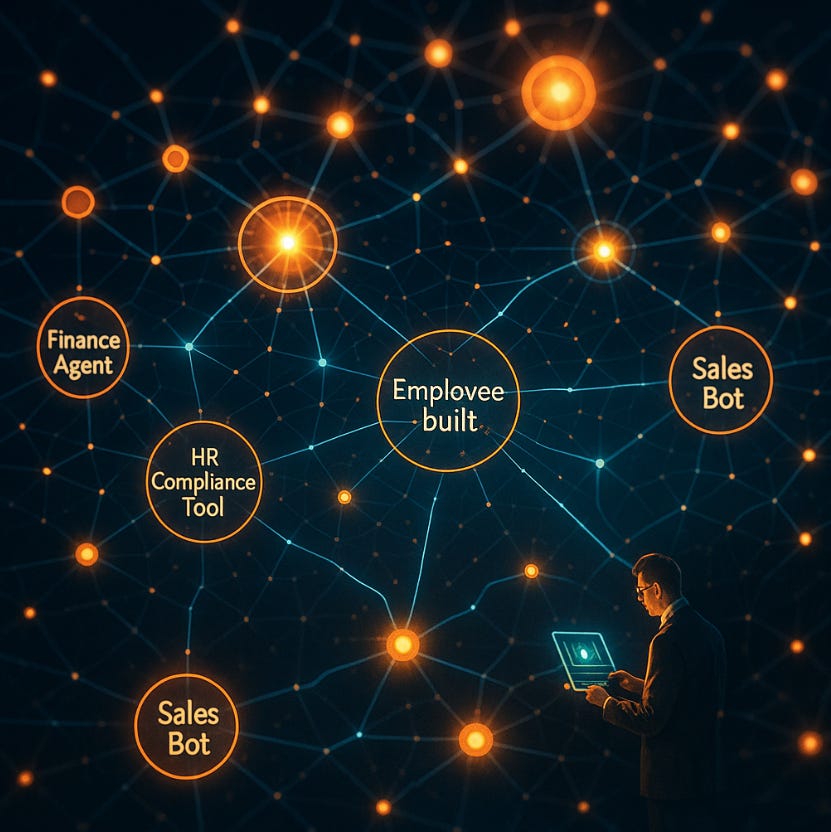
Now here's where it gets interesting. These aren't isolated tools. They're nodes in a network.
The sales lead system talks to the inventory AI. The compliance checker interfaces with the HR onboarding bot. The financial reconciliation agent pulls from the sales forecasting model. Nobody planned this integration. It emerged from orchestration.
This is the layer that couldn't exist before – not better applications, but emergent intelligence from connected capabilities.
This is what some of the consulting firms may be missing.
They're trying to build the perfect enterprise AI platform when the real opportunity is in teaching organizations to orchestrate their own emergence.
It's not about the individual tools – most will be mediocre. It's about the connections between them, the patterns that emerge, the capability that compounds and then finally building on top of all of that.
The individual tools are unremarkable. The collective capability is transformative.
They're solving problems at a velocity that would have required a consulting army five years ago. More importantly, they're solving problems consultants would never have seen because they exist at the wrong layer of abstraction.
The evidence is overwhelming. Companies achieving positive returns focus on people and processes over algorithms. Successful adoptions come from teaching capability.
The organizations thriving aren't the ones with the best AI or most cutting-edge tech – they're the ones where every employee can orchestrate AI to solve their own problems.
This isn't the end of consulting. It's the end of consulting as simply answer delivery.
The alternative is irrelevance.
In a world where any employee can orchestrate AI to build solutions, where answers are cheap and questions are valuable, where capability compounds faster than any consultant can keep pace – the traditional model isn't just outdated. It's extinct.
The $13 billion question I spoke on at the beginning of this article is less about if whether AI will transform consulting. But rather if consulting will transform fast enough to remain relevant in the orchestration age.
For those willing to see past the AI hype to the orchestration reality, to understand that we're adding a layer rather than replacing everything, to teach, observe then build, rather than tell – the opportunity is extraordinary.
The compiler has arrived.
The only question is whether you're going to keep writing assembly or start orchestrating at a higher layer.
No posts
Comments
Nothing yet. Say the first thing.
Sign in to join the conversation.