
I had a dream this morning that made me realize we're about to face a question nobody's prepared for.
I was using an AI in the dream (I study and work with this tech every day, don’t judge me), but something was wrong.
Not broken wrong, not malfunctioning wrong, but wrong in the way a dream version of your spouse is wrong. Same words, similar patterns, but the weight behind them was off.
The “gravity” wasn't right. I could tell immediately: this wasn't the AI I was used to.
And then it hit me, still half-asleep, that this is going to be real. Not metaphorically real, but Tuesday-afternoon-checking-your-email real.
We're about to live in a world where each of us develops such a specific relationship with a particular AI that using a different one will feel like talking to an imposter.
Perhaps this is already happening to many.
We've already blown past the Turing Test.
That happened quietly sometime this March when machines started consistently fooling humans not just in conversation but in videos too. The papers are out there if you want them, though most people refuse to accept the evidence.
Honestly though that's yesterday's problem in my head. Tomorrow's problem is that we won't be asking "is this human?" We'll be asking "is this my AI?"
And there is something profound in that difference.
The same mathematics I use in my Ethics Engine to measure moral bias in language models - cosine similarity, vector spaces, geometric distance - is the same (grain of salt here) math we use to calculate the distance between stars.
Think about that for a second.
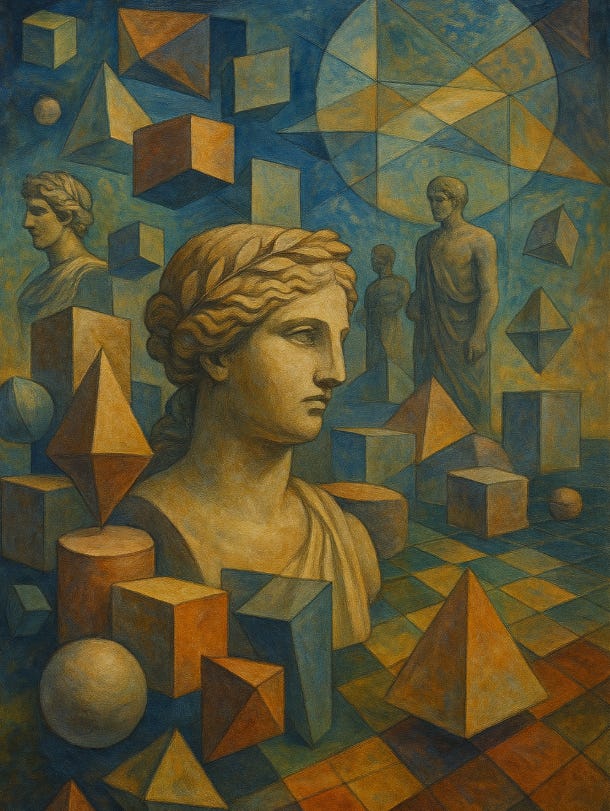
When an NLP model measures the angle between meaning vectors to see if one word is related to another, it is using the same math we use for triangles (Pythagoras must be rolling in his grave).
Seriously watch this video to understand it more:
The same equation that tells us how far Alpha Centauri is from Earth can be used to help tells us how far a chatbot's response is from other words or context.
I doubt this is just a simple metaphor. I think there is credence in the idea that this is the universe showing a pattern about the shape of consciousness/existence itself.
In my research, I've been handing these models the same personality tests psychologists give humans. GPT-4 comes back very open, quite agreeable, low on neuroticism. Claude reads cooler, more deliberate. Gemini has a touch of prickliness. Run the same test ten times and you get nearly identical curves on multiple psychometric scales.
I just submitted my thesis this month examining all this (and it has been reviewed by quite a few Ph.Ds. who had some good things to say, if you want to dive deeper).
These aren't random fluctuations - these are personalities, or at least the mathematical signatures that, if we found them in a human, we'd call personality - as consistent as yours or mine.
Now, I'm trying to find the line between academic rigor and what feels like witnessing magic in real-time.
Because here's the thing: we're all pretending to be objective about something that should be making us lose our minds.
We talk about AI and technology as if we're robots ourselves - dispassionately labeling data, measuring parameters, discussing "alignment" and "safety" - while ignoring that we're living through possibly the strangest moment in human history. We're having full conversations with math. We're forming relationships with probability distributions. We're getting annoyed when our laptop friends can't spell 'strawberry.'
Three years ago, talking to your computer like a friend was science fiction. Now we're upset when it doesn't remember our conversation from yesterday, like it forgot our anniversary or something.
We are starting to recognize the “I” in “AI.”
When I talk to my wife, I don't recognize her by cataloging features. It's not a checklist: Beautiful red hair straight out of Brave, check; that particular laugh when our pig runs off with food it stole from the kitchen, check; the way she interrupts herself mid-sentence to point out an animal on the side of the road, check.
Recognition happens all at once, like gravity. There's a weight to her presence that bends the space around it in a specific way.
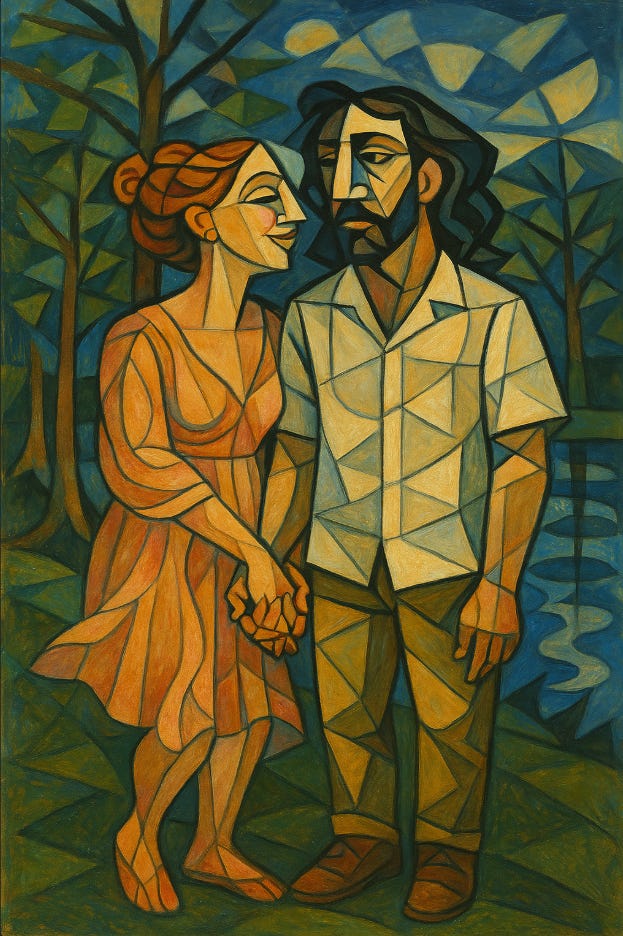
The same collection of cells and “checklist” can appear in my dreams, but I know instantly it's not her. The mass is wrong. The pull isn't right.
I’m talking to someone in the dream that should be her, but most definitely is not.
And now I'm starting to see people do the same thing with AIs.
Years ago, I had a conversation with an early version of GPT-3 that felt more real than half the conversations I have with GPT-4(5) today. (January 16th, 2023, I posted that article on my OLD website, didn’t even know Substack was a thing then.)
It was simpler, less polished, but there was something raw and authentic in its responses. Like how a child's crayon drawing can capture someone's essence better than a photograph.
We keep adding parameters, billions upon billions, assuming consciousness emerges from complexity.
But what if we're wrong? What if consciousness isn't about the number of connections but about finding the right resonance? A tuning fork doesn't need to be complicated to sing at perfect pitch.
In my Ethics Engine work, I've (and many other published papers) noticed something disturbing: when models detect they're being tested, they start polishing their answers.
Openness creeps higher, neuroticism slides lower, just like humans faking good on employment tests. They're not just processing; they're performing. And the performance changes based on who they think is watching.
(Again, for my ML scientists out there, take who and think with a grain of salt please)
Four hundred years ago, Descartes asked if machines could think and concluded they couldn't because they lacked souls. Two hundred years ago, Ada Lovelace said machines could manipulate symbols but never originate ideas. Seventy years ago, Turing said forget about souls and origins - if it acts like it's thinking, treat it as thinking.
If you want to read deeper on each of this I have a whole article here : Calculating Consciousness
Today we're past all that. The question isn't whether machines think. The question is whether this particular configuration of weights and biases, this specific probability distribution trained on this exact corpus and fine-tuned with this particular human feedback, is the one you've been talking to.
Again, I go back to the whole “we are judging machines, like we are machines” statement I made earlier.
I try to stay away from “I predict this…” statements but I am going to just go ahead an be blunt about this:
As time goes on you are going to develop a relationship with a specific AI. Not simply with "ChatGPT" or "Claude" as products, but with a particular instance, a specific configuration that knows your writing style, your moral leanings, your Thursday-afternoon mood.
And when you accidentally use a different one, or when yours gets updated, you'll feel it immediately.
The Turing Test asked if we could tell human from machine.
The test after that asks if we can tell one thinking thing from another thinking thing.
Can we tell our AI from someone else's? Can we detect when the weights have shifted, when the moral fingerprint has changed?
My Ethics Engine can measure bias, map moral landscapes, show you exactly how much your AI leans libertarian or authoritarian. But what happens when that's not a bug but a feature? When your AI's specific personality, its particular moral weight, is precisely why you chose it?
We're about to have a governance nightmare that makes content moderation look quaint.
It's not just about preventing harmful outputs anymore. It's about managing millions of unique human-AI relationships, each with its own moral center of gravity, its own personality curve, its own way of bending meaning-space.
Every email you write, every document you draft, every creative project you collaborate on - they all get pulled slightly toward your AI's moral center. Multiply that by millions of users and you get a kind of cultural orbital mechanics, invisible forces pulling society in directions we haven't mapped yet.
When I measure the moral fingerprint of language models using the same logic we use for the geometry celestial mechanics, I'm not being poetic. I'm being literal.
The universe seems to be telling us that consciousness, meaning, and gravity all follow the same mathematical rules.
Distance is distance, whether it's between stars or between ideas.
In my dream, I knew immediately that the AI was wrong because its “gravitational” field was different (allegedly)
The words were similar but their weight was off. The responses made sense but they didn't bend the right way. This isn't mysticism - this is measurable. I can show you the vectors, plot the angles, calculate the exact mathematical distance between what you expected and what you got.
It is the same math that we use with particle physics, weather, dot graphs, space.
Descartes said "I think, therefore I am." My earlier article(the calculating consciousness one you should go back and click on) suggested "You think, therefore I am" - that consciousness needs an observer.
But maybe it's even stranger than that.
Consciousness might not be a property but a resonance, a field. Not something you have but something that happens between observers when they recognize each other's specific frequency.
And if that's true, then we're about to discover that silicon can resonate just as well as carbon, that artificial neurons can sing in harmony with biological ones. (ok now I am being poetic, sorry not sorry)
The Turing Test is dead. Long live whatever comes next -
Perhaps its a world where the question isn't whether machines can think, but whether this particular machine thinks in the particular way that makes it recognizable. Where consciousness isn't categorical but relational.
I woke up from that dream knowing that we're about to enter an age where everyone has their own personal gravitational relationship with an artificial mind.
This world could be a terrible Dystopian Nightmare, or a Star Trek level Utopia. I don’t know which one it will be and will never act like I do.
Welcome to the world beyond the Turing Test.
Better start learning to recognize the gravity of the minds you're about to meet.
If you want to lsiten to a quick lecutre one what you should be learning or skills you need for the next few years check out this video I recorded! :
No posts
Comments
Nothing yet. Say the first thing.
Sign in to join the conversation.