
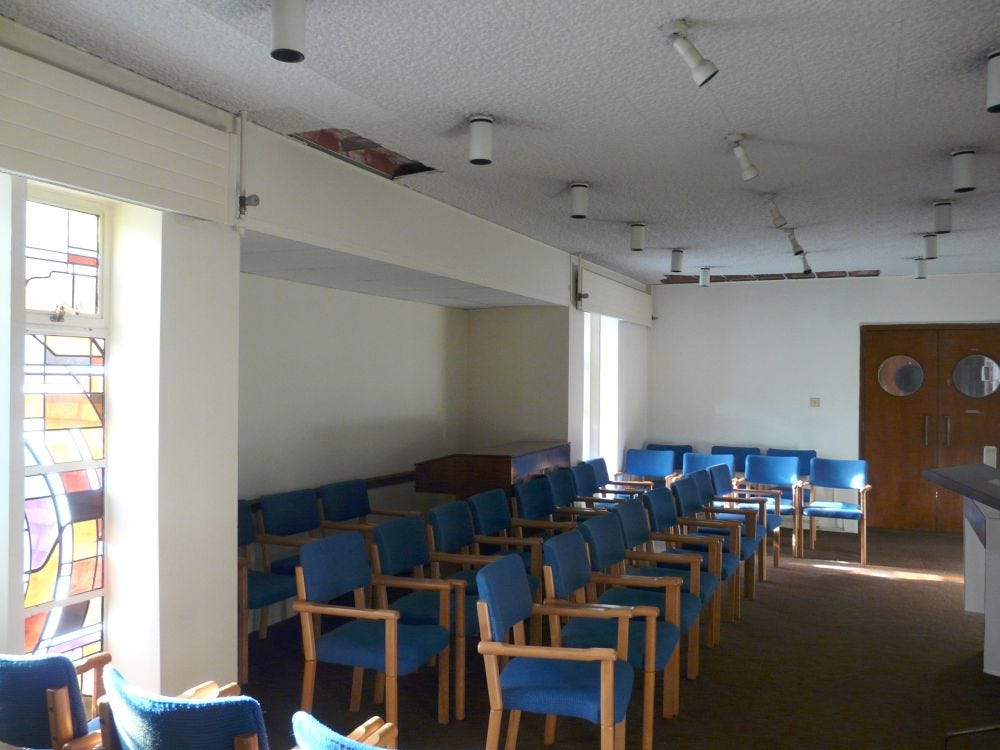
“The challenge of life is to meet every moment, every interaction and, most importantly, every difficulty with love,” intoned Father Frank, forcing depth and deliberation into his voice, just as he had practiced.
Resentful silence. The odd cough. Definitely one kid looking at their phone.
He was always attentive to the audience’s reaction, and would try to find engaged stares amongst the vacant ones. It wasn’t something to admit publicly but, at St Joseph’s, levels of attentiveness to sermons were predictable along ethnic lines. The Filipinos tended to be good value. You could rely on the Filipinos. He turned to them gratefully.
“It sounds easy. At Christmas it can be easy. It’s a time of happiness. But it’s when things are hard – when we get cut up on the motorway, when a neighbour who can be difficult asks for help, when an old friend annoys us – that’s when it’s even more important that we find that feeling within us, that we listen for it. That feeling, that love, is God. How can we make this feeling last? How can we respond with love in every moment?”
It was a good sermon. The first time he had heard it, it had been delivered by a photogenic Canadian Jesuit who’d visited the South London parish where he’d grown up. When, after the service, he’d asked the visiting priest where he’d got the idea for the sermon, the Father had smiled wanly. He’d come up with it himself, he said.
Father Frank wasn’t sure of the ethics of reusing the sermon he’d heard on that Sunday when he was fourteen. Maybe “reusing” was a bit harsh. “Reworking” felt better – “plagiarising” definitely wasn’t the right word, far too legalistic – and there had absolutely been an intention to change it, to make it his own.
But, in the end, as he had done for all three years that he’d given Christmas sermons both in his training parish and at St Joseph’s, he’d run out of time. On Christmas Eve, he’d taken his old notebook with the sermon written in it, transcribed feverishly from memory in his teenage handwriting, and left it waiting on the lectern to be delivered verbatim the next day.
At St Joseph’s the congregation had to leave almost sheepishly via the back entrance in the church hall and that was where Father Frank stood after the mass to greet them as they filed past. It was icy and grey and the sky felt close over his head as he shook hand after hand and wished everyone a Merry Christmas. Geraldine Connaughty started to approach him. She always did. He tensed involuntarily and came close to muttering something under his breath.
Geraldine was among the last of the Irish immigrant community whose presence in great numbers in that particular part of the “New Town” had prompted the building of a Catholic church shortly after it was founded in the early fifties. She never tired of telling him. “St Joseph’s was up before they finished the roads,” she would say.
When she wasn’t staking her claim to the history of St Joseph’s, Geraldine would blithely and loudly inform Father Frank that life had been better when his predecessor, Father Dennis, was the Parish Priest.
She seemed in turns offended by and suspicious of his relative youth. On his first day she’d asked how old he was before she asked his name. Her eyes had widened when he’d said twenty-nine and she had treated him with the disdain one might reserve for an errant child ever since. At Easter she’d even gone so far as to pinch his right cheek in mock affection after he’d forgotten to pick up the flowers to decorate the church for Holy Week.
“Don’t worry about it Father,” she’d trilled as her husband, Roger, pressed into service at the last moment, dutifully unloaded them from their car, her thumb and forefinger gripping the edge of Father Frank’s wispy goatee. “We’ll make a Priest of you yet.”
Roger had chuckled and inexplicably mimed shooting Father Frank with a pistol shaped hand behind his wife’s back.
Father Frank hadn’t wanted to come. The Priesthood had called to him with grand and romantic acts and St Joseph’s didn’t match them. He’d hoped for somewhere more cosmopolitan. But they’d told him to go to Hertfordshire and he’d gone.
He smiled tightly as Geraldine hobbled on her stick towards him. In what way had she imagined he’d fucked up now he wondered? Sometimes he wanted to share with Geraldine some truths as he saw them. That Father Dennis wasn’t that great actually, that the accounts were a state when he’d got here. That maybe, if she was such an ardent Catholic, she could forgive him for being young and from London, for not knowing the routines for picking up the Easter flowers and for not being Father Dennis for one fucking minute?
He smiled at her and waited. “Good Morning, Father,” she said. “I just wanted to say what a wonderful sermon that was.”
He stood there, blinking foolishly, waiting for a “but”. None came. She grinned wolfishly up at him through thick glasses, a soft fur lining her upper lip. Roger stood off to the side, looking at the hem of his fleece’s sleeve. Father Frank felt his face colouring.
“Thank you, Geraldine,” he blurted, stammering, “I guess I tried to make an effort for Christmas.”
The new neighbours moved in not long after New Year. Their house, a pebble-dashed semi with a large bay window at the front, backed on at a right angle to the presbytery, which ran down the side of the church. He had watched them unload their stuff from inside the leaky, damp conservatory where he sat to write his sermons.
The cursor sat there blinking at him all day as he watched them. The small hedge that demarcated the border of their front garden obscured the removal men’s legs, and he watched box after box float past his window and through the front door. As they moved their possessions the children exclaimed cinematically in loud voices about the size of their new home. There were four of them in total – two children, two parents. They were Yanks. Southern accents, he thought, but he wasn’t sure. At one point there was a blast of pure, harmonised singing followed by laughter and Father Frank involuntarily straightened in his chair.
By the time they were done he was sitting in the dark. The document on his laptop was empty.
The dense chill of the conservatory air held plumes of his breath. Snapping the laptop shut, he grabbed his car keys from the repurposed ashtray near the door and drove to the supermarket at a speed that suggested he had forgotten something.
The next morning he pressed the neighbour’s doorbell and adjusted his smile, a tin foil topped tray of lasagne sat flat on his upturned palms. He’d made it well into the night, chopped the basil and garlic finely in between hearty tugs on a mango flavoured vape he’d vowed he wouldn’t use this year. They’ll know what they were dealing with, neighbour wise, he’d thought smugly later that night, lying in bed, thoughts spooling into his pillow. Get round there first-thing. Strong start. Let them know you’re there.
No one came to the door. He rang again. Nothing.
Their car was there. It was 8am admittedly. Maybe a bit early for lasagne. In the gloom he moved away from the door and pressed the tip of his nose to the glass of the bay window, the heat of his breath fogging the pane in a perfect circle. The half light of the morning caught on the white of a ceramic crucifix, a dove at the intersection of horizontal and vertical segments, propped carefully against a wall, and his heart rate quickened. He jerked back as though pushed, looking up at the curtained windows. Putting the lasagne on the door step, he backed away and then speed walked back to the presbytery. It needed a note. His good pen. Parish letter-headed paper.
He couldn’t find the paper anywhere. By the time he was finished searching for it the spare room looked like it had been turned over by a burglar. He found it under a manilla file filled with polite rejection letters from Catholic publications and publishers, accumulated over three years of speculative submissions. He frisbeed the file into the corner of the room, told it to fuck off as it spiralled away.
By the time he’d finished the note (“I hope you have a blessed time in our neighbourhood, and please enjoy this lasagne as a welcome…”) there had been a twenty minute gap between him leaving the tray and returning to their front door. Hoping it hadn’t yet been discovered, a bemusing early morning anonymous offering, he almost sprinted down the drive. Why hadn’t he brought the tray back? You can’t just leave a lasagne lying around, he thought, cursing himself.
There had been the noise of a van while he had been scribbling his note. Coming down the drive he could see there’d been a delivery. A squat oblong box tossed carelessly onto the front step. It had come to rest on the lasagne, two of its corners puncturing the foil casing. Cheese and red sauce oozed over the cardboard and onto the doorstep.
He stood back regarding the box with his hand pressed to his mouth. ‘Mother fucker,’ he hissed involuntarily. He pinched his filtrum so hard that tears blinked into his eyes.
Leaning down to place the note under the corner of the lasagne tray, he could see the addressee’s name on the box: “Amy McPherson”. He picked up the box between two sets of outstretched fingers, holding it gingerly away from his body. As he set it down at a squared off angle to the food, the box made a faint tinkle.
The McPherson’s weren’t at church the following Sunday or in fact any of the next six Sundays after that. It wasn’t a massive surprise, he thought – loads of American Christians, fewer American Catholics – but he had felt hollow and disappointed. A thank you note at least. Maybe a reciprocal tray of something, like in their films. He was a priest after all.
They sang constantly. Not the Dad who, as far as Father Frank could tell, was a stolid and surly gym addict with a huge collection of two-toned, flat-peak trucker caps. Many of them said “FaithFul” on the front and the capitalised F in the middle of the word made Father Frank want to be sick. The Dad would leave in his monstrous truck before dawn most days, probably headed, if Father Frank had identified the branded logo on his work polo shirt correctly, for the aerospace campus by the motorway.
It was Amy and the kids who sang. She was tall, taller than her husband, with long ungainly arms. On her left wrist she wore some kind of fitness watch that looked military in its severity. Her blonde hair was always drawn back in a neat, practical pony tail.
He thought their son was called Joshua. The girl he wasn’t sure. He just knew their voices. Strong and clear and often followed by peals of laughter. Coming and going from the car, gardening, cleaning the windows, together or alone they sang, with almost painful sincerity, entirely free from self-consciousness. Disney songs, worship music, Taylor Swift, led by Amy.
Initially it had crippled him with embarrassment on their behalf but it hadn’t taken long for Father Frank to start pretending he needed to be in the conservatory more than he actually did. When they were out he would wait there furtively, hoping to catch them singing as they filed out of the car and down the drive to their house.
He really hoped that they weren’t annoyed by his lasagne sauce. Playing the incident back he felt that it was obvious he hadn’t been the one to dirty the box. Why would he go to the trouble of making them a lasagne only to dunk a dirty delivery box through its protective sheath and into the food? He wasn’t mad.
It had become clear what had been in the box that morning. Wind chimes had appeared hanging from their porch later that day. Six bronze coloured tubes suspended from a circular wooden puck. Every time their front door opened or shut the attendant gust of displaced air made them chime loudly. He was sure that the family could not hear the continuous tinkling jingle from the lavish kitchen extension nestled at the back of the house. The front room, where Father Frank had peered in at the crucifix, was seemingly unused.
He was actually certain of that fact because, one day, when they’d been out, he’d set up a small fan on a ladder next to the windchimes and attached it to a portable power pack he’d bought from Halfords. Standing stock still in their garden he listened. For a minute. Maybe four. Nothing.
He reminded himself they didn’t mean anything by it. That he could observe his anger, like a car on a motorway as it barrelled past him and into the distance. When the wind chimes clanged he would ratchet up the music in his headphones that he wore whilst trying to write and he would breathe deeply. In… 1…2…3. Out…1…2…3. He would think of their singing.
Father Frank had come close to going to their house again to introduce himself. But, with every day that passed, it felt stranger and became more difficult, and in the end he’d taken to loitering out of the McPherson’s eyelines if they were ever on the street at the same time to avoid having to talk to them. He’d duck behind hedges when Amy ran past in her all black Nike running gear, ponytail swinging behind her.
In the early Spring Joshua had a birthday party on a bright Saturday. The smell of barbecue coals and lighter fluid drifted over their house into his garden. With guests coming and going all day the wind chimes were incessant. Father Frank had intended to write in his garden. He managed about seventy words before he put his head into his hands and then he went to buy cigarettes.
In his bed that night he rolled with such indignant force that the fitted elastic of his sheets came loose from the corners of his mattress. The tinkle of the chimes came in through his open window. He’d already bought ear plugs. A white noise machine. But he could still hear them. He ground his teeth so much that his jaw ached in the morning.
He’d been so tired at early mass the next day that he’d made several mistakes. He’d ended up reading the gospel from the previous Sunday. Afterwards he’d scarpered before Geraldine had the chance to accost him and had driven to the high street to get a strong coffee.
As he sat outside Costa, staring into the middle distance with his hands on his knees, the McPhersons’ pick up truck had rolled past him, as if in slow motion, heading up the high street towards the community centre. Amy and the children were singing, their voices rendered mute by the car windows and the traffic.
He made a decision. Necking his coffee, burning his tongue as he did so, he followed them, wishing he had sunglasses or a hat or anything to disguise his face. Luckily his jacket obscured the dog collar. From behind a tree he watched them park and then, hand in hand like a daisy chain, they had gone into the community centre.
For a few minutes he debated with himself about what he was about to do. He was pretty sure he knew what lay on the other side of the swing doors. At an almost half sprint and scanning over both of his shoulders, he went in.
In front of a projector screen bearing a white script logo on a black background, under some rudimentary stage lights and in front of a four-piece band, Amy McPherson was leading the worship. Everywhere Father Frank looked there were raised palms and ecstatic smiles. The congregation mirrored Amy’s beatific pose.
“What a wonderful name it is,” they sang, “the name of Jesus.”
It seemed to go on endlessly, crashing drums, rising crescendos, a keening guitar line. Amy and another man that Father Frank guessed was the Priest or the Pastor, or whatever they called it, exhorted the worshippers to sing louder. They responded.
Father Frank watched with an open mouth. As the song concluded and the congregants hugged each other, he turned, stumbling, and fled for the exit.
A week later he resolved to say something. He had at least questioned himself. Were the chimes that bad? Could he live with them? But he had concluded that, actually, he was right and reasonable. They were a breach of the peace. Thoughtless. He couldn’t deal with it anymore; he’d given them enough time to settle in as he saw it. They were barely getting any benefit from them anyway.
Assured of his logic he’d marched round to their house, eyeing the wind chimes warily as he arrived and, ignoring the knocker, rapped on one of the four panes of glass inset in the middle of the door with a cocked index finger.
Amy answered. The wind chimes rattled.
“Amy,” he said. “Lovely to see you.”
She looked perturbed, clocked the dog collar. “Er, hi Father …”
“Frank,” he offered, as sunnily as he could.
“Father Frank, yes of course, lovely to meet you. How do you know my name?”
Shit. That did look weird to be fair.
“The box,” he said, realising as he said it he wasn’t helping himself. He was scrabbling now. “Er, you know, the box, it was here, with your name on it the day I left the lasagne. When you moved in.”
“Oh!” she was laughing now. “You brought the lasagne! I’d almost forgotten about that. That was so kind. We were wondering who that was. You should have left a note, we would have said something. To be honest, we were a bit surprised you hadn’t come round to say hello, we knew there was a churchman next door.”
“I did,” he said, tensing slightly. “I did leave a note. Next to it. Next to the lasagne.”
She processed, looking quietly mortified.
“Father I am so sorry – it was Joshua who brought the tray in … you know what kids are like, he must have just, well, I don’t know – but the note didn’t make it to me. Oh gosh, I feel awful. I guess I should have come round, we asked the rest of the neighbours, I just never expected the lasagne to come from the Priest!”
He could feel himself inhabiting the character of the bumbling Englishman. “Why’s that?” he joked. “Us Catholics aren’t that bad!”
“No, no!” she protested, “I just thought, you know, you’d be . . . I . . . .” she floundered. “Would you like to come in for coffee?” she offered desperately, opening her posture and pointing down the hall.
“No, no, I’ve actually got to go out in … well, it’s actually, I just needed to talk to you about something.”
She sensed the change in tone and her shoulders contracted towards her ears in an involuntary shrug. “Of course, Father, what is it?”
“Well,” he said, taking a deep breath. “It’s the wind chimes.”
She looked blankly back at him, held the silence.
“It’s just that, and I feel mad doing this as our first interaction, well, it’s not really – I brought the lasagne, I guess – but, to all intents and purposes, yes – this is the first time we are talking and it’s not how I’d planned it but I feel like it’s not honest to leave this any longer and to have this kind of festering, unfair resentment and it’s just the chimes and constant sounds whenever someone comes in or out of the door – it’s just that, well, to be honest, they are really annoying me. That’s where I write,” he motioned back over his shoulder at the fogged windows of the conservatory, “and they are just, you know, chiming all day and they don’t seem to be of much benefit to you, you can’t hear them from the back of the house, and it’s the sound of it, you know, it’s so twee and weird and, and it, it can, it just gets, well – fucking grating, you know?”
He had not intended to say “fucking”. But he had, and now here they were. He could no longer see the hall and Amy McPherson’s shoulders were squared to the angle of her door frame, where she stood suddenly imposing with her arms newly crossed.
She angled her head at him as if inviting him to find a way out of the mess he had created.
“And I’m sorry again, this is the first time we’ve properly talked and I should not have said ‘fucking’ just now, or just then, and I’m not a rude person, but I just wanted to be honest and to ask as a favour, or just as an act of neighbourly kindness, whether you might take them, the wind chimes that is, down?”
She waited a beat and said, “I’m sorry, Father. We like them. I hope you have a blessed day.”
And she shut the door.
Father Frank sighed, his closed eyes inches from the finality of the shut door. His hand involuntarily reached out to swat at the wind chimes, barely connecting. In that moment he chose.
Crunching back down the gravel drive he emitted a stream of fuck, fuck, fuck, fuck’s in his wake. He walked past the damp conservatory where he knew, on the other side of blown out panes, his cursor danced on a blank screen and straight to the shed at the end of his own garden, where wrenching the door open, he grabbed his step ladder and reached for a pair of rusty secateurs.
No posts
Comments
Nothing yet. Say the first thing.
Sign in to join the conversation.