
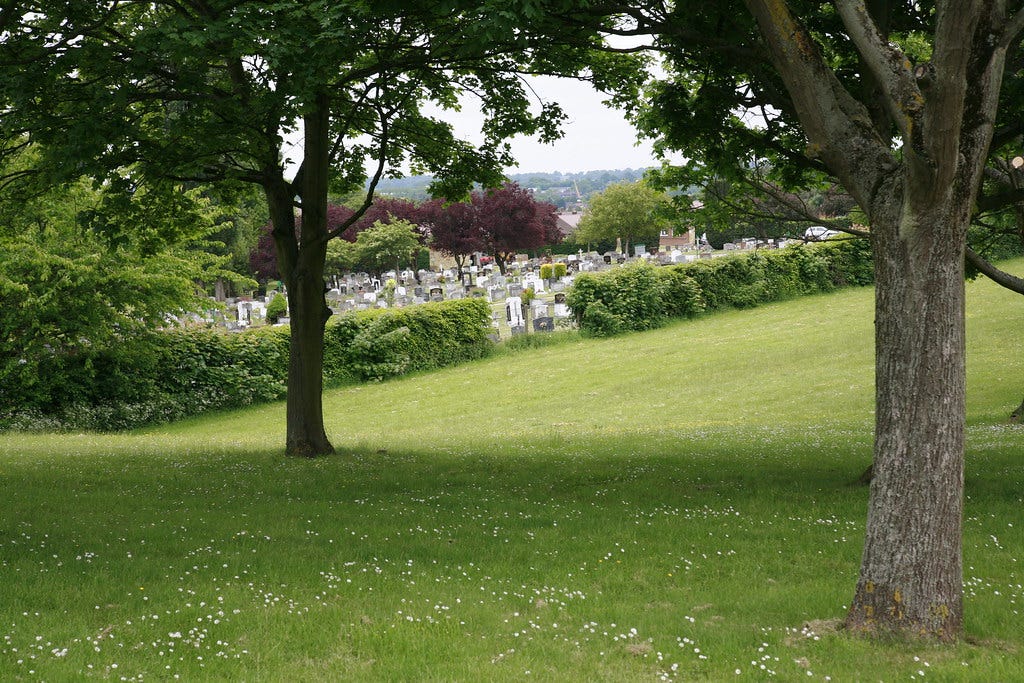
The car smelt of crisps and fag smoke and the rain was yammering against the windscreen like pennies on concrete when I was startled awake by my own fart. It took me a moment to regain composure and I felt furtive and embarrassed. There were no other cars in the car park so my twitching and grunting went unobserved.
I’d spent the best part of two fucking days in this car park staring at the graves and the woodland behind them. Staring at one grave really, directly in front of me, about five rows of headstones back, its earth still fresh and turned. A red and white pinwheel had been stuck possessively in the mud next to the slab marked with the dead boy’s name.
I could feel a jabbing pain in the small of my back, my hamstrings gnarled from hours just sitting, looking, waiting. The funeral had been at 10am on Thursday and now in the grey dawn I contemplated another day in the car eating rubbish and smoking and pissing in bottles.
“Just go and sit there, watch the funeral” Shrike had told me initially, rolling a cigarette between his long, manicured fingers, his hooded eyes downturned to the floor. “Maybe his mate will show. To pay his respects.” I was sceptical but I said fuck all. Kids like Damien didn’t pay respects to anyone, mate or no mate.
I’d rang Shrike when the mourners had straggled away in the unceasing rain, and told him that he hadn’t shown. He’d told me to stay there. “How long for?” I’d asked, struggling to keep a tremor from my voice. He replied “Until I tell you you can leave” and then he’d hung up.
The turnout for the burial had been small. A grandmother, probably, her hair blue rinsed, paper streamers hanging off of the steering handles of her mobility scooter. A priest. A couple of people that looked like teachers in suits and, of course, the police, looking over their shoulders and scanning the car park where I had been, laid back in the passenger seat avoiding the lighthouse beams of their gaze.
I hadn’t been there when the kid died but I’d been told it was an accident. Stuff like this was exactly what Shrike had claimed wouldn’t happen. He’d seemed sincere in his desire to run this thing like a business, like we were opening up shop in a new town - the first New Town as it turned out.
This was his second line; the first covered a few out of the way towns in Essex and was flying. It had opened two years ago in the usual way – I helped Shrike recruit the first wave of kids local to us in East London, many of them loners and pariahs and children of regular customers who weren’t missed at school and could be put on trains to the suburbs with backpacks full of wholesaled heroin and a pay as you go phone. The market place they were entering was primed with baseball bats and, though rarely required, rusty guns that had been over the Irish sea and back more times than the Holyhead ferry. It never took long to run off the local incumbents – imbeciles with no muscle, artisans without the economies of scale required to make our trade any more than a cottage industry. A virgin market. Ours for the taking.
From there, as Shrike always said, it was just a case of taking the locals along the customer acquisition journey. Awareness of the new brand via short-lived free tasters; consideration of the product as a solution to their problems, which were manifold; the decision to pursue the product as their God and salvation and life’s work; and then the final stage – retention – well, that took care of itself.
Twenty-four-seven that line rang, and in and out of various, regularly rotated houses the captured would lurch, desperate for their smack and their crack and their weed and whatever we could give them. Bubbling along with profitable regularity. So we took what we learned from Essex and found another bit of the frontier basically untouched and we took it. The roll out went well. It had all been OK till Damien and Chris turned up.
I had tried to warn Shrike. Damien was a horse that couldn’t be broken. The kids had turned up together, of their own accord, smelling money. It wasn’t the usual way. But the two of them, Damien sharp and bright, the natural leader of the two, and Chris – his wordless but seemingly stolid, companion – had impressed Shrike. We’d taken a house, a council two bed whose occupant we fed on enough scraps to keep quiet. Damien and Chris moved in. They ran the line seven days a week and I’d travel up and down to check on them.
Three months in, a package went missing and, stupidly on their part, Damien and Chris did too. They didn’t even have the sense to break their own arms and blacken their eyes, to say they had been stuck up, to try to brazen it out. They might have lasted a day or two longer if they had.
Shrike got to Chris first. Found him with pinhole pupils and snares blaring in a fetid council flat out by Welwyn - he’d snorted more than he’d sold, hadn’t even left the county. The package wasn’t there though. Just some dregs. As Shrike told it he’d simply tried to make Chris cough up the answers, him and a couple of his cousins he’d brought down from Poplar for the purpose. Chris told them all manner of stuff in his pain, none of it, it turned out, true. Damien clearly hadn’t thought highly enough of his friend to give him more than some personal use gear let alone tell him where he was going to lay his head or where he’d stashed the motherlode. So now they needed Damien.
Though Shrike was projecting his usual predatory calm I sensed in the overreach of Chris’ death a grim warning sign of panic. There was an urgency to his need to get the package back – this couldn’t be written off as lost stock. I’d always known our margins were thin – the money from the last one bought the next one. With Shrike’s personal expenses he might even have used a bit of credit from elsewhere to buy the one that had been nicked - and collateral with the type of people he’d likely lent from was bodyparts. There was no cash coverage, reserves, no fallback plan. Shrike had running costs; payments to dodgy accountants to clean his cash, retainers for lawyers who could get a mule kid out of a pinch, not to mention a succession of women who he had children with who knew a lot about what he did and were paid silence-inducing extra legal child support every week in cash. I’d done the rounds with the black bag to pay them myself.
There was also the gambling. Shrike thought himself impenetrable, but I’d seen him two years ago on an Essex high street, stood outside a Ladbrokes thirstily dragging on a Marlboro, muttering to himself, his hands going back and forth through his blonde hair. I’d never seen him so exposed, never seen him with his pulse rate higher than a resting marathon runner. I’d seen the look before and I kept it to myself. All of this urgency, all of this desperation and now violence – Shrike, it seemed, was scared.
Not that he’d ever tell me, a middle-management fuck up. Shrike had been promising me my own line, my own shop, forever. But tomorrow never seemed to arrive, so I drove, I ferried packages, I marshalled the kids, I kept my head down - going to the Albanians over his head would of been suicide. I practiced gratitude and tried to be content.
Being a fucked, balding, fat bloke whose tattoos didn’t protrude beyond collar or cuff had at least proven handy within the bizarre corporate structure Shrike had created. I’d pick wholesale from the Albanians in a staid rental car or go and bail a kid out if I needed to and I never turned many heads. That made me useful. Useful enough to effectively earn a salary in cash and to sit in graveyards and wait to blow the whistle on teenage idiots in case they were stupid enough to turn up and shed tears over the holes in which the broken bones of their mates now rested.
I screwed up my eyes and rubbed crusty granules from their corners, a yawn stinging the tightness at the corners of my mouth. Lighting a tab I loosened my polyester tie, a needless affectation of professionalism, and tried to massage stiffness from the nape of my neck. Checking the burner phone in my mac pocket, I noticed the discoloration on the epaulet of my right cuff. Dirt and age had left it shiny, the threads standing out, livid and taut like a loom. The unmistakable mark of poverty or negligence. When I was at school it was both. I was never bullied. But the dirty grey of my frayed short sleeved shirt, the smell it held, of substances and smoke, alien and strange to my classmates and teachers but redolent of my living room and my home. That shirt marked me out, like an exclamation mark of humiliation hovering over my head, following me like a cursor around the classroom.
It was a wound. Chris had that same wounded look when he turned up, a kid whose ghosts had followed and embarrassed him, just like mine. Chris whose dead arm was probably broken in three places with a hammer, whose dead skin was likely pockmarked by cigarette burns, whose mouldering skull was in the cold earth and whose dead eye balls looked up out of this grave at me, me, me, me and whose mouth told anyone who would listen about me and what I hadn’t said and what I hadn’t done, me, me, me, me . . .
The passenger door clicked closed smoothly and instantly Shrike was sat next to me. I’d been staring glassily into the middle distance and suddenly he was there, an apparition. He did that. Somehow he seemed barely wet despite the rain and I couldn’t see another car that he’d transferred to mine from. My breath caught in my throat and the silence in the car felt heavy. He was smirking at me, the hood of a heavy twill jumper cinched tight by a drawstring around his throat, cargo trousers impeccably clean, heavy boots.
I still didn’t know where he’d got that alias. Definitely didn’t know his government name. Some said he’d been christened Shrike by an early client, back when Shrike was a kid selling weed to the has-beens and hippies on the estate where he grew up. An old guy in the flats, buying eighths for his living room and his jazz, a birdwatcher apparently was the christener. Said there was a look to the boy, now a man, sat in front of me, that put him in mind of this breed of bird.
“You can leave,” Shrike said in his slow baritone. He lit a cigarette and the paper crackled in the quiet of the car. “It’s done.” Seconds elongated beyond the point of all meaning, time stopped in the smoky stink of the car. On my cuff there was a loose thread and I picked and pulled at it, clawing at the dirt clogging the adjacent seam. I asked if he needed me to drop him anywhere.
“No” came the reply. “You’ve done enough. Take tomorrow off. We’ll go and see Arjan about the next package on Monday”. Then he opened the door soundlessly and loped with a long stride, past the flowers and pinwheels and the shiny, wet stones towards the cover of the tree line behind the graves.
No posts
Comments
Nothing yet. Say the first thing.
Sign in to join the conversation.