
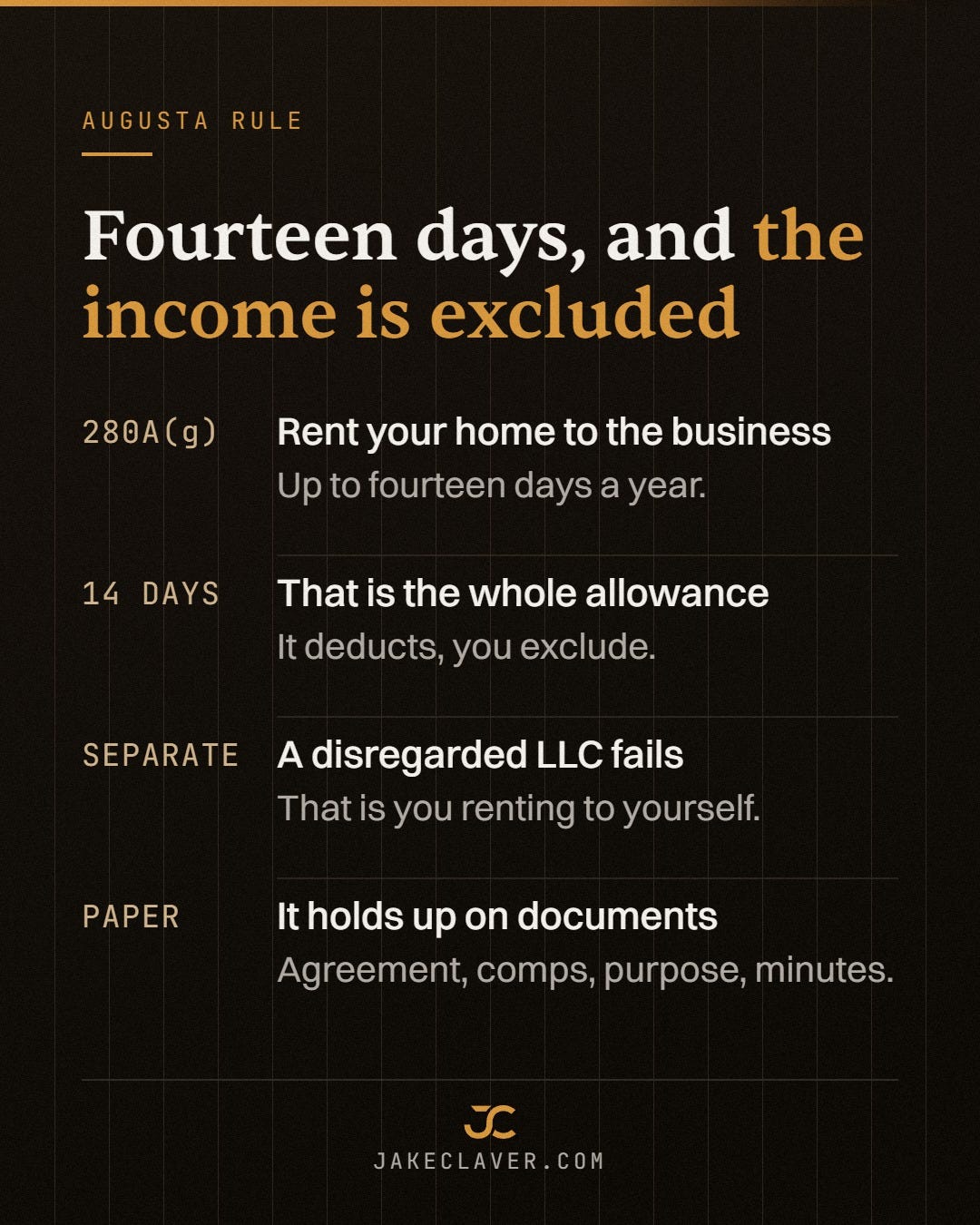
The Augusta Rule for a crypto LLC comes from IRC Section 280A(g), which lets you rent your home to your own business for up to 14 days a year and exclude that rent from your personal income.
The business pays fair-market rent for real use, like board meetings and strategy sessions, deducts it, and you report none of the income on your return.
It only works if your LLC is a separate taxpayer. A single-member LLC that files as a disregarded entity is you renting to yourself, and the IRS treats it that way.
The deduction holds up on paperwork: a written agreement, fair-market comps, a genuine business purpose, and minutes that show what happened.
Charging the business $5,000 for a backyard barbecue with no agenda is the kind of move that draws an audit and loses.
The mechanics are specific and the line between legitimate and aggressive is thin, so model it with a CPA before you run it.
I have watched crypto founders track every wallet to the satoshi and then leave one of the cleanest deductions in the tax code sitting on the table.
They run actual businesses. A trading LLC, a mining operation, a fund that holds the family stack. They hold meetings about serious money. And every one of those meetings happens at the kitchen table or the home office, for free, when the tax code says the business could be paying them rent that never gets taxed.
That is the Augusta Rule. Congress wrote it into law in 1976, and it is still on the books. So let us walk through how it works for a crypto holding or trading LLC, and where the floor gives out if you push too hard.

The Augusta Rule is the nickname for a short provision in the tax code, IRC Section 280A(g). The name comes from Augusta, Georgia. Homeowners there rented their houses to visitors during the Masters golf tournament every spring and did not want that one-week windfall taxed. Congress agreed and wrote the exception into law.
The rule itself is one sentence of plumbing. If you use a home as a residence and rent it for fewer than 15 days in the year, you do not report the rental income, and you do not deduct rental expenses against it. The IRS spells out the same thing in plain language on its own page about renting residential property: rent the place for fewer than 15 days and you do not report the income.
Read that again with a business in the room. The income is tax-free to you. And if the renter happens to be your own company, the company still gets to deduct the rent as a business expense. One payment, deductible on one side, invisible on the other. That is the whole engine.
The practical limit is 14 days, because day 15 breaks it. Rent for 15 days or more and the exclusion is gone, every dollar becomes reportable rental income, and you are into the normal rental rules. The cliff is hard. There is no partial credit.
Picture a holder who runs a crypto venture through an LLC. Could be a trading entity, a mining business, or the structure that holds and manages the family’s digital assets. The business has decisions to make: rebalancing, custody and key management, security reviews, tax positions, the quarterly numbers.
Those decisions need meetings. The Augusta Rule lets the business hold them at your home and pay you rent for the space.
Here is the flow, step by step:
The LLC holds a legitimate business meeting at your home. A quarterly strategy session. An annual planning offsite. A security and custody review with your team.
The LLC pays you fair-market rent for the day, the kind of rate a hotel or conference venue in your area would charge for comparable space.
The business deducts that rent as an ordinary business expense, which lowers its taxable income.
You receive the money and, because it falls under the 14-day window, you exclude it from your personal income entirely.
Repeat up to 14 days a year.
Run the numbers. Say comparable meeting space in your market runs $1,500 a day, and the LLC holds 12 legitimate meetings at your home over the year. That is $18,000 the business deducts and $18,000 you collect tax-free. At a 37% federal rate on the business income that rent offsets, the deduction is worth roughly $6,660. The cash moved from your company to your pocket and skipped the tax that normally rides along.
For a crypto LLC the fit is natural, because so much of this work already happens at home. The founder who reviews cold-storage procedures in a home office, or walks through the year’s gains with a partner over the dining table, is already holding the meeting. The rule just says the business can pay for the room.
This is the part that decides whether the strategy survives a second look. The Augusta Rule is legitimate. Sloppy execution of it is not, and the IRS knows the difference.
The deduction holds up on documentation and on the reality behind it. Four things carry the weight:
A written rental agreement between you and the LLC. It names the property, the dates, the daily rate, and the business purpose. Sign it like you would sign a lease with a stranger.
Fair-market rent backed by comps. Pull real quotes from hotels, conference rooms, or event venues near you for comparable space, and keep them. The rent has to be what an unrelated party would pay, not a number you picked because it was convenient.
A genuine business purpose for each day. The meeting has to happen and has to serve the business. An agenda, the topics covered, who attended.
Minutes that prove it happened. Board or member minutes, dated, with the agenda and the decisions made. This is the record that turns “we had a meeting” into something an examiner can verify.
The payment trail matters too. The LLC writes an actual check or transfer to you for the rent. The business books the deduction, and you keep the documentation with your records in case anyone asks. Treat it like a transaction between two separate parties, because for tax purposes that is exactly what it is.
There is a court case behind this caution. In a 2023 Tax Court decision, business owners tried to run large payments through the Augusta Rule and the court gutted the deduction, largely because the rent was not supported as fair market value and the business purpose was thin. The rule did not fail them. Their paperwork did.
The same feature that makes the Augusta Rule attractive, paying yourself, is exactly what makes it easy to abuse. So the line is worth drawing in bright paint.
Legitimate looks like this. Genuine meetings about the business, on a sensible number of days, at a defensible rate, with a paper trail. A crypto LLC that holds a monthly strategy and security review at the founder’s home and pays $1,200 a day is on solid ground if the meetings happen and the rate matches the market.
Audit bait looks like this:
A rate with no basis. Charging the business $5,000 a day when comparable space in your town rents for $800. The excess is not rent, it is a distribution wearing a costume.
No meeting that happened. A “board meeting” that was actually a family birthday party. If the only business that took place was cake, there is no deduction.
No paperwork. No agreement, no comps, no minutes, no agenda. An examiner asks for proof and you have a bank transfer and a story.
A single-member LLC pretending to be two parties. More on this next, because it sinks more crypto founders than anything else.
The instinct to maximize is the trap. The deduction is capped at 14 days for a reason, and the rent is capped at fair market value for a reason. Treat both as ceilings, not targets. The holder who books 14 perfect days at an honest rate keeps the deduction. The one who books 14 days at triple the market rate hands the IRS an easy adjustment and maybe a penalty.
This is the question that quietly disqualifies a lot of crypto holders, so it deserves a straight answer.
The Augusta Rule needs two separate taxpayers: you the homeowner, and a business that is treated as its own taxpayer paying you rent. The problem is that a single-member LLC, by default, is a disregarded entity for federal tax. The IRS looks straight through it and sees you. So a default single-member LLC paying you rent is you paying yourself, and you cannot generate a deduction by moving money from your left pocket to your right.
The fix is structural. A single-member LLC that has elected to be taxed as an S corporation, by filing Form 2553, is no longer disregarded. It is a separate taxpayer, and Section 280A names S corporations as eligible. Multi-member LLCs, partnerships, and C corporations clear the bar for the same reason. They are separate from you for tax.
For a crypto LLC this is not a detail to wave at. Many digital-asset holders set up a single-member LLC for asset protection and never made a tax election, which means the entity that owns the stack is disregarded and cannot anchor an Augusta Rule deduction as is. Whether an S-corp election even makes sense for a crypto entity is its own analysis with its own tradeoffs, and it is a conversation for your CPA, not a checkbox.
If you are still setting up the entity, Digital Ascension Group has written separately on setting up a crypto LLC for tax benefits and asset protection. The structure you pick at the start decides which strategies, including this one, are even on the table later. And the firm’s broader advanced crypto tax planning overview puts this deduction next to the others worth knowing.
The Augusta Rule is one move in a larger game of keeping more of what you hold while you are alive. It pairs naturally with the other strategies in this series.
It sits next to the crypto wash-sale gap, where the absence of a wash-sale rule for property still lets crypto holders harvest losses in ways stock investors cannot, at least for now. It sits next to the borrow-versus-sell question, where some holders raise cash against their coins instead of selling and triggering gains, a strategy with its own tax math and a serious liquidation risk that deserves its own honest look. The Augusta Rule is the smallest of the three, but it is also the easiest to run cleanly and the easiest to repeat every year.
None of these are a substitute for the others, and none replace sitting down with someone who can model your specific numbers. The point of knowing all of them is that the right combination depends on your entity, your income, your state, and what you plan to do with the stack.
How many days can the business rent your home under the Augusta Rule? Up to 14 days in a calendar year. On day 15 the exclusion disappears and all the rent becomes taxable.
Is the rental income really tax-free? The income is excluded from your personal gross income under Section 280A(g) when the home is rented fewer than 15 days. You also cannot deduct rental expenses against it, but the business renting from you still deducts the rent it pays.
Can a single-member LLC use the Augusta Rule? Not as a default disregarded entity, because that is you renting to yourself. It can work if the LLC has elected S-corp status or if the business is otherwise a separate taxpayer, like a multi-member LLC, partnership, or corporation.
What rent can the crypto LLC pay? Fair-market rent for comparable space in your area, supported by documented comps. The day rate a local hotel or conference venue would charge for similar space is the benchmark, not a number chosen to maximize the deduction.
What paperwork do you need? A written rental agreement, fair-market comps, a genuine business purpose with an agenda, dated minutes, and a clean record of the payment.
The Augusta Rule will not move a crypto fortune by itself. A few thousand dollars a year in tax saved is real money, but it is not the headline. What makes it worth the page is that it is legitimate, repeatable, and sitting unused in front of people who already do the work it pays for.
The crypto holders who capture it are not being clever. They are running genuine meetings about a working business, paying themselves a fair rate for the space, and keeping the paperwork that proves it. The ones who turn it into a problem are the ones who treat 14 days and fair-market rent as a starting point to beat rather than a ceiling to respect.
Want to understand how the Augusta Rule or any of these strategies fits your own crypto LLC? The team at Digital Ascension Group is happy to answer your questions and connect you with a CPA or tax professional who handles digital-asset entities. You can start the conversation at DAG.com.
Comments
Nothing yet. Say the first thing.
Sign in to join the conversation.