
Does your stomach drop when that polite “we’ve decided to go in another direction” email lands in your inbox? Do you lie awake replaying a sales call, wondering why the prospect didn’t get what you were offering? When a peer in your industry hits another milestone, does a small part of you feel left behind — even though you know your work is more impactful than theirs?
After reading this, you’ll stop giving away the most valuable thing you own. You will discover:
How One Shoe Store Owner Stopped Losing $500 Sales Without Lowering Prices — What she did instead of cutting prices to match the cheaper look-alikes her competitors sell — and why it worked.
Why Your Expertise Is the Very Thing Pinning Your Revenue to a Ceiling — The math showing how being brilliant for your clients keeps you stuck — and how a single weekend of work can break the ceiling without adding a single new lead.
The One Move a Regional Soda Made That Helped It Beat the Competitors — How a single sentence about a practice every competitor was already using became a moat that decades of marketing budgets couldn’t breach.
The 90-Second Exercise That Finally Gives Your Asset a Name — Set a timer, answer one question, and the thing you’ve spent years building gets a working name. Not another workbook for your $47K digital graveyard. A single question that makes the pattern hiding in plain sight visible for the first time.
You’ve already built the most valuable thing in your business. You did it years ago. You did it the hard way… through every client win, every loss, every late night figuring out what worked.
What you don’t have is the language for it.
That’s not a thinking problem or a strategy problem. It’s a translation problem. Your expertise lives in one language — instinct, pattern recognition, accumulated judgment.
Your prospect needs it explained in another language: named steps, clear stages, a system they can point to. You’re fluent in both, but somewhere along the way you forgot you needed to translate.
In 15 minutes, you’ll walk away with:
The Phrase You’ll Put at the Top of Your Next Proposal — A name for your methodology that stops the prospect from price-shopping you against someone half as good.
The Map That Makes the Person Across the Table Stop Hedging and Start Nodding — Your abstract expertise turned into a clear, de-risked, step-by-step process.
The Exact Words That Turn “Let Me Think About It” Into “When Can We Start?” — Simple, powerful sentences you can copy and paste into your website and proposals tomorrow to justify your fee.
The Outside Perspective You Can’t Give Yourself — Let us show you the map you’ve been drawing for years, finally pulled out of your head and onto the page.
I sat down with the owner of a high-end women’s shoe store who was facing a crisis. Her store sold exquisite stilettos at $500 a pair and up. They were works of art. But customers were balking. They could walk into a department store across the mall and find shoes that looked almost identical for a fraction of the price.
Her store was losing sales. Week after week.
She was competing on aesthetics — but the market was flooded with cheaper, mass-produced look-alikes coming in from every corner of the world. She was trying to justify her prices by talking about “quality.”
“But the leather is obviously better,” she said. “You can feel it.”
I told her the customer holding two shoes in a department store doesn’t have time to feel anything. They have a price tag and a story — or maybe no story at all. That’s the whole comparison.
This was her paradox. The customer was oblivious to the very thing that made her shoes exceptional: the obsessive curation, the manufacturing standards, the craftsmanship.
The good news was that her greatest asset was yet to be tapped, because even though she was a world-class buyer, she was a novice at communicating what these things meant.
I stopped her mid-sentence.
“This isn’t a pricing problem,” I told her. “It’s a storytelling problem.”
“You’re selling a shoe. You need to be selling the hunt for the shoe.”
So, I wrote her a story: a marketing narrative her staff could use at the register, in the catalog, in every conversation with every customer who walked through her door.
We didn’t change the product. We didn’t change the price. We didn’t train a single new salesperson. We just made the backstory visible.
The story started with the store owner. She traveled 350,000 miles a year. She visited 30,000 different manufacturers. She evaluated over 75,000 different styles and colors of shoes — just to pick the roughly 100 pairs that made it into her store.
Then we told the story of how those shoes were actually made. How the manufacturer scrutinized over 100 skins to find a single matching set. How they used dyes five times more expensive than the industry standard. How they stitched with silk threads that cost ten times what ordinary thread cost.
Every one of those facts was already true before we wrote a single word. Every competitor selling a $500 shoe was working with roughly the same manufacturing process. But none of them had ever said any of it out loud.
We told the story of the hunt, not just the shoe. We told the story of the making, not just the merchandise. We sold everything the customer couldn’t see and didn’t know to look for.
The results were immediate. The price objections stopped. A customer would pick up a $500 shoe, hear the story, and understand — for the first time — what she was actually buying.
This shoe store became preeminent on a story that defined the criteria its customers should be using to evaluate the product. They stopped selling a $500 product, and started selling $500 worth of invisible work finally made visible.
Here’s the rule that came out of that store, and out of forty years of watching this same pattern play out in dental practices, wedding planners, custom furniture makers, accounting firms, landscape designers, and every other industry where the work is real but the value is hard to point at:
Your most valuable marketing tool isn’t a new skill you need to learn. It’s the invisible process you already use to get results. You’re just not articulating it.
That shoe store owner was an expert at her craft. She knew every buyer, every mill, every dye, every stitch. And her entire business was vulnerable because she assumed her customers could see the value she saw. She assumed the craftsmanship was self-evident.
It never is.
You’ve spent years getting good at what you do. You’ve earned the results. The question isn’t whether your work is excellent — it’s likely better than excellent.
The question is what your client can actually see when they look at it.
What value are you assuming they see? What expertise are you assuming is obvious?
The dentist, who can read a patient’s bite pattern from a single x-ray and predict which tooth will fail in five years.
The cabinetmaker, who can look at a raw board and know which way it will warp in seven years — and adjusts the joinery accordingly.
The wedding planner, who knows which reception venues will sound terrible at peak occupancy because of an architectural detail nobody else notices.
Your expertise is so ingrained, it’s become instinct. But you cannot sell instinct. You cannot put “my gut feeling” on a proposal, an estimate, or a price sheet and charge a premium for it.
You have to package your instinct. To deconstruct it, name it, and make it visible.
The first person to articulate the standard becomes the standard.
Let’s talk about that proposal — or estimate, or service agreement, or new product announcement — that’s been sitting in your prospect’s inbox for the last nine days.
You’re checking your email every hour, aren’t you? Hoping for a “yes” but bracing for the polite “we’ve decided to go in another direction.”
The reason you are about to lose that deal isn’t because your competitor is better.
You’re losing the deal because your competitor has articulated a process, while you’re selling your expertise as an abstract concept. You’re selling a mystery. They’re selling a map.
Customers will always choose a concrete system over the vague promise of “experience.”
Your competitor’s cheesy “5-Step Growth Activator™” (or “Total Comfort Installation Method” or “Signature Color Process” or “Precision Onboarding Sequence”) sounds more reliable, more tangible, and safer than “we’ll take great care of you.”
Even when your actual work is vastly superior.
By not naming and articulating your process, you’re competing with one hand tied behind your back. You are forcing clients to guess at your value and take a leap of faith.
There’s a better way.
Your process is your most defensible, unique, and valuable piece of intellectual property.
It’s the one thing no competitor can ever replicate, because it’s born from your unique combination of wins, losses, client experiences, and insights.
It’s your cognitive fingerprint.
To leave it unarticulated is to leave money, and respect, on the table every single time someone asks you what you do.
Let me walk you through the math the way I’d walk a client through it.
Imagine a contractor, who I’ll call James. James runs a small remodeling firm. He’s closing four projects a month at an average of $14,000. That’s $56,000 a month in revenue, or $672,000 a year.
But he feels stuck. His annual revenue has been frozen at around that level for three quarters running, and the only way forward looks like working more hours he can’t spare or hiring people he can’t manage yet.
What if James takes one weekend to extract, name, and articulate his proprietary process?
He turns “remodeling services” into “The Heritage Build Method”: a clear, named, six-step system that walks a homeowner from first conversation to final walkthrough.

Two things happen.
First, his close rate on proposals goes from a nail-biting 30% to a comfortable 50%.
Read that again. James didn’t add a single lead. He didn’t run a single new ad. He didn’t take a sales course. And he jumped from $56,000 to $84,000 in monthly revenue.
The same prospects who were already getting his proposals are now saying yes more often… because for the first time, they can see the system they’re buying.
That close-rate jump alone adds two more projects a month.
That’s another $28,000 a month (from $56,000 to $84,000 monthly revenue). Now James is doing just over $1 million in business annually, without having to find new leads.
Second, because James now has a system, he can charge for it.
His average project fee climbs from $14,000 to $18,000. He’s no longer being compared on price to the guy with a pickup truck and a hammer. He’s a specialist with a proprietary methodology. The story he tells about his system justifies the higher price.
At six projects a month at $18,000, James is now at $108,000 a month. That’s just under $1.3 million a year.
James ran the math three times. “I haven’t added a single thing to my business. I just described what I already do.”
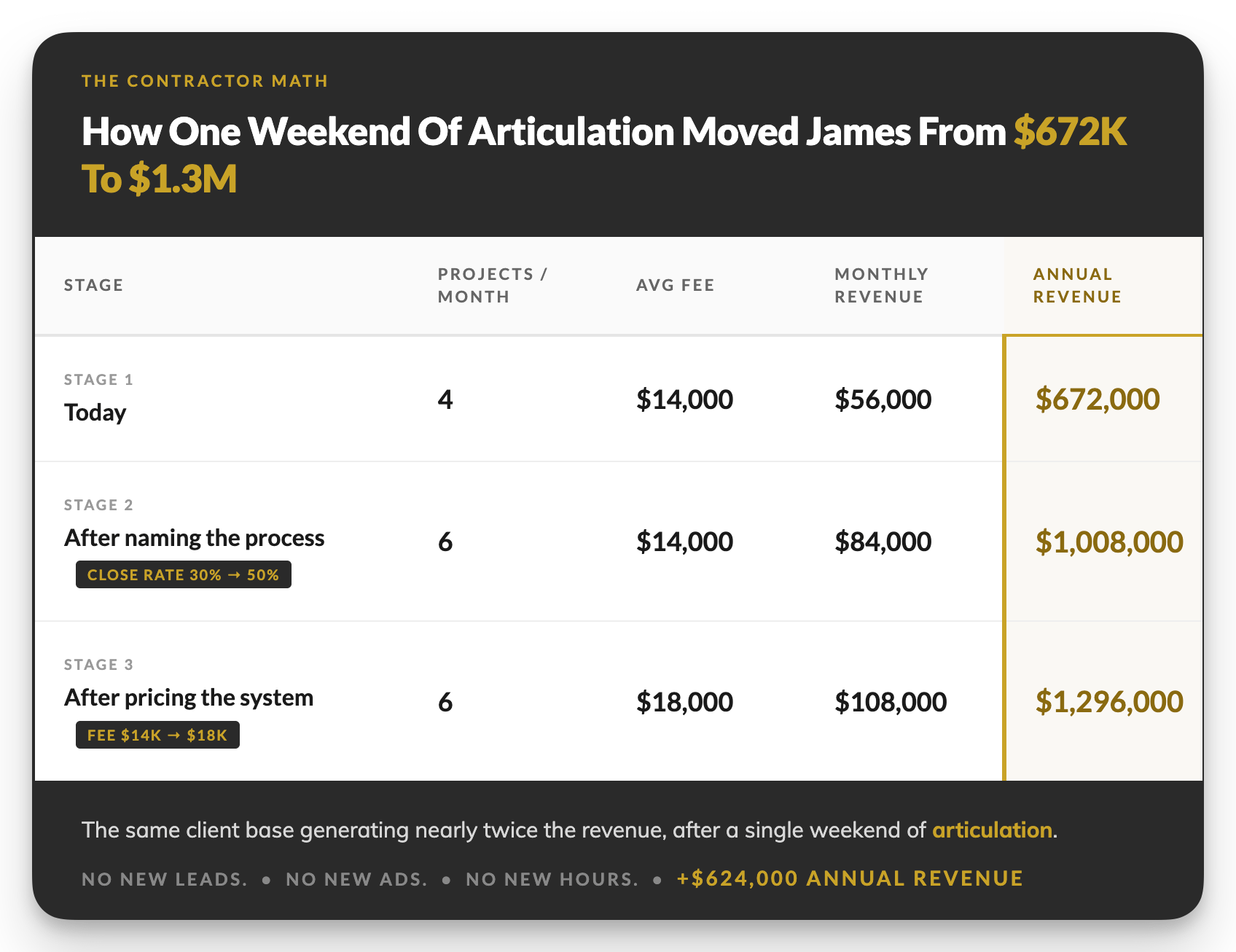
Same client base. Same amount of work. James more than doubled his revenue by monetizing an asset he already owned but had left invisible.
This is the difference between being the best at what you do and being known for it.
Come back to the shoe store for a minute.
The owner didn’t change her shoes. She didn’t change her prices. She didn’t hire one new salesperson. What changed is that her customers could finally see what they were paying for.
Which means the gap between her old revenue and her new revenue wasn’t a marketing gap. It wasn’t a product gap. It wasn’t a pricing gap.
It was a vocabulary gap!
She had the asset. She’d had it the whole time. She just didn’t have the language for it.
What’s the vocabulary gap in your business? What have you been doing for years that you’ve never named, never described, never put on the page in a way a prospect could actually understand?
That could be the most valuable thing you own.
This isn’t a clever trick for solo operators. Some of the largest, most dominant companies in the world were built on this exact principle: articulating the invisible standard.
Every major soft drink company blends multiple flavors into a proprietary syrup. Coca-Cola does it. Pepsi does it. Every regional cola and cream soda does it. A complex flavor blend is not a secret weapon. It’s industry standard.
Dr. Pepper was not one of the giants. It was a regional soda fighting for shelf space in a market that Coke and Pepsi had already carved up. On the product itself, Dr. Pepper had no decisive edge. Their syrup was complex, but so was everyone else’s.
Then they made one move. They began telling consumers that Dr. Pepper contained 23 flavors.
That was the entire claim. They counted. They named it. They printed it on the label and included it in their marketing.
Their competitors could have said the exact same thing. Coca-Cola’s formula is famously layered. Pepsi’s is no less intricate. Any one of the giants could have announced a number and claimed the same ground. But none of them had bothered.
They assumed — like the shoe store owner once did — that the customer already understood.
Dr. Pepper claimed it first, so the invisible standard became theirs. “23 flavors” stopped being a fact about one soda and became a yardstick for all of them. Any competitor who tried to match the claim now sounded like they were copying Dr. Pepper… even though the underlying practice had been universal all along.
Your competitors are doing what you’re doing. They have processes. They have standards. They have hard-won expertise.
None of them are saying it out loud.
The first one to articulate their system has a huge edge.
There’s a tremendous benefit to articulating your process — one that most operators never see coming until they’re standing on the other side of it.
Right now, you ARE your business. The process lives in your head. The judgment, the standards, the thousand small decisions that produce the result. All of it is happening inside you, in real time, every day. Take yourself out of the equation and everything stops.
That’s not a business. That’s a job that pays you well.
The moment you extract your process — name it, codify it, put it on the page — something fundamental changes. Your expertise is no longer trapped inside you. It exists outside you.
Which means:
You can train someone in it. The new hire who used to take eighteen months to be “ready” can now follow a documented system and be productive in three.
You can take a vacation without the business stalling. The work continues because the system continues.
You can raise prices without flinching, because what you’re selling is no longer “my time” — it’s “the result this proven system reliably produces.”
And — most importantly — your business becomes sellable. A buyer cannot purchase your instincts. They cannot acquire your gut. But they can absolutely acquire a documented, repeatable system that produces a predictable outcome. The named process is what turns the work you do into an asset someone else would pay you a multiple of annual revenue to own.
The shoe store owner didn’t just unlock premium pricing the day she could articulate her process. She unlocked the potential to eventually walk away from the store and have it still be worth something.
Same with James. The Heritage Build Method isn’t just a closing tool. It’s the thing that makes his company worth selling in fifteen years instead of being a paycheck that ends the day he stops swinging a hammer.
The Stiletto Rule isn’t just about pricing.
It’s about asking the question: Do you want to own a business or continue working a job?
Try this right now. It takes 90 seconds. Don’t skip it.
Set a timer on your phone. Open a blank document or grab a pen. Now answer this question as if you were explaining it to your dream client:
“What is the step-by-step process you use to take a client from their initial problem to their desired result?”
Don’t overthink. Don’t edit. Just write.
Tick… tock… tick… tock…
Time’s up.
If you named stages, each one with a distinct purpose, each one a prospect could repeat back to you in their own words — congratulations. You’re close to implementing the Stiletto Rule in your own business. The work ahead is refinement, not excavation.
If you got stuck describing it, you just proved the point of this entire article. The asset is there — you’ve spent years building it. But what came out on the page is the camouflage, not the asset itself. The real process is still inside you, where no prospect can see it.
Did you struggle with that exercise? Did the words feel generic and hollow? If so, you’re not alone. This is the expert’s curse.
The very thing that makes you brilliant at what you do — the thousands of hours of repetition that have turned complex analysis into unconscious instinct — is the very thing that makes you terrible at explaining it.
It’s hard to articulate the process when you are the process.
In your mind, it’s just what you do.
This is why even the world’s best strategists need a sounding board sometimes. Not for new information, but for a new perspective. A set of questions designed to deconstruct your instinct back into a process.
The goal is to translate your internal genius into external language a client can understand, value, and pay a premium for.
The prompt below is designed to give you that outside perspective. It forces you to articulate the what, the how, and the why behind your results in a way a client can understand and value. It pulls the system out of you.
The Phrase You’ll Put at the Top of Your Next Proposal — A name for your methodology that stops prospects from evaluating your product or service solely on the basis of price.
The Key Distinctions of Your System — The map that makes the person across the table stop hedging and start nodding. Your abstract expertise turned into a tangible, easy-to-follow roadmap with all core elements clearly identified.
The Exact Words That Turn “Let Me Think About It” Into “When Can We Start?” — Simple, powerful sentences describing your unique process that you can copy and paste into your next proposal to justify your fee.
Open Your AI Tool: Use Claude, ChatGPT, or our own Jay-I Super Clone.
Copy and Paste the Prompt: The prompt contains the full methodology. Just paste it in.
Have the Conversation: The AI plays the role of the outside strategist you can’t be for yourself, asking the questions that pull the system out of you. In 15 minutes, it will synthesize your answers into the structured process you’ve been unable to see.
ChatGPT will give you a name for your process. Jay-I can tell the difference between a a process that sounds like a $500 stiletto and one that sounds like a department store knockoff. It’s been trained on the specific patterns that produces premium pricing across more than 1,000 industries — and it will push you toward the version of your process that justifies your premium, refusing to let you settle for the version that doesn’t.
That shoe store owner wasn’t just selling shoes. She was selling her profound belief in craftsmanship. She was selling the story of a world in which 350,000 miles of searching for the right shoe still mattered. The story we wrote didn’t just list facts — it revealed her philosophy. It made her deeply held values tangible.
The diagnostic exercise you just did, and the prompt that follows, isn’t just about finding a new way to market your work. It’s about excavating your own professional philosophy. It’s about codifying the hard-won wisdom you’ve earned over thousands of hours of practice into something you can stand behind, point to, and declare with unshakable confidence: This is how I do it. This is my system. This is what makes my work valuable.
This is the foundation of preeminence.
Let’s go find your $500 stiletto.
Jay Abraham
Michael Simmons
Max Bernstein
Comments
Nothing yet. Say the first thing.
Sign in to join the conversation.