
The Leverage Economy — Series Recap
You’ve spent the past month learning four strategies. Which ones did you apply to your business?
Each article was designed to stand on its own. But here’s what you couldn’t see reading them separately:
Those four strategies weren’t four separate ideas. They were a four level ladder. And each level makes the next one more attainable.
When you stack them, you stop seeing four strategies and start seeing one system. A system that turns every new client into fuel for every other level of growth you’ve already built.
The Trap That Looks Like Hard Work — When you’re building every asset from scratch (your audience, your pipeline, your referral flow), you’re on the slowest path to growth.
Why Four Individual Lever Strategies Aren’t Compounding — We’ve given you four growth tools. You’ve probably been thinking about which one to try first. That’s the wrong question. These four strategies aren’t options to choose from. They’re levels of a ladder, and each one makes the next level more attainable. The difference between running them separately and running them together isn’t addition. It’s something most business owners have never seen.
The Rung You’ve Been Skipping — You’ll finish this article knowing which level of leverage you’ve been operating at, which levels are underperforming or nonexistent in your business, and which one would change the most for you if you tried it first. The answer is probably uncomfortable. It’s also probably worth six figures.
When I sit with a business owner, I don’t ask which strategy they should try. I ask which level they’re operating at. The answer determines everything: which move to make next, how much to invest in it, and which possibilities are being starved because the owner doesn’t know they exist.
You describe your business. The prompt diagnoses what rung you’re on and shows you the path up.
Clarity instead of confusion — Right now, you have four strategies and no way to know which one matters most for where you are. After the diagnostic, you’ll know exactly which level you’ve been operating at, and the guessing stops.
The blind spot that’s kept you stuck — The diagnostic doesn’t just tell you which level you’re on. It names the specific number you haven’t calculated, the question you haven’t asked, or the asset you haven’t recognized that’s been keeping every level above yours invisible. Once you see it, you can’t unsee it.
Monday morning confidence — Not four strategies to consider. One move. The specific person to contact, the specific offer to make, and the specific words to use this week, matched to your level and your business.
You spent the past month learning the strategies. This prompt shows you which rung you’re standing on and what’s one level up.
Last month, we covered a lot of ground. Four articles. Four ways to grow without grinding harder:
Article 1: The Most Expensive Lie In Business — Robert paid his biggest competitor twice their own product price to send a single email and grossed $660,000. You learned the Law of Endorsement Economics: it’s much faster to rent trust that’s already been aggregated than it is to build it yourself. The Three-Layer Stack (trust transfer, performance pricing, and the math that makes saying no irrational) is why a competitor kept sending your emails.
Article 2: You Don’t Need More Cash — Sam and Paul were paying reps $20 to land a relationship worth $3,000. The Future-Funding Law showed you that growth isn’t funded from your bank account. It’s funded from the value your customer will receive over the full relationship. Once you know your Allowable Acquisition Cost, the “careful” spending habit that you’re so proud of, often turns out to be the thing capping your growth more often than you realize.
Article 3: The Math of Your Unactivated Sales Team — Graham went from sporadic, unpredictable referrals to a referral-driven business, 10% to over 60%, in a single year. You learned the Four Referral Machines and discovered that the gap between “my customers love me” and “my customers bring me business” isn’t hoping and waiting. It’s engineering.
Article 4: The $396,000 Deal — Dale was about to spend three years and a few million dollars building a national sales team. One partnership conversation made it unnecessary. He brought in $396,000 from a single Lock-and-Key combination. You learned that the most powerful growth deals aren’t transactions. They’re combinations where each side brings the piece the other is missing.
If you read those four articles as four separate strategies, you got four useful tools.
But the four strategies aren’t four options to choose from. Instead they should be looked at like four rungs of a ladder. And each rung makes the rungs below it more powerful.
The difference between a business running on one level and a business running on all four isn’t addition. It’s something most business owners have never seen, its exponential growth.
Today, I’m going to show it to you.
You’ll see what this four level ladder looks like in a single business. I’ll call the owner Nora. She’s not one client. She’s a composite, built from patterns I’ve seen across hundreds of businesses that are dealing with the same problems.
The details are specific in the examples below because the patterns are specific. If you’re a business owner with a strong work ethic, happy clients, and revenue that won’t move, this hypothetical will feel familiar.
Ground Level: The Grind
Here’s the scenario.
Nora runs a commercial interior design firm. She creates beautiful environments for businesses: offices, restaurants, retail spaces.
Revenue: $400,000 a year. Flat. For three years.
She works 55 hours a week. She has one junior designer. She finds new clients the way most business owners in her situation do: networking events, LinkedIn posts at midnight, following up on the occasional lead that shows up because someone mentioned her name at a dinner party.
Her clients adore her. The work speaks for itself. Reviews are glowing. She gets the occasional unsolicited referral, maybe three or four a year.
But the pipeline is unpredictable. One quarter she’s overbooked; the next she’s staring at an empty calendar wondering whether to lower her rates.
Her plan for next year is the plan every stuck business owner writes: do more of the same, but grind harder. More events. More posts. Maybe hire someone for business development. Maybe try paid ads.
A business owner like Nora would describe her company as excellent at its core and starving at its edges. She’s doing everything herself, building every asset from scratch, and wondering why she can’t break through.
I’ve seen this a thousand times. The business is real. The talent is real. And the owner is standing on the ground, looking up at a building they think they need to construct, not realizing there’s already a ladder right in front of them.
Nora has four rungs available to her. She doesn’t know any of them exist.
Level One: Rent the Audience
I’d ask Nora the same question I ask every business owner in the first ten minutes: “Who already has your customers?”
She’d think about it. Three names would come out quickly.
A commercial real estate agent who specializes in office leases.
A general contractor who does commercial build-outs.
An office furniture dealer with a showroom full of the buyers she wants.
I’d point at the first one.
“That real estate agent signed about 80 lease deals last year. Every single one of those businesses needs to design their new space. How many of those 80 businesses found you?”
“Maybe two.”
“And the other 78?”
“They found someone else. Or they didn’t hire a designer at all.”
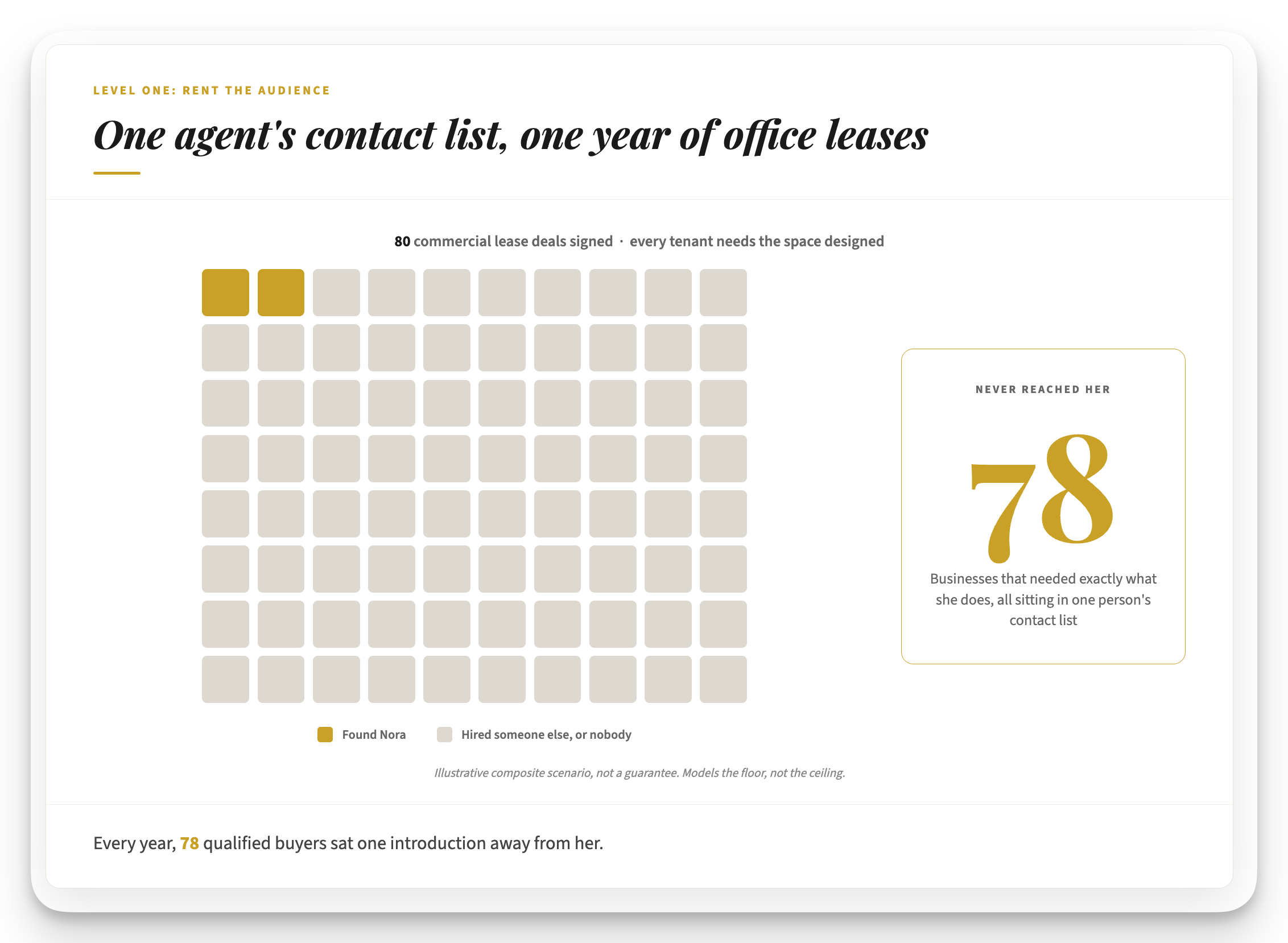
“So there are 78 businesses each year that need exactly what you do, and they’re all in one person’s contact list. What would it take to get that person to introduce you?”
The answer would be simpler than she expects. Nora’s average design project is $30,000. And right now, the real estate agent is making zero dollars from design referrals. He closes leases, shakes hands, and moves on. The tenant’s next problem, designing the space, is someone else’s business.
Here’s the deal we’d structure: for every signed design project that comes through the agent’s introduction, he earns $2,500 for one introduction that brings Nora a project.
The agent is making nothing on that relationship after the lease is signed. Now one introduction is more valuable than taking a client to dinner.
If the agent sends four introductions in the first quarter and three become signed projects, that’s $90,000 in new revenue for Nora and $7,500 in referral fees for the agent.
That’s the first rung. The principle from the first article in this series: the audience you’ve been spending years trying to build already exists. You don’t need to build it.
You need to figure out what would make the person who already built it want to introduce you.
When the math is right from their side of the table, the deal closes itself.
Think about your own business:
Who already has your customers, and what would make introducing you the most profitable thing they do this month?
Level Two: Know What You’re Buying
With new clients arriving from the agent’s introductions, I’d ask Nora another question.
“What is one of your clients actually worth?”
“About $30,000,” she’d say. “That’s my average project.”
“That’s the wrong number. How many of your clients come back?”
If Nora thinks about it, she’d realize that about half come back for a second project within two years: an office expansion, a new location, a refresh. Some come back three or four times over five years as their business grows. And the good ones send a friend or two, eventually.
We’d run the number. The average client, over the full relationship, is worth roughly $75,000 in design fees.
Not $30,000. $75,000!

“You’ve been spending about $500 in networking time and effort to find a $75,000 relationship,” I’d tell her. “And you’ve been treating that $2,500 fee to the real estate agent as expensive.”
“It’s not expensive?”
“It’s 3.3% of what that client will be worth to you over the next five years.”
One caution before you run this on your own numbers. Nora's $75,000 is design fees, and design is mostly her own time. Your business may work differently. If it costs you 60 cents on the dollar to deliver, calculate the percentage against what's left after delivery. The acquisition ceiling is a share of gross profit. The invoice total will overstate it every time.
Something would shift in her face. I’ve seen that shift hundreds of times. It’s the moment when a business owner stops looking at the first sale and starts looking at the value of the full relationship.
That calculation changes everything.
Now she’s willing to offer the real estate agent $5,000 per referral, not $2,500. That would make the deal so irresistible that the agent would start bringing up her name in every single lease signing, not just the ones where the tenant asks about design. More introductions. More projects.
She could afford to bring on a part-time business development person, paid on commission from first-project revenue, because the lifetime math more than covers it. That hire alone could add another $60,000 in new business over the next year.
That’s one of the best things about the ladder. The LTV calculation doesn’t just change how Nora thinks about her clients. It changes how she executes on Level One.
A $5,000 fee turns an agent who mentions her occasionally into an agent who brings her up at every lease signing. Same deal, same partner, same handshake. The only difference is that Nora now knows what a client is actually worth, and she’s willing to pay accordingly.
The first rung gets stronger because the second rung is in place. Keep that in mind. It’s going to keep happening...
Think about your business:
What is your customer actually worth? Not the first sale. The full relationship. If you’ve never run that number, you’ve been making every growth decision against the wrong figure.
Level Three: Activate Your Advocates
If Nora has 40 satisfied clients from the past three years, glowing testimonials, five-star reviews, and at least a dozen “I tell everyone about you” emails sitting in her inbox, you’d expect a strong referral pipeline.
The reality? Sporadic. Three or four a year. No pattern. No predictability.
I’d ask her: “For how many of those 40 clients have you ever made a specific offer, a real incentive, to introduce you to someone who needs what you do?”
“None.”
“Why not?”
“It feels... awkward. Like I’m asking for a favor.”
This is the gap I see in almost every business I work with. The owner has earned deep trust. Customers genuinely want to help. But the owner treats referrals as something that either happens naturally or doesn’t happen at all. There is no system. Just hope.
Hope is not a growth strategy.
We’d build Nora a simple referral machine.
The type that fits her business is Built-In Rewards: for every introduction that becomes a signed project, the referring client receives a $2,000 credit toward a future design refresh, an add-on consultation, or a small project.
The credit costs Nora relatively little because her margin on add-on work is high. But it feels genuinely valuable to the client because it’s more of the same service they already love, delivered at no additional cost to them.
And notice what the structure solves: the awkwardness. Nora wouldn’t be asking for a favor. She’d be presenting a professional exchange. “Introduce me to a business that could use my help, and you’ll get $2,000 toward your next project with us.”
The client gets something they want. Their friend gets a recommendation they can trust. Nora gets a pre-sold lead who’s already interested in working with her.
If six referral projects come in during the first year, that’s $180,000 in new revenue. $12,000 in referral credits issued. And those credits bring past clients back for add-on work they would otherwise postpone.
Notice what’s happening between the rungs:
The referral credits bring past clients back for add-on work. That extends the relationship, which raises their lifetime value (Level Two).
A higher LTV justifies a more aggressive endorsement fee (Level One).
And the six new referral clients? They become candidates for the same referral program that produced them.
You’ve added more rungs to your ladder, making it taller. Now you’re able to climb even higher.
Think about your business:
How many of your happiest customers have you given a clear reason, a clear mechanism, and a clear reward for introducing you to someone who needs what you do?
Level Four: Combine Your Key With Their Lock
Remember the office furniture dealer from Nora’s original list? Back in Level One, she was thinking of him as a potential endorsement partner. Pay him a fee for introductions, just like the real estate agent.
But when I’d look at the relationship, I’d see something bigger.
The dealer has a showroom full of high-end commercial furniture and over 500 business clients. Strong relationships. Repeat buyers. But his customers keep asking the same question: “This is beautiful, but what do I actually buy? How do I make it all work together in my space?”
The dealer has products. He does not have design expertise.
Nora has design expertise. She does not have a showroom full of pre-qualified buyers.
“Your design makes their furniture more valuable,” I’d tell her. “Their client list makes your design more reachable. You’ve each got the piece of what the other one is missing.”
This is the difference between borrowing and combining. An endorsement deal (Level One) gives you access to someone else’s audience. A Lock-and-Key deal creates something neither of you could build alone.
We’d structure a co-branded “Design + Furnish” package: Nora’s design expertise, built into the dealer’s offering as a premium service tier. The dealer’s sales team would present the package to every client: “We don’t just sell furniture. We design the space it goes in.”
Nora would get a steady stream of warm, pre-qualified prospects who are already spending money on their spaces. The dealer would get a premium service that justifies higher-ticket sales and gives clients a reason to come back instead of shopping online.
A conservative projection for that single partnership in its first year: 12 new design projects. $360,000 in design fees.
And the dealer’s average sale per client could rise 40%, because Nora’s designs showcase the furniture in context. Clients who come in planning to furnish one conference room could end up redesigning an entire floor.
Neither side could build what the combination offer creates.
The dealer can’t offer design services. Nora can’t fill a showroom. Together, they have a complete solution that would be hard to replicate.
The 12 partnership clients would enter the referral system (Level Three).
Their lifetime value (Level Two) would justify even more generous endorsement fees to the agent (Level One).
Some of the partnership clients would know other business owners who need design, and the referral machine would catch those introductions and reward them.
Every level below the partnership is already feeding the others, and now Level Four is feeding all of them at once.
Ask yourself: how do you compete against a business where every new client makes every existing strategy more powerful?
Think about your business:
Who in your market has the lock your key opens?
What do you have that would make their offering more valuable, and what do they have that would make yours more valuable?
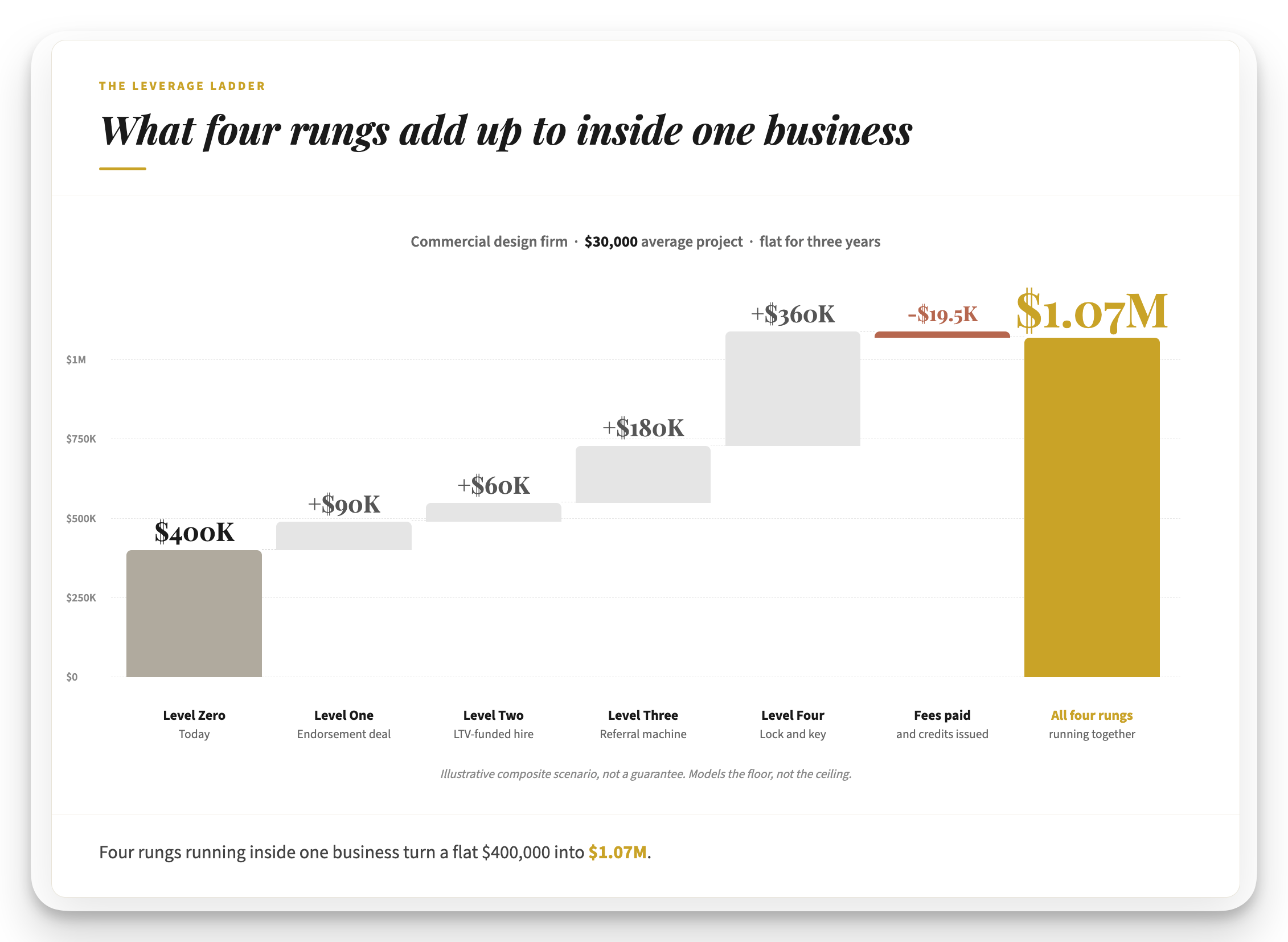
Here’s what Nora’s numbers could look like, level by level:
Ground Level (before the ladder): $400,000. Flat. Three years.
Level One (endorsement deal with real estate agent): +$90,000 in new revenue, minus $7,500 in fees.
Level Two (LTV calculation, raised endorsement fee, hired business development person): Agent’s referrals increase because the higher fee makes introductions a priority instead of an afterthought. Business development hire adds another $60,000.
Level Three (referral machine): +$180,000 from six referral projects, minus $12,000 in credits. Credits bring past clients back for add-on work, extending their relationships and increasing their lifetime value.
Level Four (lock-and-key with furniture dealer): +$360,000 in design fees from the partnership. Dealer’s per-client revenue up 40%.
Add those up and you have a business earning north of $1 million.
Now ask yourself where you’re standing.
You’re building everything from scratch. No endorsement partners. No LTV calculation. No referral system. No combinations. Growth means working harder, posting more, networking more, hoping more. You are the business development department, the marketing team, and the sales force, all in one exhausted person.
You’ve borrowed someone else’s audience or trust. Maybe you have one endorsement deal, one affiliate arrangement, one partner who sends you the occasional introduction. But you haven’t calculated what your customer is actually worth over the full relationship, so you’re probably under-investing in the deals you’ve already struck. You’re renting access, but you’ve likely been paying below market rate for it, because you don’t know how much you’re allowed to spend.
You know your LTV and your Allowable Acquisition Cost. You’ve done the math. But you haven’t activated your happiest customers. You have advocates who would gladly refer you. You just haven’t given them a reason, a mechanism, or a reward for doing it. You have a number. You don’t have a system.
You have a referral machine running. Clients are actively introducing you to new buyers. But you haven’t found the partner whose lock your key opens. You’re growing, and you’re growing faster than you were at Level Two. But you’re still building alone. The combination that would turn your expertise into a premium tier inside someone else’s offering, or their distribution into a channel for yours, is sitting in your market right now. You just haven’t looked for it yet.
You’ve found a Lock-and-Key combination. The partnership is producing results. Now the question is whether the levels below it are feeding it. A partnership without a referral engine, without LTV-informed spending, without endorsement deals running underneath it, is operating at a fraction of its potential. The business running on all four levels will always outpace the business running on one.
Most business owners I sit with are at Ground Level or Level One. They have the assets for all four levels inside the business they’ve already built. The clients are there. The relationships are there. The partners are there.
The only thing missing is the climb.
Now that you know what level you’re on, you could map this out yourself. Audit your client list. Run the LTV numbers. Identify endorsement partners. Design a referral incentive. Research potential Lock-and-Key combinations. Three days of focused work, minimum.
But you know exactly how this goes. The audit gets interrupted by a client email. The numbers get pushed to the weekend. The partner list never makes it off the napkin. And another month passes where your business runs on the same level it’s been running on for years, not because you don’t know the strategies, but because you never diagnosed where you are or saw how the levels connect.
You have four powerful strategies and no map.
The Leverage Ladder Diagnostic does in 15 minutes what most business owners spend months guessing at: it identifies your current level, calculates a specific dollar gap between where you are and one level up, and hands you the first move. The person to contact. The offer to make. The words to use. The seven-day plan to get it done.
You’ve seen what the ladder looks like in one business. This prompt maps it to yours.
Your Current Level — Instead of wondering where you stand and which strategy to try first, you’ll know which level your business is actually operating at and why everything above it has been invisible. The diagnosis is based on your real numbers, not a personality quiz.
Your Level Gap — The specific dollar amount sitting between where you are and the next rung, calculated from your own revenue, margins, and customer base. Most business owners have never seen this number. Once you do, every growth decision gets simpler.
Your First Move Up — One play matched to your level: the endorsement partner to approach, the LTV number to calculate, the referral machine to build, or the lock-and-key partner to call. You’ll finish the diagnostic knowing who to contact and what to say, not wondering where to start.
Your 7-Day Ladder Plan — The bridge between learning and doing. One action per day for seven days, specific enough that you can start Monday morning. By Friday, you won’t be thinking about the four strategies anymore. You’ll be running one.
Step 1: Open Your AI Tool
You need an AI that can think through your business strategy. Three options:
Claude.ai: Use Claude Sonnet 4.5 or higher
ChatGPT: Use ChatGPT 5 and toggle “Thinking” mode ON (upper left corner)
Jay-I: Your 24/7 strategic thinking partner modeled on 50+ years of proven methodologies
Step 2: Copy And Paste The Prompt
Before you paste it, have rough numbers from your last twelve months within reach. Not perfect. Honest. Your average price, roughly what's left after you deliver the work, and how many clients you've served.
Scroll down to the prompt box below
Click anywhere inside it, press Ctrl+A (Windows) or Cmd+A (Mac) to select all
Press Ctrl+C (Windows) or Cmd+C (Mac) to copy
Paste into your AI and hit Enter
Step 3: Have the Conversation
The AI will walk you through three phases. Answer naturally, like talking to a strategist who’s done this 10,000 times.
While the universal prompt works in any AI tool, Jay-I is specifically trained on my 50+ years of consulting across 465+ industries.
The Leverage Ladder Diagnostic is where Jay-I really separates itself from generic AI. A standard AI can suggest any of the four strategies in isolation. It can tell you to “find a partner” or “calculate your LTV.” What it can’t do is see where you are on the ladder, identify which rung you’re skipping, or map how the levels connect in your specific business.
Jay-I can. It knows that calculating LTV first can make the endorsement deal twice as aggressive. It knows that a referral system built before a partnership can make the partnership three times more productive (maybe more). It thinks in connected levels, not isolated tactics, because that’s how I’ve been doing this for fifty years.
The prompt shows you the ladder. Jay-I helps you climb it.
As a paid subscriber, you get 25 free credits monthly, enough to run multiple strategic diagnostics.
Here is what I know after fifty years of doing this.
The business owners who grow fastest aren’t the ones who learn the most strategies. They’re the ones who figure out where they are, pick one level, and move. Not all four at once. One.
You’ve read the strategies. You’ve seen the ladder. You know more about how these levels connect than most business owners will ever learn.
Now find out where you’re standing.
Fifteen minutes with the diagnostic. Your business. Your numbers. Your next move up.
Jay Abraham
Comments
Nothing yet. Say the first thing.
Sign in to join the conversation.