
This article highlights some of my mental frameworks when looking at investment opportunities in an AI-dominated world, using Duolingo as an example.
Competitive advantages are evolving. Companies capable of collecting unique, high-quality data can compound value through increasingly personalized and effective AI systems.
At the same time, exponential improvements in component technologies drive the cost of delivering intelligence toward zero.
When I wrote about Duolingo a couple of weeks ago I argued that the current LTV of their subscriber base (paid users) is worth approximately $6bn–$7bn, which is close to today’s EV.
I also made a conservative estimation of their LTV/CAC ratio to understand how strong their unit economics are. You must make some assumptions, but it’s easy to get to a number above 4x, meaning that the value of a new customer is at least 4 times the cost of acquiring it.
Those numbers represent a safe net for investors but say nothing about the future. Given only 9% of users are paid subscribers and that user growth continues at strong rates, it’s fair to assume that most of the company’s value will come from increased paid conversion and continuous user growth.
If I’ve learned something about Luis von Ahn, it’s that he will not be focusing on increasing conversion any time soon. You could see what Wall Street thinks about that strategic decision when looking at the 6M price chart.
Continuous user growth it is.
I believe that is the correct path for two reasons.
1) Network effects
Proprietary data will be the most valuable asset in an AI-dominated world. More data means more value for users because it allows for the creation of a better product. Duolingo has years of iterations that allow them to optimize engagement and quality by understanding what their users want and how they learn.
The main critique to the product is that it’s so gamified that it impedes learning. This is a common case of reverse causation, where an outcome is incorrectly treated as the cause. The product is set as it is after thousands of iterations through A/B tests to see what works and what doesn’t. I believe the gamification of the product is, for the most part, the result of short attention spans and users being accustomed to high dopamine hits from social media apps.
The app is a reflection of the user’s activity and preferences over the years. The result of proprietary data and AI working their magic.
Network effects describe how a product or service becomes more valuable to users as more people use it, creating a positive feedback loop. In the 80s, Metcalfe introduced the idea that the value of a network is proportional to the square of the number of connected users, which was first applied to telecom networks and then to the first platforms on the internet.
AI introduces a new kind of network effect where Metcalfe’s Law still stands. The proprietary data created from the existing customers allows AI to improve the experience of the product, which in turn attracts new users. The additional data allows for the creation of an even better and more engaging product, creative that same positive feedback loop.
1) Curve convergence1
Duolingo is set to target the private tutor market, a TAM of approximately $125bn. I believe they can do so at a high pace of adoption because of the idea of curve convergence.
Curve convergence states that when multiple component technologies improve on exponential curves while industry architecture remains frozen around outdated assumptions, it creates the opportunity for disruption with a better product.
Teaching technology works around two pivotal points:
The teaching figure
The teaching methodology and content
Over the last thousand years, teaching progressed from Scholastic text and logic instruction to Humanist learning focused on languages and the whole person, then to Comenius’s structured universal education, followed by the Enlightenment’s standardized school systems. The Industrial era scaled this into mass schooling, which later sparked Progressive, child-centered learning. Mid-century Behaviorism introduced reinforcement-based instruction, then the Cognitive Revolution shifted focus to how the mind processes information. Finally, Constructivism emphasized active meaning-making, leading to modern digital and data-driven adaptive learning.
It’s easy to see the common denominator of all these improvements. Everything orbits around the idea of changing the form and the content, but not the figure delivering it. To this point we’ve been able to improve what we teach and how we teach it, and we depend on the teaching figure to learn and apply new improvements. This progress is limited by human cognition—not by that of the student, but by the teacher!
AI being able to generate a conversational tutor personalized to each student is a change of paradigm. It tries to solve the never-ending problem of teaching quality by looking at the teacher instead of what is being taught.
I don’t believe that human connection will ever be substituted. Most of the value of education institutions relies on socialization, interchange of ideas, and teaching students the ability to learn in itself. Once that is done, I think most people will choose an AI tutor because of a) proven efficiency and b) dramatically lower cost.
This is where the curve convergence idea comes into play. Both the teaching methodology/content and the teaching figure will improve exponentially, supported by AI, while old technologies will remain stagnant or instantly introduced into the system.
Following Moore’s Law, obsolescence will be evident when the components keep improving (LLM capabilities double in capacity every 6 months) while the original architecture stays frozen.
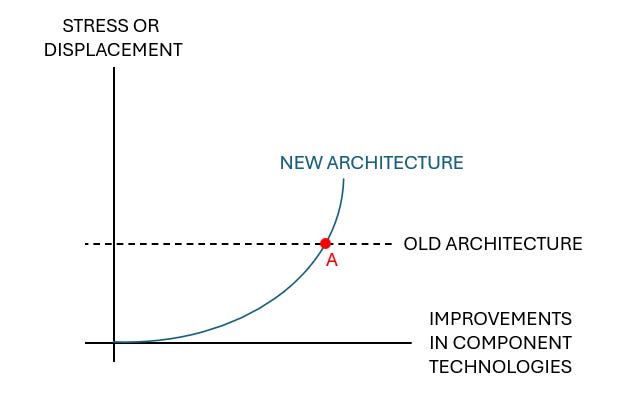
“A” is the point of maximum tension—the point where component technologies vastly outperform existing architecture, leading to rapid displacement of the old and rapid adoption of the new.
The opportunity lies in rebuilding the system in its entirety, with fundamentally superior economics and performance from day one. Disruption at a high pace.
While the market seems fixed in playing the AI wave through AI enablers, I believe it’s much safer to bet on AI users, especially one like Duolingo, which already has a winning position in this race.
The content of this webpage is not investment advice. It is for general purposes only and does not take into account your individual needs, investment objectives, and specific financial circumstances. Investment involves risk.
No posts
Comments
Nothing yet. Say the first thing.
Sign in to join the conversation.