
It will be months if not years before I land a ticket to the Museum at the Obama Presidential Center (OPC). All the summer Garden Events—which are free—are booked, too. Demand for merchandise is off the charts, with shipping delays because staff can’t pack up orders fast enough.
I could not be more delighted to wait my turn. When it eventually comes, I will be thrilled.
I am thrilled already.
Indeed, I am still buzzing from the Saturday of the Juneteenth opening weekend I spent wandering the Center’s 19.3 acre campus nestled inside Chicago’s glorious Jackson Park.
When the harshness, cruelty, greed and sheer wrongness of where we are threaten to flatten the colors of my soul into a grim muddy gray and it becomes all but impossible to see beyond headlines, I now have a touchstone to bring me back from the brink.
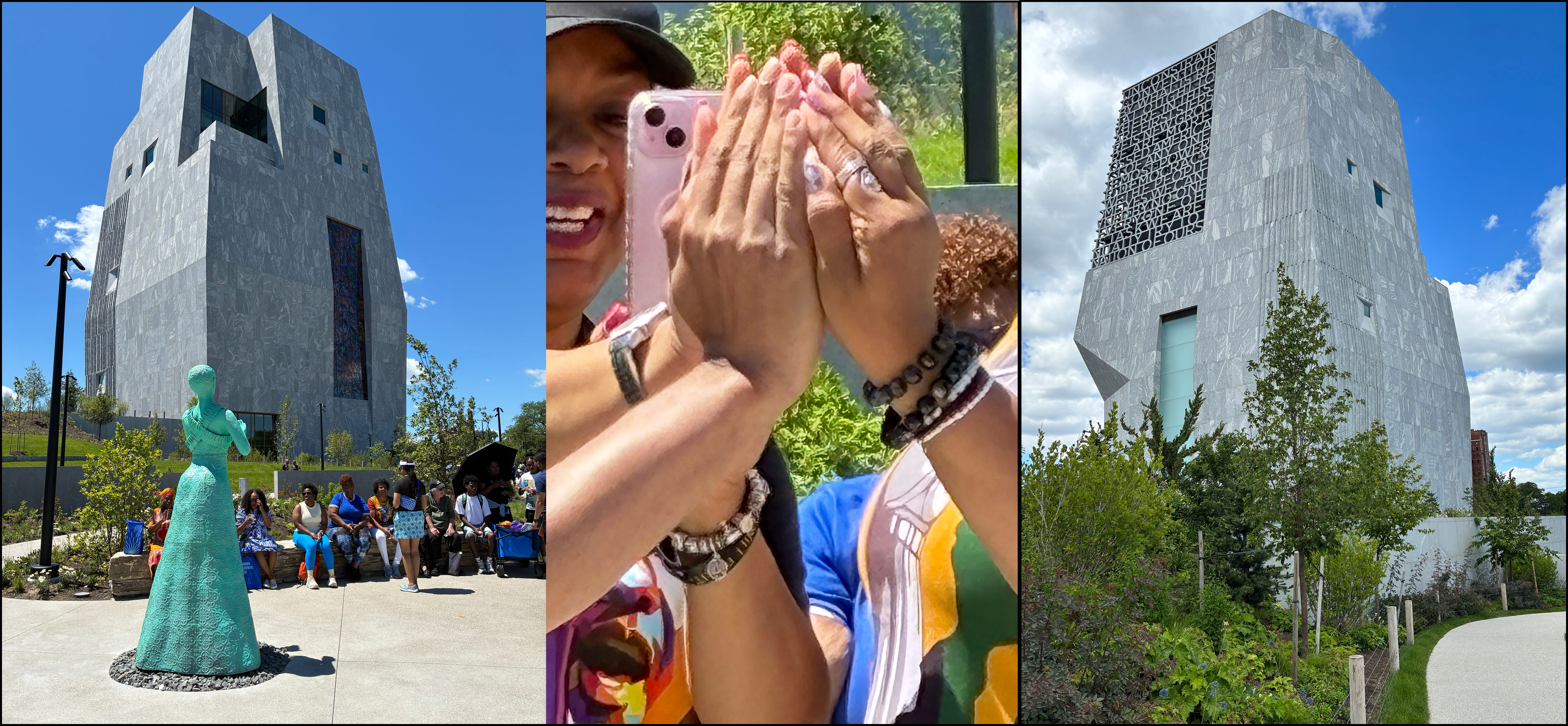
The shape of the eight-story “Obamalisk,” as the Museum is affectionately called, is based on four hands folded together—a concept I didn’t get it until Jeremiah, an inspired tour guide, demonstrated with the help of three very happy volunteers. It is lovely symbolism.
But for me the Obamalisk functions more as a lens that brings everything back into an energizing, empowering focus.
Make America Decent. Again.
“No one is above the law or beneath its protection” said President Obama in his speech dedicating the Center.
There are days when that just doesn’t seem true anymore, which is heartbreaking. Also, terrifying. But it is hardly the end of the story.
Walking around the Obama Center grounds I felt lighter than I had in quite some time. Near an ice cream stand, I met a woman from the neighborhood who had been of one of Obama’s campaign workers on his very first campaign thirty years ago for the Illnois State Senate and for every campaign that followed. She told me about her church, her faith and her determination. I told her about seeing the Obamas at a very crowded bookstore in a suburban shopping mall a few days after he announced the run for the Presidency.
I met people standing in a long line for a tour of the newest branch of the Chicago Public Library, which is part of the OPC campus. I met so many people who had traveled from all over the country to be part of this very special Juneteenth weekend. I sat on park benches and struck up conversations. I took countless photos of couples and families so they could be in group shots together with the Obamalisk in the background. I mingled in crowds delighted by a series of fabulous performances on the John Lewis Plaza.
For a few hours I was surrounded by people who shared the vision of America I grew up with, the one that included a gilt-free Oval Office.
Diversity is good. Science is important. Liberty and justice for all.
YES WE CAN.
Yes we did. From the first Juneteenth in 1865 when Union troops freed enslaved African Americans in Texas, more than two years after the Emancipation Proclamation, to the joyous celebration at OPC in 2026—that’s eight generations.
On June 19, 1865, Union troops freed enslaved African Americans in Galveston Bay and across Texas some two and a half years after President Abraham Lincoln signed the Emancipation Proclamation.
Yes we will. The enduring American challenge is to create a “more perfect Union,” one that leaves future generations a nation and a world in better shape than the one we inherited.
It has been only three generations since 600 Black people walked across the Edmund Pettis Bridge in Selma, Alabama in a march for voting rights. They were met by police armed with billy clubs who brutally beat and teargassed everyone they could. The carnage made the evening news and outraged the country. More marches followed until the Voting Rights Act of 1965 was passed, outlawing poll taxes, literacy tests and other discriminatory practices designed to disenfranchise Black Americans across the South. It is a law the current administration is intent on dismantling.
Etched into the top southwest corner of the Museum building is the text of a speech Obama gave at the 50th anniversary of the march.
You are America. Unconstrained by habit and convention. Unencumbered by what is, ready to seize what ought to be. For everywhere in this country, there are first steps to be taken, there is new ground to cover, there are more bridges to be crossed. America is not the project of any one person. The single most powerful word in our democracy is the word ‘We.’ ‘We The People.’ ‘We Shall Overcome.’ ‘Yes We Can.’ That word is owned by no one. It belongs to everyone. Oh, what a glorious task we are given to continually try to improve this great nation of ours.
It is at once a rallying cry and mission statement.
Everyone on that glorious Juneteenth day at the Obama Presidential Center was fully on board. “There are more bridges to be crossed.” There will always be more bridges to be crossed.
So we will keep crossing them.
Four hands together.
Yes.
In early 2025, shortly before the inauguration, my friend, designer Brian Collins, called to share the news that he was being awarded an honorary doctorate from The Massachusetts College of Art and Design, his alma mater. To use a Brian-ism, he was “beyond humbled.”
Then he learned he was to give the commencement address and that was beyond daunting. Would I help?
We had co-written several essays about branding and design, so I thought I could at least be a good sounding board.
It was also clear that the Class of ’25 was going to graduate into a world turned upside down. The usual platitudes typical of such occasions weren’t going to cut it. This was an opportunity to say something that might, in some small way, matter.
Over the next few months, Brian and I had several conversations about the role(s) of artists and designers. We walked around the MassArt campus in Boston together talking to teachers and students. He told me stories about being the kid who was good at art and fascinated by the future. He talked about his years as an art student and his professional arc that began with a frantic call to a trusted professor for advice on how to write an invoice and eventually led to co-founding an award-winning consultancy with a roster of clients that range from Al Gore and Spotify to Olly Pop and Blackstone.
It has been a year since Brian gave the speech (reprinted below) and it has only grown in relevance—not just for newly-minted graduates, but for anyone trying to chart a path forward at a time when every tipping point seems to be tipping: Political. Social. Technological. Physical. Climate change is real. Resources are limited. The population is growing.
•••••••••••
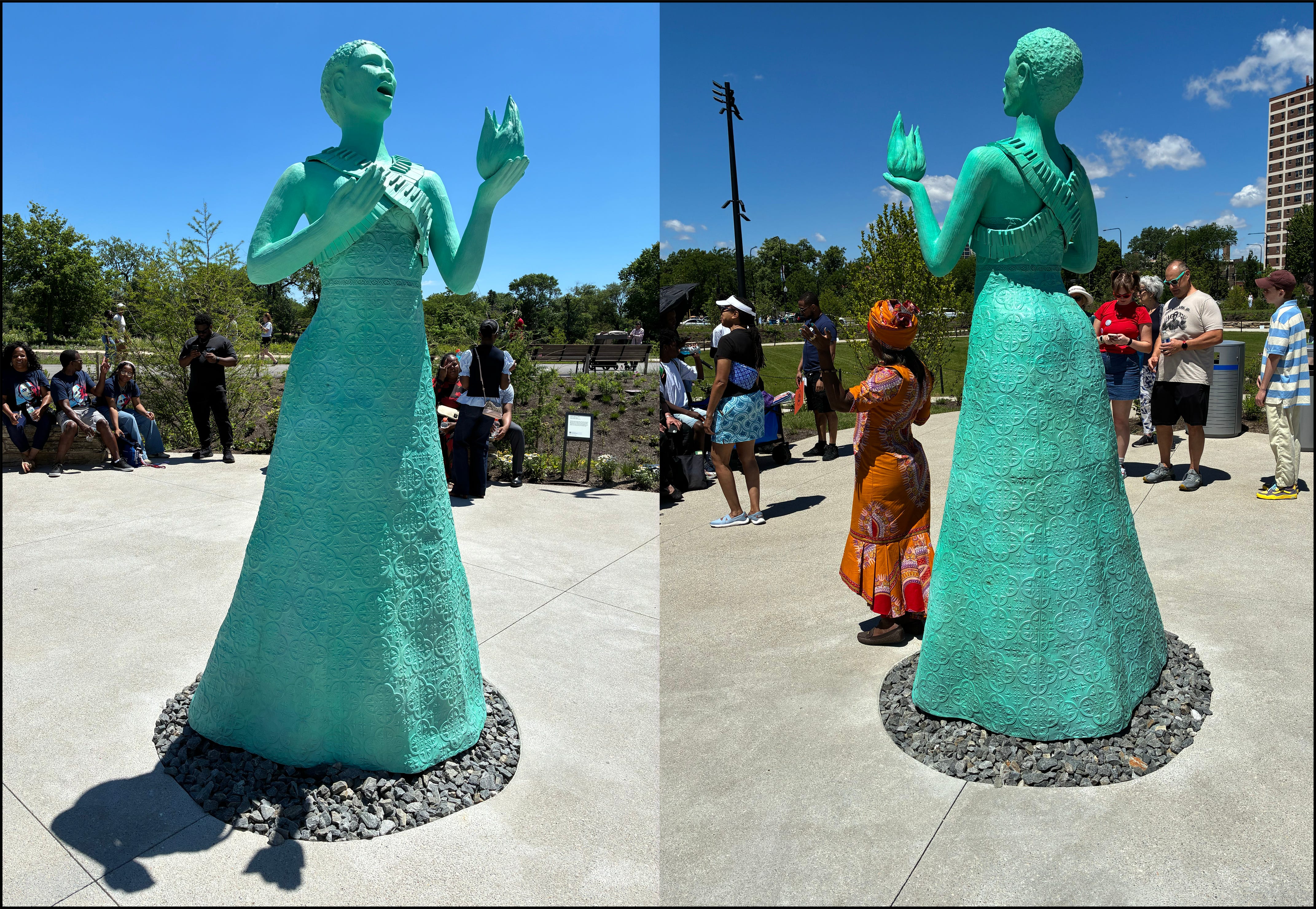
Spread across the OPC campus are 28 commissioned works of art. There is Richard Hunt’s delightful “Book Bird” sculpture in the courtyard of the Public Library. Alison Saar’s “Torch Song,” a bronze with a nod to the Statue of Liberty honoring powerful Black female voices, in the Women’s Garden. And Julie Mehretu’s monumental 83’ tall stained glass installation inspired by Obama’s Selma speech, in the Museum. This isn’t about decoration and aesthetics, although the art is beautiful. Rather, notes Obama, it is to “provoke thought, challenge our assumptions, and shape how we define our narrative as a country.”
We celebrate and reward innovation and invention. But it is another “i”—imagination—that is the foundation of everything. (“To dream the impossible dream,” as Jennifer Hudson sang at the OPC opening).
Artists and designers are needed most when the world feels precarious, as it does today. This is the core of Brian’s message.
Design is not what we make.
Design is what we make possible.
That has been the motto, the mission, the mantra, the second star to right and straight on ’til morning credo of COLLINS, the company I founded fifteen years ago with Leland Maschmeyer.
Those two sentences have carried us through bad economies, demanding clients, giant projects and the kind of mad deadlines that cause adults to eat Frosted Flakes (okay, Frosties) for dinner.
But what are we making possible? What are we as artists, designers and craftsman, writers and makers—what are we really making possible?
Because we can make anything possible.
And we can do that because we can imagine anything possible.
Imagination. A power so embedded in us, we often forget it is extraordinary.
When we were children, it was just how we moved through the world. We staged elaborate theatrical productions featuring plastic figurines crossing galaxies for reasons that made complete sense to us. We designed clothing no one asked for, but everyone, of course, would want.
Then someone—a parent, an aunt, a neighbor or a teacher—took a closer look at your cardboard city, or was enthralled by your rocket-ship, or admired your last outfit and announced as indisputable fact, “You have quite an imagination!”
And that felt amazing.
“You have quite an imagination.”
The shock came later, learning that what we took for granted, as natural as breathing, was unusual. Not everyone gets to hear that sentence.
Some people, maybe most people, can see only what’s directly in front of them.
The trouble is if that’s all you can see, you will trip. And fall.
Not maybe. Guaranteed.
Why? Because 90% of our visual field is peripheral. We are wired to take in vast amounts of information without really knowing we have done so. We literally know more than we think we do. In life and in metaphor, peripheral vision is how we stay upright and move forward.
Yet we are told and told and told that success requires us to keep our “eyes on the prize!” It is all about focus. Laser focus. Relentless focus.
But what if the prize is not in front of you?
The prize, I would like to point out, is almost never directly in front of you. It is off to the side. In the blur. Lurking slightly outside the frame. Missed by everybody too busy staring straight ahead and bumping into things.
That kind of seeing? That edge-of-frame, fuzzy, one-step-beyond-where-we-are-right-now way of perceiving? That’s your realm. Artists and designers have exceptional peripheral vision—and plenty of imagination to fill in the blanks. For all the tech-bro talk extolling the brilliance of “innovation!” and “invention!” nothing happens without that other “i”: imagination in all its weird, odd, finicky, convention-bending, marvelous glory.
Real visionaries don’t stare at the horizon waiting for the future to arrive on schedule. They glance sideways and catch a preview. Then they figure out how to make it real.
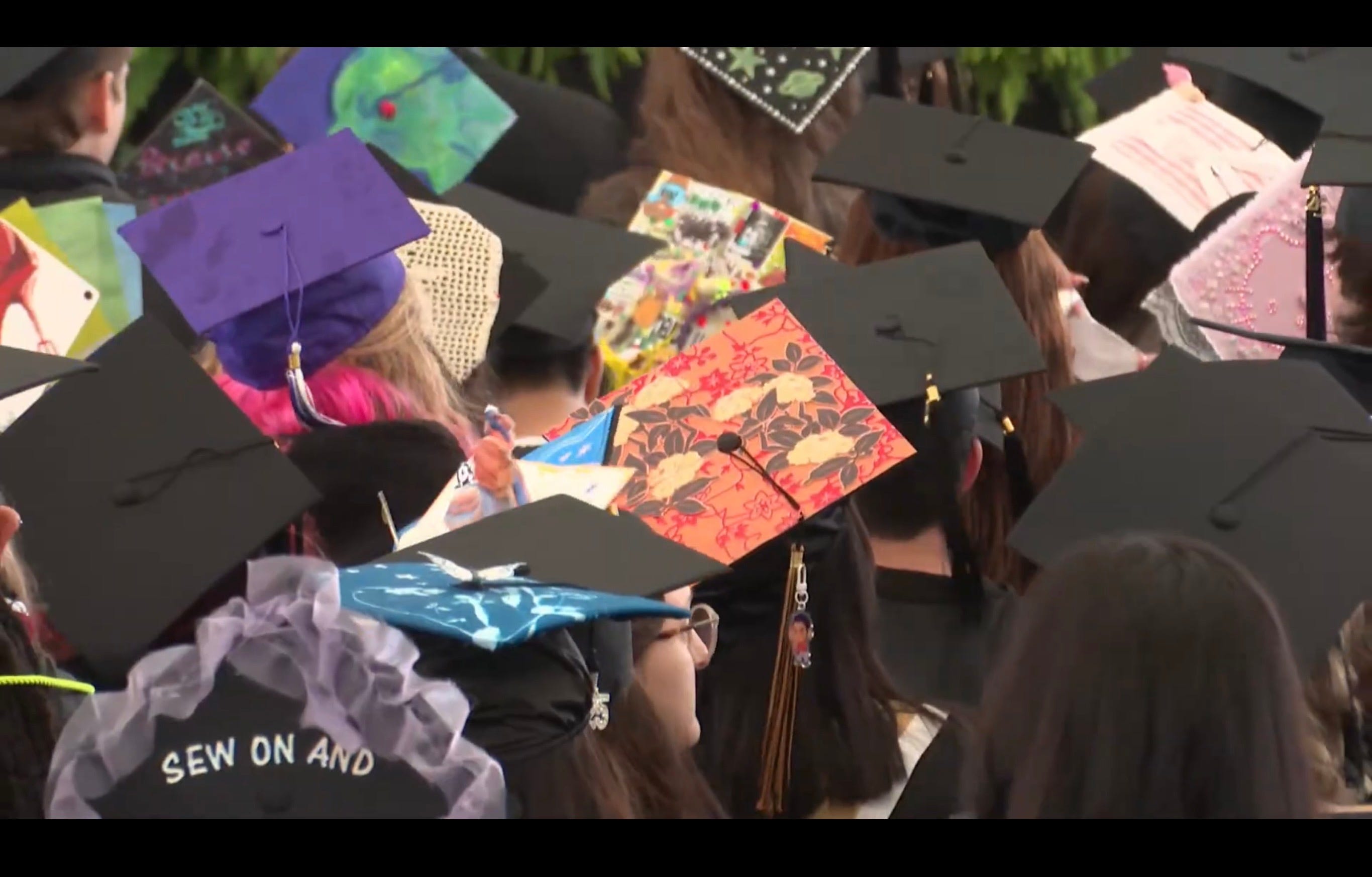
If you were lucky, you grew up in a house with lots of crayons and paint and paper and clay and smocks and glitter and cheerful disorder. A place where glue sticks and scissors were embraced and creative mess had a honored place.
If you weren’t so lucky, you scavenged for whatever you needed to make things, to experiment. You found others who understood the importance of making marks on paper, shapes out of clay and the mad, unbridled joy of color. Orange, my favorite color, is essential.
That’s the story, one way or the other, of everyone who found their way to MassArt.
Which brings me back to my central question: What are we making possible? Even more to the point, What could we be making possible?
My mentor, the woman who gave me a career, Professor Elizabeth Resnick, offered an answer that has stayed with me over the years:
“Designers have both the opportunity and the responsibility to model and promote the behavior we want to see in the world.”
Okay. Noble. But how do you do that? Seriously? How do you hold fast to that responsibility in a world where so much seems to be flying apart at the seams? How do you keep going?
••••••••••••••••••••••
I graduated MassArt in 1982 in the middle of a nasty recession. There were no jobs, no soft landings. Only “stagflation,” a toxic legacy of the 1970s oil shocks.
A couple of years later, Apple introduced the Macintosh, which detonated the entire field of design. Whether doors were opening or closing wasn’t immediately clear.
It was also a time of devastating loss: the AIDS crisis. All around me friends—people exactly like you just starting their lives—were dying. Everywhere illness and death. I think about them all the time. I miss my friend Marc Sawyer, a MassArt graduate, a genuinely gifted designer, a good man. I miss what he would have made. I miss what all of them would have made.
What would our world be like today had they lived?
••••••••••••••••••••••
Mark Twain supposedly said, “History doesn’t repeat itself, but sometimes it rhymes.”
It is 43 years later and you are graduating into yet another economic storm, facing yet another technological upheaval (AI) and are a generation scarred by yet another plague (COVID).
If there is anything I have learned that might be useful to you from my similar-but-different experience it is this: Stand your ground. Yes, disappointments will be numerous. Yes, challenges will be beyond discouraging. Do not let them flatten you.
With all that has been recklessly squandered in such a short time, the road ahead is going to take every last bit of grit you’ve got. But artists and designers are good at living outside the mainstream. That’s our gift. A force multiplier that makes us tougher and stranger and more resourceful.
This is the moment when people with exceptional peripheral vision and rule-bending imagination—that’s you—are indispensable. Who else is going to figure out how to build something good from what’s left in the rubble?
Your imagination is not some charming personal quirk. It is your credential. It will get you into rooms that at least on paper may seem a stretch.
Enter anyway.
The people inside who didn’t know how much they needed you will be very glad you did.
••••••••••••••••••••••
In 1870, five years after the end of the Civil War, amid brutal cultural and racial divides and a national economy in shambles, the State of Massachusetts did something astonishing: They passed the Massachusetts State Drawing Act. Every town with at least 10,000 people was now required by law to teach art in public schools.
Why?
For one, it was a savvy business move. The Commonwealth’s future as an industrial hub depended on workforce able to draft and read mechanical plans. A background in art was considered as essential as literacy and numeracy. Yet even for those bound for other professions, the discipline of drawing gave them a new way literally to sketch out ideas. A new way to think.
Three years later, in 1873, The Massachusetts College of Art & Design was founded. Not to produce gallery stars. But to produce art teachers for the schools and artists to work with engineers at MIT, biologists at the Marine Biological Laboratory, and scientists at Harvard. They worked with shipbuilders, in metal foundries and at glassmaking studios. They painted. Sculpted. Drew. Designed. Wrote. Taught.
••••••••••••••••••••••
You are who they made possible.
It is a long legacy of “they” that includes generations of MassArt teachers, administrators, staff and alumni. Also, visionary citizens who understood the importance of art and artists in society. And legislators who ensured that the practice of art would play a foundational role in our very special Commonwealth.
Today is a celebration of all you have just accomplished.
But tomorrow?
Tomorrow is when you begin your legacies. Not only what you will make possible in your lifetimes, but also far into the unknowable future for people you will never meet.
More than ever, the world needs artists and designers who can see the first glimmers of the future from the furthest, blurriest edges, then bring the most promising possibilities into focus and make them real.
“You have quite an imagination!”
And am I ever grateful you do.
—Brian Collins and J.A. Ginsburg
Comments
Nothing yet. Say the first thing.
Sign in to join the conversation.