
I love research. For the last many months I have been digging deep into materials stories for a book I am writing about how everything we make can be made better. (The very good news: It’s true!) I have followed the meanders of supply chains and learned that supply chains have supply chains that, in turn, have supply chains. Also, that it takes a world to make just about anything. And that everything you can imagine comes from source materials that were either mined, drilled or grown. Those are the only options.
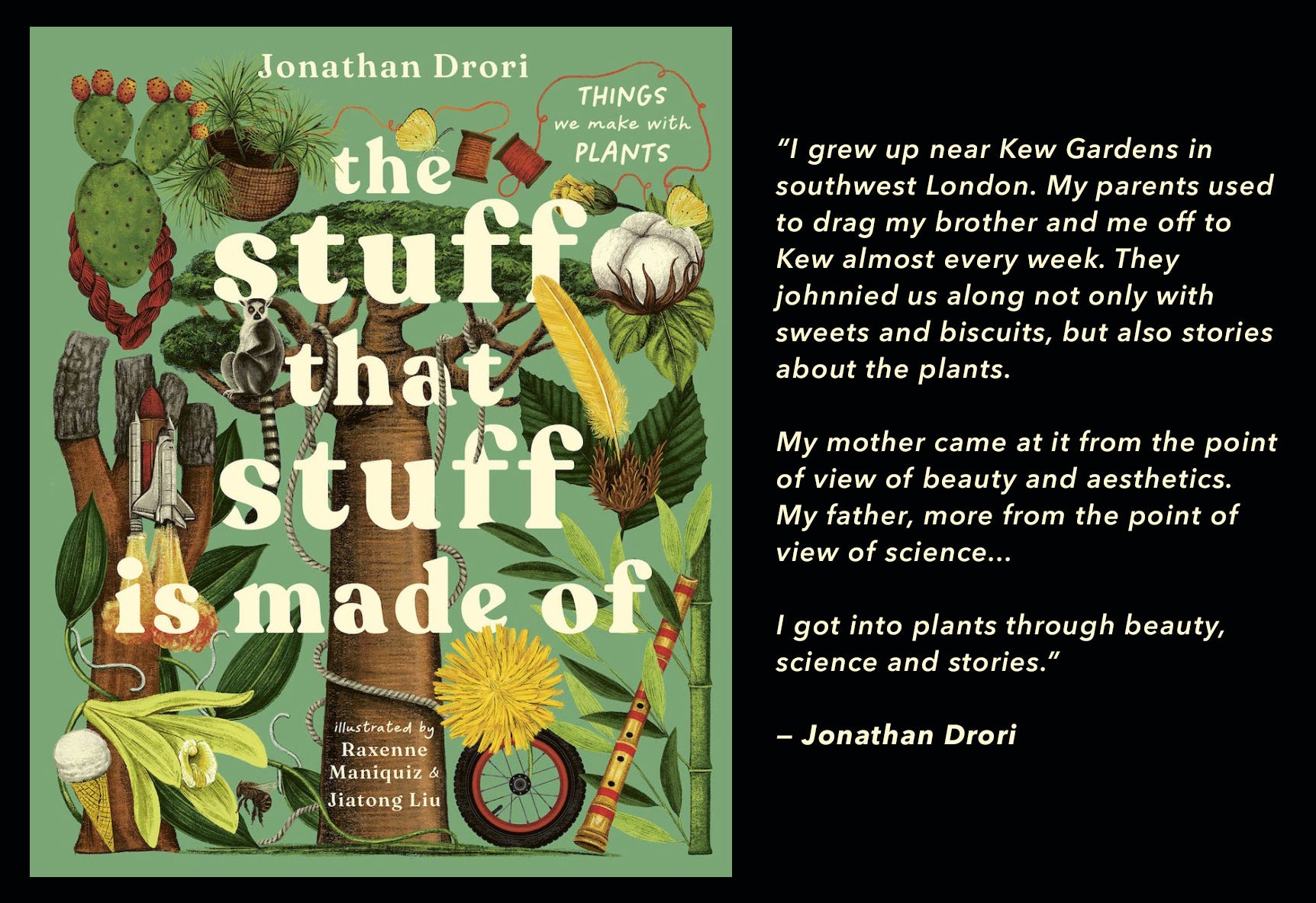
What fun to read—as part of my job— botanist / storyteller Jonathan Drori’s latest book, The Stuff that Stuff is Made Of. Indeed, I read it twice, taking notes. So let’s cut to the chase: Everyone should buy a copy right now. Ask your public library to buy five copies. Tell your friends. Tell every teacher you know. But especially tell those who have never thought twice about the extraordinary bounty this lottery-winning blue dot of a planet called Earth provides.
Drori focuses on the materials that are grown. Unlike his two previous books—Around the World in 80 Trees and Around the World in 80 Plants—Stuff is an oversize picture book filled with gorgeous illustrations spread across extravagantly large double-page spreads. It looks like a children’s book and it will be found in the children’s section. Don’t be fooled. Children will the love this book, but to appreciate the many layers of thoughtful visual detail and absorb all the information Drori deftly packs into caption-length paragraphs takes a beat. So it’s for us older kids, too.
Stuff is full of “I didn’t know that!” wonders. Potatoes, it turns out, are actually underground stems, not roots, which completely topsy-turvied my sense of plant anatomy.
Of the 30 plants featured in the book, five are grasses: bamboo, corn, wheat, rice and sugarcane. So a bamboo table laden with tortillas, porridge and rice cakes served in bamboo bowls with bamboo cutlery and sweetened with a bit of sugar would be an all-grass feast. Who knew grazing could be this tasty?
Three plants produce latex, a sticky, oozy blend of rubber and water that discourages nibbling and quickly heals any wounds inflicted by those who dare nibble. The most well-known, of course, is the aptly named rubber tree, which is native to Brazil, but today grown mostly in Asia. Its story touches on two recurring themes: the role of trade in expanding the range of plants and how humans have adapted plant products for needs never imagined by evolution. Plants don’t need tires. People need billions of them.
Dandelion roots also ooze latex, although compared to a rubber tree not a lot. Still, you can grow a lot of dandelions in the seven years it takes a rubber tree to mature, which is why when supplies of Asian rubber were cut off during WWII, the Allies experimented with dandelion rubber. They got pretty far with it, too, but when the war ended, interest waned. Over the last 15 years, with demand for rubber surging (tires! latex gloves! gaskets!) and rubber trees in the cross-hairs of climate change (heatwaves, unpredictable rains, disease), at least two tire companies—Continental and Goodyear—have continued to tinker with the idea.
The least well-known of the three is a tropical rainforest tree called gutta-percha. Its version of latex can be reheated and molded into whatever shape desired, which made it a perfect choice to insulate the first trans-Atlantic undersea cables. The telegraph message telling the world The Titanic sunk traveled through wires encased in gutta-percha. Today, it is used in root canal surgery to seal the area around a tooth that has been drilled out. With an estimated 15 million root canal surgeries in the US each year, that’s a lot of gutta-percha.
Moving on, vanilla has a backstory that is anything but plain. Spanish conquistadores in the 1500s “discovered” it in its native Mexico and took it home to Europe. Vanilla proved such a culinary hit that French colonists took some beans with them halfway around the world to the islands of Réunion and Mauritius, roughly 550 miles west of Madagascar. The plants flourished in the tropical climate, but none of the native insects had evolved to pollinate the oddball import. In 1841, an enslaved boy, Edmond Albius, figured out how to hand-pollinate the flowers. To this day, this is how commercial vanilla plants are pollinated.
Drori’s storytelling genius is how he is able to weave together the strands of a story in a way that leaves space to think beyond stated facts. The history of vanilla, like cotton and tobacco, includes a legacy of human trafficking.
the genius of those who came before
It is astonishing to think that 12,000 years ago, people living in Iran and Iraq began the process of breeding wheat. A thousand years later, people living in China began to domesticate rice. A thousand years after that it was potatoes in the Andes. And 5,000 years ago, it was corn in central America.
I don’t think I would have been clever enough to look at plant and see its potential as a reliable, cultivatable food source. I am still not that clever. Nor would it likely have occurred to me to use henna, a shrub native to North Africa, the Middle East and parts of South Asia, as a hair dye. Or to grind cochineal beetles found feasting on prickly pear cacti in Mexico into a powder to dye clothes red.
It is barely possible I might have been able to figure out how to make a chocolate bar, although that took a bit of doing. For thousands of years chocolate had always been a drink. The leap from drink to candy bar required kismet and the industrial revolution. In 1761, a chocolate-loving apothecary—a druggist—bought a chocolate company, which is less odd than it sounds. Chocolate, the drink, was often used to mask the bitter taste of medicines. In1795, his son used a new-fangled steam engine to develop a better way to grind beans. It would take another half century to get all the way to the first mass produced chocolate bar in 1847. It was an instant hit and now we live in a world where billions of chocolate bars roll off production lines each year, no doubt also boosting sales of that dental go to, gutta-percha.
seeing deeper
The Stuff that Stuff is Made Of is a joy to read. It is a joy to know all these things. But the biggest takeaway for me has been a deepened sense of wonder and humility. Wonder at all that nature provides. Humility for the many stories of genius and also those of suffering.
There is a tendency to think ours is the most advanced civilization in history; that we are somehow smarter, or more intelligent, than those who came before. With AI, we have doppelgangers flirting with “superintelligence” that can think more quickly than humans. But smarter should not be confused with wiser and thinking more quickly isn’t the same as thinking different.
The people who spotted the potential to turn grasses into wheat, rice and corn had an intelligence for observation most of us have lost. The people who figured out how to turn reeds into paper unleashed a disruptive innovation that changed everything from communications to accounting.
The Stuff that Stuff is Made Of, cleverly disguised as a children’s book, gives us a chance to take a moment to see plants—and the stuff they make—in all their many, nuanced overlapping contexts: Science. History. Technology. Trade. Food. Textiles. Architecture. Art. Ecology.
I will never see the world in quite the same way again and hope that after reading this book, neither will you.
Bonus! A 5x15 podcast video with Jonathan Drori, along with gardener and author Sarah Raven, and Tim Smit, co-founder of Eden Project.
Comments
Nothing yet. Say the first thing.
Sign in to join the conversation.