
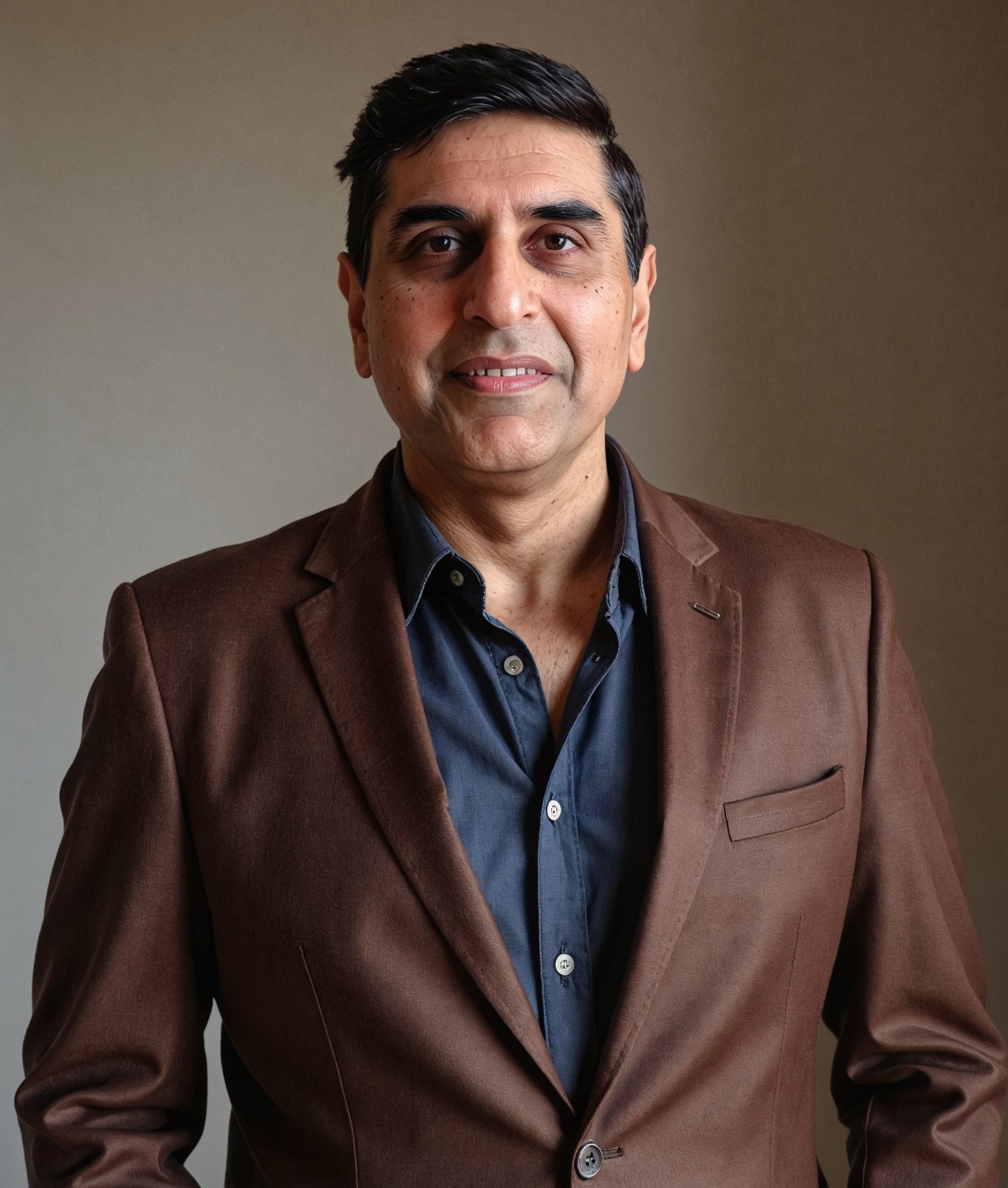
Mamood Ahmad is a tutor, speaker, and author of A New Introduction to Counselling and Psychotherapy. He founded the #TADF community, which works proactively with training organisations to support the transition toward a decolonised and contextually embedded counselling and psychotherapy curriculum.
With nearly two decades of experience in private practice, Mamood brings extensive expertise in wholeness by design, trauma-informed practice, multicultural competence, and social change. His current focus is on driving meaningful change in professional standards within the helping professions, advocating for more inclusive and responsive training frameworks.
Mamood hopes to attract neurodivergent advocates to join #TADF to advocate for curriculum change that embeds neurodiversity as standard throughout helping professions, instead of viewing it as an add-on.
For many years, I have lived and worked within psychological helping education systems that, often unintentionally, decentre those who are most vulnerable, marginalised, and positioned outside dominant social norms and structures.
Through both lived experience and professional observation, I have witnessed the pain this creates, not only for students navigating training programmes, but ultimately for the clients they go on to support. Time and again, I saw difference, neurodiversity, different beliefs, and other intersecting identities treated as additions, accommodations, or afterthoughts rather than fundamental aspects of human experience.
Eventually, I reached a point where I felt compelled to ask a different question: What would happen if we designed training from multiple centres rather than a single dominant perspective? What if neurodiversity, alongside the social context and other forms of difference (as well as normativity of course!), was not merely included but embraced from the very beginning? What if our curricula, teaching practices, and training systems were built on the understanding that variation in minds, bodies, experiences, and ways of relating is not exceptional but expected?
This question led me on a journey that lasted approximately five years. During that time, public awareness of neurodiversity was growing, but meaningful integration within counselling and psychotherapy training remained limited. My goal was not simply to identify the problem but to find a solution that could create lasting, systemic change.
I am pleased to say that I found an answer I call the Wholeness Solution, one that has the potential to transform how we understand experiences, relationships, learning, and practice. The challenge now is not whether a solution exists, but whether individuals and institutions are willing to advocate for and implement it.
If you want to advocate, join the #TADF WhatsApp group
In this blog, I want to share that solution, the thinking behind the solution, and how a more holistic and equitable helping curriculum can be created by design. I will explore how embedding neurodiversity and other intersecting experiences from the outset can create positive ripple of transformative change for students, tutors, training organisations, and ultimately the clients who rely on us. Rather than viewing neuro-difference or any difference as something to accommodate, this approach recognises diversity (as well as recognising normative cultures), as a source of knowledge, growth, and relational understanding, an essential foundation for ethical and effective practice.
What would it be like if neurodiversity were fully embedded throughout the curriculum of every helping profession, rather than being treated as an add-on or afterthought? Whether in counselling, psychology, social work, nursing, medicine, education, or public human services, what would change if neurodiversity was woven into learning from the very beginning?
Imagine a learning environment where neurodiversity and neurodivergence are naturally embedded in the way we understand ourselves, others, and the helping relationship. An environment where organisations, services, access pathways, and processes are designed with neuro-context in mind from the outset. Rather than being retrospective accommodations, but rather services become responsive, conscious, and genuinely designed to serve the people who use them.
The benefits are not difficult to understand. A curriculum, and the wider training environment that supports it, that is neuro-context aware can improve student experience, increase proficiency and confidence in practice, enhance accessibility, and ultimately lead to better client outcomes. It can also help reduce inadvertent harm caused by systems and practices that fail to recognise different ways of thinking, processing, communicating, and being.
The question, then, is how helping professions can move towards this vision of systemic change.
This question has occupied my thinking for the best part of five years. A foundational part of the answer lies in the curriculum itself, where professional identity and understanding begin. Along this journey, I experienced a number of light-bulb moments that ultimately led to a solution. In this blog, I will describe that solution at a high level. To date, it has been adopted by around twenty training providers.
What gives me hope is that the solution is both practical, now tried and tested, and relatively low-cost to implement. The #TADF provides the resources, on demand training and materials as a community project. It does not require training providers or tutors to abandon their existing theoretical approaches or styles of helping. Instead, it offers a framework that can be integrated across different modalities and disciplines, creating a more equitable, accessible, and neuro-context-aware curriculum by design.
You arrive on the first day of your course induction. The first training session, ethics, begins by discussing ethical dilemmas without considering the client’s personal or broader context. Humans are humans, after all. This approach then overlooks the ethical considerations of adapting clients to social norms, the ethics of the medical versus social model, providing accommodations, or customising informed consent based on difference. Of course, neurocontext could apply to any topic such as group dynamics, sexuality, eating disorders, relationships, grief, theory, skills, or even supervision. Neurodiversity is either not mentioned or is referenced only in relation to learning needs, accommodations or later training.
Neurodiversity is often positioned as something separate, something we will “get to later on.” However, that “later on” is too late. The opportunity to embed it from the outset is missed, leaving neurodiversity framed as an “Other” category or group. In education, this mirrors how marginalised people are at risk of exclusion. Furthermore, these approaches can constrain neurodivergent students from expressing their authentic selves, as they are encouraged to fit universalising norms.
On the other hand, rather than decentring or centring neurodiversity within the curriculum, a multicentred approach to the curriculum is adopted. This approach meets and understands individuals and prospective clients in their own experience, embedding context as a foundation for learning from day one.
How, though?
Historically, this has been a well-known issue identified over the past 50 years in many textbooks: that “diversity” or I would argue “normativity” is not embedded in curricula or is frequently treated as an afterthought. In my research, I could not find a simple, accessible, or coherent answer to the question of how to embed neurocontext, or more generally self or broader context. This challenge initially appeared complex. How do we do it? Do we need to rewrite all modules, assessments, and theory? What do we add or take away?
The answer emerged slowly over time, and, fortunately, it gradually formed through an organic process. Of course, this was not only about neurodiversity, as the issue of “add-ons” exists across many intersecting areas, including mind and body, worldviews, knowledge systems, equitable organisation and practice, language, power, decolonisation moves, intersectionality, and anti-discrimination practice. The challenge, therefore, was how to address the gaps without continuing to treat them as additions or afterthoughts within curricula.
The solution and rationale emerged over approximately five years, culminating in the writing of my book A New Introduction to Counselling and Psychotherapy: Embedding Context, Diversity and Equity. The book describes an augmented baseline approach to helping curricula and has been adopted by nearly 20 tutors across organisations, alongside accompanying free learner and train the trainer resources. A key part of advocating for change has been producing a resource that describes an embedded curriculum, which can influence professional culture when adopted by teaching organisations and tutors.
First, experience and its phenomenology, as well as how problems are conceptualised, are formative across many factors that are often seen as add-ons. This led to an important breakthrough in developing a fully context-embedded view of the self (see Figure 1).
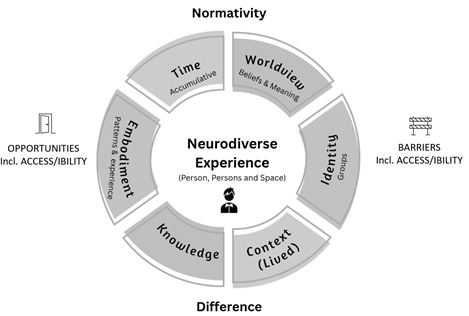
Simply, the model describes inner, interpersonal and spatial relationship as being formed of six interrelated intersecting high-level contexts: Worldviews, Identity, Contexts (Cultures), Knowledge, Embodiment (Mind body styles and experience), and Time orientation (Accumulative).
Rather than relying on a universalised model, this day one view incorporates areas that are often missed, including those typically addressed only later. A lower-level model of experience was developed to ensure dimensions of experience accounted for neurodiverse traits. For example, sensory, motor, emotional, stress and trauma, communication styles, or executive function are part of embodied patterns for all and they may be more normative or different. So rather than adopting a generic universal model of experience neuro-context is made visible as base of learning.
Second, I realised that although there are many theories and educational curricula, there is, across most disciplines including counselling and psychotherapy, a common ground of knowledge that is widely applicable. While this may differ across schools and modalities, it forms the base of learning. This insight supported the development of an augmented common curriculum and thus book structured around shared knowledge pillars: self and professional development, conceptualisation, relationship, skills, and organisational practice.
Third, I realised that the framework of the self-experience (figure 1 and its lower level description) can be used to systematically evaluate and embed neuro-context within this common ground of knowledge. This becomes a powerful evaluative transtheoretical framework for producing embedded knowledge. For example, simply asking questions like what might be usually missed if we consider an aspect of neuro-context when describing relational styles, self-care, group dynamics, or lived-in cultures. This framework was applied in the development of the New Introduction to Counselling and Psychotherapy book.
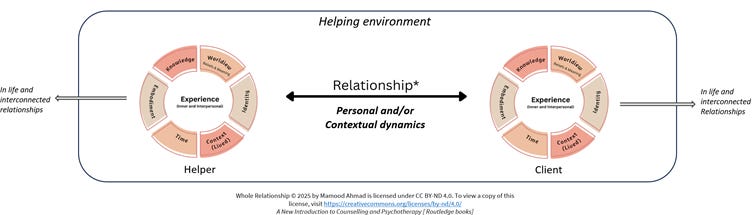
Fourth, the experience model frames the relational scope (Ref 1) and contextual embedded relational frame of reference (see Figure 2) from the first day of teaching, learning, and assessment. Since neurodiversity, along with other aspects of identity, is understood relationally, the model shifts the focus from a universalised approach to an explicitly personal and contextual one. Relationships are viewed in multiple ways such as neurocontext to neurocontext or even more granular, communication style to communication style, sensory to sensory, etc. This ensures that students are supported to hold the whole person rather than fragmented parts. The whole relational model thereby supports self-development, relationship building, skills, exploration, and neuro-affirming practice.
Fifth, the solution includes a tried and tested pedagogy for teaching, learning, and assessment. Students and tutors (with a train-the-trainer phase prior to facilitation) are given an experiential induction day covering the whole framework, which is then embedded within their understanding of self and carried throughout the course. It is used as a reference point in handouts, on walls, and within module materials, alongside the book as a core text where needed. By exploring themselves as embedded in context, they come to understand how neurocontext is also embedded within them, and this carries forward into all aspects of training, assessment, supervision, and research. Ultimately, changing the culture of the training. Sit back and relax and watch how the curriculum becomes intrinsically embedded.
Sixth, in addition to the above components, resources for train-the-trainer and self-training are part of the solution and available, along with free-to-use and shareable images and training guidelines. Recognising that training providers have cost barriers, these resources are designed to be on demand with free support.
As we move forward, we need your help. We have formed a #TADF advocacy community of tutors, and individuals that supports the development of a fully embedded curriculum, particularly within helping professions. If you wish to contact me or join the community in developing strategies, actions, and support for change, please email and join the group on WhatsApp.
If you are interested in the next whole-solution induction day and want to move towards a by-design approach to the whole model in self, see: https://www.tadf.uk/courses/wholesolution
What now? We need advocates…
[1] Ahmad, M. (2025). A new introduction to counselling and psychotherapy: Embedding context, diversity, and equity into practice. Routledge.
[2] The Anti-Discrimination Focus (TADF). (n.d.). The Wholeness Solution for Training, Curricula & Practice. Retrieved June 7, 2026, from https://tadf.co.uk/ [ See Whole Solution Resources ]
Wholeness Induction Day: Embedding Social Context, Diversity and EDI into Self, Learning and in Practice
Fri 2nd Oct 2026 live, with recording
Subsidised training day equips students, therapists, supervisors and tutors with a whole model for embedding social and personal context, normativity, diversity and EDI into everyday learning, supervision and tutoring
Book: A New Introduction to Counselling and Psychotherapy: Embedding Context, Diversity and Equity [ Routledge books ]
Course: Wholeness Solution
Embedded curriculum resources: www.tadf.co.uk and on demand training
Contact Links:
Email: ma@tadf.co.uk
Linkedin: Mamood Ahmad
Join in as an #TADF advocate: email in or just join the WhatsApp group: https://chat.whatsapp.com/Kgdm6g54knvFVwMQ002jp0
Comments
Nothing yet. Say the first thing.
Sign in to join the conversation.