
Picture this: a startup tripled their customer count in under 18 months. Their product was doing what customers wanted to pay for. Their small, but mighty sales team of two was sharp and believed in what they were selling. They were on their way to achieving product-market fit. But then something curious happened.
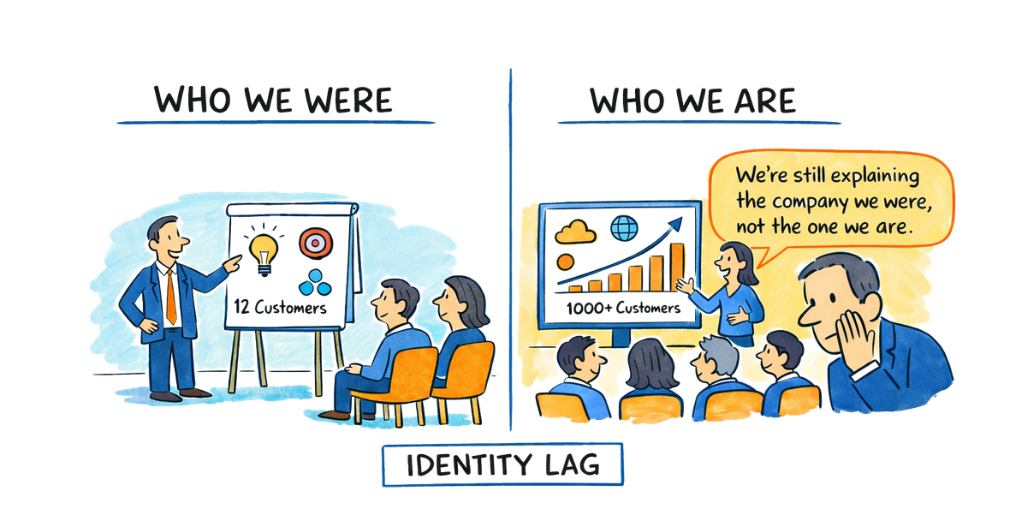
The website traffic suddenly stopped converting. The sales team believed that the marketing team wasn’t spending enough. The CFO thought the marketing team wasn’t spending strategically.
I was referred to the company by one of their investors and as part of my initial discovery process, I had the sales team walk me through the sales presentation. The CEO also sat in. During the Q&A part of that meeting, the CEO DM’d me something that was clearly a surprise for him.
“We’re still describing the value proposition of who we were, and not the one we are now.”
I wrote a blog about this and I am sharing an expanded version of it here with illustrative examples. These aren’t cautionary tales from obscure startups. They’re names you know. And at some point, every single one of them had to decide whether their story was still telling the current reality.
Messaging gets written during the founding sprint. It’s born in urgency. You have a handful of customers, one, maybe two core use cases and one clear competitor you’re positioning against. That story is tight, vivid and effective because it reflects exactly where you are.
Then things change.
The market shifts. The product expands into adjacent categories. A new type of buyer starts showing up. Your best customers are using the product in ways you never anticipated and getting outcomes you never thought to promise.
But the story? Still from the founding sprint. Nobody had time to update it. Nobody was sure who owned it.
I call this “Narrative Lag.”
Narrative Lag is the gap between who a company has become and how it presents itself. Narrative Lag tends to surface in three predictable places.
Here’s what Shopify’s homepage said in 2012 versus 2022.
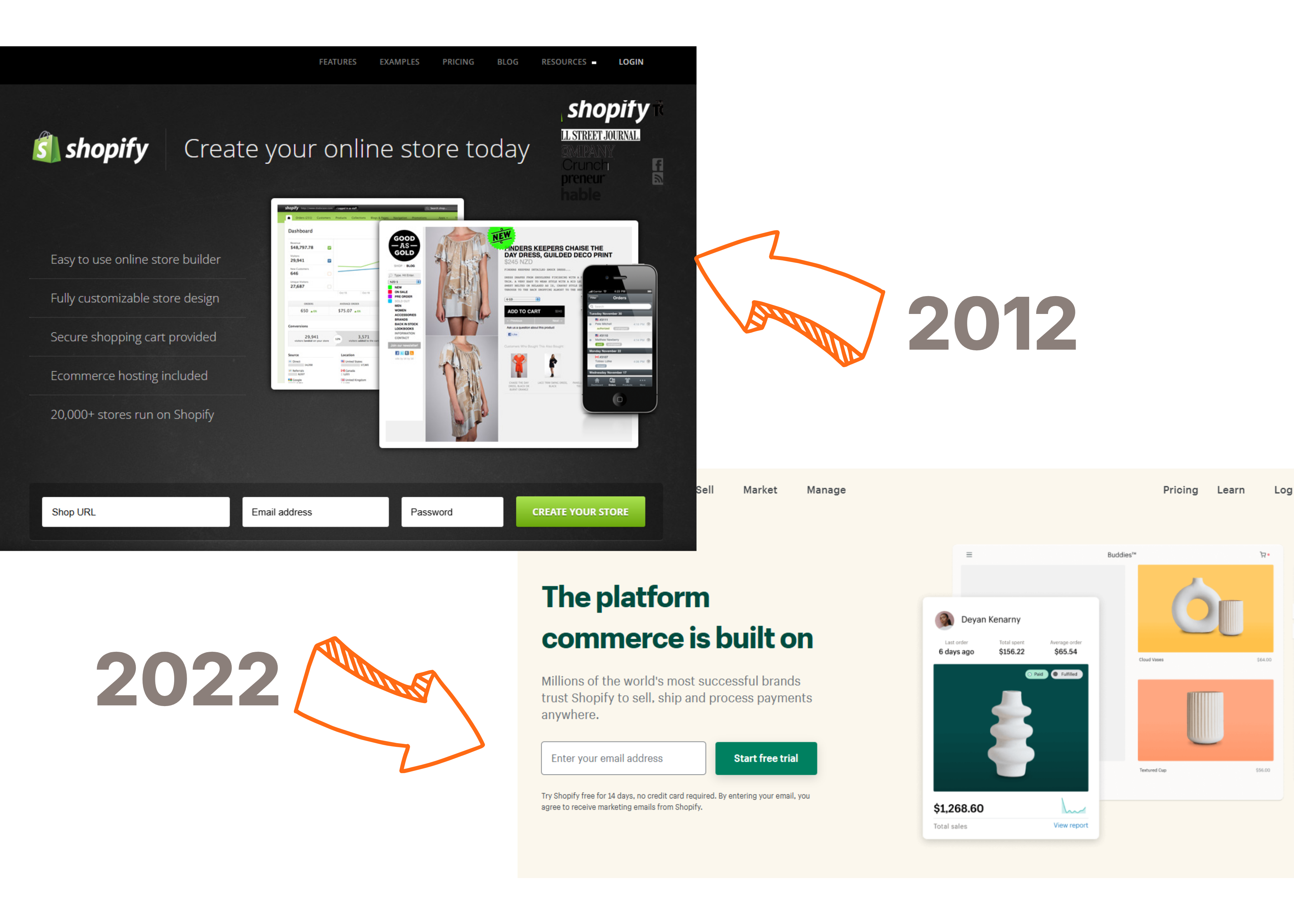
Early Shopify spoke directly to small business owners who wanted to set up an online store without hiring a developer. Clean, simple, approachable. Then Shopify became the commerce infrastructure for brands like Allbirds and Gymshark and eventually for enterprise retailers migrating off legacy platforms. The story had to grow. It did. But plenty of companies that grew at that same pace are still showing visitors a story that describes customers they outgrew two years ago.
Visitors land and can’t see themselves in the story. The company looks smaller, narrower and less sophisticated than it actually is.
Salesforce built a multibillion-dollar company in part by making a deliberate choice: stop leading with what the software does and start leading with what the customer becomes. Their reps weren’t selling CRM features. They were selling a world where no deal slips through the cracks and no rep operates on gut instinct alone.
When a deck leads with features, it signals the company is still thinking about what it built rather than what its customers achieve. Buyers at the enterprise level don’t buy features. They buy confidence that you understand their world and can change it.
Snowflake’s narrative evolution is worth studying closely. Their early pitch was essentially a better data warehouse. Faster, cloud-native, scalable. That story worked at seed and early Series A. By the time they were approaching their IPO, the pitch had shifted to something much larger: the Data Cloud, a platform for building an entirely new data ecosystem with Snowflake at the center. Same product trajectory. Completely different story. A leadership team that delivers a Series A narrative to a Series B investor signals that the numbers grew but the thinking didn’t.
What growing companies actually have is an identity lag.
Identity Lag is the delay between who a company has become in practice and who they believe themselves to be.
Slack is the clearest modern example of a company that closed the gap and then had to close it again. The early story was about replacing email. Direct, simple, a little confrontational. It worked.
Then Slack became something more complicated: an enterprise communication platform, a workflow hub, a place where external partners collaborated alongside internal teams. The “email killer” framing started to feel small. The pivot to “where work happens” wasn’t just a tagline change. It was a structural acknowledgment that their customers had already decided what Slack was. The company just needed to catch up.
Closing the gap requires a structured conversation, not a creative brief.
It means: sitting down with the leadership team, the sales team and most importantly your best customers and asking genuinely open questions. Who are we to them? What did they hire us to do? What problem do they describe to their colleagues when they explain why they chose us?
That conversation almost always surfaces something sharper, more compelling and more accurate than anything a marketing team could write in isolation. Your customers have already decided what you are. The work is simply catching up to them.
Stripe built one of the most durable narratives in tech not by describing their product but by naming the world their product made possible. “The financial infrastructure of the internet” isn’t a feature list. It’s a declaration of belonging.
Every developer who was tired of cobbling together payment systems heard that line and thought: that’s for me. Stripe didn’t wait for analysts to define their category. They defined it themselves, early and deliberately, and then kept expanding the narrative as the product expanded.
Growth is supposed to be the goal.
But unchecked growth without narrative alignment creates a company that’s harder to sell, harder to fund and harder to rally a team around.
People inside the business start to feel the dissonance even if they can’t name it. New hires struggle to explain what the company does. Sales cycles lengthen because buyers can’t quite place you.
The fix isn’t dramatic. It’s a deliberate pause to ask a simple question.
Has your story kept up with your company?
If the honest answer is no, that’s not a failure. It’s just momentum. You grew faster than your narrative could follow.
The companies that close the gap don’t just communicate better.
They compete better. They attract more aligned employee candidates.
If this is hitting close to home, I’d love to know where in your company the gap is showing up most. Reply and tell me. The homepage? The pitch? Something else entirely. I read every response.
Curious about what happened to the startup referenced at the beginning? Through our Narrative Architecture process, they were got a much better understanding of the value they were creating for their customers.
Since our work together, the company saw a pretty dramatic reduction of the time from Discovery to Negotiation, an increase in their customers’ willingness to participate case studies and in the number of inquiries.
No posts
Comments
Nothing yet. Say the first thing.
Sign in to join the conversation.