
I, the traveler, note something about London, smiling, visibly charmed by my own observation, only to see in response a kindly, generous acknowledgment on a Londoner’s face. They’ve heard this observation before. I scramble to offer, people say that a lot don’t they? But that too, they’ve heard. Can’t do it.
I’m grateful to experience cities for the first time because I have a reason to go there, in my case to do a show. It relieves me from worrying about ‘how should my first trip to Paris unfold?’ The city must come at my sideways, unfolding as it would through the window of the path determined by my actions as they move through it. Exhausting sentence, best not to reread it, not sure it will hold on revisiting.
I’m irritated that writing quickly for Substack as promised is experiment, is leading to sentence constructions I don’t stand by, where I find myself at the end of the sentence unsure whether I’ve only offered dependent clauses so far, and must I, out of breath, drum up an independent one quickly?
I’m mourning the fact that when writing quickly to express thought, it’s so directional, in motion, leaning into the wind. It hurts because I love construction so much.
A sentence like a standing structure, not just brick and dead, but with breezeways, and open windows, rustling curtains, a swinging bench. That’s probably too much for one sentence.
More on words, synesthesia vibes, below…
Or a paragraph. A paragraph could be the kind of house I’m talking about. This one has begun weakly, with an or. Perhaps it it can still be a house, the kind they dig into the side of a hill, and there’s barely a door except for an or.
Note: Accidental rhymes are such an indignity. It’s like if you tripped but landed by accident with a stomp-ball-change.
I love composing something that can stand there and be reread, and it holds like a structure that’s, wind blows through. It’s stands on its own, but also contains movement.
I’m concerned with what parts of language stand still, exert forces in what directions, a grammar as a kind of standardized approach to interacting with fundamental physics of language.
I’m fun!
Another thing I noticed. Words are usually written on a horizontal surface, paper on a table, while typed they appear before the writer in a more vertical surface, the screen or page a few degrees less the 90. So what is their true nature? Or how do most people think of them?
Do they have weight? In my mind, their weight is in they’re base, the bottom of the word, and when they’re flat on a page on a horizontal surface, it’s like putting a tv on its back. Like a standing figurine that has been laid on its back. I hope you’re following and if not, still enjoying the ride.
Next up. In theory, letters are flat. 2D.
Consider letters that cross themselves in formation. In an f, is the horizontal cross always formed second, and therefore, is an f a letter where a sloped vertical line is crossed by a horizontal dash? Sure.
But if you form it with a dash first, and then crossed that dash with a vertical stroke, is that also an f? It is, certainly.
And typing is stamping, You choose the letter, in total, on the keyboard, and it is hammered, in total onto the page, physically or digitally. No crossing ever occurs, but isn’t it still implied?
In a typed f, you see it as slicing the vertical stroke, versus two little dashes appended to each side of the vertical stroke? Do you not?
I find that odd. No, I find that interesting.
Is there a correct way to form a f? In the strict sense of communicating meaning, a signifier, if it reads as an f it is an f, even if were formed by appending two strokes, like arms to the vertical stroke.
Who cares? I care because it makes me wonder what else we take for granted as implied that is not actually relevant or there or necessary.
I tend to experience writing, on, say, this computer, as assembling vertical letters, which are shallow, but standing upright. They have a bit of depth, and you could move around them. You could see them from behind.
They are standing on an invisible plane.
In the case of this font, a bit like an iron-wrought 3d letters lined up on a shelf.
But script. If script hand writing is constantly crossing itself, then imagine the iron wrought version of the words. Some of them would move towards you of the strokes had depth, because every time they cross themselves they’d be doubling the depth.
There’s a way in which what I’m saying is completely meaningless, but I’m trying to get at something, a sensation of how the letters and the words they form are…experienced. If you’re into words and writing, how are these factors affecting your writing or your reader’s experience of them.
I’m not sure where but I had a paragraph in here somewhere. I must have scooped it up to move elsewhere but never set it back down. (What’s lost between cut and paste).
It was about how this might all read as ‘mental gymnastics,’ a term I’m tired of. While that is true, I feel you should know why I care.
I’m interested in what we take for granted on the most basic levels, what experiences of basics we might be experiencing differently, and never realize it because the terms we use to discuss these things are shared.
Everything on the micro exists on the macro and back again, so if I discover we’re all experiencing letters in different ways, it should serve as a reminder that, we are probably doing this everywhere, and need to keep an eye out.
Thanks for reading.
JN
If I had more time, I’d compose and construct.
ps. my friend’s book came out yesterday. go check it out.
pps. catch up on chris’s substack coverage of edinburgh fringe festival.
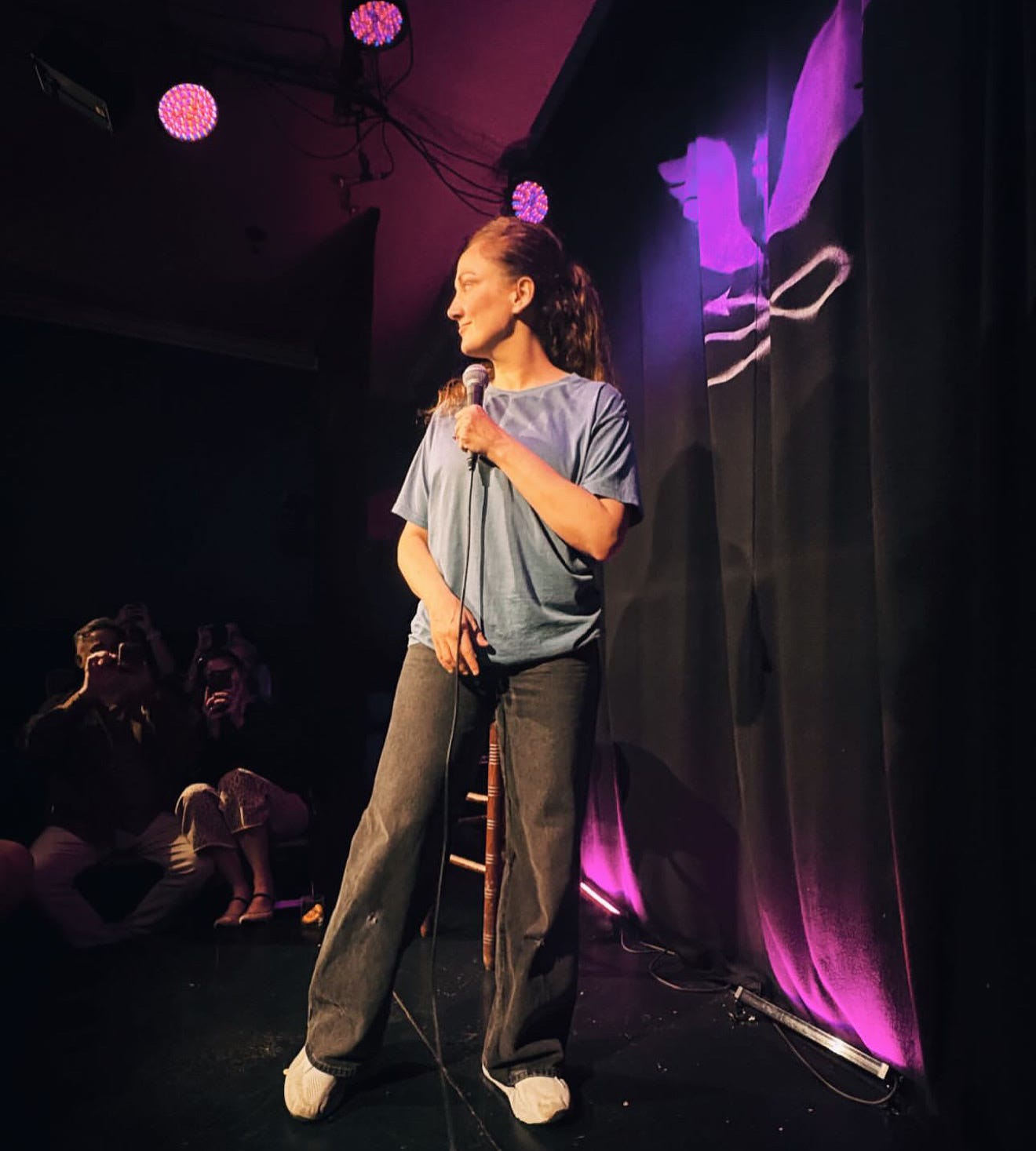
ppps. love seeing audience members in the sweatshirts/tees, it really cheers me when I come on stage.
Comments
Nothing yet. Say the first thing.
Sign in to join the conversation.