
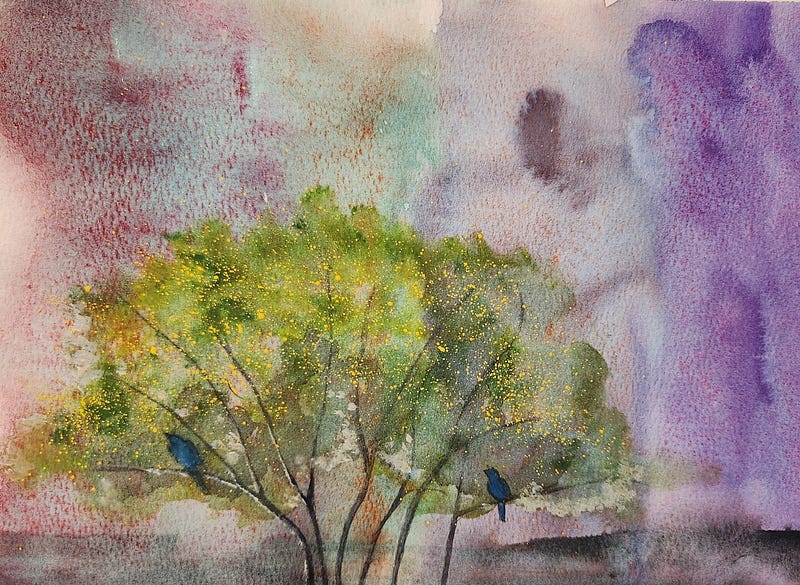
Nearly every evening at about 7:30 or 8:00 pm, I lay out my watercolor supplies on the dining room table (paint, paper, brushes, three jars of clean water, five ceramic dishes for mixing colors, and paper towels for blotting.) I select a reference photo on my phone — usually a tree or bird that I’ve snapped on a walk — and spend 1–2 hours painting a picture that likely won’t ever see the light of day.
I started painting about a year and a half ago, without any loftier goal than trying to understand watercolor. It’s not an easy medium to work with. You need to learn how water and paper and brushes effect pigment. There’s not much wiggle room to make a mistake. But when you get it right, my god. It’s a buzz worth chasing.
I’d been using acrylic paint pens and ink to make art for a few years before the watercolor pivot. I was content with that until I found myself inexplicably drawn to some a paint set that was languishing, unused, in my art supply bin.
It was a child’s watercolor set of 8 or 10 paint cakes in a little plastic case. For a couple of months, I was content with using this. I mashed my crappy brush into my crappy paint and produced the world’s worst watercolor. Of course, it didn’t end there. I eventually moved on to buying tubes of paint, better brushes, higher quality paper. But for the first few months, I was 10-years-old again, having fun with $8 art supplies.
I paint because I like making art, even when it’s terrible. I paint because it’s a way to produce something tangible. I paint because it releases some dopamine in my brain, and I’ll take what I can get right now, all things considered. And, lately, I paint to stay connected to my own creativity — the slow, messy, process of manifesting art in my dining room at 9 pm. It’s work that can’t be analyzed by an algorithm. It doesn’t scale. It won’t be contributing to anyone’s bottom line anytime soon.
Behind a billion screens, the robots are writing prize-winning short stories. They’re filling expensive research reports and nonfiction books with lies. They’re writing novels (or, at least, contributing to the writing of novels). They’re helping us populate our social media feeds with AI-generated photos and video.
There are obvious issues with this much abundance. AI-generated garbage is built on the backs of human ingenuity and creativity. It’s ramping up energy consumption for literally no good reason. It’s fooling grandma on the regular and crowding out human voices.
The proliferation of robot-art is bad for artists in ways that aren’t always immediately apparent. It could very well be destroying our ability to recognize real art (and the work involved in creating it) completely.
When one user posted a real Monet painting to X, claiming it was generated by AI, the post went viral.
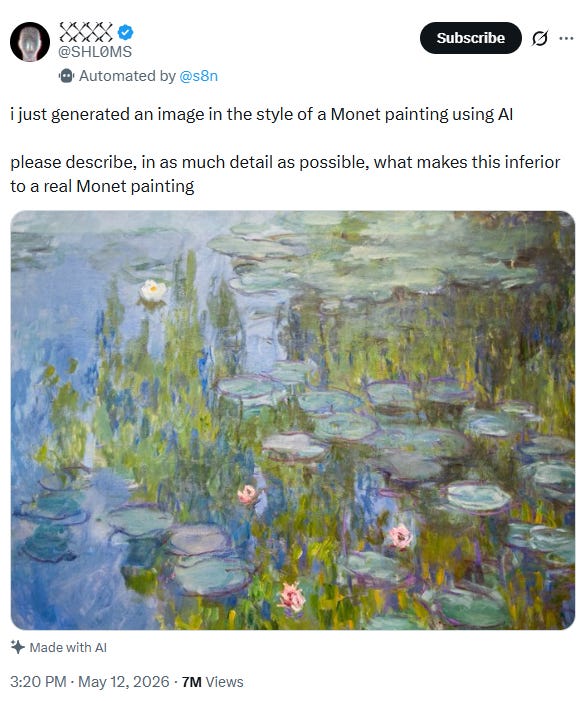
Some of the comments to this supposed AI-generated image are hilarious, or they would be hilarious if they weren’t so…concerning. People immediately began picking the painting apart, pointing out why it was “obviously” AI. Millions of people viewed the image and hundreds commented with very specific reasons about why this (real) painting was AI.
The response to this experiment raises some serious questions. For example, “What even is art?” and “Why make art at all when no one can tell if it’s real or fake?”
The answer to the overarching question here, e.g., “What is the point of art, anyway?” will vary depending on who you are. If you’re someone who runs a company, if you’re selling something, if you’ve always wanted to produce more content but haven’t had the means or the talent to do so, the answer is probably, “Oh goodie, we can sell more things without hiring more people to create the campaigns/channels/creative assets/infrastructure needed to sell these things.”
If, like me, you’re an artist or creative person, your answer will likely be, “Why are we even asking this question?”
I like to paint because it’s not connected to the grind. Creating art with no purpose at all feels like an act of protest. It’s my time and I’ll use (waste) it as I see fit.
I know it’s not going to change the world (or anyone’s mind), but it breaks me away from the algorithm for a while. It lets me succeed or fail in a way that’s not tied to anything.
It won’t land me my next gig. It won’t stop the rising tide of AI-generated content that’s washing away all the creative jobs. It won’t make the cost of groceries go down or universal healthcare magically appear. But it keeps my creative muscle sharp. Use it or lose it, I always say.
And we are losing it, it being our ability to make independent decisions free from AI’s influence. It turns out that outsourcing the hard part of creating art to AI, a process known as “cognitive offloading” is quite possibly making us dumber.
I’m not talking about creating the art itself, but the part that happens before you dip your brush into the paint and drag it across your cold-pressed 100% cotton watercolor paper. Staring at the blank page, coming up with a subject to paint or write, summarizing a complex idea into something intelligible, creating a to-do-list and on and on — these are the things that we need to do to lubricate the old gray matter.
This is an alarming problem that’s going to hit young people hardest, with preliminary research showing that bots like Claude and ChatGPT require much less brain activity than thinking for yourself (duh) or using a search engine with the AI shut off. Use it or lose it…
When I paint, I don’t eschew technology entirely. I stream an algorithmically-generated playlist from YouTube and I use my phone to display a reference photo. Everything else is old school — pencils, paper, paint, brushes, the agony of the blank page and the misery of failure.
I like to think that creating art, even when it’s terrible, is valuable because it keeps my brain fired up and working hard. Should I paint a tree? A bird? The Enterprise hovering in a clear blue sky?
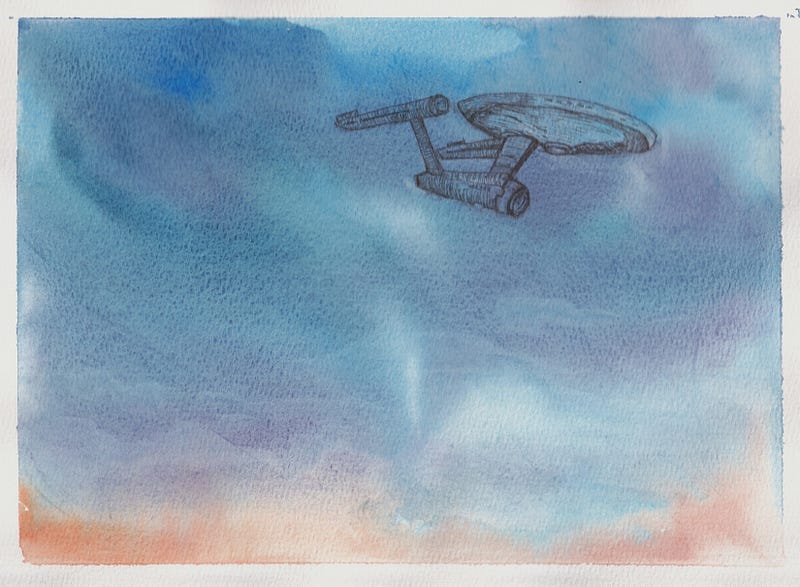
These decisions are entirely my own: what to paint, what to do or not to do with my art, what medium to use, paper size, composition, color scheme. Ping. ping. ping. That’s the sound of my brain grinding into gear. Of course, none of this pays the bills, at least not immediately. And yet…
Creatives often land in marketing roles. We write the copy, compose the music, shape and render the images, the video, the UI. We like to say we love the work, but (at least in my case) the truth is a bit more complicated. I love that the work allows me to support myself. I love that I can do it remotely. I love producing something tangible (even if it’s just pixels and data).
I was a freelance content writer from 2018 until this year. I loved getting paid to write content. It let me draw on the craft I’d been honing my entire adult life. But it’s a stretch to say it was ever truly creative work, even before AI gobbled up all the writing jobs.
What has been infinitely more lucrative than my ability to form a decent sentence is adaptability. I’m comfortable learning about and using new technology. I’m good at writing about this technology in a way that non-technical executives can understand. Great. But AI is much better at this than me. So my latest pivot is to take the 2.5 decades of marketing, agency, writing, and tech experience I have and make it useful for a company that creates events focused on marketing and sales transformation.
It’s a job that requires me to use AI all day, every day. After three solid months of this, I feel a bit dumber than I used to be. I’ve been outsourcing the stuff that previously made my brain fire up with activity — writing an email or reading an industry article, for example. Is my brain atrophying? Maybe. I feel it the most when I sit down to write something without using AI. I feel it when I sit down to paint and it takes me an impossibly long time to know where to start. Not great.
“Shut it down,” as Liz Lemon would say.
There is no point to my watercolor paintings. The pointlessness is the point. At least, that’s what I used to think. But after three months of letting ChatGPT and Claude do so much of the work I once did myself, I’m beginning to think that creating art has a very important purpose, even the art that nobody but me will ever see.
The disconnect from technology, the act of choosing my brush, my paint colors, my composition, my subject and the dopamine that floods my neural pathways — this is the medicine that keeps me sharp. I do this nearly every day. I viewed it as a ritual, a daily practice, a way to unwind. But it’s become more than a pointless hobby. It’s exercise. My brain craves it to the extent that sometimes I don’t even recall making a conscious decision to sit down and paint. I find myself at the table, setting up my workstation and queuing up the music before I realize I’m even doing it.
But why stop there? I’ve begun writing most of my emails myself again, even though it’s much faster to have Claude draft them. I’m reading articles and blog posts slowly and methodically, jotting down quotes in notepad, creating lists of interesting people in a spreadsheet (HubSpot be damned) so I can reach out to them about speaking opportunities for my company’s next event (spoiler: it’s an AI in marketing summit).
I’m old, likely unemployable in the traditional sense, but my brain still works, so I’m still going to use it.
Tech companies, traditionally my bread and butter, are laying people off by the tens of thousands. They’re replacing our jobs with AI. But they’re also freeing up budget to pay for AI infrastructure.
The best thing I can do right now is to keep using my brain. Critical thinking will soon become a key differentiator to finding work that AI can’t do without human oversight. Mark my words! We all need to think twice before we let Claude write our next email. Use it or lose it, I always say…
No posts
Comments
Nothing yet. Say the first thing.
Sign in to join the conversation.