

In 2015 legendary hedge fund manager Paul Tudor Jones realized that his firm, Tudor Investment Corporation, was falling behind the times. They had been slow to adopt computerized trading relative to their peers, who were getting better returns. Jones knew something needed to change so he turned to his employees, beseeching them to combine their human intuition with the power of technology. He said:
No man is better than a machine, and no machine is better than a man with a machine.
Jones decided that his firm would reallocate away from their more traditional traders who primarily relied on qualitative judgment rather than large-scale computation. They instead moved towards “big-data strategies” that practitioners might call “quantamental,” sitting somewhere between a purely algorithmic strategy and a discretionary, fundamentals-driven one.
Even by 2015, much of finance had moved beyond the man + machine model. High-frequency trading already constituted a slim majority of equity trading volume. Latency for those trades is counted in terms of microseconds or even nanoseconds; human reaction time is hundreds of milliseconds, making humans entirely non-competitive for executing these trades.
This balancing act between man and machine has played out across many domains, arriving at different times and in different forms. Chess, with its easily measurable outcomes and well-defined rules, provided an early proving ground. In 1996, Garry Kasparov played a closely-watched game against IBM’s chess supercomputer Deep Blue. He won 4-2, but it was clear that the tides were shifting. Just the next year, he lost to Deep Blue, but this did not mean that humans were out of the loop entirely.
For a little while longer, Kasparov continued to be competitive with other chess supercomputers, taking a number of draws through 2003. But the most effective way to play chess, in line with Jones’ dictum, was for man to play alongside machine, with human players consulting computer engines before ultimately deciding what move to make. This was called centaur chess. In the first major “freestyle” chess tournament, allowing for human entrants, centaur entrants, or computer entrants, it was the centaurs who dominated. Of the eight quarterfinalists, six were centaurs, one was a computer engine, and one was an unassisted human. The winning player was a centaur who figured out how to use his computer aid to great effect; he won the tournament, defeating a number of computer-assisted grandmasters, despite lacking any chess rating prior to the match.
This centaur-dominated equilibrium lasted for a while. It was still in place when Jones1 declared that the combined powers of man and machine win out in finance. But this period did not last forever. In 2017, a computer engine won a “freestyle” tournament, beating a field full of centaurs. By the time Google DeepMind’s AlphaZero arrived at the end of 2017, teaching itself how to play by playing against itself rather than by analyzing human games and thus becoming better than any other engine in a number of hours, humans had already been left in the dust.
These days, the Elo of top computer engines like Stockfish is estimated at 3600, while the highest human Elo ever is Magnus Carlsen’s 2882 in 2014. In 2026 I’m more likely to beat Magnus Carlsen in a game of chess than he is to beat Stockfish. I don’t play chess.
Still, centaurs had a good run. There were twenty years between Garry Kasparov’s matches with DeepBlue and the total obsolescence of human chess ability when compared to computers. In the scale of technological development, that’s a long time.
Centaurs in chess were able to last that long in part because the incentive for innovation in chess engines was limited. There simply isn’t a huge profit motive there, as there is no huge market for chess engines. It’s a cool PR opportunity for a tech firm, which is why IBM and Google DeepMind put some resources towards novel approaches, but that’s all. In fact, the aforementioned Stockfish is free and open-source, yielding no profit at all. Still, the models improve over time because of algorithmic advancements that can yield profit in other areas, and because computation becomes exponentially cheaper and more powerful over time due to physical advances, a phenomenon known as Moore’s Law.
The centaur dynamic looks very different when applied to artificial intelligence. For one thing, the profit motive is intense, perhaps more intense than any ever before. As a result, unprecedented amounts of capital are being steered towards developing machine intelligence. Some companies working on AI are very explicit about their goal of automating all human labor. Human + AI centaurs do not figure in their vision of the future.
Just four tech companies (Google, Meta, Amazon, Microsoft) are on track to spend a combined $650 billion of capital expenditure in 2026, with most of that going to AI datacenters. That’s $1.8 billion a day. The stock market is more concentrated than its ever been, and these megacorps are all making leveraged bets on AI.
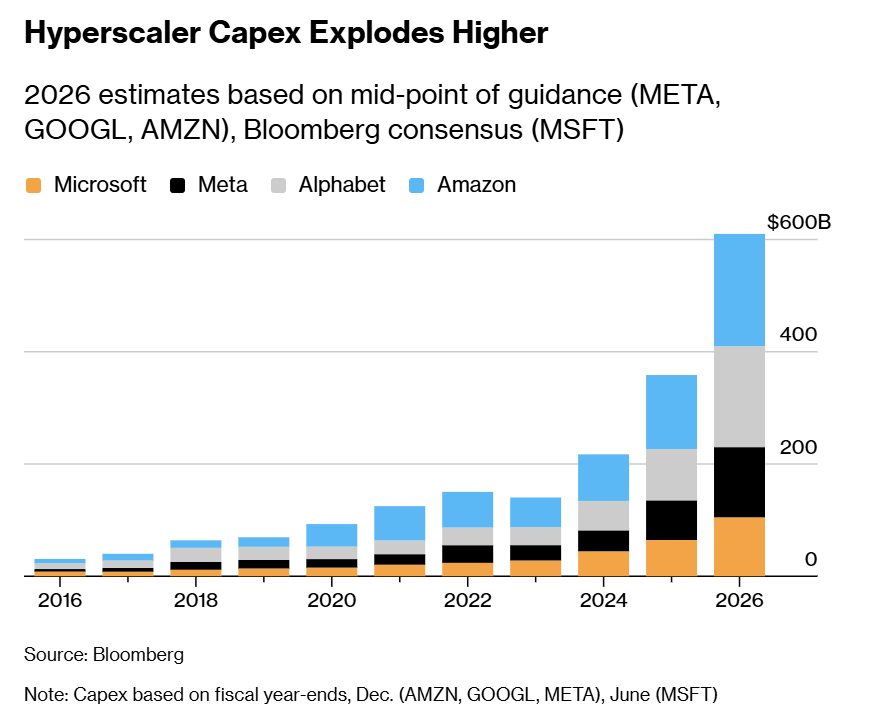
Another key factor to consider here is the recursive nature of AI development. Frontier AI labs like Anthropic, OpenAI, and Google DeepMind dedicate much of their effort towards improving the coding outputs of their LLMs, in large part because they want the LLMs to build themselves.
The models may be on their way there. Certainly, we are already in an age of centaurs for software. When Anthropic announced their newest model the other day, Claude Opus 4.6, they declared: “We built Claude with Claude.”
Building Claude does still require that collaboration; they can’t yet plug in AI models as fully autonomous employees. In their system card for new models, Anthropic evaluates whether the model has “the ability to fully automate the work of an entry-level, remote-only researcher at Anthropic.” For Opus 4.6, zero out of sixteen surveyed Anthropic employees believed that the model was there, although the system card notes that the model “[exceeded] most of the thresholds for short-horizon tasks on which it was tested.”
If we continue to have highly efficient centaurs working on these models, the models will improve such that we hit Anthropic’s threshold above. In fact, some of the researchers surveyed did believe that, “given sufficiently powerful scaffolding and tooling,” the model may already be able to reach the "entry-level, remote-only researcher at Anthropic” standard.

roon@tszzl
it’s just so clear humans are the bottleneck to writing software. number of agents we can manage, information flow, state management. there will just be no centaurs soon as it is not a stable state
8:59 AM · Feb 4, 2026 · 202K Views
177 Replies · 93 Reposts · 2.04K Likes
Pseudonymous OpenAI employee/prophet-in-residence Roon believes that the centaur era in software won’t last long, calling humans “the bottleneck in writing software” and claiming that it simply is “not a stable state.” Another AI-inclined X user responded to him, saying that he believes centaurs have until this upcoming fall, which he said is actually “surprisingly long.” In another post, he worried for his own job security in the face of AI development, writing: “so many people are out of a job. I have months left.”
It isn’t just software engineers who should be worried. Even if we look solely at Anthropic, which is known for focusing most narrowly on improving the coding abilities of their models, there are a number of products that could automate vast swaths of the workforce within a number of years. In October, they released Claude for Excel. Alongside Opus 4.6, they released Claude for PowerPoint. And just yesterday, the news broke that Anthropic engineers have spent six months at Goldman Sachs working on automating accounting and compliance tasks.
Goldman’s chief information officer Marco Argenti said that Anthropic will provide “a digital co-worker for many of the professions within the firm that are scaled, are complex and very process intensive.” He was “surprised” by how effective Anthropic’s models were at non-coding tasks that require reasoning through complex problems and applying both mechanical rules and more abstract judgment.
There will be a period where these apps are a force multiplier for your archetypical white collar worker. Goldman says they don’t plan to reduce headcount, although changes like this allow them to “constrain headcount growth.” Instead of taking two hours to build a slide deck, maybe it’ll be four prompts and twenty minutes. But in this world, it’s really only social pressures and corporate magnanimity that prevent wide-scale layoffs.
Most likely, models will continue to scale and bring us closer to that reality and perhaps beyond. The Moore’s Law dynamics that led to improvement in chess are supercharged here. In Moore’s Law, the number of transistors on an integrated circuit doubles every two years. In AI, the length of coding tasks2 that frontier models can handle doubles every seven months according to AI evaluation non-profit METR. In recent times, since the amount of capital dedicated to this started spiking dramatically, the increases have been even faster. Perhaps the doubling time is now closer to four months.
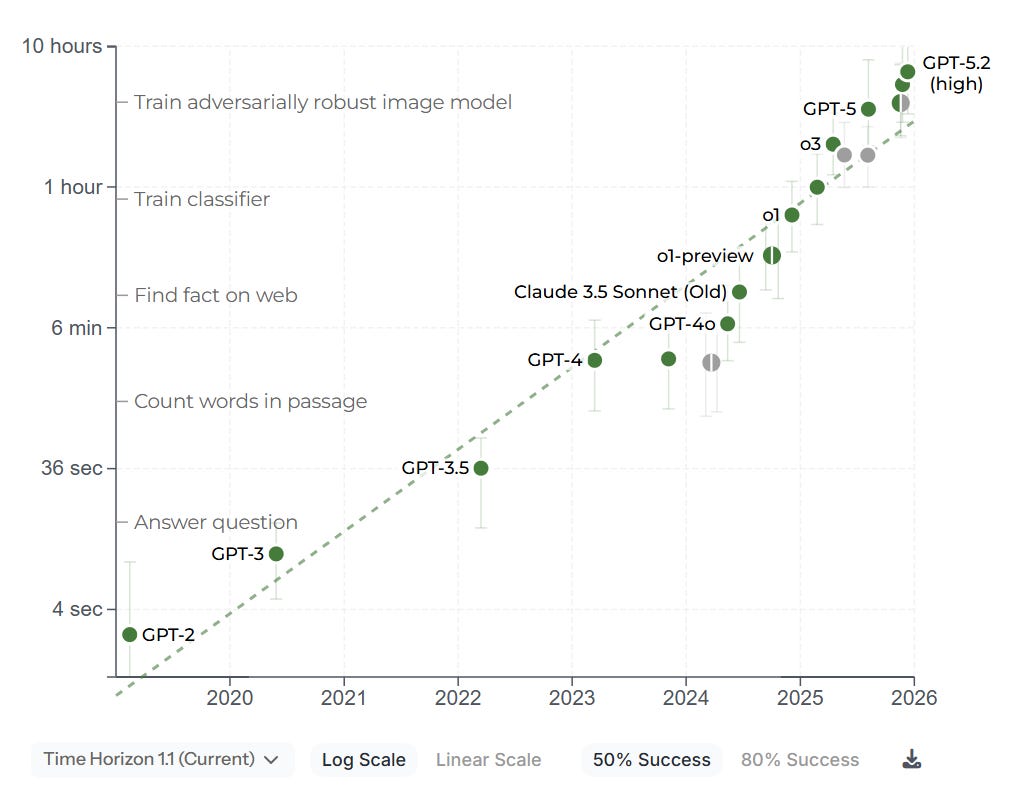
Now, these numbers are not uncontested. Not everyone agrees with METR and their methods. One paper was published three days ago that argues that the rate of development looks more like a sigmoid, which is exponential then linear before plateauing. Sigmoids are very hard to predict and we should take this idea seriously rather than immediately dismissing it. But the fact that their projections were already woefully inaccurate by time-of-publishing makes it hard to believe that we’re close to any sort of plateau.

tom cunningham@testingham
@hamsabastani @METR_Evals

11:07 PM · Feb 5, 2026 · 16.9K Views
6 Replies · 9 Reposts · 171 Likes
I don’t have a crystal ball. I don’t know how long man will be able to contribute something meaningful to the economy beyond what machines alone provide. Maybe we will never be entirely marginalized, and the sigmoid-believers will be vindicated. But the default assumption should be that the growth will continue apace.
If that assumption holds, the transition won’t be uniform across domains. It will take longer for AI to automate physical work. Recent demonstrations from humanoid robots are impressive, but they are not yet close to automating human elbow grease.
Perhaps chess provides a vision for what the future of human labor and meaning will look like. Centaurs are irrelevant in chess now, but humans, despite their inferior performance relative to machines, are not. Millions of people watch chess every year, tuning in to root for their favorite players compete human-against-human.
The post-centaur age could be an idyllic one3, where humans compete and cooperate in only the most satisfyingly human pursuits towards non-economic ends. Is life better after work?
Jones may have actually been inspired by a Credit Suisse write-up comparing centaur chess to trading, written 12 months before he told his firm they needed to change. The Credit Suisse piece included the formulation “Machine + Man > Machine or Man.”
Credit Suisse ultimately concluded that traders have a lot to learn from centaur chess and that “a melding of fundamental and quantitative methods may well yield better results than either of them on their own.”
These time-scales refer to how long it takes a human expert to complete the task, not how long it takes the AI to complete the task. And this graph in particular refers to the task duration at which the model achieves 50% success probability. You can find the equivalent graph for 80% success rates on METR’s website. Fully automating human tasks will require a much higher success rate than 50% or even 80%.
Not to start a second essay in the footnote, but there is much consideration of both utopian and dystopian AI futures that I neglect to bring into the body of this piece.
The transhumanist Extropians, who are in a meaningful sense the intellectual forebears of contemporary AI discourse, wanted to conquer death by ushering in the singularity. About 30 years ago young Extropian Eliezer Yudkowsky wrote:
Our fellow humans are screaming in pain, our planet will probably be scorched to a cinder or converted into goo, we don’t know what the hell is going on, and the Singularity will solve these problems. I declare reaching the Singularity as fast as possible to be the Interim Meaning of Life, the temporary definition of Good, and the foundation until further notice of my ethical system.
In 2026 Yudkowsky is better known for his opposition to superintelligent AI on the grounds that it will kill us all. He did in fact write the book on that, titling it “If Anyone Builds It, Everyone Dies.” Which future will we see? I don’t have the ability or space to give this question the attention it deserves, but I do highly recommend engaging in further reading on the question.
Comments
Nothing yet. Say the first thing.
Sign in to join the conversation.