

Happy July 4 to all. I’m proud of my country.
My dear friend Leif moved to Denmark after high school. His father is Danish, but his mother is Korean American, and so he does not look like anyone’s first idea of a Dane despite his strapping, Viking-like figure.
I’ve visited him in Copenhagen. Leif attends university there, and during my visit his dorm was throwing a party that he would have loved to attend. But the custom is that only residents of the dorm may attend, and so I could not go. Because of that, Leif also skipped the party. Such a custom would never have existed at my American university, and if it did people would feel entitled to ignore it.
You may think that this Danish behavior stems from an exclusionary and insular culture. I’d argue that’s the wrong read. People in Denmark just have a strong impulse to abide by the rules. They are content with how society operates, so they respect its laws and customs. The dorm kitchen was spotless. Danes don’t jaywalk and look askance at those who would. They are loath to impose even a very slight negative externality on another person.
There’s a code of conduct, first catalogued satirically by Danish-Norwegian author Aksel Sandemose, that has been seen as broadly reflective of the norms in Scandinavian countries. The first three Laws of Jante (Danish: janteloven) state:
You’re not to think you are anything special.
You’re not to think you are as good as we are.
You’re not to think you are smarter than we are.
These laws are not taken as gospel within Denmark (Leif tells me that they are taught within schools as a somewhat antiquated way of thinking) but, in his words, they still provide a cultural undercurrent. Alexander Skarsgård once told Stephen Colbert that he couldn’t boast about his recent acting accomplishments because of the janteloven. The janteloven subordinate an individual to the whole. Under this scheme, it’s easier to be content with a more mundane life, perhaps contributing to the high happiness scores in Scandinavia.
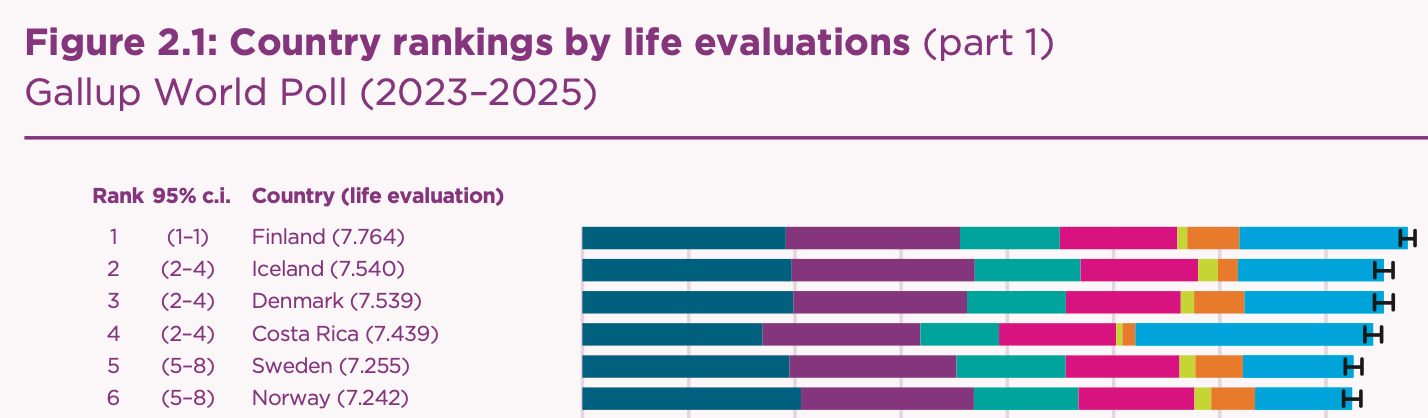
And thanks to the janteloven, Denmark has very high social trust. People are happy to contribute to society by paying high taxes, and they see how those high taxes help people live better lives. Leif gets paid $1000 per month to attend his university, and his rent is subsidized. I have great respect for this model.
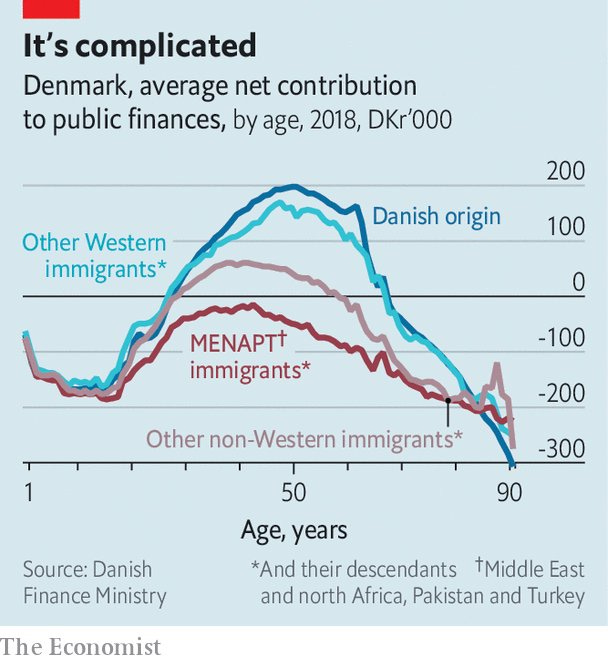
But this is a fragile social contract. Denmark’s norms break without homogeneity. It isn’t a purely racial homogeneity—Leif feels fully embraced, despite his visible Asian heritage—but there is broad conformity to one set of norms, and defecting from those norms strains the system. High taxes feel like solidarity when everyone pays, and like theft when some don't.
And unfortunately, immigrants from North Africa and the Middle East, in many cases, do not buy in. They often live within separate communities. Their employment rate is over 20 points lower than the rate for native-born Danes. On average, there is no point in their lives when they are net contributors to public finances: as a group, they take out more than they put in.
Last year the New York Times wrote about the continued successes of Denmark’s center-left party at a time when the far-right is ascendant across the West. They pointed to Denmark’s relatively more limited immigration as one reason that the center-left has held power. I don’t begrudge Denmark this approach. Given my understanding of how Danish society operates, I believe that large-scale immigration would fundamentally alter the fabric of the country, and they should be able to make their own decisions about such things.
I’m not sure I would be able to buy into the way Denmark organizes its society! I love to jaywalk. Thankfully, my country has different norms. The American Dream inverts janteloven. It tells you that you can be special, that anyone can come to America and make it here if they have the necessary zeal. The most driven people in the world take us up on it. Two-thirds of our billion-dollar startups were founded by immigrants or their children. And the people who come here illegally, willing to pick strawberries or build houses, contribute too. They see America as a place where hard work will buy comforts they couldn’t find at home: in 2022 they paid $25.7 billion into a Social Security system they can never draw from. We do the world a service by providing such a place, and they do us a service by contributing to American prosperity.
Denmark’s historical homogeneity has made them happy to provide generous security for all, but that altruism changes immigration’s selection pressures. A promise of security appeals to everyone. A promise of opportunity appeals only to those who mean to seize it. Luckily for us, the American Dream selects for tenacity. And when they arrive, they have access to the world’s most dynamic capital markets and a government that mostly stays out of their way. We are a nation of immigrants that has become the world’s superpower.
Americans have always come from a wide range of backgrounds and religions and customs, so we have set up systems that run on disagreement. Our Constitution enshrines the right to free speech. James Madison’s Federalist No. 10 argued that we should design our republic for faction: multiply the interests and set them against each other, and no single one can dominate. Where Denmark asks its people to buy into a shared set of cultural norms, we only ask you to make something of yourself.
I do worry about nativism within America. The backlash against immigration looks like the same impulse I respect in Denmark, but it mistakes what kind of country this is. To demand sameness here is not to protect the American system but to import someone else’s.
I carry the lessons of our founding fathers with me. We are an exceptional nation that was founded in an exceptional way. In 1790, George Washington wrote to a Rhode Island synagogue of Sephardic Jews:
The Citizens of the United States of America have a right to applaud themselves for having given to mankind examples of an enlarged and liberal policy: a policy worthy of imitation.
All possess alike liberty of conscience and immunities of citizenship. It is now no more that toleration is spoken of, as if it was by the indulgence of one class of people, that another enjoyed the exercise of their inherent natural rights.
For happily the Government of the United States, which gives to bigotry no sanction, to persecution no assistance requires only that they who live under its protection should demean themselves as good citizens, in giving it on all occasions their effectual support…
May the Children of the Stock of Abraham, who dwell in this land, continue to merit and enjoy the good will of the other Inhabitants; while every one shall sit in safety under his own vine and figtree, and there shall be none to make him afraid.
Washington asked only for “good citizenship” of those who would live under this government’s protection. It’s easy to be an American. I don’t ask other countries to follow our example. But I’m glad that one nation works this way, and that it’s mine. At its best America can be a city upon a hill, exemplifying pluralism, tolerance, free enterprise and free speech. That America is worth fighting for: a place where anyone may pursue their own interests and sit in safety under their own vine and fig tree, with none to make them afraid.
Comments
Nothing yet. Say the first thing.
Sign in to join the conversation.