
My youngest son and I worked on a rocket kit this week. It had sat in a box for a few years, a gift from Papa. Lately when I tell him to put his phone away, he falls asleep (fourteen is hard.) But this time he pulled the rocket out and asked slyly for help. He didn’t really need it. He needed a few assurances along the way that he was on the right path. He was.
Once completed, we went to the field near our house so we didn’t lose the rocket to a barn roof or neighbors tree. (I thought it would be fun to tie the rocket that we see on the neighbors rooftop to this would-be-epic summer memory until the snow took down in January. He didn’t like this idea as much.)
It didn't work. Following the directions yielded nothing — no swoosh, no zip, no smell of sulfur. He couldn’t get the key and the button to work. He rolled his eyes when I asked if the batteries were in right (being fourteen and having a Dad is hard.) Anticipation is building. Waiting. Trying. Staring at the un-rocketing rocket on the launch pad. I say “let me try” and somehow, against all odds it shoots into the air… and goes maybe 30 feet. The parachute deploys, we exhale.
It didn’t do what it what supposed to, but we did. (Father and son.)
Here’s five more things from the week that was:
My to-do list post Just Jelly consists of getting some of the book ideas simmering in the background further along. They have all crossed the “hmm… something might be there line” and into the “let’s do the work” and find out stage.
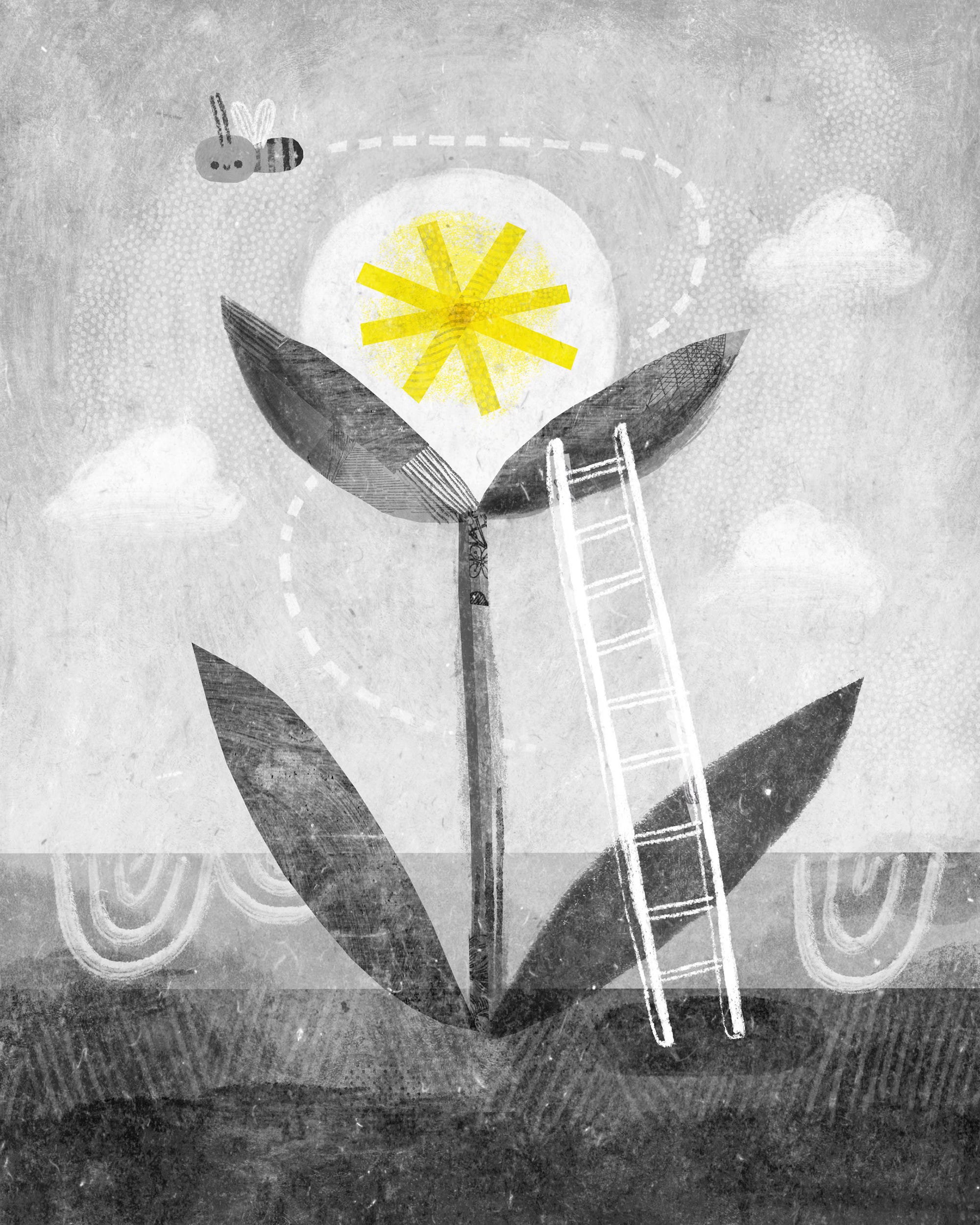
One of them, The Big Blank, is an idea that I explored out loud here as a series of deep dives, taking it from manuscript to thumbnails, to 1 final illustration. I liked where it ended up but in the end, didn’t love it.
Rather than bang my head against the wall desperate to figure it all out, I waited. I looked at it once while I was wrapping the finals for Jelly, asking myself “why is it falling flat?” This week, I knew I needed to answer some specific questions and created a daily project or game to get at it.1
Here’s one of the resulting experiments:
I’m thankful for whatever level of support you’re willing to give. I write as authentically as I can about my creative journey into kidlit as an author-illustrator. The ups and downs and an over-indulgence in silly analogies. Your subscription means a lot. Thanks.
Long story short, I think this was one of the first picture books in which I realized it was not only my job to tell the story visually, but also to find a way to make it exciting for me to do so.
— From “The picture book that changed how I approach illustration” by Christian Robinson
In one of my most recent deep dives, I talked about having a brutal checklist when pitching your agent or a publisher. #1 on the list was “Am I passionate about it?”
The same approach works for deciding when to sign on to a book where you’re the illustrator. Books are really, really hard. They only really work you’re passionate. Sometimes it’s right there in the manuscript itself. The ideas flow immediately. Sometimes it’s a bit like a puzzle and you know the joy will be in the figuring it out. There are other times where you might need to find a way to make it something the inspires some passion. 2
I’ve found that the source of the passion is not as important as making sure you can enter the project with enough to sustain your best effort.
I’ve been going through my old published work and finding seemingly small things that symbolize something greater. “One small step” that led to a “great leap” on my way to getting better as a working author-illustrator.
My first couple of published books, had a lot I’d do differently — but that’s the point! Growth happens from stacking those lessons up over time. If you’re the rarest of unicorns that came out of the art kiln fully-formed, hats off. For me? I find it encouraging to revisit these old milestones. 3
Here’s the most important spread from the first book I ever worked on, Hide and Seek Ladybugs (by Paul Bright, published by Tiger Tails in the US 2020).
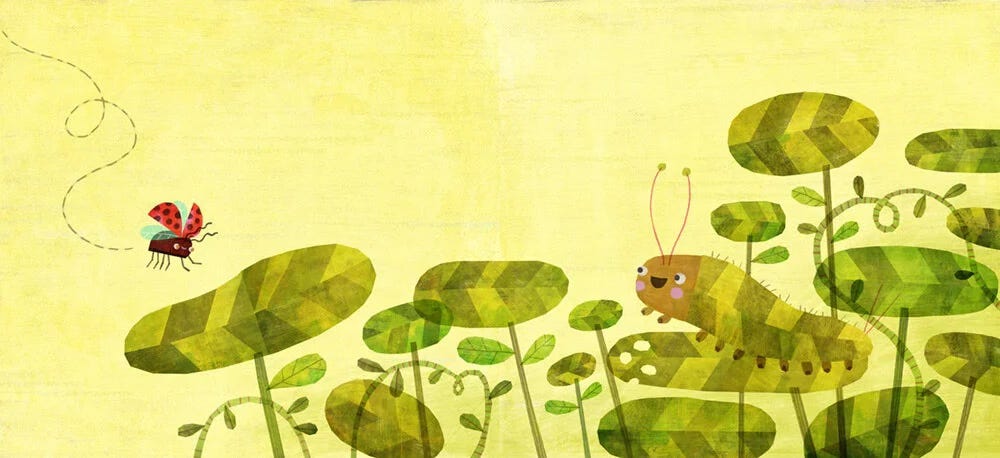
I still love this illustration. The lesson learned here is in those leaves. I’d played with texture enough to know a rich application was what was needed. What I stuggle-buss-ed on for way too long was the flattening the offsetting stripe while knowing this did not appear in nature. I suspended my need for it to make sense visually and opted for what looked optimally interesting. This is a huge lesson that I employ on all of my projects and in any illustration I work on.4
And, this seems to be the crux of it: an Author writes a story hoping to connect with the reader, a content creator produces a product for consumption.
AI is a shortcut, a means to an end. If you use AI to produce your book you are a content creator. Not an Author.
— From “I asked booksellers how AI is changing their field” by Andrea Bartz
Lots of food for thought in Andrea’s interviews with booksellers. My take away is that booksellers get what we do and see it worthy of protecting. Not so sure on the big box sellers and some publishers… who see it as solely a product and not as art. Worth your time.
Rooting you on!
Best,
Jacob
I have a deep dive coming next Friday, sharing one of the ways I like to unblock myself when I’m stuck. I’ll have tons of new work to share.
Yes. I’ve had a couple where the passion dried up like an old grape under the couch.
Have you done this? Looked at old work and found those little shoots of growth? Let me know — I’d be interested to hear about it.
This particular spread is hanging in my Mom’s bathroom at the home I grew up in. Surreal.
Comments
Nothing yet. Say the first thing.
Sign in to join the conversation.