
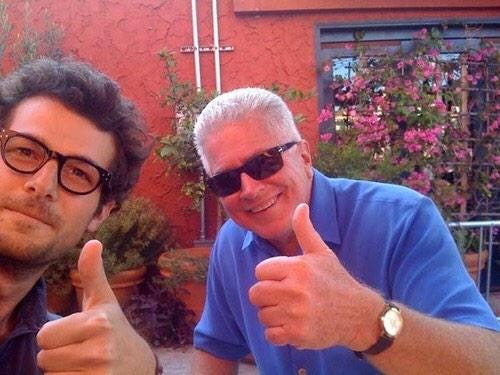
Huell Howser, the late legendary public television figure in Southern California, was my idol. He’s how I got into television — by literal happenstance. More on that in a second.
I wrote about my reverence for Huell in my book FIRESTORM as part of a passage about my visit to his archives on the eve of the Great Los Angeles Fires of 2025:
Late that afternoon, I was driving to Orange County, after having spent the morning with my family, who had gathered to celebrate the birth of my newest nephew. I was on my way to see an exhibit about the late Huell Howser, my television idol, at Chapman University.
Huell was the master of talking to everyday people in just about every situation throughout California. Every episode was a journey into a different corner of life and culture. Most of his archive—thousands of hours of television—was donated to the university when he passed away in 2013—including his exploration of fire.
On June 23, 1998, under gloomy skies and clad in that yellow Nomex fire gear, his trademark shades, and a helmet, Howser visited a training session at a controlled burn led by the Los Angeles County Fire Department for female state and county inmates who would be enlisted in firefights. The goal was to instruct them on how to control the grass and brush fires that have terrorized city dwellers and wildland firefighters alike for generations in Los Angeles. Huell’s reaction to waist-to-shoulder-high flames, in his trademark Tennessee accent, was as unfiltered as it was honest:
“You know, this is the first time I’ve even been this close to a fire like this, and this is overwhelming! Look at this!”
“One of the incredible things is you can hear the noise,” the county fire official speaking to Huell explained. “Fire creates an incredible amount of noise. And the heat. It starts to heat up, right where we are.”
“Oh my gosh!”
He darted over to two female inmates beating back the fire by “cutting a cold trail” with hand tools.
“Ladies, what do you think of this fire this morning?”
“Oh, love!”
“Love it!”
“What do you mean, ‘Great, love it’?”
“It’s intense,” one said, covered in inmate orange fire gear, a neck covering, goggles, and helmet, still holding her hand tool. “That’s what we like. We’re intense!”
Huell, thrilled to experience the power of the fire, commented on feeling the heat on his face and how mesmerized he was by the skill and techniques of the firefighters.
“This spring burn is one that’s been a real eye opener for us,” Huell observed later. “It’s one we’re going to remember for a long time.”
It was most definitely not a “particularly dangerous situation.” But Huell made everything memorable. It’s why I idolize him. He showed a small test fire the same respect as he would the most extraordinary moment you could imagine. It meant something. But I hadn’t yet learned that lesson from him, nor from fire.
For a long time I mimicked Huell in the work I would do in the field. I still do. Nobody wielded a stick microphone better, and used it to make television magic. To connect with other human beings. When he passed away, I was devastated.
The moment that made me believe I could do what he does — or my own version of it — was this one, when I ran into him randomly almost twenty years ago as I was testing out a new video camera at Los Angeles State Historic Park. And I decided to interrupt the taping of his show.
I’ll never forget Huell’s generosity that day. He became a friend and mentor, and I think of him often. How people made him light up and how he gave that energy right back. He even put my footage into the episode of Downtown he was filming.
As I work through what my new show on MS NOW will be, I have been thinking a lot about Huell. The man, the myth, the legend. If you don’t know him, take a deep dive in his archives. If I can bring just a little of Huell to my show, I’ll consider it a win.
Any other Huell Howser Heads out there?
No posts
Comments
Nothing yet. Say the first thing.
Sign in to join the conversation.