
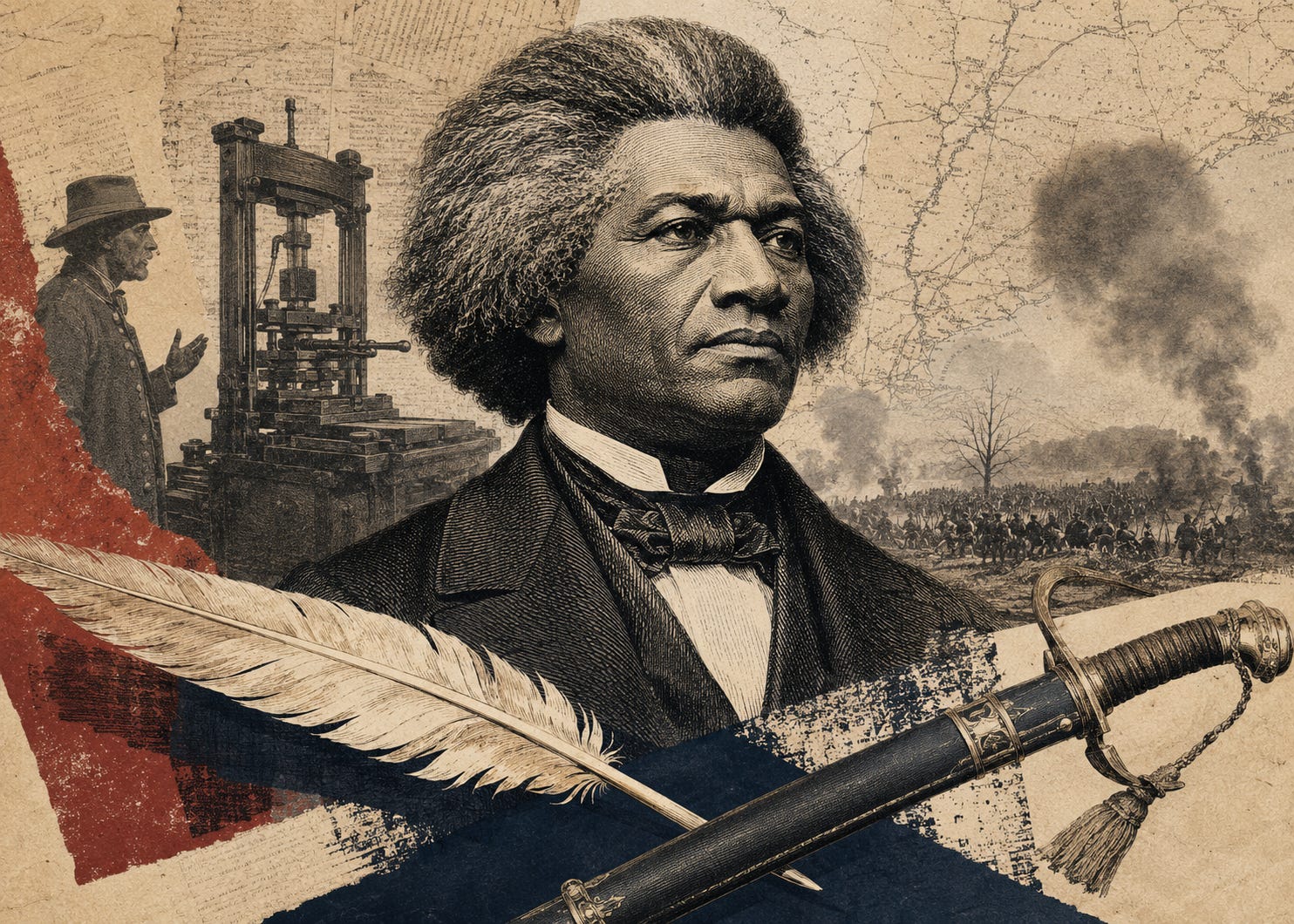
“A man’s right to speak does not depend upon where he was born or upon his color. The simple quality of manhood is the solid basis of the right – and there let it rest forever.”
So ends Frederick Douglass’ famous speech “A Plea for Free Speech in Boston” from December 9th 1860. A Plea is Douglass’ defiant and rousing response to the disruption of an abolitionist meeting in Boston six days earlier. In a mere 1,099 words Douglass writes a gripping and compelling defense of free speech constructed on the mutually reinforcing pillars of universal freedom and equality, natural rights and civic commitment. To embed the foundational value of free speech in the minds of his audience he uses vivid imagery and formulations that have become timeless despite the very specific context in which they were written. Free speech is “The Dread of Tyrants” and the “great moral renovator of society”. So consequential is free speech that “Five years of its exercise would banish the auction block and break every chain in the South”. Therefore to “suppress free speech is a double wrong” that “violates the rights of the hearer as well as those of the speaker”. No wonder that A Plea is treated as the canonical Douglass text on free speech from which everyone quotes (myself included).
But how important was free speech really to Frederick Douglass? A Plea is deeply inspiring but it’s not a systematic work of philosophy or political theory. Douglass never wrote a longer work specifically dedicated to free speech such as Chapter 20 in Spinoza’s Theological Political Treatise, Cato’s Letters No. 15, 32 and 100, Chapter 2 in Mill’s “On Liberty” or Madison’s “Report of 1800”.
I had read a number of other Douglass speeches, his second autobiography “My Bondage and my Freedom” and David Blight’s sublime “Frederick Douglass: Prophet of Freedom”. They all seemed to confirm Douglass’ sincere and deep commitment to free speech, but none of these texts are specifically focused on this topic and might give a skewed or incomplete picture. Given my reverence for Douglass and the prevalence of “Milton’s Curse”, I felt that I had to know exactly what his position was on free speech. And specifically whether he, like Milton, Spinoza, Cato’s Letters, Voltaire, J.S. Mill and so many other great champions of free expression, had glaring blind spots or a record of advocating “free speech for me, but not for thee”.
So over the weekend I started a small side-project that quickly got out of hand. With ChatGPT’s help, I created the “Frederick Douglass Free Speech Corpus”. The project is my attempt to identify and log every publicly available speech, article and letter in which Douglass discusses free speech and related freedoms, including press, religion, assembly, petition and literacy. ChatGPT assists with discovery and organization, while I check the entries against original sources. I expected perhaps 15–30 relevant texts. I currently have an index of 203 entries and a 169-page Master Corpus of quotations, summaries and themes, not counting the many repetitive texts logged only as cross-references. To work through all that material, I also vibe-coded an audio app that lets me listen, bookmark and annotate uploaded texts from the corpus while driving, working etc. Both projects remain works in progress, but I eventually intend to publish the corpus and its methodology.
Given the huge number of relevant texts it’s safe to say that free speech was not merely a passing reference for Douglass. It was an obsession both as a practice and a principle. Yet, at this stage, I will resist the temptation to make any categorical claims about Douglass’ free speech philosophy or consistency across all themes. I still have more than a thousand pages of underlying text to trawl through. But in the following I’ll give a (very) preliminary verdict on whether Douglass remained committed to free speech maximalism during wartime.
Take nothing away from A Plea, but it’s not surprising that a man in Douglass’ position would appeal to free speech given the draconian censorship of abolitionist ideas in the South, the hostile mobs he often had to confront and more generally his membership of an unpopular minority that suffered pervasive stigma and discrimination. In such a vulnerable situation it’s not hard to see how the right of free speech can be invoked as a shield against majoritarian intolerance and a precondition for speaking truth to power. But as everyone who cares deeply about free speech knows all too well, the real test for free speech defenders is not whether you advocate free speech for yourself and the ideas you want to advance. The real test is whether you also defend the rights of those you most vehemently disagree with and are willing to take a stand for the right to express deeply unpopular ideas no matter how massive and vocal the public backlash.
A great topic to test Douglass’ free speech philosophy and consistency is wartime restrictions. National security is and remains one of the essential drivers of censorship. As witnessed by World War I and the subsequent First Red Scare, such wartime restrictions can often extend beyond and outlive any genuine and pressing requirements, and end up targeting dissent and opposition alleged to threaten national unity.
Douglass lived through the American Civil War; a war fundamentally fought over the very question of slavery, which also animated Douglass’ personal struggle. He therefore had a deeply personal stake in the outcome of the war and in supporting one side against the other, both when they faced off on the battlefield and when they clashed in the public square. So what does the record say?
On January 14 1862 - nine months after the attack on Fort Sumter - Douglass gave an address “Fighting the Rebels With One Hand” in which he lamented the ruinous costs of the war as measured in blood, property, treasure and rights:
“liberty of speech and of the press have ceased to exist….one stroke of the pen from Davis or Lincoln sends any citizen to prison, as in England, three centuries ago, British subjects were sent to the Tower of London”
Douglass found this state of affairs “terrible beyond all description”, but ultimately also warranted by the exceptional circumstances:
”We speak and write now by the forbearance of our rulers, not by the sacredness of our rights. I speak this not in complaint; I admit the necessity, while I lament it.”
Whatever necessity Douglass conceded in January, six months later he was sharply limiting its reach. On July 4, 1862, speaking in Yates County, New York, Douglass delivered his “The Slaveholders’ Rebellion”; an incendiary speech highly critical of the way that Lincoln and his generals were conducting the war. More importantly for our purposes, Douglass explains why he feels compelled to so vocally attack the very leaders he wants to succeed on the battlefield:
I am quite aware that some who hear me will question the wisdom of
any criticisms upon the conduct of this war at this time and will censure me
for making them. I do not dread those censures. I have on many occasions,
since the war began, held my breath when even the stones of the street
would seem to cry out. I can do so no longer. I believe in the absence of
martial law, a citizen may properly express an opinion as to the manner in
which our Government has conducted, and is still conducting this war. I
hold that it becomes this country, the men who have to shed their blood and
pour out their wealth to sustain the Government at this crisis, to look very
sharply into the movements of the men who have our destiny in their hands.
To Douglass no less than the “safety of the nation” depends on the public’s ability to hold “every officer of the nation strictly responsible to the people for the faithful performance of duty”. But instead of open discussion Douglass argues that the war has bred a “slavish and abject” tendency to shut the eyes of the nation to the blunders of those in power whose decisions must be accepted blindly. To Douglass this will not do since:
Our rulers are the agents of the people. They are fallible men.
They need instruction from the people, and it is no evidence of a factious disposition that any man presumes to condemn a public measure if in his
judgment that measure is opposed to the public good.
He then highlights three men whose decisions and conduct warrant special scrutiny: Lincoln and Generals McClellan and Halleck, in other words the President and two of the most senior commanders of the Union Army.
Douglass goes on a detailed and scathing attack against McClellan, concluding that the general is either a “cold-blooded Traitor” or “an unmitigated military Impostor.” He also turns his fire on Lincoln’s policy—or lack thereof—on slavery. Douglass stops short of saying that the administration has no policy, but observes that “an Administration without a policy” is an administration “without brains,” while anyone who professes the ability to act but cannot explain how “confesses his own imbecility.” If Lincoln does have a policy, Douglass argues, “the people have a right to know what it is” and “to approve or disapprove of it as they shall deem it wise or unwise.”
So Douglass seems to accept the legitimacy of martial law in exceptional circumstances. But outside such genuine and declared emergency, there is neither a legal nor moral duty to refrain from uttering even harsh criticism of government policies and actions, that many might view as bordering on disloyalty and sedition.
In February 1863 Douglass professes an even more radical tolerance of wartime speech. In The Proclamation and a Negro Army Douglass celebrates the momentous issuance of the Emancipation Proclamation a month earlier as the triumphant victory of “the glorious liberty of truth” over the “thraldom and darkness of error”. The Proclamation is proof that:
The hope of the world—the progress of nations—the triumph of the
truth and the reign of reason and righteousness among men are conditioned
on free discussion.
Douglass is not praising free speech as an empty and abstract ornament in which this freedom equals pleasant ideas. He is a man deeply committed to principles and who abhors hypocrisy. So much so that Douglass refuses to let the hypocrisy of his most hated opponents defeat his most cherished principles:
One of the peculiarities of our times compels notice here. Parties have to
some extent changed sides on the subject of free speech. The men who
would a few years ago mob and hang Abolitionists for exercising the sacred
right of free thought and speech, have all at once become the most urgent
for the largest liberty of speech. And I must say, detestable as are the
motives that have brought them to the defense of free speech, I think they
have the right in the controversy
Frustratingly, Douglass does not provide us with a clear doctrinal test on where to draw the line: “I do not know where I would limit the right of simple utterance of opinion”. Yet the bar he sets - and this is during wartime mind you - seems very high indeed:
“If any one is base enough to…shout for Jefferson Davis, let him, and do not lock him up for it.”
Treasonous opinions should be protected, while treasonous acts should be met with force. That’s an almost unbelievably principled position. Douglass is very clear that he regards supporters of the Confederacy as traitorous rebels intent on waging war to keep alive the very institution which he has dedicated his life to abolishing. Yet, even as bloody battles are fought across the nation Douglass is prepared to defend the right to utter support for the supreme leader of the Lords of the Lash.
But to Douglass, it would seem that this presents no Paradox of Tolerance. Free speech is literally the remedy against the erroneous and unjust ideas that support slavery. To underline that position Douglass invokes Thomas Jefferson: “error may be safely tolerated where truth is left free to combat it”. He also points to several historical examples of bigoted intolerance - from the burning of heretics and witches to Christian persecution of Jews - that rested on ideas now widely regarded as erroneous, superstitious and false.
Contemporary proponents of Militant Democracy might argue that a republic fighting a slaveholding rebellion would be suicidal to allow Confederate sympathizers to exploit free speech by voicing support of its destruction. Douglass reaches the opposite conclusion. He views censorship and suppression as vectors of the disease and free speech and open debate as the remedy:
Such is my confidence in the potency of truth, in the power of reason, I
hold that had the right of free discussion been preserved during the last
thirty years, had the Northern parties and politicians been half so diligent in
protecting this high constitutional right, from the first ruthlessly struck
down all over the South, as they have been in framing laws for the recapture of poor, toil-worn and foot-sore slaves, we should now have no Slavery to breed Rebellion, nor war, black with dismal terror, to drench our land with blood, and fill our dwellings with sorrow and mourning. Slavery would have fallen as it fell in the West Indies, as it has fallen in the Free States, as it has fallen in Russia, and elsewhere, and as it will fall everywhere, when men can assail it with the weapons of reason and the facts of experience.
Douglass’ confidence in free discussion ran so deep that, although fiercely committed to winning the war and abolishing slavery, he could contemplate peace on one indispensable condition:
“Much as I hate Slavery, and glad as I should be to see it instantly
abolished, I would consent gladly to any peace if but the right of speech,
and the liberty of peaceably assembling could be secured in every part of
the Union.”
Make no mistake: Douglass (at this point of time) was no pacifist. His position rested on a sharp distinction between speech and violence: “When error consents to reason truth may also consent to reason. But when error takes the sword, truth must also take the sword.”
As long as the Confederacy used arms, Douglass’ response was guns and bullets. But Douglass believed that if the freedoms of speech and assembly were universally protected, truth and reason would ultimately be more powerful than armies.
Douglass’ willingness to accept “any peace” securing free speech and peaceful assembly throughout the Union was obviously hypothetical. No such settlement was on offer, and the suppression on which slavery depended made those freedoms impossible throughout the South. Confronting the concrete question of what peace would actually mean, Douglass called for an “Abolition peace” in his speech “The Mission of the War” at Cooper Institute in New York on January 13, 1864. His refusal to accept any peace preserving slavery did not signal a retreat from his commitment to free speech. Even as Douglass recognized that the Confederate cause was aided by the “national prejudice and hatred” directed against his own people and that even Northern newspapers were “firing the nation’s heart with hatred to Negroes and Abolitionists,” free expression remained central to the country he envisioned emerging from the war:
We want a country, and are fighting for a country, through the length and breadth of which the literature and learning of any section of it may float to its extremities unimpaired, and thus become the common property of all the people—a country in which no man shall be fined for reading a book, or imprisoned for selling a book—a country where no man may be imprisoned or flogged or sold for learning to read, or teaching a fellow mortal how to read.
I started this article by asking the question “Was Frederick Douglass a Free Speech Absolutist?” That framing set an extremely high bar - even modern First Amendment doctrine allows for narrow restrictions on speech. As far as I can tell Douglass never supplied anything like a comprehensive doctrinal test. But based on my (initial and non-exhaustive) reading of Douglass’ wartime speeches, I think he came close to absolutism in his defense of the universal human right to voice any opinion, however repulsive, offensive, hateful or unpopular with magistrates, majorities or mobs.
In future articles I hope to explore other aspects of Douglass’ free speech philosophy, including how it developed over time, his reactions to lies and slander, mob action, counterspeech and the ethical framework of moral rights and duties sustaining a vibrant culture and civic commitment to free speech. This is very much a work in progress and I will undoubtedly revise and refine my writings and conclusions as I delve deeper into the material. No doubt readers with a deeper knowledge of American history than I have will be able to connect some of Douglass’ writings and ideas with relevant contexts of which I am insufficiently aware—or entirely ignorant. I therefore welcome comments and corrections.
Jacob Mchangama is the founder and CEO of The Future of Free Speech and a research professor at Vanderbilt University. He is also the author of Free Speech: A History From Socrates to Social Media and The Future of Free Speech: Reversing the Global Decline of Democracy’s Most Essential Freedom (with Jeff Kosseff).
No posts
Comments
Nothing yet. Say the first thing.
Sign in to join the conversation.