
You know what would have been chill: being a music maker in 1650. Just relax, you are square in the middle of the baroque era. No need to push yourself to come up with the latest and greatest innovation, just coast. The classical era won’t begin for another one hundred years.
Instead we are here in 2026. It’s got to be new new new. Our socials hit us with newness left and right. This person’s album is groundbreaking, this one is earth-shaking and this one is world-altering. You have to be constantly pushing ahead, a cutting-edge musical chameleon. Don’t be like those fuddy duddies with the Brooks Brothers suits pretending it’s the 50s or the orchestra with the white bow ties pretending it’s the teens. No, you are a human of the present era, a modernist.
A lot of people in the experimental wing of the jazz world hold a kind of snobbery about what they think they are doing. “We are the innovators,” they think, “not like those traditionalists.” The problem is that today, free playing is also old. Free jazz is no longer the ”new thing”. Our experimentalist sacred gospel, handed down by Ornette and Cecil, that we could leave behind the changes and/or the groove, was 70 years ago. Odd meters, atonality, fusion with outside elements, microtones, electronics - these are all well-trodden territory in jazz by this point, over 50 years old.
Discussions about what is new and what is cliche are worthwhile but they can also be futile. I don’t believe that “everything has been tried before”. Nor do I believe that music creation should be boiled down to making some sort of enormous checklist of innovation, assessing the previous decades, ticking off boxes and seeing what remains. Quality trumps newness. OK, quality + newness would be ideal. OK, OK, sometimes newness is interesting for its own sake, with or without quality.
I recently walked into an antiques store in Brooklyn looking for a wardrobe and walked out with a late 70s Marantz receiver. It sounds wonderful. I’ve been blasting away Bernstein conducting Le Sacre, Ellington Indigos, Miles at Carnegie Hall, Woody Shaw’s Stepping Stones, and Bartok’s Music for Strings, Percussion and Celeste.
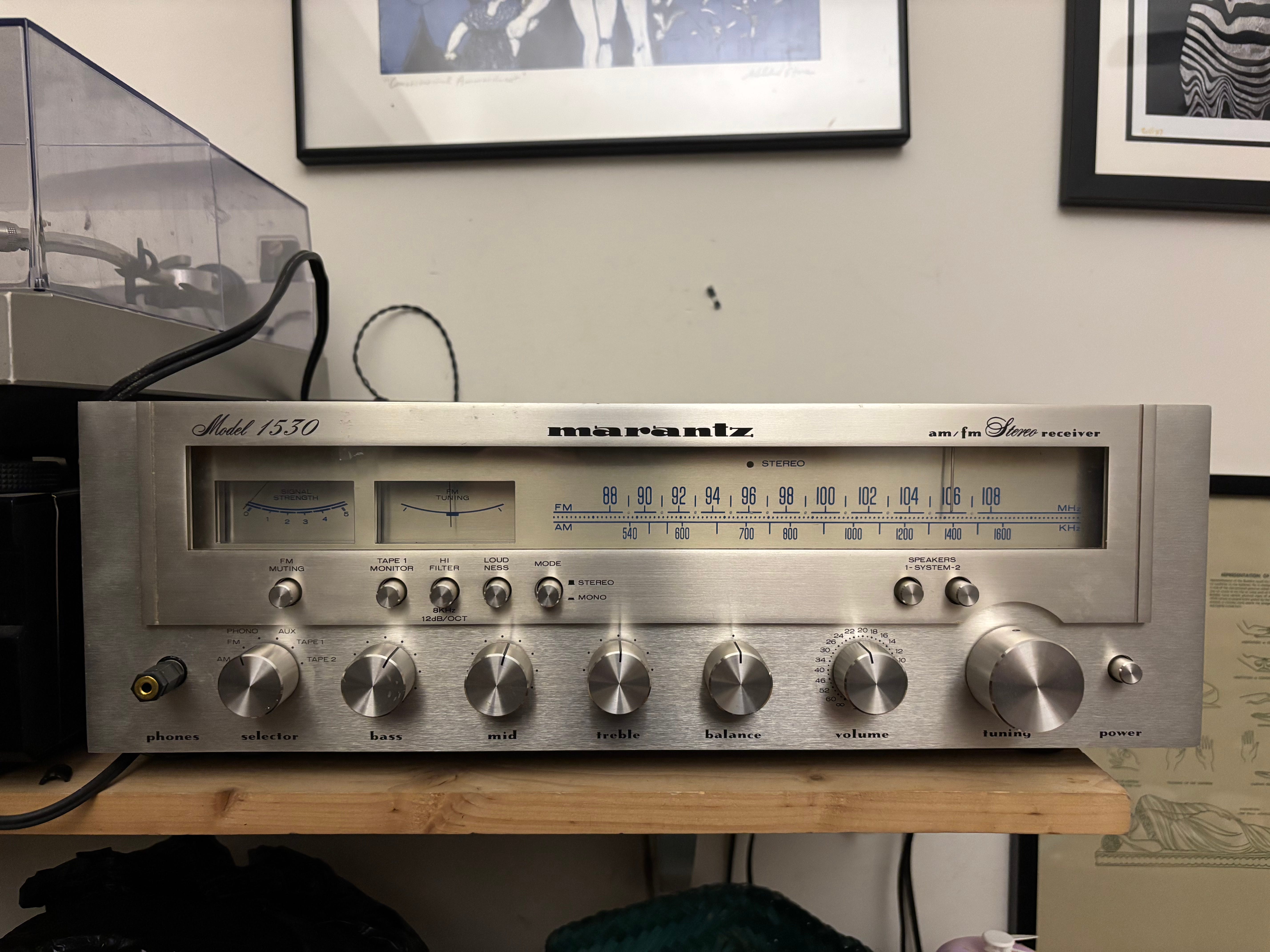
This silver-faced piece of antique electronics joins my growing collection of old stuff: 80s JBL speakers, a 70s turntable, and a few thousand records, mostly from the 50s-70s. I’ve got trombones from the 1920s, a sousaphone from the 1960s, and a tuba from the 1890s. Then there are my vintage cameras, old watches, a Remington typewriter, a Farfisa organ and a Chickering grand piano…ok, you get the picture. I’m a vintage guy, a card carrying member of the Brooklyn hipster club, a walking stereotype. Our old house is filled with male midlife crisis detritus, or what my grandmother would call hazerei. The vast majority of this stuff I got for very little money from years of dumpster diving, music libraries downsizing, ebay listings with blurry photos, and good luck. But don’t get me wrong, most days I’m composing with ProTools or Dorico, a midi keyboard, and two monitors, the setup of a 2026 music maker. My studio is a hybrid of new and old tools, like a replicant workshop in Blade Runner.
Many people into old stuff will tell you that it’s a reaction to the unsatisfying experience of using modern tech, that they are yearning for a tactile experience. They say that vinyl has a certain sound, film has a certain look, and old brass instruments have a certain tone. There’s also some nostalgia involved, although most of my stuff is actually older than my childhood, which should be properly in the mid 1980s. Neither nostalgia nor dissatisfaction with modernity adequately explains what’s going on.
For one thing, I am mostly a jazz and modern classical trombone player. Even if I surrounded myself purely with digital gadgets and had a shiny new horn I would still be playing a trombone, an instrument essentially unchanged for 500 years. I would be playing jazz, which probably peaked in the mid 60s, or perhaps the late 50s, or maybe even the mid 40s. Even if you make a living in “commercial” settings, the pop band with a horn section peaked in the early 70s. Playing classical music nowadays is even more disconnected from modernity. People have been declaring it dead for most of its existence. No wonder some of us like vintage gear. An old LP, mouthpiece or wristwatch can make us feel connected to the time of Bird or Heifetz. If humans making electronic music is now old hat (so sayeth our tech overlords, eager to replace us with LLMs), then what does it mean to play an acoustic instrument? It is even more of an act from the past, a declaration of your living in a broader “now” than just the last few years. We who play this music are practitioners of lost arts.
On the other hand, are they really lost? The 1960s were before I was born, but they were not actually that long ago, in a cosmic sense. It’s broadly in our modern era, the time of computers, space exploration and nuclear armed missiles. Why is riffing off of that music considered anachronistic? Why can’t I adapt a chord progression from 60 or 120 years ago and rework it for my own purposes? Why do we feel that an era has an expiration date, like milk?
Aha, you say, back then the pace of change was slow, and now it is fast. Music was radically different in 1970 compared to 1960. The same cannot be said for say, 1400-1410. When Bach wrote an innovative concerto it took years before it was dispersed throughout the musical world whereas Coltrane’s new records could come out in August 1963 and by September every 20-something saxophone player in New York could sing his solos back to you. A year or two later his music would be again reshaped. It was a period of breakneck revolutionary change, of year after year of creative upheaval. To follow in the footsteps of the jazz greats is to maintain their commitment to rapid development.
However, the music of 2020 is not so radically different from 2010. It seems as though the pace of change is slowing down again. For someone like Miles Davis, making 1960-style music in 1980 was out of the question. But is it OK for me to make 1990s-style jazz, or 1990s-style contemporary classical composition, whatever those might mean, even though those styles are now 30 years old? I’m not entirely sure what a 90s-style jazz record would sound like.
To complicate matters, although I love Miles, I don’t believe that someone in 1960, making music like it was 1940, is a problem. There were plenty of inspiring musicians who weren’t innovative in the same way that seismically shifting artists could be. I love listening to Paul Gonsalves, Korngold, Frederic Mompou, Ruby Braff, and Turk Murphy. I love anachronistic composers like John Williams, writing even now in a style that Schoenberg would have said was corny in 1910. Or Max Steiner, Sibelius, Vaughn Williams, Brian Easdale, Grainger, and Barber. They were aware of their anachronistic place in the music world. Consider Benjamin Britten, who in 1964 declared:
There are many dangers which hedge round the unfortunate composer: pressure groups which demand true proletarian music, snobs who demand the latest avant-garde tricks; critics who are already trying to document today for tomorrow, to be the first to find the correct pigeon-hole definition.
These folks were not necessarily living on the cutting edge like Stravinsky, Varese, or Webern. Perhaps they were 30 or 40 years behind the trends. But they made lovely, memorable music. They too confronted a crisis of modernity. They were not dealing with the unsatisfying soul suck of smart phone addiction but with the break with tonality, the move away from metric regularity, and the abandonment of the formal structures of the classical tradition.
Howard Hanson was writing singable, tuneful, skillfully constructed pieces in the same era as Cage, Xenakis, Chuck Berry, Cecil Taylor and Kraftwerk. Born in 1896 and died in 1981, he lived at least 50 years too late. His “Romantic” Symphony No. 2, written in the very-much-not-romantic era of 1930, had a sense of wonder that was co-opted into the 1982 soundtrack to ET by John Williams. Amidst the late 20th century vogue of films scored with eerie electronic sounds or pop playlists, Williams made a lush orchestral soundtrack to a popular movie about childhood innocence, nostalgia and the dangers of the modern world. It was anachronism building upon anachronism in the service of anachronism.
If I can make one prediction about the future it’s that there will be a widening split between those who embrace new tech and those who reject it. Perhaps this will mean our grandkids will have to choose between two unsavory options: getting implants and living in a dopamine-induced permanent tik tok feed or moving to the woods in a sort of MAHA/unibomber Luddite existence of growing vegetables and building water powered grain mills.
But now we are in a hybrid era, picking out activities from here and there. Consider the modern metropolis I live in: a stroll down the street can be an interaction with strata of history. A few blocks from my house is a Target that opened a few years ago, housed in an old theater from the 1930s, across the street from a church from the 1790s and a cemetery from the 1650s. The street itself, Church Ave, along with the cross street, Flatbush, are remnants of Lenape trails, hundreds of years older. All this works in conjunction to create an urban landscape.
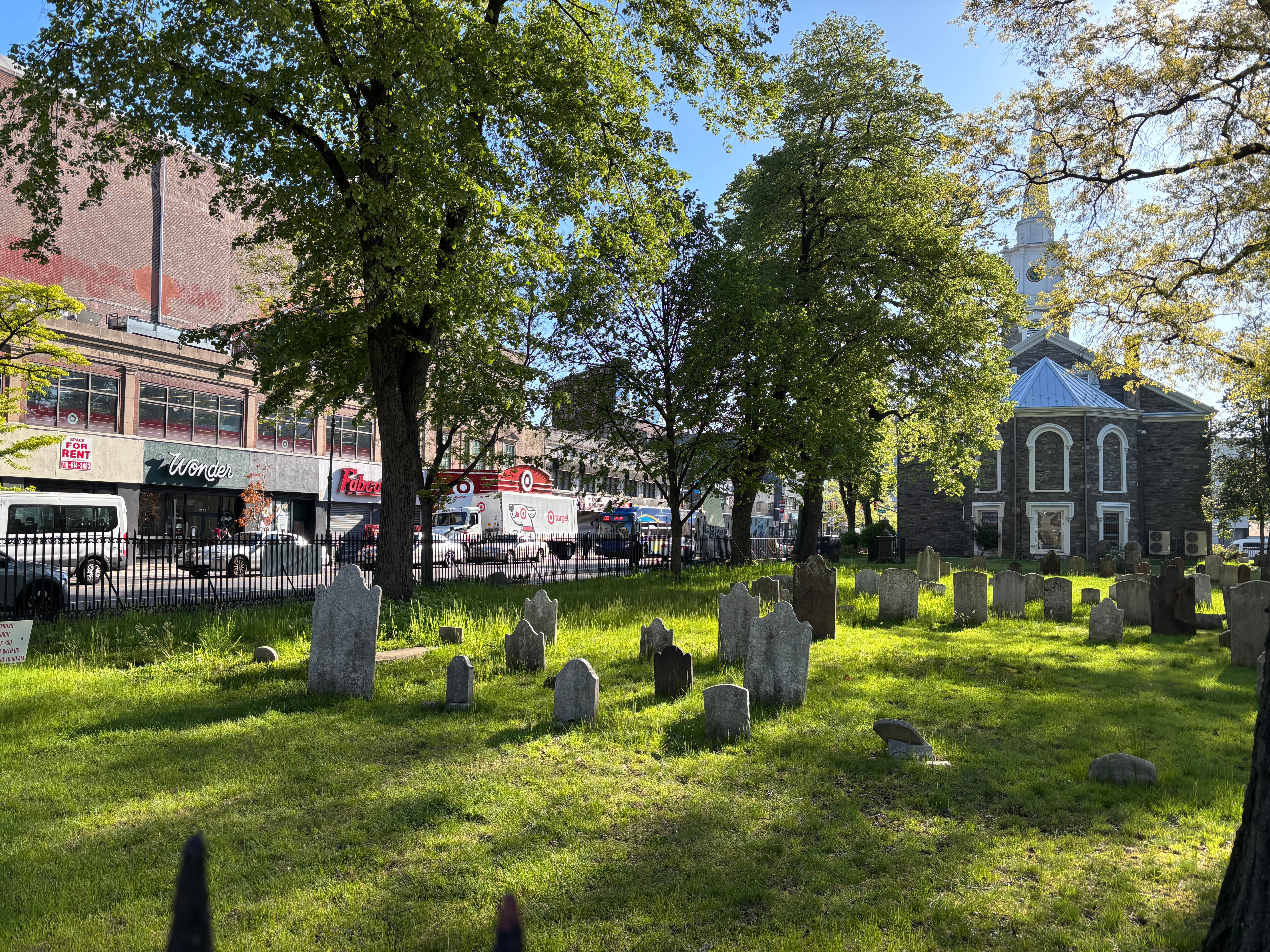
As in 1650 or 1850 we can go for a walk, draw a picture, pet a dog, or raise a child. Similarly, in music, we should be free to inhabit the past, simultaneously with the present and the future, if we want to. Play those standards or that baroque suite. Learn to sound exactly like Donald Ayler, or Donald Glover. Make that showy YouTube video in the style of the Chick Corea Elektric Band and collect those sweet likes. Live in your time.
No posts
Comments
Nothing yet. Say the first thing.
Sign in to join the conversation.