
This post is part of a series largely geared towards trombone players. I’m also going to touch on a lot of tangentially related musical goodies.
If you are trombone-articulation curious, read on. Otherwise, sit tight, I’ll have plenty of non-trombone specific content in the weeks to come. No apologies for going so deep into a niche topic. My whole career could be described as going deep into a niche topic.
Read Part 1 Introduction
Part 2 Double Vs Doodle: Ultimate Smackdown
Part 3 Mastering Single Tonguing + Double Tonguing first steps
Part 4 Teaching Jean-Baptiste Arban, Professor au Conservatoire Imperial de Musique, to swing
Part 5 Improvising with Isorhythms
J.J. Johnson was not a double-tonguer. At least, we don’t think he was.
In an interview with Tom Everett, when asked about his articulation, he said
It would be a combination of the doodle…certainly not tu-ka tu-ka [double] because I don’t do that well and it doesn’t seem to lend itself to jazz playing, jazz phrasing, for me at least. I’ve heard some guys that have had better luck than I.
However, his doodling sounds like no one else. They are often quite even. Doodle is inherently uneven and must be trained to be even. He worked hard to make his articulation sound the way he wanted.
Sometimes he plays rapid fire single notes, as 8th note triplets, in a way that sounds like double or triple tonguing. These instances sound even more even than his 8th note lines. These, too, could be doodle, but it’s also possible he did those as double and the 8ths as doodle.
Blue trombone from “J.J. In Person” (1958)
0:00
-0:06
Even his answer “certainly not tu-ka” leaves room for the possibility that he sometimes did a softer double, (“du-ga”?). Perhaps he considered that to be different. Of course, I’m projecting my own preferences here, but his answer seems to leave room for the possibility that he mixed different tonguing techniques. He said “some combination” but never really finished the sentence to say what he was combining doodle with!
Regardless of what he did, I have found that double tonguing suits the playing I do, and double tonguing the vocabulary of J.J. Johnson is a good path to increasing fluency with the technique.
There are important lessons to be learned in studying J.J’s fast vocabulary. One is the absolute economy of motion. The vast majority of his fast phrases are built on a certain register, from about middle F up to high C#. This allows most everything to be played in positions 1-5, and the majority of it 1-3.
When I first moved to New York in 1959, I was stumbling around trying to find my bearings and going to clubs to see what was going on. One Monday night at Birdland, I happened upon a jam session that J.J. Johnson was in. I watched him play that trombone and was amazed at this technique. Instead of using the entire slide he was extending the slide only half way out while still managing to hit all the notes he needed. That got me thinking about my bass and how to get that same effect of covering a lot of territory without a lot of physical effort…
I remember thinking that he must have figured out all the notes available in each position he played in, so that when he wanted to play a note he wouldn’t have to push the slide out as far as other trombonists.
J.J. held the slide very loosely. This video from 1961 shows his slide technique was very relaxed. Sometimes he let momentum pass the slide from resting on his index finger to against his thumb for the distance of a position or two. You can also observe how his slide movement anticipated his articulation. He lands on the position before he starts the note.
Apart from being a sterling improviser, J.J.’s perfect articulation was revered even beyond the world of trombonists.
In Aidan Levy’s Sonny Rollins biography Saxophone Colossus: The Life and Music of Sonny Rollins, the author posits that Sonny Rollins’s articulation came, in part, from imitating his colleague J.J. Johnson.
Like a trombonist, who needed the deliberate intentionality to coordinate slide and embouchure to speak, Sonny’s syncopated runs were not just in his fingers, which in lesser players had a way of getting ahead of the mind’s ear as they flew up and down the body of the saxophone - he too was speaking…This propensity for a speech-like style is in part why throughout Sonny’s career, so many of his interlocutors were brass players - and J.J. Johnson was one of the first.
Another key innovation is the adaptation of bebop phrases to the trombone through careful editing, using ghost notes and rests, to make them more suited to the instrument and more rhythmically varied, to play a kind of “subtracted bebop”. Playing a bebop 8th note line and you can’t get to 5th position for F# without breaking up the flow? Replace the F# with a rest.
In a 1977 interview, George Lewis said this:
J.J. Johnson. Let me say something about him because I think he’s a far-out cat. For me he’s the cat who shows the direction that the instrument can really take if you really think. Because he thought. And that’s the thing that really wipes me out about him, that he’s a thinking guy - he had to think about how to play that fast. I’m seeing now the approach he had to take to think about the possibilities of playing quickly on the trombone, getting over the horn in a big hurry, because I had to go through the same process and lots of musicians have described to me the processes they used by which they jump over a certain hurdle to get to the next one. Through a very logical process of deduction. It’s very cold and analytical.
I’m going to assume you have diligently done all the steps mentioned in previous installments of this series. I’m also assuming you have dipped into the world of solo transcriptions, and possibly have done some of the easier J.J. Johnson solos. You have to be able to play simple solos first that don’t have streams of fast notes that require multiple tonguing. Then start with single note repetitions. Then small bursts of 8ths. Finally, take on longer streams of 8ths like those presented in these excerpts.
There is a strange idea going around the trombone world that learning J.J. Johnson solos is somehow “easy”, compared to solos from virtuosic later players. Perhaps some of them are straight forward. But putting together this essay and the accompanying sound clips, re-acquainting myself with solos I hadn’t studied in decades, I actually found that they were fiendishly difficult. The meticulous technique, perfect sound, and lightning fast slide movement are all quite hard to do!
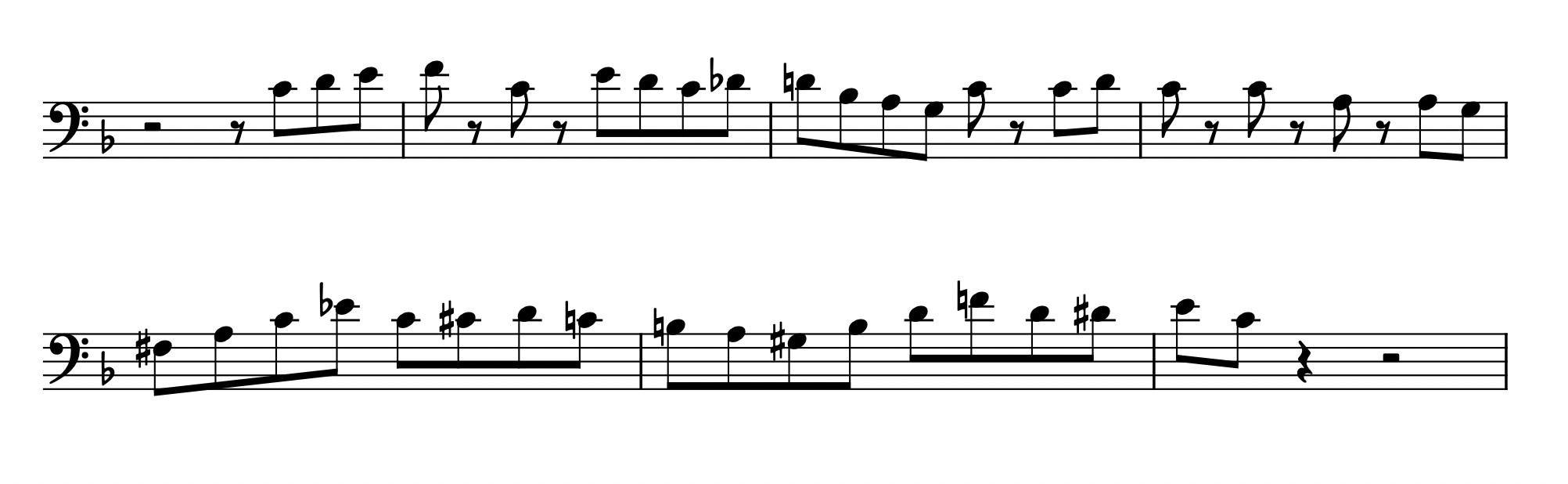
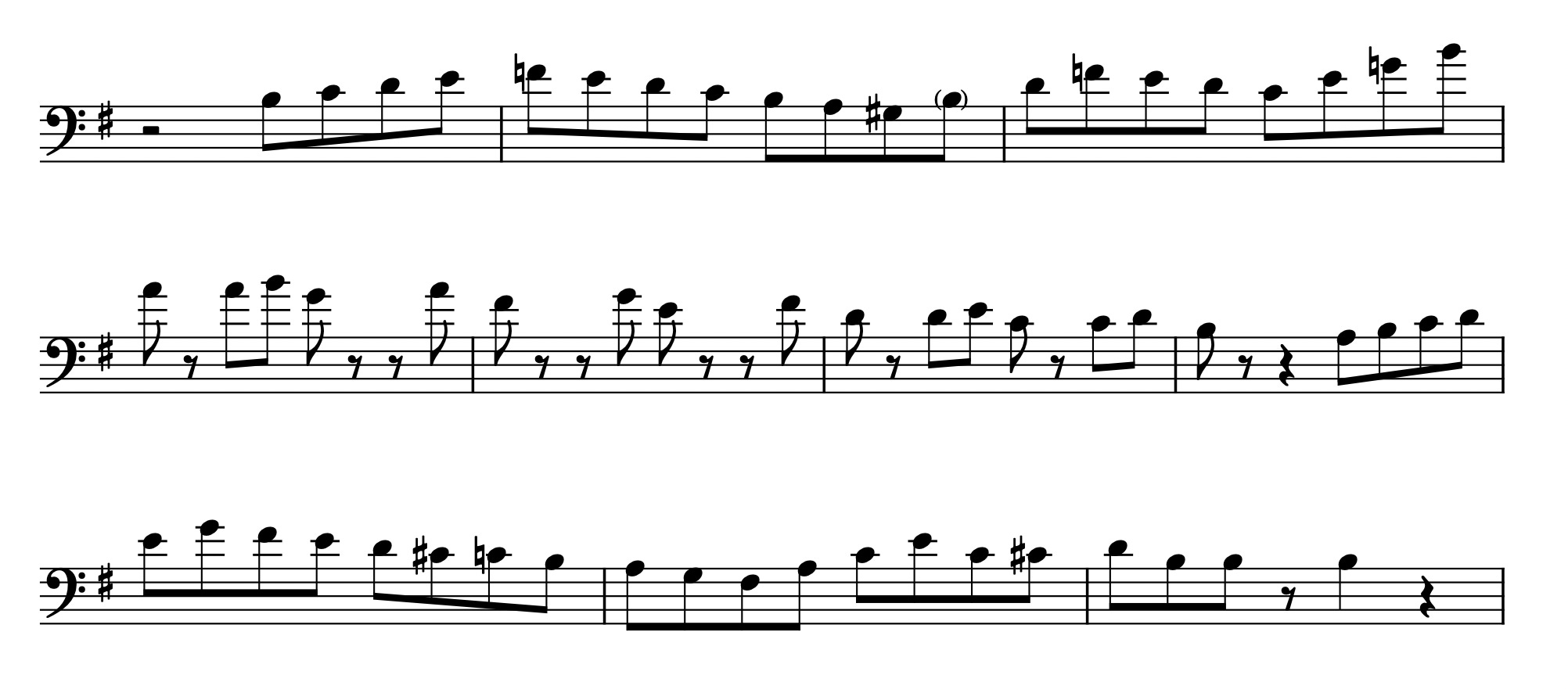
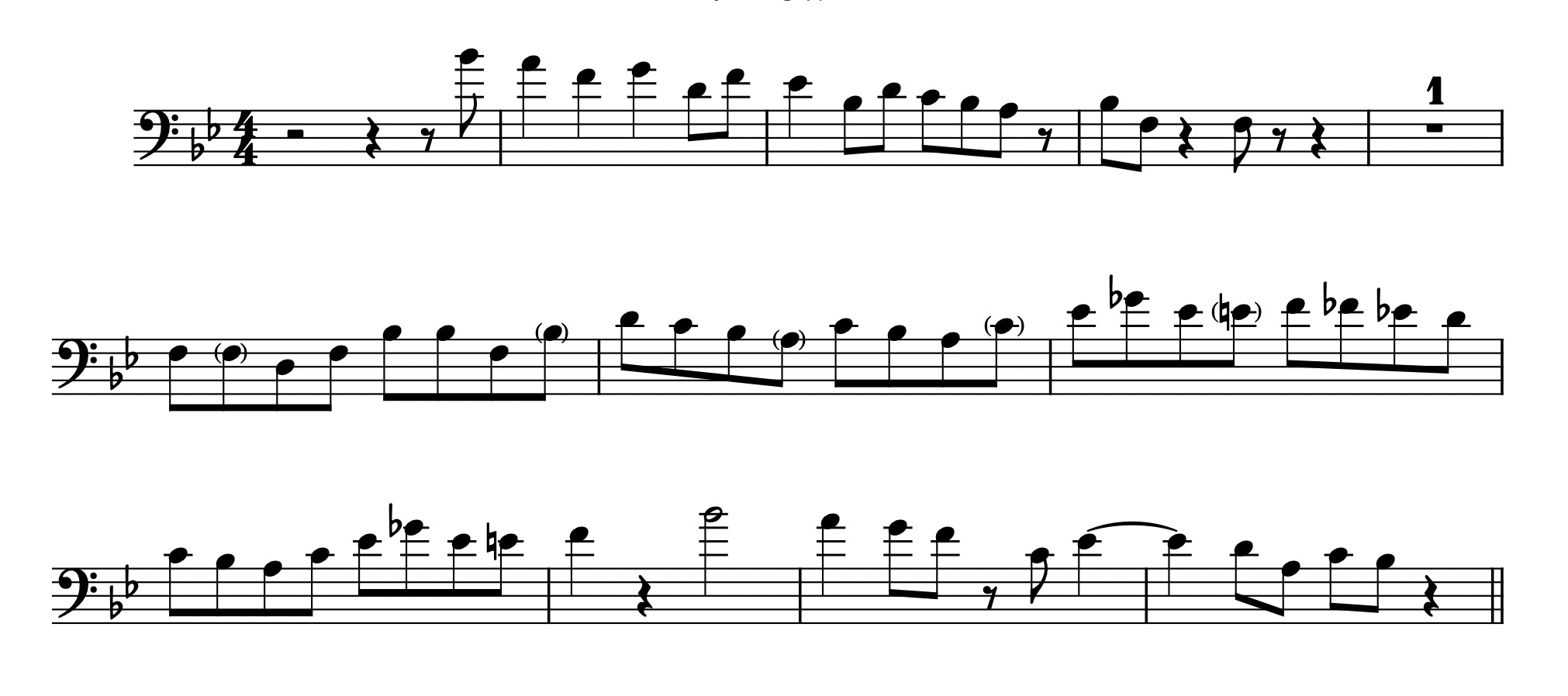
In presenting these examples, I include 3 versions of each phrase, one with just me playing, one with J.J., and one with both together. All are done here at tempo, but when you are learning these, start slower.
I tried to pick phrases that are streams of 8th notes. As I have discussed, J.J. didn’t always do that many unbroken streams of 8th notes. The more a phrase is broken up, the easier it is to articulate with a multiple articulation. Longer streams are the most difficult to pull off. The tongue gets fatigued after 4-6 notes. Getting to 16 or more notes in a row takes stamina.
Tips:
If there’s a natural slur option, take it. Don’t tongue unless you have to.
Use alternate positions to make the minimum of arm movement. This doesn’t necessarily mean every note is an alternate position - sometimes that will result in herky jerky slide movement.
Articulate as lightly and as little as possible. If there’s an unintended glissando here and there the result will still be better than over-articulating.
The goal is not to clone. I don’t think I sound like J.J. Johnson here. The goal is to study. See what he did, how he created this style, how it fits on the instrument. Eventually make it your own.
Here they are, in order of difficulty
From The Eminent J.J. Johnson vol 2 (rec 1954)
Coffee Pot - just fast enough that it almost definitely needs to be done with multiple tonguing
quarter=~280
original
0:00
-0:05
with me playing along
0:00
-0:05
with just me
0:00
-0:05
Jay example 1 - Another example of the type of repeated note phrases that seems like it could be du-gu-du-gu? You tell me.
quarter=~300

Original
0:00
-0:03
Both
0:00
-0:03
just me
0:00
-0:03
Jay example 2 - not too many notes, but fast
quarter=~300

0:00
-0:02
0:00
-0:02
0:00
-0:02
From “J.J. in Person” (rec 1958)
Laura - Double time on a ballad but I have notated it as 8ths rather than 16ths, to show the relationship to the other examples
quarter=~300
I would not use alternate positions for the first long phrase or the last one. Conventional positions on these make smooth motions and avoid the herky jerky.
0:00
-0:08
0:00
-0:08
0:00
-0:08
The Eminent J.J. Johnson Vol 1 (rec 1953)
Turnpike - the ghosted notes here really give you a sense of “subtracted bebop”
quarter=~340
0:00
-0:08
0:00
-0:08
0:00
-0:08
Next part: More solos. Incorporating double tonguing into your daily life. All double tonguing all the time.
No posts
Comments
Nothing yet. Say the first thing.
Sign in to join the conversation.