
This April, while on a semi-regular trip to DeepMind HQ in London and with nothing better to do, I took a solo weekend jaunt up into the British countryside. I picked Cambridge off a map, a city I assumed, on no basis other than the name, would be similar to Cambridge, MA, which I love. I left my bags in the office and took only a clothing-stuffed running vest with me, having hatched a spur-of-the-moment plan to run from Cambridge through some ruddy Thomas Hardy heath to a dimly-lit B&B in a small neighboring town. The vest came in handy almost immediately as I sprinted across Coal Drop Yard to catch the next 2-hour train from King’s Cross.
Cambridge, sadly, was a bit of a wash, as was my plan. Cambridge is rather sad, a small, compulsively antique town full of touristy stores and closed college campuses (to their immense credit, MIT and Harvard open their quads and buildings to strangers). Rather more upsettingly, sometime in the 20th century the British built roads, and the endless golden scrub-brush hills of Chesterton’s wanderings seem to have gone. After failing to find a running path, and then stumbling across a copy of W. G. Sebald’s “The Rings of Saturn” in a local bookstore, I decided instead to take a second late afternoon train to Ipswich, a small city on the eastern coast.
The train to Ipswich was a small one, run by the East Anglia company which until recently ran all the trains in this poor corner of the country. East Anglia, north-east of London along the coast, has two major cities: Ipswich and Norwich, both fishing towns dating to early in England’s history. Sebald, who taught in Norwich for many years, paints late ‘90s East Anglia in dusken, funerary colors. Twenty years later, I was curious to see what it had become.
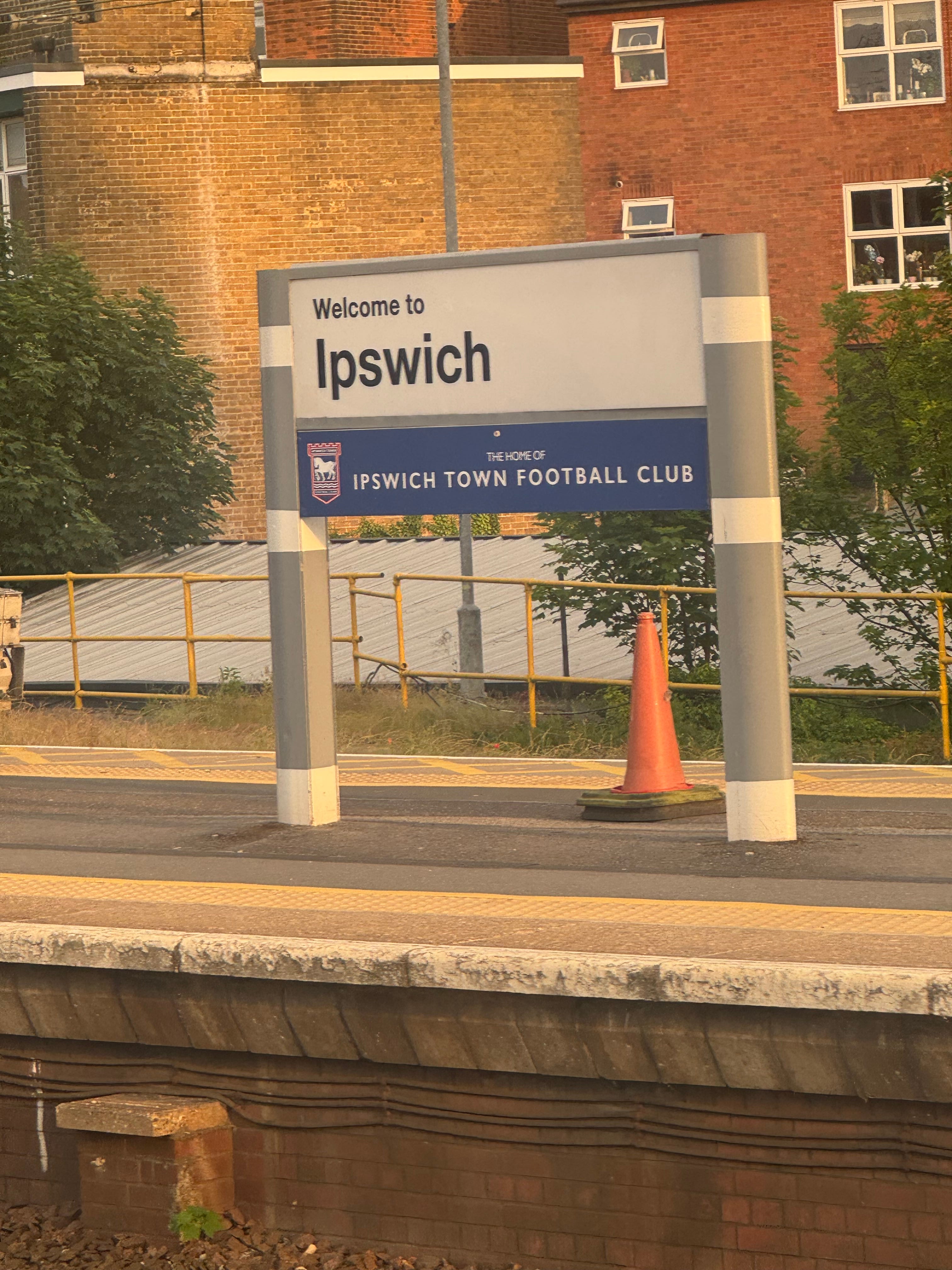
Taking a seat on the train, I came down with perhaps my worst ever case of hay fever, resulting in an unpleasant hour of sneezing and crying in the corner of a train car. I did not feel much better when I got off at the small Ipswich station, so I walked a mile past boarded up stores and a trans rights protest to what was probably the nicest hotel in town and got a room and a late, solitary steak dinner in the corner of the dining room. The steak was pricy, even by NYC standards. Google’s accountants might have been surprised by that expense report.
I did not sleep well (even after about 5 antihistamines) and woke up around 5AM with a sinus headache. At 6, I gave up on sleep and walked into the early morning sun to find a drug store that would sell me ibuprofen. As is usual in the UK, the only store open was Tesco Express, where a cashier with emaciated, methamphetamine-sculpted cheeks fixedly refused to sell me more than one container of ibuprofen. “It’s against our store policy, sorry!” Still unable to sleep, I sat alone with a coffee on the waterfront and watched the gulls.
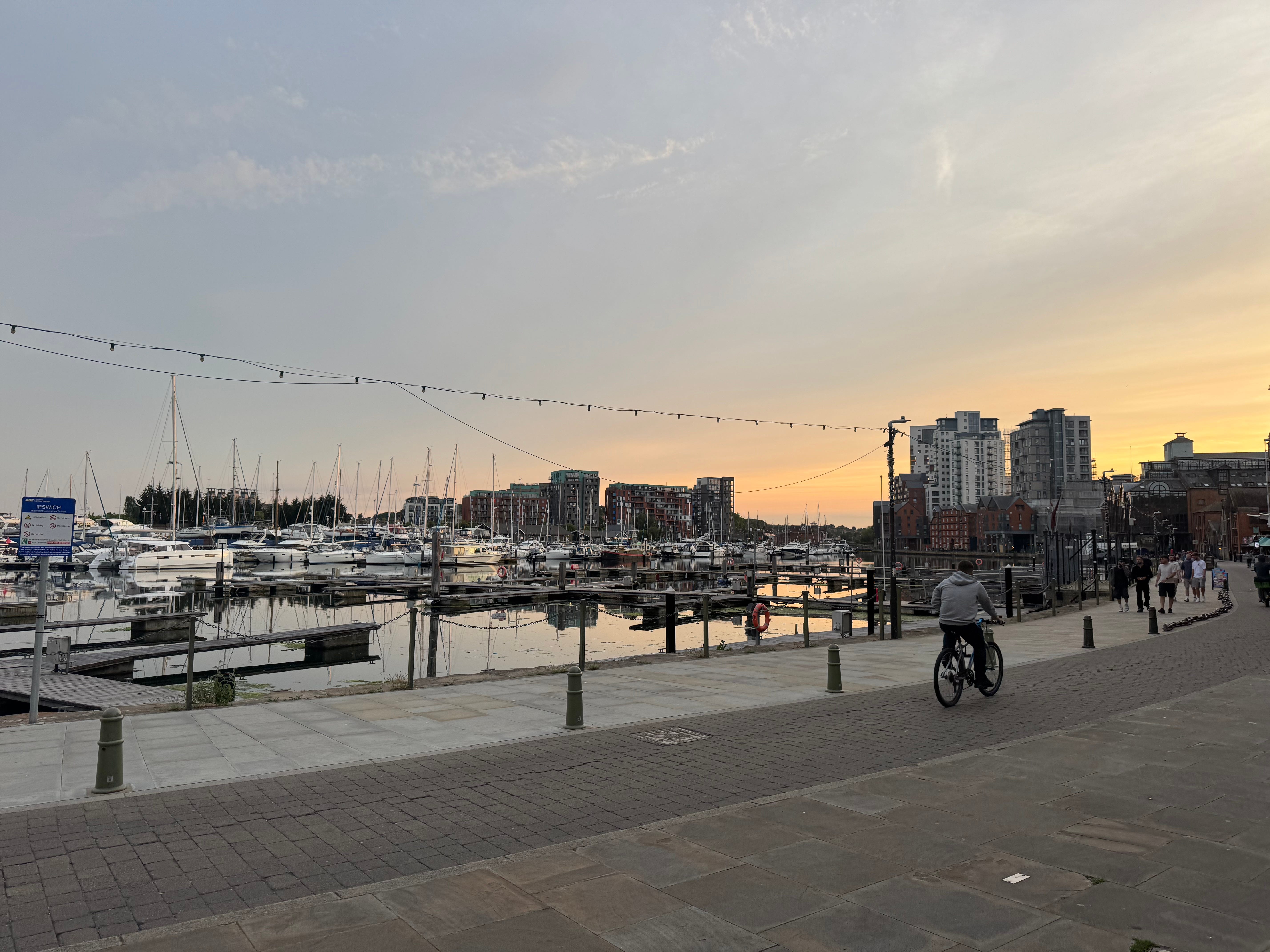
In the early morning, Ipswich is a mournful place. Nothing is open and only a few people are out. The boarded-up storefronts are more prominent, and the waterfront which was clearly at one time an active fishing harbor is silent except for cheap sailboats rocking against their mooring. After an hour a man perhaps five years older than me pulled up on a bike and hesitantly introduced himself. His speech was labored seemingly from a mild intellectual disability, but he was clearly quite lucid.
“Where are you from…from”, he asked, leaning against his handlebars.
When I told him I was from New York City he asked, “Why…why are you here?” I’d gotten the same reaction from the attendant at the hotel. Both looked slightly bewildered when I said I’d read about Ipswich in a book. When I asked in turn how he liked Ipswich, he looked down and away at the waterfront and after a while said, “There are worse places…It’s home”. After a few more minutes, he offered to show me around the city, an offer I, perhaps out of awkwardness or insecurity, declined.
Reflecting on it now, our conversation has a particular poignance for me, likely what inspired me to write this. Meeting strangers in a strange land, you are confronted by how we are living in history. This man, like the boarded-up stores, the cashier at the Tesco, represents a point in the trajectory of Britain, as I represent some piece of the history of AI, of capitalism, of technology, of America. There in this place, unfamiliar to each other, speaking the same language, we played out a piece of this story. Ipswich feels like a city in decline, as I’m sure it did in the 90s and the 80s. Maybe it’s declined so much it is no longer “in decline” as much as in some languishing steady state. But to see this degree of poverty in a country that at one point ruled the world is sobering. To be the representative of the new guard in such a place is strange and romantic, a kind of Hemingway-in-Europe but without the bulls, the glamour or allure, only a longing for the past.
Comments
Nothing yet. Say the first thing.
Sign in to join the conversation.