
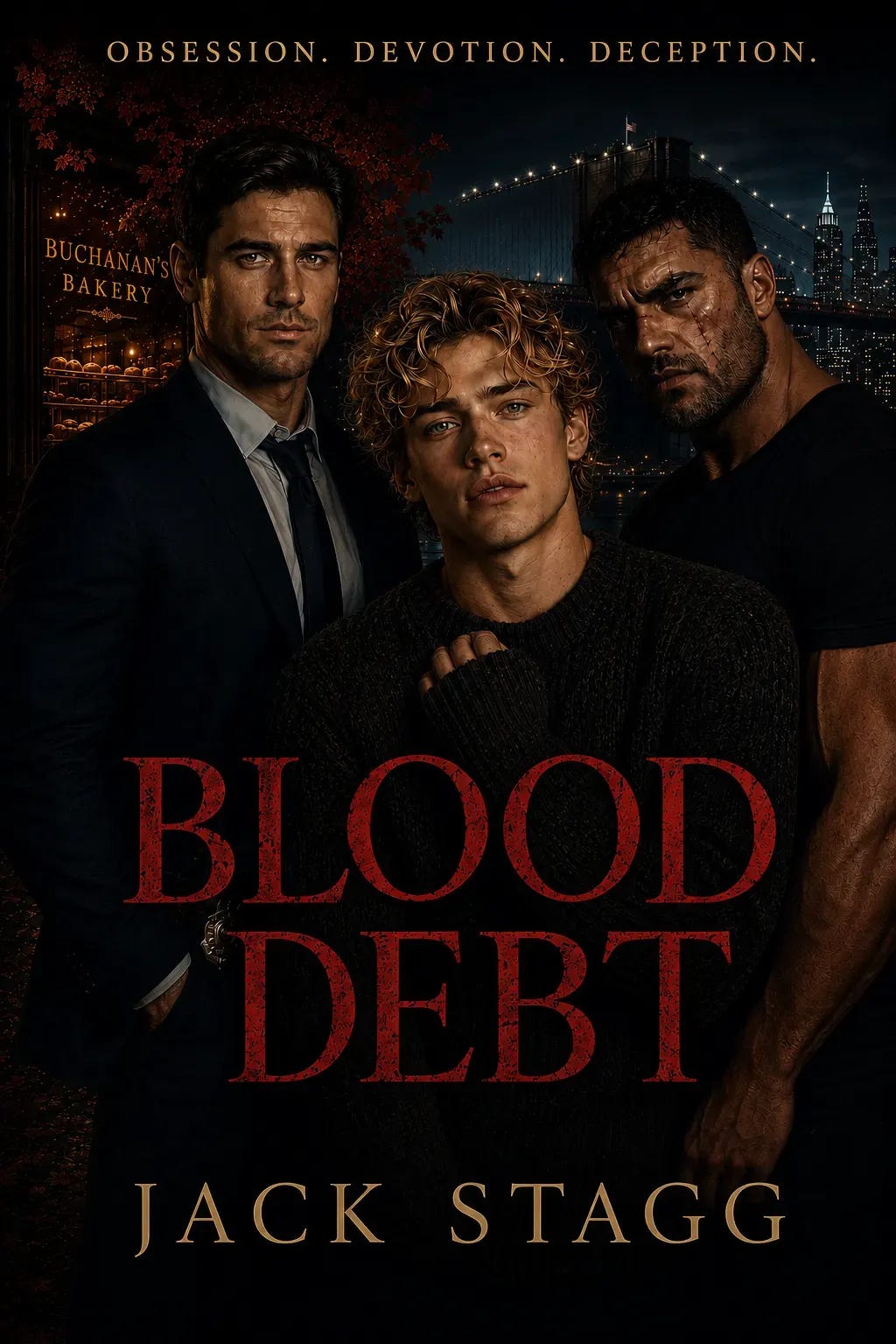
Two hours had passed since Colby Davenport had called Oliver a murderer in front of a television crew and Oliver was still brushing his cat.
He was sitting cross-legged on the living room floor, his back against the armchair, Marshmallow draped across his lap in a boneless sprawl of white fur. The fire was lit. The apartment was warm. Below him, through the floorboards, he could hear the muffled rhythm of the bakery — Lily’s voice at the register, the hiss of the espresso machine, the soft percussion of ceramic on wood. Lily had taken over without being asked and Oliver had climbed the stairs and locked the door and sat on this floor and started brushing his cat and hadn’t stopped.
The coat was immaculate, every strand lying flat and gleaming, and Oliver kept brushing because his hands needed something to do and if he stopped moving them he was going to start replaying it again. Colby’s voice in his bakery. The camera’s red light. Lily’s white face. Cal on his feet. And somewhere in a Channel 7 editing suite, every second of it was sitting on a hard drive, waiting to be cut together, waiting for a producer to decide whether a grieving widower accusing a beloved baker of murder was tragedy or entertainment, and Oliver already knew which way that decision would go.
Oliver’s breathing was steady. His hands weren’t shaking. Marshmallow purred beneath the brush and Oliver’s body sat on the living room floor doing a convincing impression of a man who was fine. His mind was somewhere else entirely. It was running calculations with the same clinical precision he brought to diagnosing a pneumothorax or balancing a hydration ratio, except now the patient was his life. He worked through the variables one by one, each scenario slotted into place, examined and stress-tested.
The segment would air. Maybe tonight, maybe tomorrow, maybe next week, but it would air and when it aired, people would react. The question was how many and how badly.
The newcomers would be the first to go. The TikTok crowd, the New Yorker tourists, the people who’d lined up around the block for a financier they’d read about in a magazine — they had no loyalty to Oliver. They had loyalty to a story, and the moment that story curdled from hero baker into accused killer, the line would evaporate. Oliver could survive that. The bakery had existed before the article and it would exist after.
What kept his hand moving on Marshmallow’s coat, shoulder to tail, shoulder to tail, was the other calculation. Meredith. Camille. The couple from the block who waved and ordered without checking the menu. The father who brought his daughter every Saturday for a croissant and a hot chocolate. Would they watch the segment and come back the next morning? Would they sit at their usual tables and look at Oliver like they always looked at him, or would something have shifted behind their eyes, a question they wouldn’t ask but that Oliver would see anyway, the same sideways reassessment he’d watched happen at Lennox Presbyterian, one face at a time, until there were no faces left?
Oliver could rebuild a customer base. He couldn’t rebuild trust. Not again. Not a second time.
He could call Dana James. Appeal to her decency, ask her not to air the footage. Oliver could be persuasive, he could make his voice do the thing it did, soft and bruised and reasonable, and Dana was a human being before she was a journalist. Maybe she would listen. She’d looked genuinely shaken when Colby started shouting. But Dana was also a professional, and the footage she had was better than anything she’d walked into the bakery expecting to film, and Oliver knew, because Oliver understood people, understood what they would do when self-interest and sympathy pulled in opposite directions, that Dana James would air the segment and feel bad about it afterward and that the feeling bad would not undo the airing.
He could call a lawyer. He’d thought about this before, during the investigation, and had decided against it because lawyers cost money Oliver didn’t have and because hiring one looked defensive and defensive looked guilty. That calculation hadn’t changed. If anything, it had gotten worse: a baker who lawyered up after being called a murderer on camera wasn’t a man protecting himself, he was a man who had something to protect himself from. The distinction was everything. Or he could call Trevor. Trevor would come, he would drop whatever he was doing and drive across Brooklyn and hold Oliver and tell him everything was going to be fine. But Oliver hadn’t told Trevor about Colby, because telling Trevor meant telling him that someone was accusing Oliver of murder, and Trevor, who had staked his career on Oliver’s innocence during that investigation, who had fought for Oliver when nobody else would, would not hear that information and stay calm. And every move Trevor made on Oliver’s behalf would invite someone to ask the obvious question: why is Detective Holloway so personally invested in this case?
Oliver couldn’t let that question get asked.
He could do nothing. Wait. Let it air. Let the wave hit and see what was left standing when it receded. Oliver was good at waiting. Oliver was built for endurance, for the slow work of surviving something by outlasting it. He had done it after Patrick. He had done it after the investigation. He had rebuilt once from wreckage and he could do it again because Oliver Buchanan’s hands were steady and his nerve was good and those things were his and nobody, not Colby Davenport, not a Channel 7 segment, not a headline, not a ghost, could take them.
The brush moved through Marshmallow’s coat. Shoulder to tail. Shoulder to tail.
The doorbell rang.
Marshmallow’s head lifted Oliver’s lap, aimed at the side door, and ten he was up and moving. He reached the door and sat at the base of it, tail curling around his paws, staring up at the handle as if expecting it to open by sheer feline will. Oliver set the brush down and followed him. He pressed his eye to the peephole.
Joey was filling the small circle of glass, standing on the iron landing at the top of the stairs, his breath visible in the October evening, and something about the set of his jaw told Oliver that Joey already knew.
Oliver opened the door.
“Doc,” Joey said, the single syllable carrying more weight than it should have been able to hold.
His dark eyes were moving across Oliver’s features, reading him, and whatever Joey found on Oliver’s face made something shift behind his own.
“Hey.” Oliver said.
Between them, Marshmallow had discovered Joey’s boots. The cat was threading himself between Joey’s legs in tight figure eights, his white body winding around one ankle and then the other, his spine arching upward to press against Joey’s shins, purring loudly enough that Oliver could hear it from the doorway. Marshmallow did that to everyone, as if the cat operated on the fundamental assumption that every person alive existed specifically to pet him.
Joey looked down, and then, to Oliver’s genuine surprise, he crouched. The operation took a moment, all that mass folding itself downward, and he extended one big paw toward Marshmallow, fingers first, letting the cat come to him. Marshmallow pushed his head into Joey’s palm without hesitation and Joey scratched behind one ear, gently, his massive fingers impossibly careful against the small white skull. Oliver watched from the doorway. Joey Knight, who communicated in grunts and had walked out of a hospital eighteen hours after a collapsed lung because no one on earth could make him stay, was crouching on Oliver’s landing petting a cat, thumb behind the ear, fingers under the chin, finding the spots that made Marshmallow’s eyes drift shut and his purr climb an octave.
“Yours?” Joey asked, without looking up.
“Marshmallow,” Oliver said.
Joey looked up at him from the crouch and one eyebrow raised.
“I didn’t name him for his toughness,” Oliver said. “Come inside.”
Oliver watched Joey take in the apartment, his eyes moving across the room methodically, missing nothing. They landed on the bookcase crammed with medical journals and poetry. On the fireplace, fire still glowing. On the apothecary cabinet with its dozens of tiny drawers. On the sage-green armchair, the cream settee, the botanical prints, the ceramic vase with its dried eucalyptus. Joey absorbed all of it in under ten seconds and his face gave away nothing about what he thought, which Oliver found simultaneously impressive and infuriating. Then Joey’s eyes landed on Oliver’s face and stayed there.
“You okay, Doc?”, Joey asked.
“How did you know?”
“Laptop guy filled me in.”
“Since when are you and Cal friends?”, Oliver said, raising his eyebrows at Joey.
“Who’s Cal?”
“Laptop guy.”
Joey shrugged.
“We talk.” His eyes were still looking at him. “That was fucked up, what happened down there.”
It was Oliver’s turn to shrug, but the gesture felt borrowed on his shoulders.
“It’s fine. I’m fine. Just needed a moment to myself.” He looked down at Marshmallow, who had abandoned Joey’s ankles and was now headbutting Joey’s shin with increasing urgency. “And with Marshmallow.”
Joey glanced down at the cat, then back at Oliver. His head tilted a fraction.
“You and your cat got the exact same eyes,” he said. “Same blue.”
Any other day, Oliver would have loved hearing that. That day, however, Oliver just, and even he could feel it sitting wrong on his face, the shape right but the fit off by just enough to notice.
Joey noticed.
“Let’s go,” he said, nodding toward the door.
“Hm?”
“Let’s take a walk. Better than sitting up here with it.”
Oliver didn’t move, and Joey clapped once, the sound enormous in the quiet apartment.
“Grab your coat. Let’s go.”
Oliver sighed, but he did as told. He grabbed wool coat from the hook by the door, deep teal blue and oversized just like he liked, and crouched to say goodbye to Marshmallow. Then Oliver followed Joey down the iron staircase and into the cold street.
The October afternoon was fading around them as they stepped off the iron staircase. Degraw Street was in that transitional hour between day and evening, the sky above the brownstones a bruised amber, the sun already gone behind the buildings but its light still lingering in the upper windows and the tops of the trees. Cobble Hill was alive around them — a woman pushing a stroller with a coffee in her free hand, a man in a suit walking fast with his phone pressed to his ear, two kids on bikes weaving between pedestrians, an older couple sitting on their stoop sharing something from a paper bag. The maple tree outside the bakery had dropped its daily offering of gold and copper leaves across the sidewalk, and they crunched underfoot as Oliver and Joey walked through them. The air smelled like wet stone and roasting garlic from someone’s open kitchen window and the cold that meant November was coming whether Brooklyn was ready or not.
They walked side by side and people stared. A couple walking their dog crossed to the other side of the street without making it obvious they were crossing and a woman coming out of a bodega on the corner held the door open and then froze for a moment, her eyes traveling up Joey’s frame. Oliver couldn’t blame them. They must have looked like something out of a casting mistake: Joey, enormous in his ever-present leather jacket, the scar catching the light from the streetlamps, Oliver beside him in his blue wool coat and corduroy trousers looking like he’d wandered out of a storybook and taken a wrong turn into a crime thriller.
“People stare at you everywhere you go, don’t they?” Oliver said, as they turned onto Court Street, where the foot traffic thickened and the staring became less subtle.
“Pretty much.”
“Doesn’t bother you?”
“Used to it.”
Oliver hummed.
“How tall are you, anyway?”, he asked.
Joey glanced down at him. “Six-seven.”
Oliver let out a low whistle. They passed a bodega with a green awning that hung out over the sidewalk, its metal frame slightly bent from years of Brooklyn weather.
“Can you touch that?” Oliver asked, pointing up at the awning’s edge.
Joey rolled his eyes, but, as they passed beneath it, he raised one arm, barely trying, almost lazy about it, and the tips of his fingers scraped the metal frame. He didn’t break stride. Oliver grinned. They walked another half-block. A basketball hoop hung over a driveway on the right side of the street, regulation height, ten feet.
“What about that?” Oliver asked, pointing.
“Don’t push it, Doc,” Joey grunted.
Oliver snickered and the sound surprised him, completely at odds with the afternoon he’d had. Something about walking next to Joey, about the cold air and the stupid height game and the absolute absurdity of the two of them side by side on a Brooklyn sidewalk, was loosening something that had been wound tight inside Oliver’s chest for hours. Joey had been right about the fresh air. By the time they crossed Smith Street, the images from the bakery had receded from the front of his mind to somewhere further back, still present but no longer pressing against the inside of his skull.
Cobble Hill Park was two blocks south. Oliver could see the trees from here, their tops catching the last of the amber light, and something in his chest pulled toward them. He used to run through that park every morning, before the bakery. Five-thirty, before dawn, when the paths were empty and the only company was the birds and the occasional other lunatic who thought that running in the dark was a reasonable way to start a day. He’d loop the park twice, three times, feeling his lungs fill with cold air and his legs find their rhythm and his mind go blissfully quiet. After he opened the bakery, the mornings had been swallowed by proofing schedules and oven temperatures and five a.m. bakes, and the runs had stopped, and Oliver hadn’t realized how much he missed them until right now, walking through his own neighborhood with cold air on his face for the first time in months.
“Want to walk through the park?” Oliver asked.
“Was thinking more like a drink,” Joey said.
“Joey, it’s barely six.”
“Exactly. Night’s just getting started.” Joey nodded down the street. “I know a place near here. I’m buying.”
“You’d better be,” Oliver said. “Ok. Lead the way.”
It was still too early for drinks. Oliver maintained this position firmly and internally while his feet followed Joey down Smith Street without hesitation, because the truth was that curiosity had already won the argument. In three weeks of six-fifteen mornings, Joey Knight had offered almost nothing about his life outside the bakery. No address. No job. No explanation for the scar or the silent boots or the expensive cologne or any of the hundred small contradictions Oliver had been cataloguing and filing away without answers. Joey sat on his stool, drank his sugar coffee, brought his terrible candles and deflected every personal question with the same invisible skill Oliver used himself, and Oliver had respected that, had given Joey the same privacy Oliver demanded for his own locked rooms.
But Joey was taking him somewhere now, his own territory, and Oliver was not going to waste the first voluntary glimpse inside Joey Knight’s world by suggesting they look at trees instead.
The bar was called The Bloodhound. Oliver knew this because of the sign hanging above the door — a wrought-iron silhouette of a hound mid-stride, nose to the ground, painted a deep rust red that had faded and chipped in places but that someone still bothered to maintain. It sat on a corner half a mile from the bakery, one of those places you’d walk past a hundred times without noticing and that was clearly the point. No other signage, no hours posted, just the iron dog and a heavy wooden door with a brass handle worn smooth by decades of hands. Oliver had lived in this neighborhood for two years and never once registered its existence, which, he was beginning to suspect, was also the point.
Inside was exactly what Oliver had expected, and exactly the opposite of everything Oliver would have chosen for himself. Low ceilings, dark wood paneling, the permanent smell of beer and peanut shells and something leathery that had soaked into the walls over the years. A long bar ran the length of the room, scarred and stained and polished in patches where elbows had been resting since before Oliver was born. Mismatched stools, most of them occupied. A pool table in the back under a hanging light with a crooked shade. Two televisions mounted on opposite walls, both tuned to ESPN, the volume just loud enough to provide a baseline of noise without requiring anyone to actually watch. The lighting was amber and low and forgiving in a way that suggested the management understood that some of its clientele preferred not to be seen clearly.
The clientele matched the room. Big men, mostly. Thick necks and heavy hands and faces that had been lived in rather than maintained. Men who drank beer from bottles and didn’t look at the cocktail menu because there wasn’t one. Men who spoke loudly and laughed louder and settled arguments with a look before they became arguments. Oliver could easily picture Joey here, planted on one of those worn stools, a bottle of Budweiser in his massive hand, a plate of nachos going cold beside him because he’d gotten distracted trading insults with someone equally scarred and equally enormous, both of them shouting at the television every time the Giants’ offensive line did something unforgivable.
Joey was a regular, that much was obvious before they’d made it three steps past the door. The bartender, a thick-necked man with a shaved head and a tattoo creeping up the side of his neck, looked up, saw Joey, and reached for a bottle without being asked. A man at the pool table paused mid-shot and nodded. Another at the bar, enormous, bearded, with hands that made the pint glass look like a thimble, raised two fingers in a silent greeting. Joey returned each one, a nod here, a chin lift there. Then their eyes found Oliver, and Oliver could see the collective recalculation happening in real time as a roomful of men who looked like they chewed gravel for breakfast tried to figure out why Joey Knight had walked into The Bloodhound with a golden-curled man who looked like he’d taken a very wrong turn on the way to a farmer’s market.
Color rose in Oliver’s cheeks. He was used to being stared at by men in bars. It had been happening since puberty hit and his ass got rounder and his lips got fuller and he’d learned that a certain kind of male attention followed him into every room he entered whether he invited it or not. But that was different. That wasn’t desire, was assessment. Every pair of eyes in The Bloodhound was asking the same question, and Oliver was fairly certain the question wasn’t phrased with hell.
He took a step closer to Joey.
“What are you drinking?” Joey asked as Oliver slid into a booth near the back.
“I was thinking maybe a Cosmo?”
Joey stared at him.
“Please tell me you’re joking.”
Oliver grinned and it felt good on his face, like stretching a muscle he’d forgotten he had.
“I’ll have whatever you’re having.”
Joey gave one of his grunts, the one Oliver had catalogued as reluctant approval, and made his way to the bar. Oliver watched him go. He leaned against the counter and said something to the bartender that Oliver couldn’t hear. The bartender nodded and reached for two glasses. Joey was easily the biggest man in the room, which, in a room full of men who looked like they’d been raised on concrete and red meat, was saying something.
Oliver looked around. The other customers had lost interest in him, their attention returned to their own drinks and their own tables and the ESPN playing silently on the screens above the bar, and he felt himself relax by a degree. He understood, without anyone having explained it, that as long as he was with Joey, nobody in The Bloodhound would say a word to him.
“There you go, Doc.” Joey slid a glass across the table and settled into the booth across from Oliver. The leather groaned under him. “Woodford Reserve. Neat. Good stuff. Put some hair on your chest.”
“I waxed two days ago, so let’s hope not,” Oliver said.
They clinked glasses and Oliver took a sip. The bourbon was warm and smooth, oak and vanilla and a long caramel finish that had no business coming from a bar whose decor suggested the cocktail menu was beer or different beer. He set the glass down and licked the taste off his lower lip. Joey was watching him closely and Oliver could see the expectation barely hidden behind those dark eyes. He had been waiting to see the pretty baker sputtering on his first sip of real liquor and reaching for a napkin.
“You were hoping I’d gag and make a scene,” Oliver said.
“Little bit, yeah.”
“I can handle my bourbon.” Oliver took another sip, slower this time, letting it sit on his tongue. “Though, for future reference, I prefer a nice Chardonnay.”
“Noted,” Joey said. He took a pull from his own glass. His eyes hadn’t left Oliver’s face.
Joey said nothing after that, which was on brand. Usually Oliver handled his silences better — in the bakery there was always something to reach for, a counter to wipe, a coffee to pour, the comfortable choreography of work that made being the subject of Joey Knight’s undivided attention manageable. Here, in this booth, with nothing between them but a table and two glasses of bourbon, Oliver had nowhere to put his hands and nowhere to hide from those dark eyes.
His mouth was moving before he’d decided to let it.
“You’re not going to ask what happened today?”
“I already know what happened,” Joey said. “Guy walked into your shop during an interview and told a room full of people you killed his husband.”
Oliver traced his finger around the rim of his glass. The bourbon caught the candlelight, amber and gold. He didn’t look up.
“You’re not going to ask if it’s true?”
Joey took a sip of his bourbon. The silence that followed lasted exactly long enough for Oliver to regret asking and not long enough for him to take it back.
“Does it matter?” Joey said. “Figured if you offed the guy you must’ve had a good reason.”
Oliver’s eyes snapped to Joey and he searched that scarred face for the things he usually found when people talked about Patrick: the careful sympathy, the performative belief in his innocence, the slight tightening around the eyes that meant I believe you. None of it was there. Oliver didn’t know what to do with that. He had spent two years collecting reassurances, from Lily, from Trevor, from his lawyer, from every person who had looked him in the eyes and said of course you didn’t do it, Oliver. He had needed those reassurances. Had built his post-Patrick life on the foundation of other people’s belief in his innocence. And now, for the first time, someone was offering him something entirely different. Not I believe you didn’t do it. But I don’t care if you did.
“This isn’t funny, Joey.”
“Do I look like I’m joking, Doc?”
He didn’t.
“What’s that guy’s deal anyway?” Joey leaned back against the bench, one arm stretched along the top of the booth. His posture was casual, but the attention wasn’t.
“He hates me,” Oliver said. The bourbon washed some of the bitterness off his tongue but not all of it. “He needed someone to blame for Patrick’s death and decided I was the one.”
“Not his first time bothering you?”
“No. He comes to the bakery sometimes.” Oliver thought about the almond croissants. Patrick’s favorite. “But he usually just sits there. Orders something. Stares. He’s never done anything like today.”
“And what does your cop boyfriend do about it?”
Oliver looked up. The word boyfriend, stripped of the careful quotation marks Oliver always placed around the concept, made the inadequacy of the term more visible than usual.
“What could Trevor do about it?” Oliver said.
“Something. Anything.” Joey’s voice hadn’t changed pitch but something underneath it had hardened. “Pay the guy a visit. Put the badge to work.”
Oliver shook his head. “Trevor and I... it’s complicated.”
“The guy’s been harassing you for a while now, Doc. Sounds pretty damn simple to me.”
Oliver said nothing after that and Joey caught the silence, letting the subject die. Oliver was grateful. He wasn’t ready to explain Trevor to Joey, wasn’t sure he could explain Trevor to anyone in a way that didn’t make Oliver sound either pathetic or delusional.
Joey got up for a second round. Oliver watched him again, watched Joey exchange a few low words with a man on a stool who laughed and clapped Joey’s shoulder, or tried to, his hand landing somewhere around Joey’s bicep because Joey’s shoulder was out of comfortable reach. Joey came back with two more bourbons and a plate of fries that Oliver hadn’t asked for and that arrived glistening with salt and grease and absolutely nothing Oliver would have allowed in his own kitchen. Oliver ate six before he’d registered his hand moving.
“These are terrible,” he said, reaching for another.
“Worst in Brooklyn,” Joey agreed.
They talked. Or rather, Oliver talked and Joey listened and occasionally offered a sentence that contained more information per word than most people’s paragraphs. Oliver learned that Joey had grown up in Brooklyn — ‘born here, never left’ — and that he had siblings, though every detail beyond that had to be earned individually, like pulling teeth. He learned that Joey liked boxing, that he’d been doing it since he was fourteen, and when Oliver asked if he was any good, Joey just looked at him until Oliver said “right, stupid question.” He learned that Joey listened to vinyl, actual vinyl, on an actual turntable, and that the look on Joey’s face when Oliver admitted he’d never owned a record player was the closest thing to genuine offense Oliver had ever seen on those heavy features.
“Never?” Joey said.
“Never.”
“That’s criminal, Doc.”
“I have a Bluetooth speaker.”
Joey closed his eyes briefly, as if absorbing a physical blow. Oliver laughed.
ESPN played silently on the screens above them. The pool table cracked in the background. The bar filled and emptied and filled again around them and Oliver barely noticed, because the booth had become its own small world, warm and dim and removed from everything waiting outside it. Joey was on his third bourbon. Oliver was halfway through his second and could feel it, not drunk, not even close, just softened, the sharp edges of the day filed down by alcohol and conversation and the particular comfort of sitting across from someone who didn’t need him to be anything. Joey wasn’t looking at Oliver the way customers looked at him, wanting the warmth, the smile, the performance. Joey wasn’t looking at him the way Trevor looked at him, wanting the vulnerability, the need, the beautiful broken thing to protect. Joey was just looking at him, and Oliver, who had spent his entire adult life calibrating his face for other people’s needs, found that he had no idea what face to wear for a man who wasn’t asking for one.
It was terrifying. It was also the most relaxed Oliver had felt in months.
The fries were gone. The glasses were getting low. The bar had settled into its late-evening register, quieter now, the after-work crowd replaced by the staying crowd, the men who nursed their drinks and watched the game and weren’t in any hurry to be anywhere else. Joey had been quiet for a minute or two, turning his glass slowly on the table, and Oliver recognized the quality of the silence — not empty, but full. Joey was working up to something.
“That guy. The widower.” Joey turned his glass slowly on the table. “What’s his name again?”
Oliver’s hand stilled on his glass. “Colby Davenport.”
“Davenport,” Joey repeated. The name sat in his mouth for a moment, being tasted, weighed. “I can talk to him.”
Oliver snorted. “I don’t think you looking menacing will change his mind, Joey.”
“I can be a lot more persuasive than that, Doc.”
Something in Joey’s voice had changed. It didn’t get louder, it didn’t get harder — if anything, it got quieter. But the temperature in the booth dropped. The warm, easy, fries-and-bourbon feeling that had been building between them all evening pulled back, and what replaced it was something Oliver couldn’t immediately identify. Joey was looking at him the same way he always did, dark eyes steady, face unreadable, but the quality of the stillness was different. This wasn’t the comfortable stillness of a man drinking bourbon with a friend. This was the stillness Oliver had seen in the bakery, the first day Joey walked in — eyes had scanned the room, the exits, the position of every body in the space. The stillness of a man who operated in a world where stillness kept you alive.
“Tell me, Doc.” Joey’s voice was low. “What do you know about the Red Command?”
Oliver’s glass stopped halfway to his mouth. Red Command. Oliver knew that name. Everyone in New York knew that name, a distant presence on the edge of the city’s consciousness, referenced in headlines and whispered about in conversations that stopped when the wrong person walked into the room. Weapons. Trafficking. An organization that had been operating in New York for generations, old enough that the city had absorbed it into its folklore, a shadow government running parallel to the real one.
“I know enough,” Oliver said carefully. “I know they’re not people you want to be involved with.”
Something moved across Joey’s face, something that lived in the same neighborhood as amusement but had a different address.
“I’m Red Command, Doc.”
The bourbon turned cold in Oliver’s stomach.
“And when you’re Red Command,” Joey continued, his voice the same low, even register. “saving someone’s life is a big deal. It triggers something. A tradition. Goes back to the founding of the organization.”
He took a sip of his bourbon, draining the last of it, and set the empty glass down on the table between them.
“We call it a Blood Debt.”
Oliver didn’t move.
“It means I owe you.” Joey’s dark eyes held Oliver’s across the scarred table. “Whatever you need, whenever you need it, I provide it. No questions. No limits. No expiration.”
The pool table cracked in the background. Someone laughed at the bar. The world went on being normal everywhere except inside this booth, where Oliver was sitting across from a man who had just told him, in the same quiet voice he used to order sugar coffee, that he was part of the most powerful criminal organization in New York and that Oliver owned a piece of it.
“Joey—”
“I’m telling you this because that guy — Davenport — he’s a problem. And problems are something I can solve.” Joey hadn’t looked away. “Say the word, Doc. That’s all it takes.”
A chill climbed Oliver’s spine, cold and specific, starting at the base of his back and traveling upward vertebra by vertebra until it reached the back of his neck and settled there. His palms were damp against the bourbon glass. He could feel the moisture forming between his skin and the surface, the kind of sweat that came from somewhere deeper than heat. Joey was serious, and seriousness had nothing to do with anger or intimidation. It was operational, the same seriousness Oliver had felt in his own chest on the bakery floor with his ear pressed to Joey’s silent lung.
Looking at Joey across the table, Oliver felt the ground shift beneath every interaction they’d ever had. The silences. The locked doors. The questions Joey redirected and the answers Joey never gave. The way he scanned rooms and catalogued exits and moved through spaces without making a sound. Oliver had found these things charming, intriguing, the endearing mysteries of a private man, tucked away alongside the sweet tooth and the terrible candles and the way Joey watched Oliver bake as if Oliver’s hands were doing something sacred.
They weren’t charming. They weren’t intriguing. They were calculated.
Oliver looked around the bar, carefully, without turning his head. The two men in the corner booth who’d been speaking in low voices all night. The bartender who had poured Joey’s drink without being asked and who hadn’t once looked at Oliver directly but who Oliver now realized had been tracking his position in the room since he’d walked through the door. Were they all Red Command? Was every man in this bar part of the organization Joey had just named? Oliver had walked into The Bloodhound thinking he was going to a neighborhood pub with a friend. He was sitting in a room full of men whose profession involved the kind of violence that left scars like the one on Joey’s face.
The scar. Oliver looked at it now and saw it differently. He’d catalogued it clinically that first day — jagged, healed white, probable knife wound — and then he’d stopped seeing it. Now it reassembled itself in front of him. Someone had put that scar on Joey’s face. Someone had held a blade to Joey Knight’s skin and drawn it from eyebrow to jaw, missing the eye by millimeters, and Joey had survived it and healed and come back and was sitting here drinking bourbon as if it were a shaving nick.
What was Oliver doing here?
He was smarter than this. He had to be smarter than this. He was a man who calculated every variable, who mapped every room. And he had followed a man he barely knew into a bar he’d never been to, surrounded by people whose names he didn’t have, in a part of his own neighborhood he’d never thought to explore, because Joey had said come on and Oliver had gone.
His hands were still sweating. He wiped them on his corduroy under the table where Joey couldn’t see.
Joey saw it anyway, his dark eyes dropping to the table line for a fraction of a second, tracking the movement of Oliver’s hands beneath it, and then returned to Oliver’s face.
“I’m not—” Oliver began, but his voice came out wrong. He cleared his throat and tried again. “I’m not comfortable with this conversation, Joey.”
“Good,” Joey said. “That means you’re smart.”
He leaned forward. His forearms on the table, his empty glass pushed aside, his dark eyes level and unblinking on Oliver’s face. The amber light caught the scar and threw the rest of his face into shadow, and for a moment Joey looked exactly like what he was: a man who lived in a world Oliver had only ever read about in newspapers.
“And if you’re smart,” Joey continued, “you’re going to tell me to fuck off and never show my face at your bakery again. And I’ll respect that. This will be the last time you see me. But I have an obligation to you, Doc. The debt is real. It doesn’t expire because you don’t want it. The offer stands until it’s paid.”
Oliver stared at him. The bar noise continued around them and none of it reached the booth.
“Is that why you came to the bakery?” Oliver asked. His voice was steady now, but only because he was making it steady. “All those mornings. The coffee. The candles. You were just — what, waiting for the right moment to tell me this?”
Joey didn’t answer immediately. Oliver watched something shift behind those dark eyes — a hesitation, brief and uncharacteristic, the first time Oliver had ever seen Joey pause before speaking.
“I like you, Oliver,” he said, and it has the first time he used Oliver’s name. “But guys like you don’t have coffee with guys like me.”
Somehow, that was the worst thing Joey had said in the last five minutes.
Oliver had liked Joey. Joey made his mornings better by being in them, and Oliver had let himself enjoy that. The stool that groaned. The coffee destroyed with sugar. The grunt that meant yes, I’ll eat. The terrible candles appearing on the counter every morning, each one uglier than the last, each one placed on the shelf with the others because Oliver couldn’t bring himself to throw them away. He had thought that Joey came to the bakery because Joey wanted to be there, because Oliver’s company was something Joey sought the way Oliver sought Joey’s silence: because it made the day feel different. And now Joey was telling him it was an obligation. The mornings had been Joey’s way of staying close to an asset he owed something to, and the candles weren’t gifts, they were maintenance, and the questions about baking and the watching of Oliver’s hands and the “you miss it?” that had pulled an honest answer from Oliver for the first time in years — all of it was the scaffolding around a transaction Oliver hadn’t known he was part of.
Oliver looked at the shelf of candles in his mind. The cactus. The fire hydrant. Ugly, perfect, irreplaceable candles that he’d kept because a man had brought them.
He stood up from the booth. The leather released him with a sound that felt final.
“I don’t want anything to do with any of this,” he said, and his voice was shaking now, and Oliver couldn’t tell if it was from fury or from something that lived closer to grief. Joey just looked up to him, his face giving nothing. “But you’re right about one thing. I am smart. And I don’t want to see you again.”
Joey said nothing. His hand was resting on his empty glass. His face did nothing. He just looked at Oliver, and the absence of a reaction was somehow worse than any reaction could have been, because it meant Joey had expected this. Joey had known, before he’d opened his mouth, exactly how this conversation would end. He’d told Oliver anyway.
Oliver turned and walked out of The Bloodhound. He passed the pool table and the men at the bar and the bartender who watched him go without expression. He pushed through the heavy wooden door and stepped under the wrought-iron bloodhound and the October night hit him. He walked home. Eight blocks through Cobble Hill in the dark, his hands shoved deep into the pockets of his wool coat. The streets were quiet. The brownstones glowed behind their curtains. Brooklyn went on being Brooklyn, indifferent to the fact that Oliver Buchanan had just lost two things in a single afternoon, his reputation and the only person whose silence had ever felt like company.
He climbed the iron staircase. Unlocked the door. Marshmallow was waiting in the hallway, blue eyes bright in the dark, and Oliver picked him up and held him against his chest and stood there for a long time, in his dark apartment, above his dark bakery, breathing into white fur that smelled like warmth and home. The only living thing in Oliver’s life that had never wanted something from him. Never performed. Never lied. Never sat across from him with dark steady eyes and made him believe the mornings were real while running a ledger underneath.
Tomorrow morning the bakery would open at seven. Meredith would take her window seat. Cal would open his laptop. Camille would order her lavender honey latte. The ovens would be hot and the bread would rise and the display case would be full and the candles would be lit and everything would be exactly as it was supposed to be. Trevor would text him something sweet and Oliver would text something sweet back and they would make plans and Oliver would wrap brown butter shortbread in wax paper and tuck a note inside that Trevor would carry in his wallet and never show anyone.
The stool at the counter would be empty.
Oliver carried Marshmallow to bed. He didn’t turn on the lights. He didn’t light the fire. He lay in the dark with his cat against his chest and his coat still on and his shoes still tied and stared at the ceiling.
For the first time since Patrick died, Oliver did not fall asleep in four minutes.
—
Everything changes from here. Blood Debt is entering territory I’ve been planning since the first word, and I need you along for the ride. Paid subscribers keep this story alive. Your support is what lets me write chapters that end like this one.
No posts
Comments
Nothing yet. Say the first thing.
Sign in to join the conversation.