
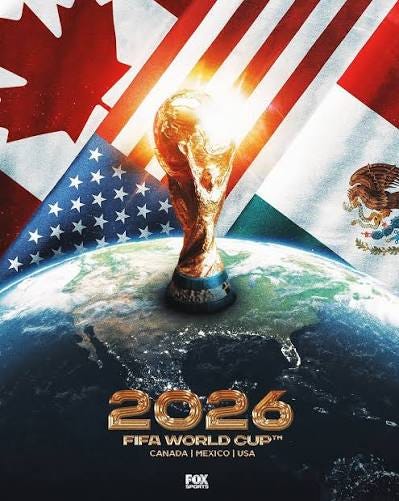
The FIFA World Cup is an extraordinary cultural and transnational phenomenon. It’s the most-watched single sporting event on the planet, with approximately five billion people watching some part of it this year. (Its only rival for overall attention is the quadrennial summer Olympics, which features dozens of sports.)
Many Americans who have tuned into the World Cup for the first time this year to watch what we call “soccer,” and the rest of the world calls “football,” have learned that following the Cup can be an incredibly pleasurable experience. The weeks of increasingly consequential matches bring people and entire communities together in a spirit of camaraderie and belonging, with untold numbers of watch parties in private homes, at bars, and in large public squares with giant screens brought in as the centerpiece of a joyful, festive, communal celebration.
Many commentators have noted that the Cup facilitates passionate but non-violent expressions of nationalistic pride in a world aflame with wars and ethnic conflict. It’s especially notable that it’s taking place this year mostly in the U.S., whose leader came to power through shameless appeals to the country’s worst traditions of nativism and xenophobia.
The World Cup is also a major “media spectacle.” UCLA philosopher and cultural studies theorist Douglas Kellner describes media spectacles as “Those phenomena of media culture that embody contemporary society’s basic values, serve to initiate individuals into its way of life, and dramatize its controversies and struggles, as well as its modes of conflict resolution.”
In today’s infotainment society, Kellner argues, entertainment and spectacle have entered into the domains of the economy, politics, society, and everyday life in important new ways. “Sports have long been a domain of the spectacle,” he writes, “with events such as the Olympics, World Series, Super Bowl, soccer World Cup, and NBA Championships attracting massive audiences while generating sky-high advertising rates. These cultural rituals celebrate society’s deepest values (i.e. competition, winning, success, and money), and corporations are willing to pay top dollars to get their products associated with such events.”
The World Cup is also a deeply gendered spectacle. For its part, the Women’s World Cup (held quadrennially in odd-numbered years) has been growing rapidly in popularity, and is a major feminist success story. Still, the men’s event draws 2-3 times as many viewers, and dominates global popular discourse in ways that remain unimaginable for the women’s event.
In addition, gender figures prominently in a multitude of sub-themes and storylines, such as the troubling fact that players on a number of teams have faced allegations of sexual assault, some in the recent past.
“Soccer” versus “Futbol”: sports culture and identity politics
It’s important to understand the ways in which ideas, concepts, and conventions that emanate from sports culture help to shape political narratives.
I’ve tried to explain this in the numerous articles I’ve published over the years on sports metaphors and their role in American politics. Sports metaphors – especially from violent and traditionally male-dominated sports like American football and boxing – contribute to a way of thinking about political campaigns as a form of masculine competition.
The Republicans understand this much better than the Democrats. In fact, I’ve long argued that the Republican Party has mastered their own version of identity politics since the late 1960s -- early 1970s, especially in terms of their outreach and messaging to white male voters.
They’ve done this, of course, while simultaneously criticizing liberals, progressives, and Democrats for playing “identity politics” whenever they acknowledge and assert some of the specific policy agendas and interests of women, people of color, LGBTQ people, etc.
A main way in which the GOP -- aided and abetted by right-wing talk radio, Fox “News,” and now podcasts and other forms of social media -- have managed to win huge majorities of the white male vote, especially the working-class white male vote, has been to frame electoral politics as a key battleground in the culture wars.
Elections are reduced to a crude binary contest, in which “real men” are supposed to vote Republican, while the Democratic Party represents women and “non-masculine” men.
Sports play an important role in this process in part because they generate rich and colorful language that is broadly understood, and through which many people come to understand political tribalism.
I’ve been following this year’s World Cup mostly on television. But I’ve also had the opportunity to catch an up-close glimpse of crowd scenes from the traveling spectacle in my home city of Boston. As I’ve taken in some of the palpable energy and excitement, I’ve thought about the ever-changing demographics of this country, and the ways in which soccer has become increasingly less “othered” in the American context.
This process of normalization has been a dramatic development for those of us who came of age in the 1960s, 1970s, and even earlier, when soccer was a fringe and foreign-coded sport in the U.S. Many of us who are fifty and older have welcomed the change and embraced the “new normal.”
But as I’ve observed the multinational, multicultural World Cup celebrations in recent weeks on the streets of American cities, it’s been hard not to think about the ways in which the rise of Donald Trump and right-wing populism are in many ways driven by resentment toward exactly that sort of rapid and decentering cultural change.
The power of sports metaphors in American politics
With all of this as a backdrop, I want to share something I wrote over a decade ago about soccer and American politics, and how the growing acceptance and embrace of the “beautiful game” as part of the American story is likely to play out politically in coming years.
It’s an excerpt about sports metaphors and American political discourse from my 2016 book Man Enough: Donald Trump, Hillary Clinton, and the Politics of Presidential Masculinity (Interlink):
The nexus of sports and politics (in relation to masculinity) also involves complex questions of culture and ethnicity. Few universal sports metaphors work equally well to define manhood across national or cultural boundaries, in part because different cultures have varying definitions of what is considered ‘masculine.’ For example, in most parts of the world, soccer is considered a manly sport (even if women also play it), and male soccer stars are often national icons.
This is not true in the US.
Although soccer is our most popular youth sport in terms of athletic participation, it is not even close to American football in its cultural influence, masculine identification, or metaphorical power. It is rare to find a national-level politician in the US who uses soccer metaphors, precisely because to do so would call into question the strength of their American identity, as well as their masculine credibility.
Thus it is important for people who use sports metaphors in their speech or writing to know which sports are identified with the dominant kind of manhood in a given society, and to use references to those sports and avoid others. For politicians or political commentators in media, failure to do one’s ‘homework’ in this instance would be to expose oneself as either oblivious to local norms and customs, or in the case of a man, as not masculine enough because he discusses, plays, or enjoys feminized—or otherwise ‘wrong’—sports.
Political professionals are well aware of this trap, which accounts for the fact that in 2004 John Kerry’s presidential campaign downplayed his collegiate soccer record and emphasized his hockey credentials.
It is possible to interpret this de-emphasis on Kerry’s soccer past as an attempt by his handlers to steer clear of biographical information that reinforced his European—especially French—sensibilities, as this was a line of attack that right-wing activists and media pundits used to paint him as elitist and out of touch with average (working class) American voters.
Right-wing critics of Kerry are undoubtedly aware of the gender and class politics that surround soccer in mainstream US culture. As Franklin Foer points out in his book How Soccer Explains the World, (2004), in most of the world, soccer is both broadly popular and the province of the working class.
But in the US, with the exception of Latinos, and recent immigrants from Asia and Africa, ‘the professional classes follow the game most avidly and the working class couldn’t give a toss about it…half the nation’s soccer participants come from households earning over $50,000…the solid middle-class and above.’
Moreover, Foer argues that when a ‘generation of elites’ adopted soccer in the 1960s and 1970s, it gave the impression that they had ‘turned their backs on the stultifying conformity of what it perceived as traditional America,’ yet another example of how Democrats and liberals were supposedly out of touch with average folks in the ‘red states’ and elsewhere. But even these ethnic/class politics are in flux.
For example, as the Latino population increases as a percentage of the US electorate, it is interesting to speculate whether Latino politicians—and Anglo politicians seeking Latino votes—choose to use soccer metaphors in their speeches or press conference banter.
How will that play out in Anglo culture, especially among sports talk radio hosts and other media personalities who have historically condescended to soccer and ridiculed it as ‘wimpy’ in relation to American football?
In other words, the politics of soccer aren’t fixed. It’s entirely possible that in coming years, the American right will find ways to co-opt the sport, and incorporate soccer fandom into a conservative, consumer capitalist framework that does little to disrupt prevailing economic, racial, gender, and political hierarchies.
It’s also possible, however, that the growing popularity of soccer in the U.S., and the greater embrace by the American public of events like the Men’s and Women’s World Cups, could contribute to a growing acknowledgement of global interdependence and connectedness. This, in turn, would provide a countervailing force to the insular ethno-nationalism that feeds off the destructive energies of white supremacy and fuels right-wing populist authoritarianism.
No posts
Comments
Nothing yet. Say the first thing.
Sign in to join the conversation.