
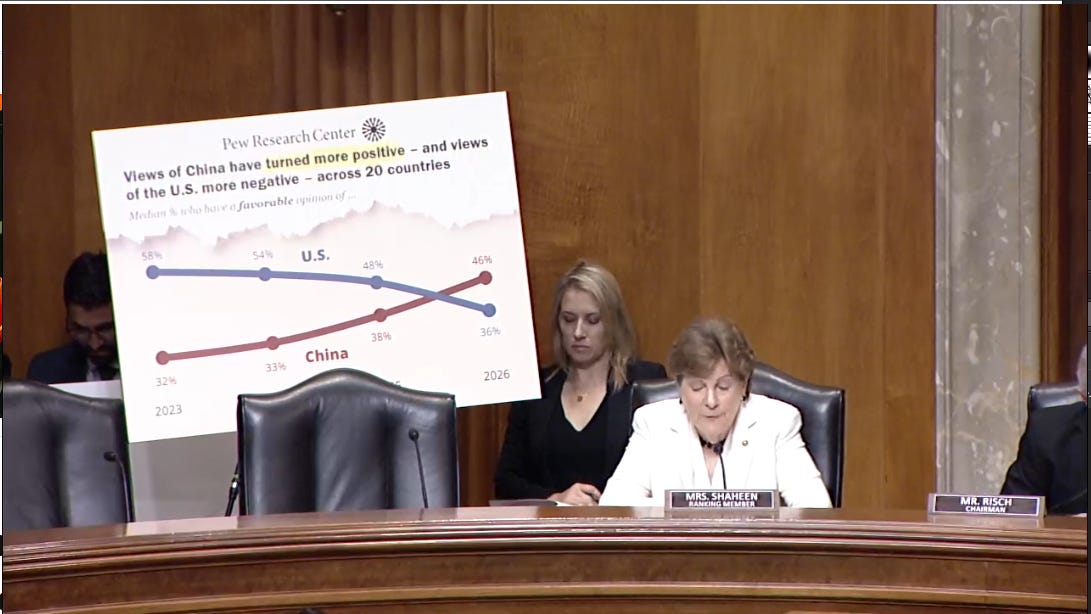
A striking poll published earlier this month by the D.C.-based Pew Research Center, regarding an apparently seismic shift in global public sentiment away from the United States and towards China, took center stage on Thursday as part of an initial hearing on three nominations before the U.S. Senate Foreign Relations Committee.
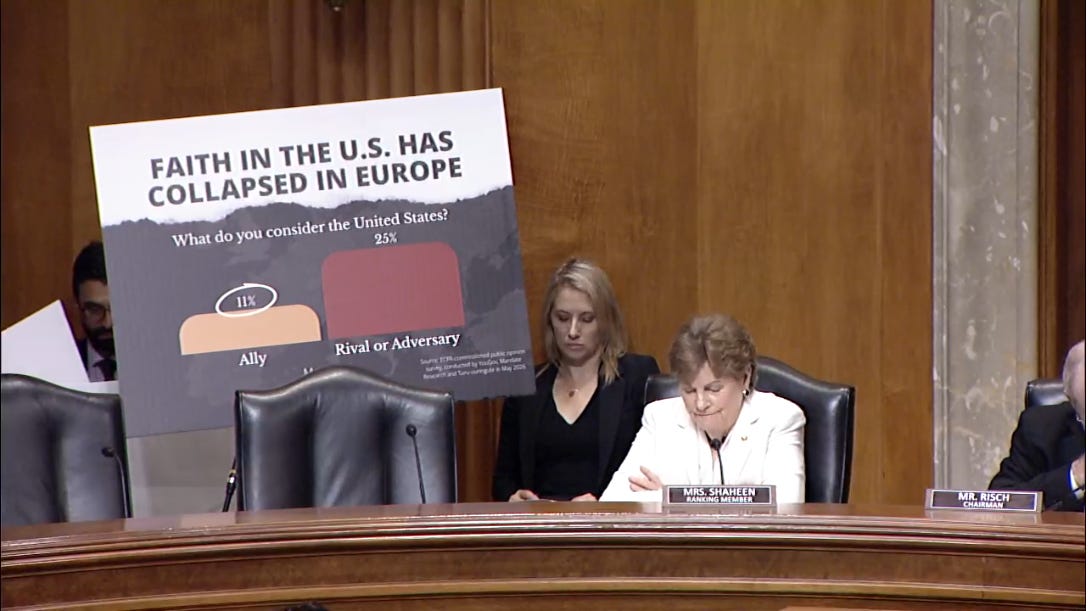
Moments earlier, Sen. Shaheen had similarly displayed an infographic from a poll published by the European Council on Foreign Relations, which claimed to confirm “the collapse in European faith in the US,” concluding that, “Only 11% of respondents now consider [the US] an ally, down from 16% half a year ago and 22% in November 2024. Meanwhile fully 25% see it as either a rival or an adversary.”
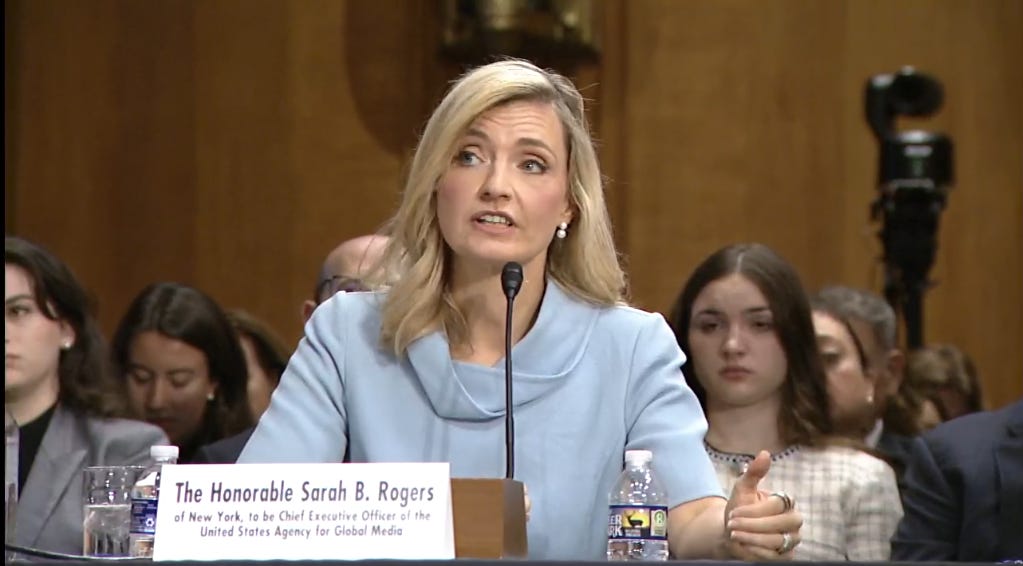
“How do we reverse that, and how will you as the head of [the U.S. Agency for Global Media] reinforce the factual nature of the differences between the United States and our adversaries, like Iran, like China, like Russia?” asked ranking member Jeanne Shaheen (D-NH) of Sarah B. Rogers, the current U.S. under secretary of state for public diplomacy and public affairs and nominee to additionally become chief executive of the U.S. Agency for Global Media. “Because that is not coming through now as part of your role at the State Department,” continued Sen. Shaheen.
As a result of the bipartisan dismantling of the U.S. Information Agency (USIA) during the Clinton administration, America’s primary overt information warfare arm was divided up into two major components: international broadcasting was spun off in the form of a newly independent agency which renamed to the U.S. Agency for Global Media during the first Trump administration, while direct strategic communication from U.S. foreign service officials and cultural exchanges such as the Fulbright Program were centralized into a newly formed Office of the Under Secretary of State for Public Diplomacy and Public Affairs.1
Leadership of the two branches has remained mostly separate since the 1999 split, though the former Roll Call editor-in-chief and co-owner James K. Glassman led the George W. Bush administration’s incarnation of USAGM — then known as the Broadcasting Board of Governors — for roughly one year before transitioning to under secretary of state for public diplomacy and public affairs under Condoleezza Rice for roughly six months.
The former National Rifle Association (NRA) counsel Sarah B. Rogers was sworn in as President Trump’s head of the second of these two components on October 10, 2025 and was nominated to simultaneously lead USAGM on March 12, but has yet to be confirmed into the position. More than one member of the Senate Foreign Relations Committee expressed concerns during Thursday’s hearing that confirming Rogers could damage worldwide perception of the editorial independence of USAGM’s flagship media arms, such as Voice of America (VOA) and Radio Free Europe/Radio Liberty (RFE/RL).
(Though left unmentioned during the Senate Foreign Relations Committee hearing, much of the international concern regarding the editorial credibility of RFE/RL originates from its covert management and financing by the Central Intelligence Agency for roughly its first 20 years of operation, with oversight ending in 1972 under RFE president William P. Durkee III,2 who had previously helped oversee the radio stations as part of the leadership of the CIA’s International Organizations Division (IOD).3)
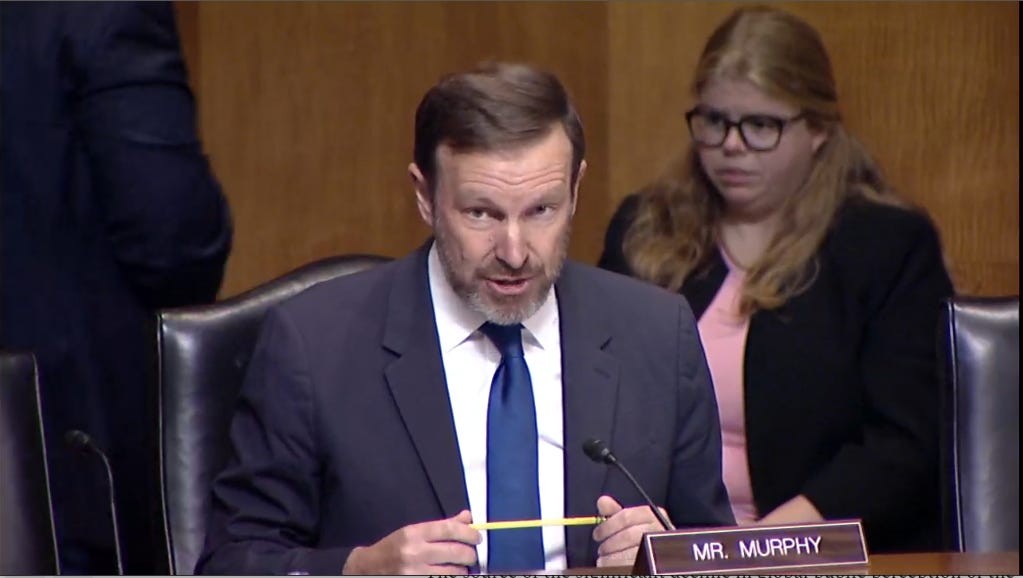
Sen. Chris Murphy (D-CT) questioned Rogers about former acting USAGM chief Kari Lake attributing the shutdown of RFE’s Hungarian language service Szabad Europa to its reports having “undermined President Trump's foreign policy by opposing the duly elected Hungarian prime minister, Viktor Orban.”
“So, undermining the elected government of an allied country is not something that I would expect to do, I think that would be pretty extraordinary,” stated under secretary Rogers.
“That does sound like you’re saying that a grantee who is critical of an allied government would lose funding. That is the opposite of free speech,” replied Sen. Murphy.
“Well, this speech isn’t free, it’s being paid for by the taxpayer to support American foreign policy,” answered Rogers.
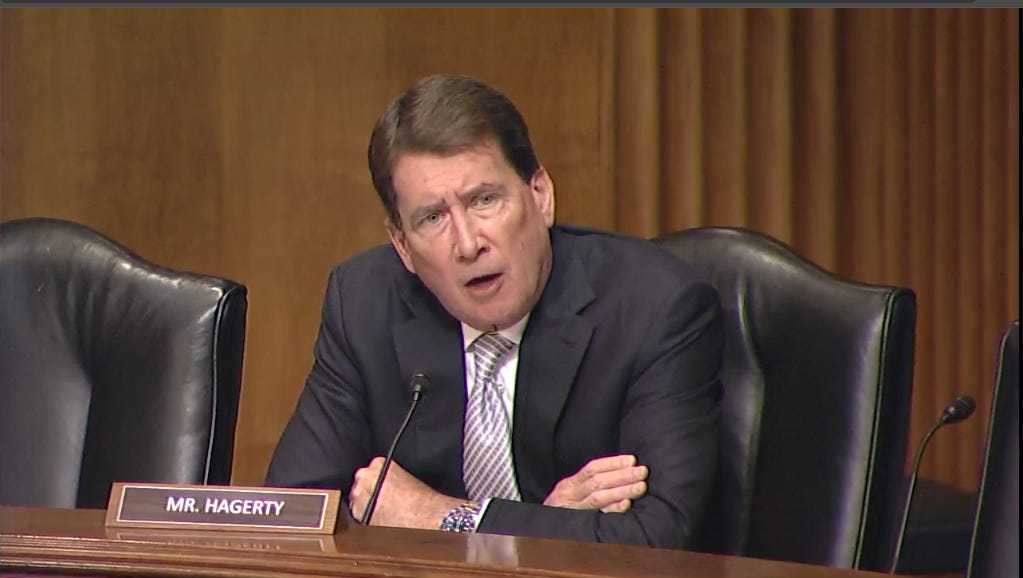
The potential merger of the former constituents of the U.S. Information Agency under Rogers was perhaps most fervently supported by Sen. William Hagerty IV (R-TN), who served as President Trump’s first-term ambassador to Japan for nearly two years.
“I think you have a unique opportunity to actually align this organization with the other role that you perform, which is our under secretary for public diplomacy,” stated Sen. Hagerty, before adding that, “I’ve been in the field, I’ve been an ambassador, and I’ve actually seen what our communications can do and should do, and where they fail.”
“This sounds to me, as a business person for my whole career, as an opportunity for alignment,” continued Sen. Hagerty.
Under secretary Rogers largely agreed with Hagerty’s suggestion that USAGM should serve as a tool of U.S. State Department policy priorities, and emphasized that such a realignment could be accomplished through high-level editorial policy rather than the dictation of particular headlines. “In terms of alignment, we hear a lot of concern from minority [the Democratic Party] about this firewall — and I don’t want to be micromanaging the editorial copyrighting or bylines of any of these outlets, but these [USAGM] grantees are asking for strategic guidance on broad foreign policy objectives, which is what I’m supposed to provide, and I look forward to providing it,” stated Rogers.
Rogers added that USAGM employees “are reporters who risk their lives to get truthful information to their countrymen in places like Iran.” “And they know they are working indirectly for the United States,” Rogers continued. “These grantees want our guidance and we’re happy to give it. And I think we can do that without the kind of editorial micro-management that I think minority is afraid of.”
For an authoritative history of the bipartisan dismantling of the U.S. Information Agency during the Clinton administration, see: Cull, Nicholas J. “The Decline and Fall of the United States Information Agency: American Public Diplomacy, 1989-2001.” Palgrave Macmillan, 2012.
No posts
Comments
Nothing yet. Say the first thing.
Sign in to join the conversation.