
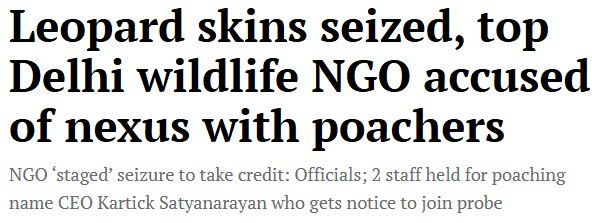
You can click on the text frame above, it links you to the story. A passionate and highly capable wildlife crime investigator gave me a heads up early this morning, the situation has been developing throughout the day, different media have grabbed it but the above gives solid background. My source is a good man whose work and opinions I’ll be referencing in future writing. For all the apathy around wildlife trafficking, there’s still those doing their best to combat it.
My take is that a seizure of ten leopard skins in India initially appeared to be another serious wildlife trafficking case — now it is developing into something even more sinister. I alluded to updates regarding this case in my writing yesterday, the information today hasn’t surprised me.
An investigation by the Madhya Pradesh State Tiger Strike Force has resulted in further arrests, the recovery of leopard remains and traps, and allegations concerning people connected with an organization involved in wildlife protection. The investigation is continuing, and allegations reported so far should be treated as allegations until established by the evidence.
That is precisely why we are watching this case closely.
At Blood of the Leopard, we are trying to move beyond simply recording seizures. A seizure tells us that something has gone wrong. The more important question is what the seizure can tell us about the system behind it.
Don’t stop at the seizure. Follow the chain.
Who killed the leopard?
Who supplied the equipment?
Who collected the body?
Who processed it?
Who transported it?
Who arranged the buyer?
Who financed it?
Who ultimately benefited?
And — critically — who was supposed to be stopping it?
Those questions are not accusations. They are some of the key questions, not the only ones, that need answering if we are going to understand how the illegal trade actually operates — by understanding each case, based on evidence.
This is also why we have adopted a simple principle for Blood of the Leopard:
Let the evidence dictate the narrative.
We will follow this investigation as it develops and report what can be established, what remains alleged, what is still unknown and what the evidence ultimately tells us.
Because there is a fundamental difference between documenting wildlife crime and understanding it — and then applying pressure to stop it.
Regarding this case, it looks like many more than ten leopards were killed by the parties involved. There is also speculation of tiger poaching.
It’s serious. It’s sinister.
More to follow.
No posts
Comments
Nothing yet. Say the first thing.
Sign in to join the conversation.