

Of course they do! In Emily Dickinson’s world, hope has feathers and perches in the soul. For Juan Ramón Jiménez, music becomes “a naked woman / running mad through the pure night.” (Translated by Robert Bly)
There’s something magical about poems that breathe life into the intangible. Grief rows a leaking boat. Democracy careens along drowsy lanes. Bliss bursts from thorny thickets. How do writers make such wild leaps?
Here’s an activity based on prompts I learned in workshops with Tim Seibles and Ilya Kaminsky. You can do this alone, but it’s especially fun when you collaborate with other writers.
1) On an index card, write an abstract noun—any noun that is not concrete. (joy, sorrow, democracy, mercy, etc). If you’re working alone, write a bunch of these — a separate card for each word. If you’re with a group, gather everyone’s cards together. Shuffle the cards and set them aside.
2) On another index card, write a short description. You can describe what you see out your window or you can reflect on a scene you remember. Include a subject, an action verb, and a sensory detail. If you’re working alone, write a bunch of these — a separate card for each description. If you’re with a group, gather everyone’s cards together. Shuffle the cards and set them aside.
Examples:
Steam rises from the mossy path.
Cicadas buzz in the darkening trees.
A kayak bobs on the horizon.
3) Now for the fun part! Without peeking, select a noun from the first stack of cards and a description from the second stack of cards. If you’re working in a group, try to select cards you did not write. Combine these.
TIP: On the description card, replace the subject with the abstract noun. For example:
“Mercy” + “Steam rises from the mossy path” = “Mercy rises from the mossy path.”
“Democracy” + “Cicadas buzz in the darkening trees” = “Democracy buzzes in the darkening trees.”
“Sorrow”+ “A kayak bobs on the horizon” = “Sorrow bobs on the horizon.”
4) Your challenge is to write a short poem in which you assign human-like thoughts and behaviors to a concept or an emotion. You can speak directly to the abstract noun (“you”), describe it in the 3rd person (“he,” “she,” “it,” or “they”), or have the abstract noun speak for itself (“I”).
Be crazy and have fun! Leave a comment to share your poem or a poem by a writer you admire.
Text within this block will maintain its original spacing when published
Broken Promises
I have met them in dark alleys, limping and one-armed;
I have seen them playing cards under a single light-bulb
and tried to join in, but they refused me rudely,
knowing I would only let them win . . .
 —By David Kirby, from Big-Leg Music (Washington, DC: Orchises Press, 1995)
Read the full poem: https://www.poetryfoundation.org/poems/48044/broken-promises
Text within this block will maintain its original spacing when published
sorrows
who would believe them winged
who would believe they could be
beautiful         who would believe
they could fall so in love with mortals
that they would attach themselves
as scars attach and ride the skin . . .
—by Lucille Clifton, from Poetry, 2007
Read the full poem: https://www.poetryfoundation.org/poetrymagazine/poems/49797/sorrows
Text within this block will maintain its original spacing when published
Words
Words are loyal.
Whatever they name they take the side of.
As the word courage will afterward grip just as well
the frightened girl soldier who stands on one side of barbed wire,
the frightened boy soldier who stands on the other . . .
—by Jane Hirshfield, from Ledger (Knopf, 2020); first appeared in Plume
Read the full poem:  https://poets.org/poem/words-1
Text within this block will maintain its original spacing when published
Grief
When grief comes to you as a purple gorilla
you must count yourself lucky.
You must offer her what’s left
of your dinner, the book you were trying to finish
you must put aside
and make her a place to sit at the foot of your bed,
her eyes moving from the clock
to the television and back again . . .
—by Matthew Dickman, from All-American Poem (Copper Canyon, 2008)
Read the full poem: https://www.poetryfoundation.org/poems/150394/grief-5d0c057c36f0c

WHISH!
When I began writing poems for WHISH, I tried to describe Time with a capital T. The concept felt so vast and vague, I needed to zoom in on specific moments — 8:00 A.M., 2:02, Midnight, and so on. By narrowing my focus, I could create multiple personalities to represent the ways time messes with our lives. Here's a snippet:
Text within this block will maintain its original spacing when published
HALF PAST YESTERDAY HAS ABANDONED ME. I sulk in the rain-slicked plaza outside the computer repair shop and the delinquent hour doesn’t come. Wind grips my umbrella; sleet stings my face. Half Past Yesterday doesn’t call, email, or text. Telephone wires sag with crows too sodden to fly. The fleeting moment flies off to some island where mollusk shells lay thick as peanut brittle. Pining for Noon. Always pining for Noon. I slog through puddles, a statue learning to walk.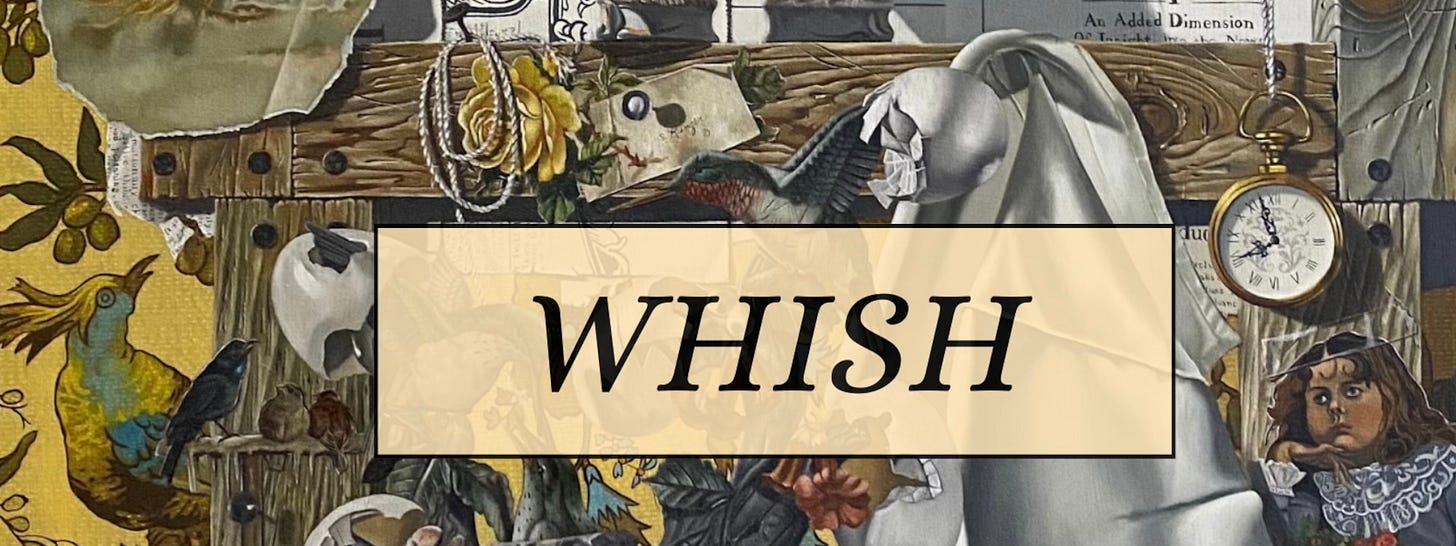
“With Albert Einstein, Stephen Hawking, and Star Trek as her muses, Jackie Craven subverts time... WHISH is a triumph of a book!" —DENISE DUHAMEL, author of Second Story
Comments
Nothing yet. Say the first thing.
Sign in to join the conversation.