
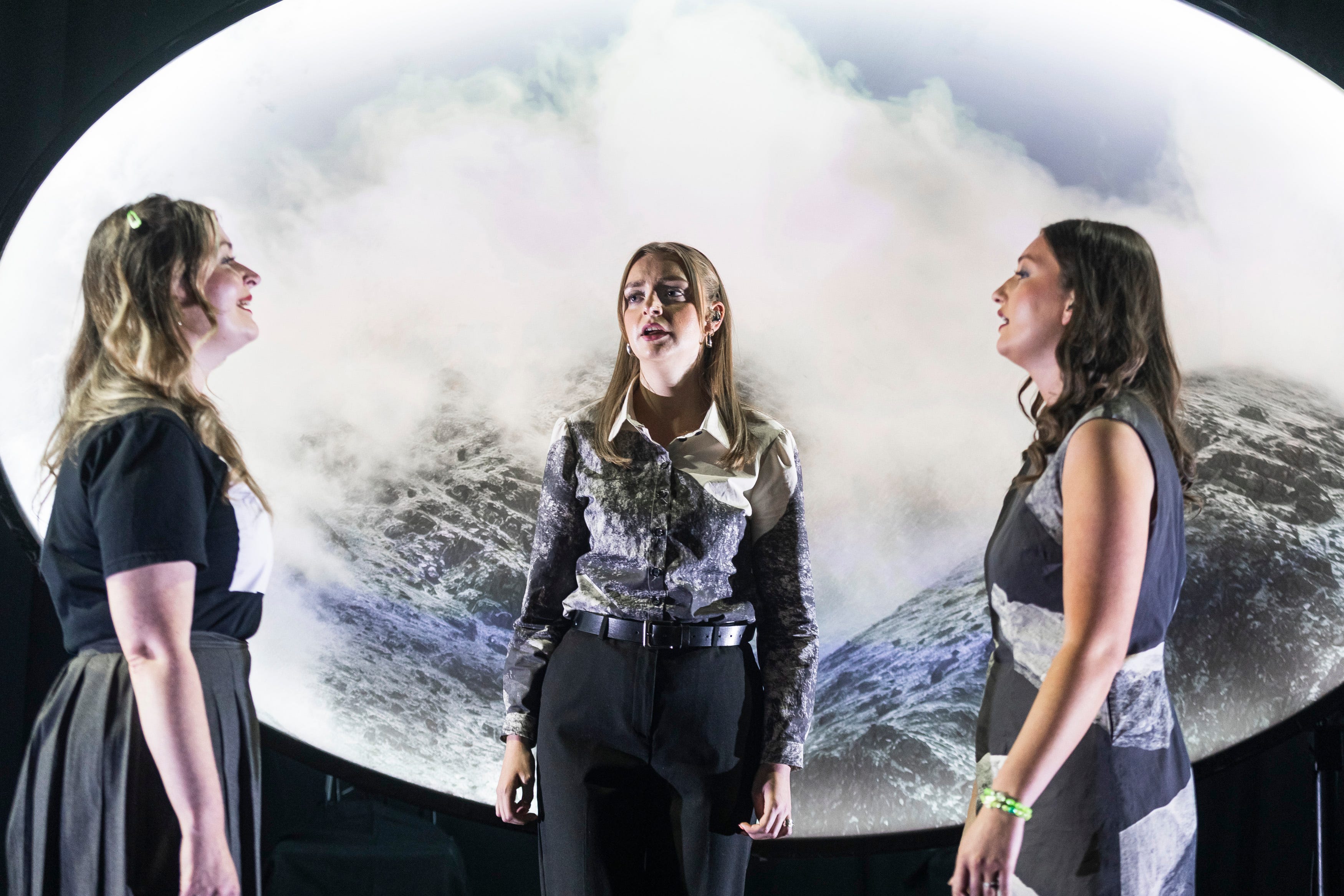
On Friday, I saw Through the Shortbread Tin at the Edinburgh Fringe, an enjoyable show about the poem cycle we know as Ossian.
Initially an international sensation, Ossian was soon branded a hoax. Over time, the shame around this created a silence. That’s probably why many Scots have never heard of it.
Written and performed by Martin O’Connor with a Gaelic chorus, the National Theatre production asks questions about who gets to tell the story of Scotland’s past - but I would like to add another:
James Macpherson said he was translating work passed down from a third-century bard called Ossian, a blind old warrior who sits on a hillside playing a clarsach as he muses on bygone days.
The 18/19th century charge was that Macpherson made the whole thing up - that it was a modern invention. We now know that is not true. Much of what he presented is drawn from Gaelic poem and song.
Ossian, a bit like the storytelling Scheherazade in the Arabian Nights, is a central character who holds it all together. Other voices are in there too, including a female bard called Minona.
The poems are full of melancholy. They came out of a post-Culloden Highlands where the British state was aggressively suppressing Gaelic language and culture.
Text within this block will maintain its original spacing when published
My love is a son of the hill.Text within this block will maintain its original spacing when published
He pursues the flying deer.Text within this block will maintain its original spacing when published
His grey dogs are panting around him;Text within this block will maintain its original spacing when published
his bow-string sounds in the wind….Text within this block will maintain its original spacing when published
Then thou art gone, O Shilric!Text within this block will maintain its original spacing when published
I am alone on the hill!Text within this block will maintain its original spacing when published
The deer are seen on the brow;Text within this block will maintain its original spacing when published
void of fear they graze along.Text within this block will maintain its original spacing when published
No more they dread the wind,Text within this block will maintain its original spacing when published
no more the rustling tree.Text within this block will maintain its original spacing when published
The hunter is far removed;Text within this block will maintain its original spacing when published
he is in the field of graves.(Lines of Ossian used by Schubert - in a famous German translation by Gotthard Kosegarten)
The poems of Ossian helped to spark the Romantic movement. Napoleon loved them, so did the German poet Goethe and the US founding father Thomas Jefferson.
People in other countries were inspired to share their own oral traditions. In Finland, Elias Lönnrot created the Kalevala, the national epic of Finland, built from ancient Finnish and Karelian oral poetry.
This is credited with helping Finns to identify themselves as a people with a separate linguistic and cultural identity. It built Finnish confidence and was a step on their road to independence.
Lönnrot’s work had a very different reception from Macpherson. Lönnrot had seen what happened to Macpherson and was more transparent about his process, how he travelled around Finland gathering the poems and songs and the work he did to thread them together as an epic, sort of like a jukebox musical today.
But Macpherson was the first person to do anything like this - so he would not have known he was walking into a cultural minefield and was about to be denounced by London’s most eminent man of letters, Dr Samuel Johnson.
Johnson’s Scottish sidekick James Boswell described Macpherson as a proud, arrogant, and easily offended man who met doubts about his work with “sullen defiance”. He probably could have handled it better to be fair. (Macpherson also got in a massive row with Irish scholars, because he denied the Highland poems were cousin to Irish ones and claimed that Caledonian Gaelic was an older and purer form of the language.)
Johnson said the poems of Ossian could have been written by a child and called them an impudent forgery. Macpherson apparently wrote to the 65-year-old that “his age and infirmities alone protected him from the treatment due to an infamous liar and traducer." That letter has not survived - but Johnson saw it as a threat of violence and said he had bought a stout oak cudgel to defend himself from the “ruffian”.
In his 1775 travelogue, A Journey to the Western Islands of Scotland, Johnson, who referred to Gaelic by the derogatory term Erse, wrote:
“Erse is the rude speech of a barbarous people, who had few thoughts to express, and were content, as they conceived grossly, to be grossly understood.”
Johnson said poems could not survive for hundreds of years in an oral tradition; he scorned the idea that Highlanders could compose work of beauty; and he repeatedly called for James Macpherson to produce the Gaelic manuscript on which his translation was based.
Johnson was not alone. The Romantic poet William Wordsworth said they were unconvincing because they lacked detail. Scottish historian Sir James Mackintosh in his History of England denounced Ossian as a fraud on the grounds that Scots of that period were incapable of civilised feelings.
He approvingly quoted the judgement of an earlier authority: “In Scotland ye shall find no man lightly of honour or gentleness: they be like wylde and savage people.’”
The cultural context is that the British establishment wanted to justify the harsh measures they were taking against the people of the Highlands. They were an ignorant and barbarous people in need of civilising - so Ossian just had to be a fake.
Macpherson had defenders too. Researching a book on Scottish history recently, I have been spending some time in the National Library reading room with James Browne’s incisive six-volume history of the Highlands.
Browne had a deep knowledge of the culture he was writing about. He made the point that the passage of Gaelic culture into writing was much later than that of English. There were very few published books in Gaelic back then.
Browne said that people who live in a text-based culture struggle to understand what people in an oral one are capable of in terms of memory. He also said that if ancient people were judged to be incapable of sensitivity and philosophy, then the Odyssey would have to be judged a forgery too. He gave some proofs of the strength of the oral tradition in the Highlands.
“The late Captain John Macdonald of Breakish, a native of the island of Skye, declared upon oath, at the age of seventy-eight, that he could repeat, when a boy between twelve and fifteen years of age (about the year 1740), from one to two hundred Gaelic poems differing in length and in number of verses; and that he had learned them from an old man about eighty years of age, who sung them for years to his father, when he went to bed at night, and in the spring and winter before he rose in the morning.”
“The late Reverend Doctor Stuart, minister of Luss, knew an old Highlander in the isle of Skye, who repeated to him for three successive days, and during several hours each day, without hesitation, and with the utmost rapidity many thousand lines of ancient poetry, and would have continued his repetitions much longer, if the doctor had required him to do so.”
Browne also recounts the findings of an official investigation conducted by Sir John Sinclair, which uncovered compelling testimony from Catholic clergymen who had seen and read a Gaelic manuscript of Ossian decades before James Macpherson published his translations.
The story revolves around Father John Farquharson, a Scottish Jesuit priest who, while living in Strathglass prior to 1745, spent years collecting ancient Gaelic poetry from local Highlanders and transcribing it into a massive folio notebook—about three inches thick. He later brought this manuscript with him to the Scots College at Douai in France, where he served as Prefect of Studies.
Rev James MacGillivray, formerly a student at the Scots College at Douai, in France, testified that he saw Farquharson comparing his manuscript to Ossian and that he complained that Macpherson’s English translation fell far short of original, and that Macpherson had inexplicably omitted several brilliant poems that were in Farquharson’s notebook.
Two Bishops, Alexander Cameron and the Bishop of Aberdeen Aenas Chisholm told the inquiry that the Ossian collection was well known among Scottish scholars in France.
When Father Farquharson returned to Scotland in 1773, he left his manuscript behind at the Scots College in Douai. It was then lost and the speculation is that younger students who could no longer read old Gaelic gradually tore pages out of the original manuscript to kindle the fire in their stove.
Browne argues that the evidence shows that pre-existing Gaelic manuscripts did exist. He contends that English critics were far too quick to assume Macpherson had invented everything. Browne argued that the fact Macpherson had embellished and adapted the poems did not affect their authenticity.
Macpherson had other defenders. I have always been a fan of the radical thinker and essayist William Hazlitt - much prefer him to Wordsworth whose first great first draft ‘I wandered lonely as a cow’ was red-penned by his clever sister Dorothy.
Hazlitt argued that the Ossian cycle was among the most worthwhile of all poetry in the English language. He also thought it didn’t matter that the poems had been altered and added to - the groundwork was solid. For Hazlitt, Ossian was about the mood that his work conveyed rather than the detail. In a lecture on English poets he said:
He [Ossian] comes over the mind like the air of autumn: the voice of the grey hair is on his harp. The desert is his dwelling-place; the lightning’s glare is his light in the dark night; the blast of the mountain is his guide; his dark thoughts sun themselves from the sun of the world; his harp-strings rustle like the dry reeds in the winter wind; his song is as the sound of the evening breeze. He is a feeling and a name that can never die, as long as there is melancholy in human nature, or a solitary seat in the mountains of Caledonia. He wraps the ignorant world in an illusion, as the evening mist clothes the barren mountain with its shroud. The feeling of desolation is complete: it measures their stature by the length of their graves; it counts their years by the moss that grows on the fallen oak. His heroes are dead; his maiden loves are no more; he sits alone in his old age, with the remembrance of the past. The foxes look out of the windows of the desolate towers; the thistle shakes its lonely head in the wind; the grey moss grows on the fallen oak; the ancient
bards are mute, and their harps are hung on the wall. He is the last of his race, the survivor of his friends; he sings his own funeral dirge, and the dirge of his country.”
The writer of the show Martin O’Connor repeatedly describes Ossian as a hoax. He is not alone, I think that is a fair summary of what historians still say.
Although we now know that much of what Macpherson presented was directly drawn from Gaelic, it is still seen by modern historians as a fraud and forgery because it was not the work of a third-century bard - even though Macpherson says in the intro to Fragments of Ancient Poetry, the first volume, that the work cannot be accurately dated.
Personally, I think that is a cop out. It is a moving of the goalposts. The English establishment figures of the 18th and 19th centuries branded Ossian a forgery not because of the date of the work or the framing device. Men like Samuel Johnson refused to believe that the coarse Gaels were capable of creating beauty, or that a culture could preserve poetry for centuries without a printing press.
They claimed that Macpherson had made it up and instead he had written the work himself. On that fundamental charge, Johnson and his contemporaries have been proved wrong by scholars like Derek Thomson who in The Gaelic Sources of Macpherson’s ‘Ossian’ compares Ossian to many long Gaelic poems. Oxford Professor and Ossian expert Fiona Stafford argues that Macpherson was a Highland poet working in a tradition with a different understanding of IP - but she avoids what she calls the binary classification of the work. Ian Stewart. In his 2025 The Celts: A Modern History summarises the controversy but not in a way that refutes this charge - his own opinion is not given. (1)
Macpherson was not a forger; he was a flawed and difficult pioneer of oral folk collection doing what Lönnrot would later do for Finland. In accepting the label of “fake”, we in Scotland have allowed an imperial smear that was in part a justification of the suppression of Highland culture to persist.
Text within this block will maintain its original spacing when published
Didst thou not hear my voice, O bard? Text within this block will maintain its original spacing when published
It was the voice of Ossian, when his soul was sad... Text within this block will maintain its original spacing when published
We fall like the leaves of the forest; Text within this block will maintain its original spacing when published
the autumn wind blows, and they are gone. Text within this block will maintain its original spacing when published
Another race shall arise; Text within this block will maintain its original spacing when published
the people of a future age shall hear the fame of our deeds; Text within this block will maintain its original spacing when published
then shall the strength of the steel fail, Text within this block will maintain its original spacing when published
and the voice of the bard be heard no more.(1) This has been corrected- Ian Stewart author of the 2025 Celts: A Modern History does not as I first stated give his personal opinion that Macpherson’s work is a hoax, he just attempts to summarise the controversy.)
No posts
Comments
Nothing yet. Say the first thing.
Sign in to join the conversation.