
The university where I teach is in the process of hiring a new president. I know that many of you don’t care all that much about such things, but from where I stand, what we expect of the leaders in higher education says a lot about what we hope to make real in our society.

My comments in this post are actually not specifically motivated by issues at my own institution, but rather by the broad trends globally regarding the assault on the humanities and attack on higher education. That my institution is hiring a new president is just a contingent circumstance that got me thinking a lot about what I would hope a candidate would say and do.
Universities, for better or worse (I think for better), used to be where people were invited to reflect on how things are, imagine other ways that they could be, and then build the virtues to enact those possibilities in the name of social flourishing and broad notions of truth, goodness, and beauty. Increasingly, though, universities are becoming not much more than a reflection of whatever the corporate overlords, tech oligarchs, and short-sighted politicians have decided benefits their own interests.
Indeed, a new “do no harm” (excuse me while I gag a bit, ugh) policy at the Department of Education (an agency that the Trump Administration wants to abolish, don’t forget) will require college graduates to make more money than non-college graduates in the same field or students will lose their ability to take out loans in that field. The idea is that going to college must “leave graduates better off” as a result of the financial investment. Of course, the big, glaring, flashing neon problem with this is that the people deciding what “better off” means are only concerned with financial outcomes. There is no concern for humanity. No concern for existential flourishing. No view of college as doing anything other than getting people jobs and making them more money.
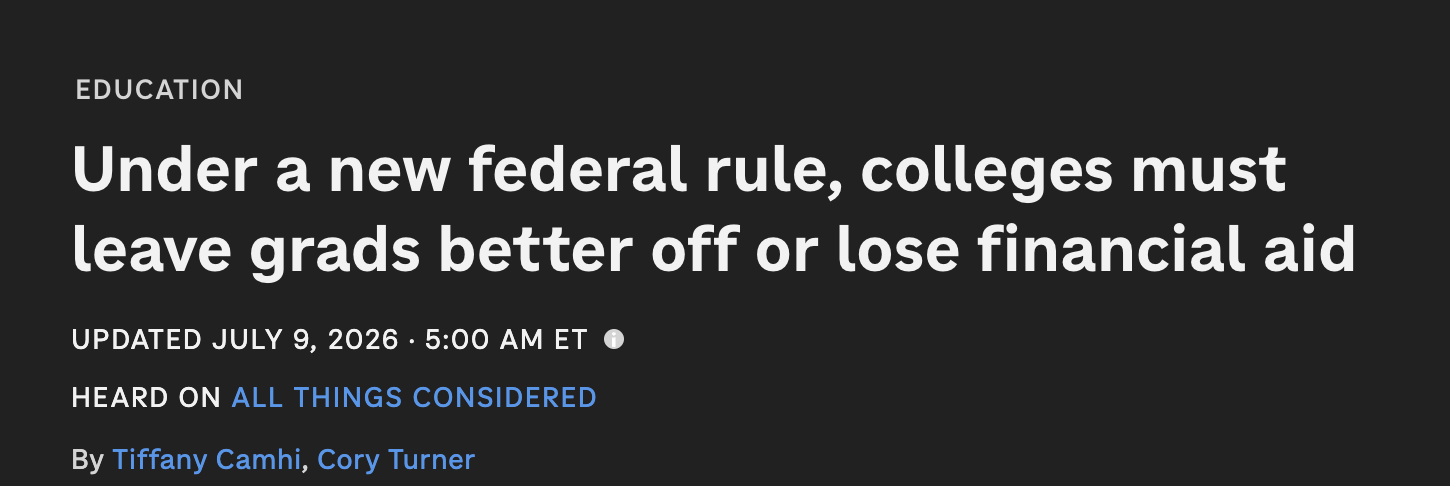
As a result of such short-sighted nonsense, universities have problematically embraced a largely instrumentalist approach to their own value. So although it would be easy to lay all the blame at the feet of the politicians, college administrators have largely embraced the basic value theory of those politicians. Accordingly, the return on investment (ROI) when it comes to higher education is no longer a matter of an improved social structure, a deepening of democratic structures, a widening of the moral community as a social vision, the betterment of one’s own intellectual and creative capacities, etc., but instead reduced to a vulgar concern for one’s own income.
If you read the vast majority of college admissions recruitment marketing and it becomes clear: college matters primarily to make me more money. In this way, universities have become about the business of making employees, not making persons capable of critical thought regarding what sorts of jobs are needed and worthy of one’s finitude. Although we would like to believe that university administrators are on the front lines fighting against such existential threats to the very idea of higher education, they are often the biggest proponents of the very thing that threatens the institutions that they lead.
I see this all as a disaster not only for higher education, but for the societies resulting from what these institutions are allowing to become normal for their students. In this way, I think that we all should care a lot about the fate of higher education. If universities continue to eliminate the humanities in the name of what are labeled “practical” disciplines, our social ability to consider what “practices” should be embraced or challenged gets radically diminished. But, notice that minimizing critical engagement is exactly what those benefiting from the operative power structures so deeply desire. People (and employees) don’t revolt when they can’t imagine other options. So, we need universities to take seriously the task of finding leaders who are standing against such trends, not just deepening them. Accordingly, faculty must speak up and not acquiesce to the vision of university administrators and governing boards who often consist of the very corporate individuals who have already compromised their ability to think critically about their own sense of the world.
In what follows I offer an open letter to anyone hoping to become a university president (or senior administrator of whatever sort). these are the things I want to hear from the candidates for president at my institution. If we don’t expect such things, then we have only ourselves to blame. We must do better and expecting better of those who lead us is the necessary first step toward changing our situation.
Dear Potential University President,
Let me begin by telling you how much we need you to be good at this. A lot is riding on your shoulders and it is more more important than simply the financial future of this institution. Indeed, if this particular university thrives, but the state of higher education continues in the direction that it is headed, it is well worth asking at what cost you helped us to navigate such troubled waters. It might be that you have benefited us by turning us into something that directly diminishes the kind of people we are becoming and the kind of society in which we find ourselves.
I know that the vast majority of what you will be asked while you are interviewing is about the financial future of this institution, and while that definitely matters, there simply is no way for you to talk about that without talking about the broader situation of a democracy in decline, the rise of Right-wing populism, the consolidation of wealth and power in the hands of an increasingly small few, the sustained political attacks on the humanities that are undermining the very ability of professors to teach with integrity, and the continued weakening of public support for higher education and research which is directly related to the increasing (and increasingly unjust) financial cost of a college degree. Sadly, I doubt that you will speak to such things out of some misguided concern that you need to remain “apolitical” or that you don’t want to get on the wrong side of members of the board sitting on the search committee. But, if you lack the courage to stand up for what matters in this context, then we don’t need you as a president because you will fail to stand up for the humanistic value of universities in the first place.
Please remember that it is not “political” to care more about truth than your own position. May you remember that the cloud of witnesses who are watching you are not just the people on the interview committee. From Seneca to Simone de Beauvoir, and from Confucius and Copernicus to Fanon and Faraday, you bear the weight of the conversation of humankind. Be worthy of that trust.
So, here are five things that I want to hear from you. These are things that we all need to hear from you if you are going to be someone that we can follow into a future that is currently so deeply marked by social division and existential despair.
First, we need to hear you say that colleges are not primarily about getting graduates jobs. Colleges are about providing spaces for human knowledge, imagination, and virtue to expand through research and teaching. The goal of colleges is to provide space for young people to be invited to think differently about where they are, why it matters, and where they want to go in light of who they hope to become. These are questions that require a broad range of intellectual pursuits. As a result there can be no division between “practical” and “useless” disciplines and majors. Instead, the very question of what counts as “practical” and “useful” is, itself, something to be considered critically in a variety of ways across a range of disciplinary perspectives. Sure, being strategic and gaining experiential awareness is crucial for thinking well, but helping students be prepared for their next steps is very different than thinking that those employment opportunities are the outcome by which the value of education is to be measured.
Second, you must tirelessly demonstrate that instrumentalism cannot be the main value theory of higher education. Overcoming instrumentalism does not mean that we abandon a concern for the relationship between cause and effect. It does not mean ignoring data. It does not mean turning a blind eye to market realities and social trajectories. Instead, it means that we stop thinking that data is value-neutral, that specific effects are obviously desirable in relation to causes taken to be natural and necessary, and that particular social/economic trajectories are unavoidable. The task of a university is to shape society, not simply fall in line with the vision of society produced by the influential few who currently have the microphone. Universities talk a lot about encouraging entrepreneurship and innovation, as they should, but they must reflect carefully about the stakes of such directional movement.
If universities understand innovation simply to be a matter of increased revenue streams, then they are not innovative at all, but simply boring replicants of a broader social value set that has led to widespread inequality, marginalization, and injustice.
We must do better. You must be better.
You must help us remain committed to such a task of what Emmanuel Levinas terms an “ever increasing justice.”
That said, it would be super rad if you used early hip hop as an example of what true innovation involves. Early hip hop pioneers were not already positioned within the power structure (buying tables at expensive fund-raising dinners, spending lots of money on market research, and figuring out how to appeal to the desires of the people with purchasing power). Instead, they disrupted the structure and inverted the orientation in order to foster new desires and foster a new “public” that consisted of those people who were previously considered irrelevant by the powerful. Sure, hip hop emerged out of what was already happening, but it didn’t seek to find traction in the existing halls of the powerful, but instead strove (as Public Enemy says) to “fight the power” (and Rage Against the Machine encourages, “take the power back”). Don’t forget that innovation requires reimagining what is possible.
Those early block parties hosted by DJ Kool Herc and Grandmaster Flash were not sanctioned by the authorities, but spontaneous moments of community formation around the idea that things could be different. In the same way, universities must abandon the idea that their primary goal is to suck up to legislators who have never done the hard work of thinking, and to affirm the values of parents of teen-agers who are looking to reinforce their own life choices while covering over their own midlife misery.
Universities need to speak to what is possible for humanity itself they need to invite us all to be part of that discussion. Leaders must inspire us all to be invested in the cultural outcomes that result from helping young people think about what world could be made real, instead of just being anxious about being better at navigating the “real world” than all of their peers (read: competition).
Third, you need to have the courage to affirm the humanities as the condition of the sciences. This is not meant to be some sort of ranking of importance, but merely a rejection of the clear dismissal of the importance of the humanities in our broader cultural narrative. Science is crucial for a truth-seeking society. Indeed, the philosopher, C.S. Peirce, labeled the most reliable methodology for establishing belief in accordance with the way things are, “science.” However, in a world where science has become politicized, the narrative of objectivity needs careful revision. What we consider “objective” is, itself, a matter of contingent social priorities and a commitment to embodied perspectives on knowledge. As such, any future for higher education, and the democratic societies in which it can flourish, will be one where the humanities are not marginalized in terms of funding and institutional priorities, but at the very center of the mission of a university and at the heart of any functional democratic society.
Thinking well about our shared existential situation is not secondary to the “objective” discourses of biology and chemistry, but the root of why such disciplines are worthwhile in the first place. Indeed, as the phenomenologist, Michel Henry, rightly notes, when we turn away from subjectivity to an externalist criterion that cares only about the “objective,” we allow a focus on interchangeability to eradicate what is most distinctive about who we are as existing individuals. As a result, impersonal profit overrides a concern for a decidedly personal investment in culture creation. Yes, we need good scientists, but we need them because of a concern about our humanity, not as a replacement for it. Yes, we will still support students wanting to go to medical school, but we will no longer allow that to be something that is presented as obviously a good choice as opposed to studying something “useless” like French, political theory, or philosophy of religion. We must model what utility looks like from a humanist perspective and stop asking those who seek to eliminate higher education in the name of profiteering to shape how higher education does business.
Fourth, you should make clear that we will not prescribe what our students will consider good, right, or just, but we will expect them to give good reasons for wherever they stand and whatever they believe to be true. In this way, we will refuse to allow democracy to die on our watch. We do not seek agreement, indeed the political theorist, Chantal Mouffe, is right when she says that agonistic disagreement is the lifeblood of democracy.

Nonetheless, we do strive to cultivate deliberative virtues from all members of our community. Being educated is not primarily about having a skill for a job, but about having the fortitude to face adulthood and a shared social world with courage and adaptability. As such, we will ardently protect academic and intellectual freedom and yet expect good faith engagement from all involved. Reasoning together is how we build a world worth living in and seeing each other as epistemic and moral equals is required if we hope to avoid our own biases and blindspots. We need our critics, but we need them to be as committed as we are to the importance of thinking well about living well. Reason-giving is not an optional aspect of life, but a requirement for any life worth living.
Fifth, show everyone that we must model the world that we want to see. As such, have the courage to insist that administrator salaries will be directly connected to the wages of the lowest paid on campus. We are a community, so act like it. Here is just one proposal that seems like a good idea to me: Nobody on our campus will make more than 10x what the lowest paid on our campus makes. So, if you want to give a raise to the basketball coach, or if you want a huge salary and benefits even to take this job, then you will need to make sure that every department assistant, every facilities worker, and everyone on the dining hall staff gets a proportional increase too. We rise and fall together. Literally put your money where your mouth is. If you make $600,000 then nobody on campus can make less than $60,000. Boom. Yeah, enact the society that you want to invite your students to consider possible.
There are many more things that I hope that we hear from you during your interview, but these five things would be a hell of a good start. The philosopher Paul Woodruff claims that virtuous leaders must be reverent to something more important than themselves. There are a lot of ways to make sense of that claim, but at its most basic is the idea that you are the first among equals. Be what you want to see. Model what you want to cultivate. You are responsible for the virtue or the vice of those who follow you. So, choose wisely.
I don’t want your job. I just want you to be good at the job you have. I long for a future where university presidents do not keep trying to convince us that we need to be singularly concerned about revenue, pre-professional priorities, industry-specific skills, and post-graduate job placement in order to keep the ship afloat. Instead, I long for a future where those presidents will stand up and say, like Tennyson’s Ulysses:
It may be that the gulfs will wash us down:
It may be we shall touch the Happy Isles,
And see the great Achilles, whom we knew.
Tho’ much is taken, much abides; and tho’
We are not now that strength which in old days
Moved earth and heaven, that which we are, we are;
One equal temper of heroic hearts,
Made weak by time and fate, but strong in will
To strive, to seek, to find, and not to yield.
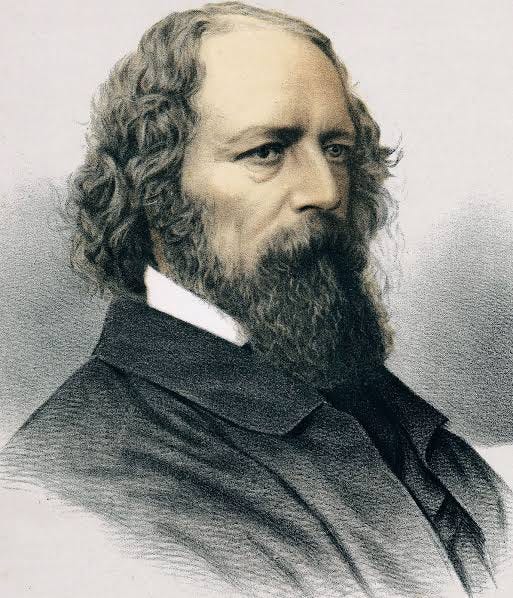
It very well might be that a humanistic approach to higher education is a sinking ship, but I would rather go down with a ship of noble friends than be forced to jump ship from a party of fools.
Whitman cries out “O Captain, my Captain" as a call to leaders to be worthy of being followed. I want to be part of an institution that does not take its lead from others trying to weather the storm, but leads others through that storm.
O Captain, my Captain, may you strive for excellence, seek truth, find virtue in the process, and not yield to the pressures of a failing society and those voices benefiting from that failure.
In hope that your concern for humanity outstrips your concern for a salary (and that ours does too).

Thanks for reading Philosophy in the Wild ! This post is public so feel free to share it.
Comments
Nothing yet. Say the first thing.
Sign in to join the conversation.