What’s now simple
One of the things I’ve done continuously for a while is photography. Recently, I did my first paid shoot, at an art gallery opening, for one of the artists. Otherwise, it’s simply things from my life, like anyone. I’ve almost posted a photo twice before, if it’s from a previous month or year.
As with others, I was recently reminded of XKCD 1425 (Tasks) 1 by Simon Willison 2. That means that I can easily solve this problem for myself.
Models considered
Considering that I may want to do this on my iPhone, I looked at well-known models that could be run. ResNet-50 and MobileCLIP came up as suitable solutions. ResNet-50 requires a modification, since its architecture is to classify an image into 1 of 1,000 distinct classes. I remove that final layer to get a model, where I can get the embeddings from. Here is a common example of the architecture 3.
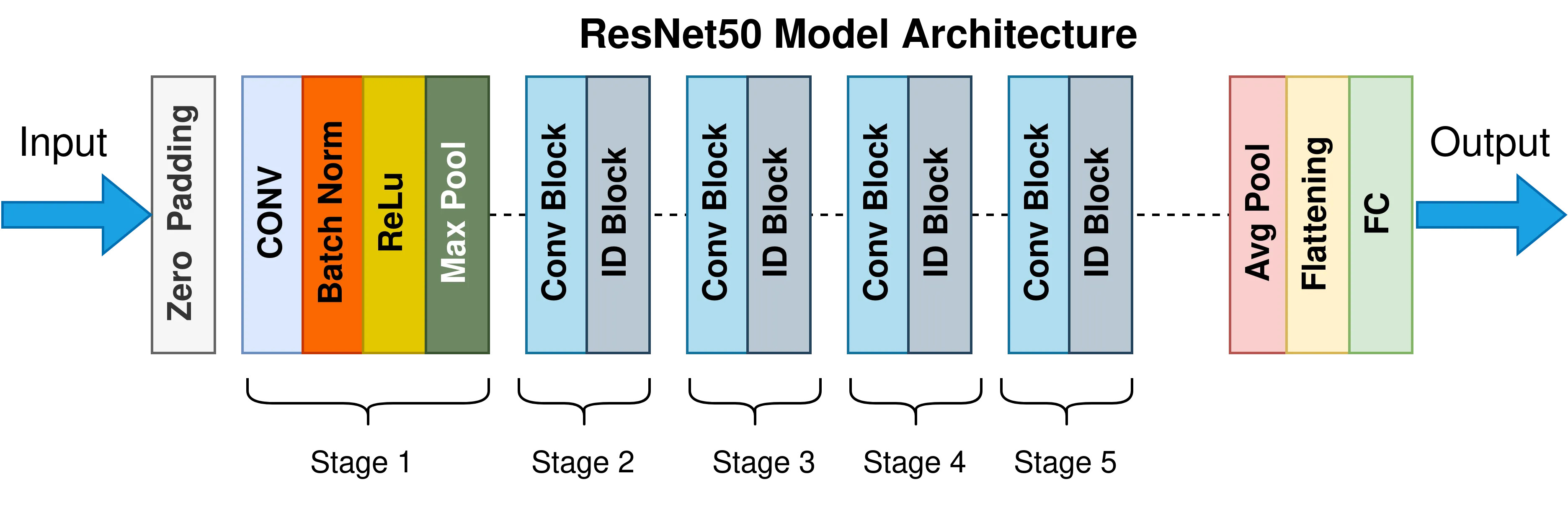
MobleCLIP was used as is
Embedding similarity distribution analysis
As someone relatively new to the more in-depth analysis of ML model performance, I did a rather simple attempt. Simply as well, I was curious how similar my photos are. I used a similarity matrix, created through Torch. I used just the dot product for similarity. This is simple, possibly a little wrong, but sufficient.
The code is available in a repository online: jesse-c/instagram-image-already-posted-check.
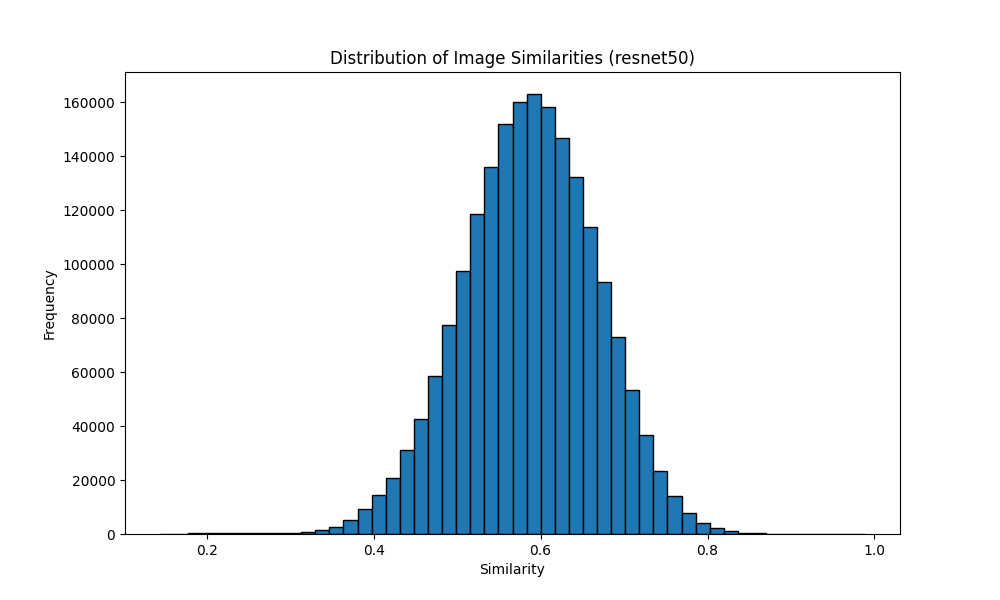
Distribution of image similarities for ResNet-50:
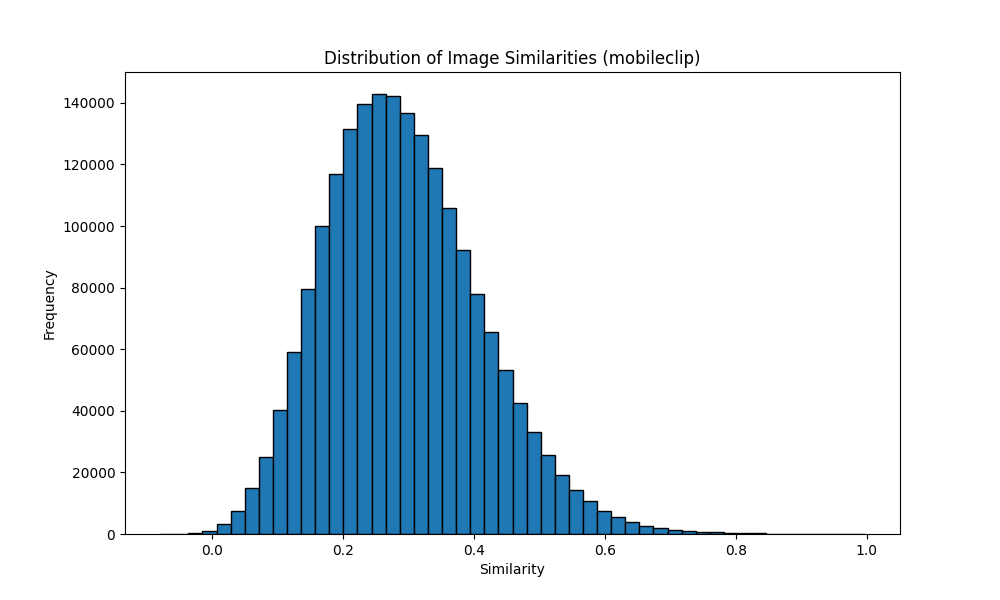
Distribution of image similarities for MobileCLIP (S2):
S2 was picked, based on general recommendations read online, for similar tasks.
I had posted a dupe
When running the analysis, and looking at the most similar pair, I did discover that I had posted a dupe! It was the same photo, albeit with slightly different editing.
Why ResNet-50 may be preferable
There’s higher similarity scores, with the distribution being centered around higher similarity values. This suggests it may be more sensitive to subtle differences.
A tighter distribution means that it could be easier to set a clear threshold, for determining if a candidate photo is a dupe. Ultimately, this would still be a manual process, but in an automated sense, you’d want to avoid surfacing candidates for a manual check.
The symmetry indicates that there isn’t bias towards any particular kind of photo.
Using it on a candidate photo
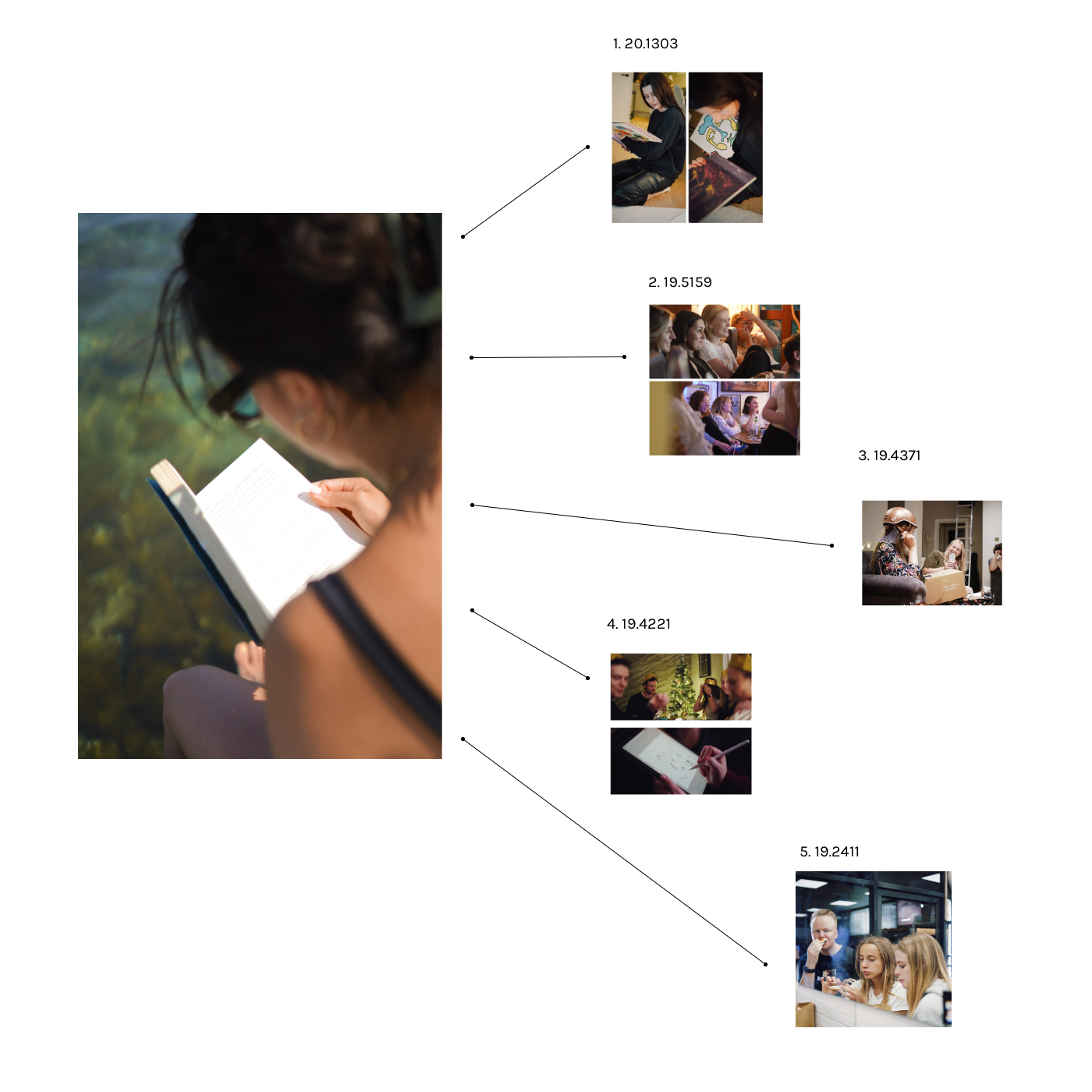
Here’s the candidate photo and the top k similar images. Fundamentally, it was helpful! Here are the results:
Next steps
Often if I’m editing photos, I’m not at my computer. Having this available as a private online service for myself would be helpful. Even better would be an offline iOS app! This could possibly be used by others.
Comments
Nothing yet. Say the first thing.
Sign in to join the conversation.