
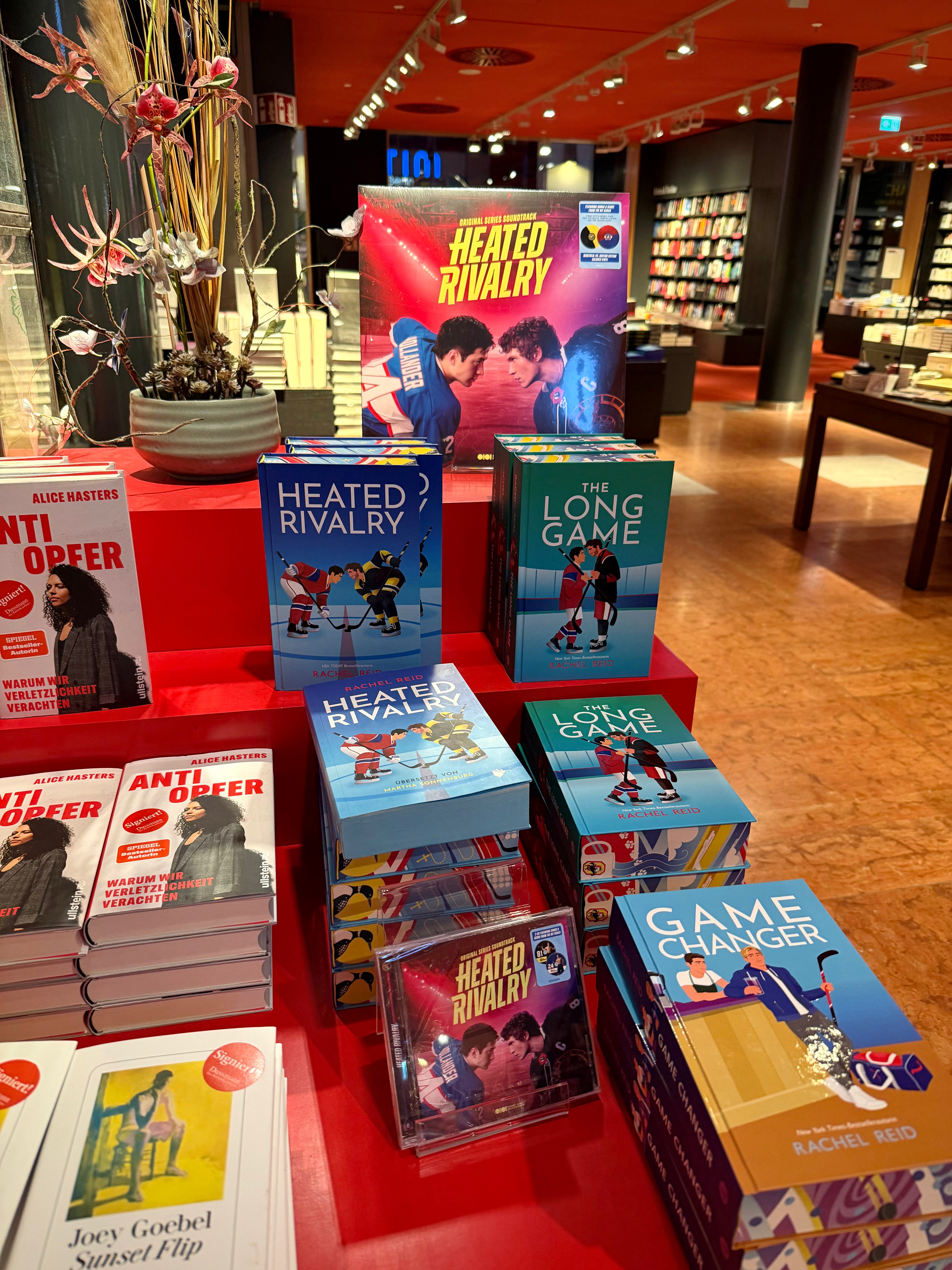
Last night I had friends over for dinner. One noticed I was reading a German translation of Rachel Reid’s Heated Rivalry—a bestseller at Dussmann das Kultulkaufhouse, and one my rudimentary German allows—and remarked on the apparent contradiction between the book and its location: Hegelplatz. This morning, thinking back on the comment after the haze of Riesling had lifted, I realized the contradiction was only apparent. Heated Rivalry is the ultimate Hegelian Romance.
For those who don’t know Heated Rivalry—and if you don’t, your right to comment on contemporary culture is hereby suspended—the premise is simple. Two hockey superstars, the Russian Ilya Rozanov and the Canadian Shane Hollander, fall in love through their rivalry. They start by loving to beat each other, they end by loving each other.
This is a Hegelian love story. Its logic is laid out in Chapter IV of Hegel’s Phenomenology of Spirit. Hegel, who taught around the corner from Dussmann, argues you cannot become yourself alone. Self-consciousness, he writes, “exists … for another self-consciousness.” It “exists only in being acknowledged.” Who I am remains provisional until another consciousness recognizes me. When two selves meet, each seeks not merely to exist but to have its existence confirmed by the other. That demand is where the trouble begins.
But we don’t get to recognition immediately. Hegel begins with desire. At first, desire takes the form of consumption: I affirm myself by negating things—eating the meal before me, winning the point, taking what I want into my possession.
That is how Shane and Ilya’s story begins. As captains of rival teams, they are determined to destroy reach other. Somehow competition becomes sexual attraction, and they hook up. A side note: despite all the homoeroticism, remarkably few of my gay friends have read the Heated Rivalry—its main market is straight women. Why this should be so is a more profound question than it seems, but one for another time.
Yet consumption fails to satisfy: the point is forgotten and the appetite returns. Hegel says this failure propels desire beyond things altogether. What it eventually seeks is not another object but another self-consciousness capable of recognizing it.
And it cannot be just any other self-consciousness. It has to be an equal.
“I love beating everyone, but yes. You the most.” Ilya admits.
“Why?”
“Because you are the best.”
This is where Hegel’s famous master–slave dialectic enters. The master’s triumph over the enslaved person is hollow because it is affirmed only by someone who is not free. Being validated by someone you dominate is a rigged casino. Recognition requires an equal—someone free and capable of withholding it.
Hence the symmetry in Heated Rivalry: in their rookie season, Shane and Ilya score exactly sixty-seven goals each. Even before they met, each had already recognized in the other the only rival worthy of recognition.
The same logic governs the tennis court. From Borg and McEnroe to Federer and Nadal to Alcaraz Sinner, great rivalries are contests between equals. Looking back, McEnroe said of Borg, “We just seemed to bring out the best in each other.” Federer admits that he “almost misses” playing Nadal every weekend. Asked what they are to each other, Alcaraz and Sinner both said: “We push each other to the limit.”
For Shane and Ilya, as for Borg and McEnroe, recognition begins as combat—a heated rivalry, or Hegel’s “life-and-death struggle.” Then comes the lesson the struggle was always meant to teach. If I destroy my rival, I lose too. A corpse cannot recognize anyone, and victory over nothing is worth nothing. Hegel calls this dead end “abstract negation”: annihilation abolishes the only witness whose acknowledgment I was fighting for. What I want is not the destruction of my rival. I want him there, at full strength, permanently losing. When Borg retired at twenty-six, McEnroe was bereft. His greatest rival had left the stage, and with him the measure against which he had come to know himself.
The struggle culminates in reciprocity and reconciliation. As Hegel puts it, “they recognize themselves as mutually recognizing each other.” Or, in one of philosophy’s most poetic formulations: “Das Ich, das Wir, und das Wir, das Ich ist”—”the I that is We and the We that is I.”
Reid plants the seed of this reciprocal recognition in the handshake line after the World Junior final. Shane squeezes Ilya’s fingers, and Ilya understands the message: “We will keep climbing until no one else can reach us, but it will always be together.”
Rivalry, for Hegel, is one of history’s engines. Individuals, ideas, and nations come to know themselves through confrontation with an opponent. Liberalism defines itself against absolutism; Protestantism against Catholicism. Achilles does not simply want to kill any Trojan; he wants Hector, his only worthy opponent. Hegel’s own philosophy of consciousness emerged through argument with Fichte, whose self is too solitary in his view. The rival is never merely someone to defeat. He is the necessary other through whom I discover who I am.
Then Hegel goes a little off the rails. Conflict, he insists, is not an accident that befalls history but the mechanism through which Spirit comes to know itself. Wars, on this view, are history doing what Shane and Ilya do: seeking recognition it cannot give itself. Since freedom emerges through such struggles, conflict becomes, for Hegel, not merely unavoidable but historically productive.
Perhaps he had reason to think so. In October 1806, as Napoleon’s army closed on Jena, Hegel mailed off the final pages of The Phenomenology of Spirit and then watched Napoleon ride through town. “The Emperor—this world-soul,” he wrote to a friend, unable to look away. Did he think he was watching history on horseback, galloping toward higher consciousness, greater freedom?
My dinner guests were quick to ask whether a love story between a Russian and a Canadian hockey player mentions the war in Ukraine. We checked: Heated Rivalry was written years before the invasion.
But tell me, Georg Wilhelm Friedrich, my friend: if conflict is freedom’s engine, what is peace? When can the engine finally come to rest? Is there an end to this struggle for freedom, for recognition, for reconciliation—or is Spirit condemned to build Babel forever?
No posts
Comments
Nothing yet. Say the first thing.
Sign in to join the conversation.