
I wouldn’t have watched Anora, 2025’s Best Picture winner, if my friend M—an expert on Russian politics—hadn’t called it “a total waste of time.” The perversity of curiosity got the better of me. I downloaded the film, if only to understand why it had provoked such polarizing reactions.
I’m in no position to speculate on what the director, Sean Baker, meant by this or that. A work of art mustn’t be reduced to a verdict of authorial intent. I’ll avoid such presumptions. The meaning of art lies, ultimately, in the experience of its audience—and I can only speak for this one.
This isn’t a review of Anora, but a reflection on the world it refracts in our present moment.
 hat ihren Prinz gefunden (Mark Eydelshteyn), und gleich geht's ab nach Las Vegas zur Eheschließung.")
Anora (Mikey Madison, right) and Vanya (Mark Eydelshteyn) at their Las Vegas wedding © Universal PicturesThe trailer, poster, and synopsis all suggest a comical, redemptive Cinderella story: Ani (Anora), a vivacious stripper living in a ramshackle Brooklyn flat, meets Vanya, the handsome son of a Russian oligarch—“Russia’s Timothée Chalamet,” the actor is called. What begins as a transaction blurs into something that almost resembles love. Prominent reviews have compared the film to Pretty Woman. Another film that came to mind was Crazy Rich Asians—only with Russians (who, depending on whom you ask, may or may not be Asians). That’s precisely where the first act seems to be heading, until the story begins to unravel in unexpected and unnerving ways.
Ani and Vanya elope in Vegas. News that Vanya has married “a prostitute” soon reaches Russia. His powerful parents demand an annulment, to be enforced by their Brooklyn-based Armenian henchmen: Toros, Vanya’s godfather, and his assistants, Garnik and Igor. The trio arrives at Vanya’s Brighton Beach mansion. Vanya flees, leaving Ani to defend herself against the Armenian henchmen in a violent, farcical standoff. Igor—the quietest, most gentle of the trio—restrains Ani and removes her diamond wedding ring. Eventually, the four set off to find Vanya, only to discover him getting a lap dance at the very strip club where he met Ani.
Vanya’s furious oligarch parents arrive in New York. Ani tries—and fails—to win their approval. She then tries—and fails—to persuade Vanya to stand up to them, and for her. The marriage is annulled in Vegas, and they return to Brooklyn. Igor drives her back to her flat. In the car, he hands Ani her ring. Touched, Ani initiates sex—but when Igor tries to kiss her, she pulls away and breaks down, sobbing. The film ends in silence. The credits roll, also in silence.
It's in this silence that the film finally lands—and it lands hard. Anora turns out not to be a Cinderella story in the vein of Pretty Woman or Crazy Rich Asians, but a riotous tragicomedy about class, sex, global power—and the inextricable knots that bind them.
The first two themes have already been well covered by critics. Sean Baker’s films are known for their nuanced portrayal of sex workers, balancing precarity with agency—even as Ani insists, again and again, that she is “not a prostitute.” His treatment of gender—through what some critics describe as a persistent male gaze—has itself become a subject of debate.
The class dimension is just as powerful. During his Vegas proposal, Vanya tells Ani he is serious about her. Ani seems to believe him, but her eyes betray a flicker of doubt: about him, about herself, about the whole situation. Julian Chang writes in The New Yorker that Ani is “if not quite in love, then eager to believe in love.” That belief is shattered when Vanya numbly obeys his parents—not unlike the way Tanya dashes Belinda’s hopes in the first season of The White Lotus, another recent masterpiece of class, sex, and emotional labor under late-stage capitalism.
Even Anora’s Oscar win feels like a story of class redemption. With its modest budget and outsider aura, “a movie like this getting a best picture Oscar feels like seeing the good guys win,” writes Will Leitsch in The Washington Post.
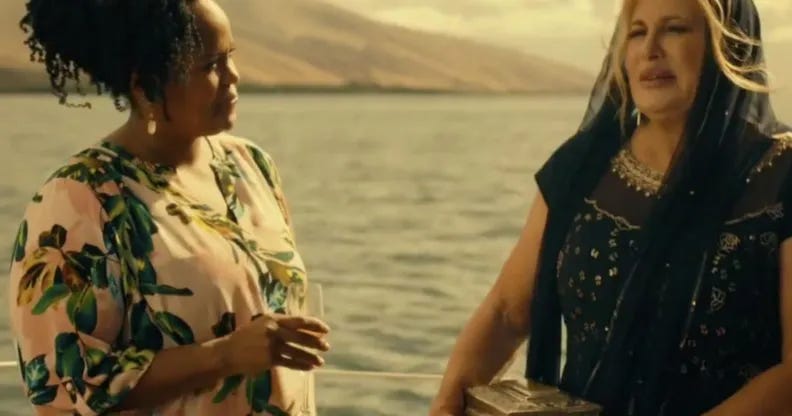
Belinda (Natasha Rothwell, left) and Tanya (Jennifer Coolidge) in season one of White Lotus © HBOBut beyond sex and class, Anora can also be read, at its core, as a story of immigration, identity, and even of international relations. It’s a tale in which the intimate is shaped by the imperial, and geopolitical tension plays out as interpersonal tragedy.
To see why, let’s rewind to the film’s beginning. Ani meets Vanya at the strip club where she works. Vanya, speaking limited English, asks for a Russian-speaking dancer. Ani reluctantly takes the assignment from her manager. She tells him she understands Russian—her grandmother never learned English—but she doesn’t speak it. Moments later, she revises: “I can speak Russian. I just prefer not to.” From then on, he speaks to her almost entirely in Russian, and she responds almost entirely in English. As their relationship deepens, her resistance softens; she begins to speak to him in Russian.
Ani’s attitude will be familiar to many Americans with Russian or East European immigrant roots, especially those who came of age during the Cold War. Russian was the language spoken at home, but not in public. As my friend J—a scholar of East European politics whose grandparents emigrated from what is now Ukraine and Belarus—once put it: “I worried that if I spoke Russian, people would think I was foreign, or weird, or Jewish, or disloyal.”
J’s remark points to a deeper complexity: many children and grandchildren of 20th-century Russian-East European immigrants are Jews whose families fled persecution and pogroms. For them, the Russian language carries a double stigma in American society—both as Russian and as Jewish. Still, many, especially those from intelligentsia backgrounds, become voracious consumers of Russian culture. They may grow up listening to Tchaikovsky; they cannot deny the allure of Chekhov (no honest person can). Some even become experts on Russia.
And yet, to renounce the land that once rejected them—and to prove their loyalty to their new home—they often become its fiercest critics. At times, they come across as both Russophobes and Russophiles, bound to a cultural inheritance they can neither fully embrace nor entirely escape.
A similar, though not identical, tension plays out among second- and third-generation Chinese immigrants. “I don’t speak Chinese” often functions less as a confession than as a quiet declaration of loyalty.
Anora is set in Brighton Beach, a Brooklyn neighborhood bordering Coney Island. Since the early 20th century, it has been a landing spot for East European, Soviet, and post-Soviet immigrants, earning the nickname “Little Odessa.” The area is predominantly Russian-speaking but also home to other diasporas from the former Soviet Union, including Ukranians, Georgians, Uzbeks, and Armenians.
This tiny neighborhood holds outsized cultural significance as a symbol of Russian immigrant life. It appears in The Sopranos as a Russian mafia enclave, a rival to its Italian counterpart. It figures in Neil Simon’s plays as the crowded home of a Polish-Jewish teenager, from where all his fantasies depart. It’s often portrayed as a 20th-century holdover in modern-day Brooklyn—the emotional homeland of Russian-Jewishness: perpetually exiled, culturally in-between, and haunted by the past.
Brighton Beach is also a microcosm of American life, with its visible decay, stark inequality, and ethnic tensions.
It serves as the backdrop for Requiem for a Dream, a harrowing exploration of the fragility of the American dream, where wealth and fame appear within grasp but ultimately slip away. In contrast to the linear, redemptive arcs seen in Erin Brockovich and The Pursuit of Happiness, Anora belongs to a more subversive tradition in American cinema—alongside Requiem for a Dream and Midnight Cowboy—that employs loop-shaped narrative to expose the mirage of reinvention: of class, of destiny, of oneself.
Vanya’s (parents’) beachfront mansion and Ani’s cramped apartment, which she shares with her sister, sit only a few blocks apart. Despite their physical closeness, Ani and Vanya inhabit vastly different worlds—one shielded by inherited wealth that moves effortlessly across borders, the other barely surviving on the most vulnerable and stigmatized form of physical labor.
Ethnic tensions simmer beneath the film’s laugh-out-loud dialogue. The henchmen hired by Vanya’s oligarch parents to keep him in check are Armenian—yet their authority over him is hollow, undercut by the very status hierarchy that employs them. In one of the many shouting matches, Vanya hurls a slur at Toros, calling him “a fucking Armenian piece of shit”—a reminder that immigrant communities often reproduce, and often intensify, the very ethnic and racial hierarchies that marginalize them in their host society.
Toros is caught in the crosshairs between Vanya and his parents, symbolizing Armenia’s precarious position at the crossroads of empires. Its modern history began with the genocide of its people under the Ottoman Empire. Under Soviet rule, Armenia gained stability but lost autonomy. After the dissolution of the Soviet Union, it emerged as an independent state—one that relied on Russia for protection in its conflict with Azerbaijan, much like Toros depends on Vanya’s parents for employment. Since Putin’s invasion of Ukraine, tens of thousands of Russians have relocated to Armenia, drawn by visa-free access and a Russian-friendly cultural environment. Armenia’s economy has seen unprecedented growth since 2022.
Yet Armenia’s future is as uncertain as the film’s Armenian hired muscles. Its relationship with Russia has deteriorated since the 2018 “pro-European” revolution, which ousted the country’s long-standing pro-Russian leadership. Economically, much depends on whether the recent wave of Russian migrants will choose to settle permanently. Geopolitically, Armenia remains a contested space where Western and Russian spheres of influence continue to collide.
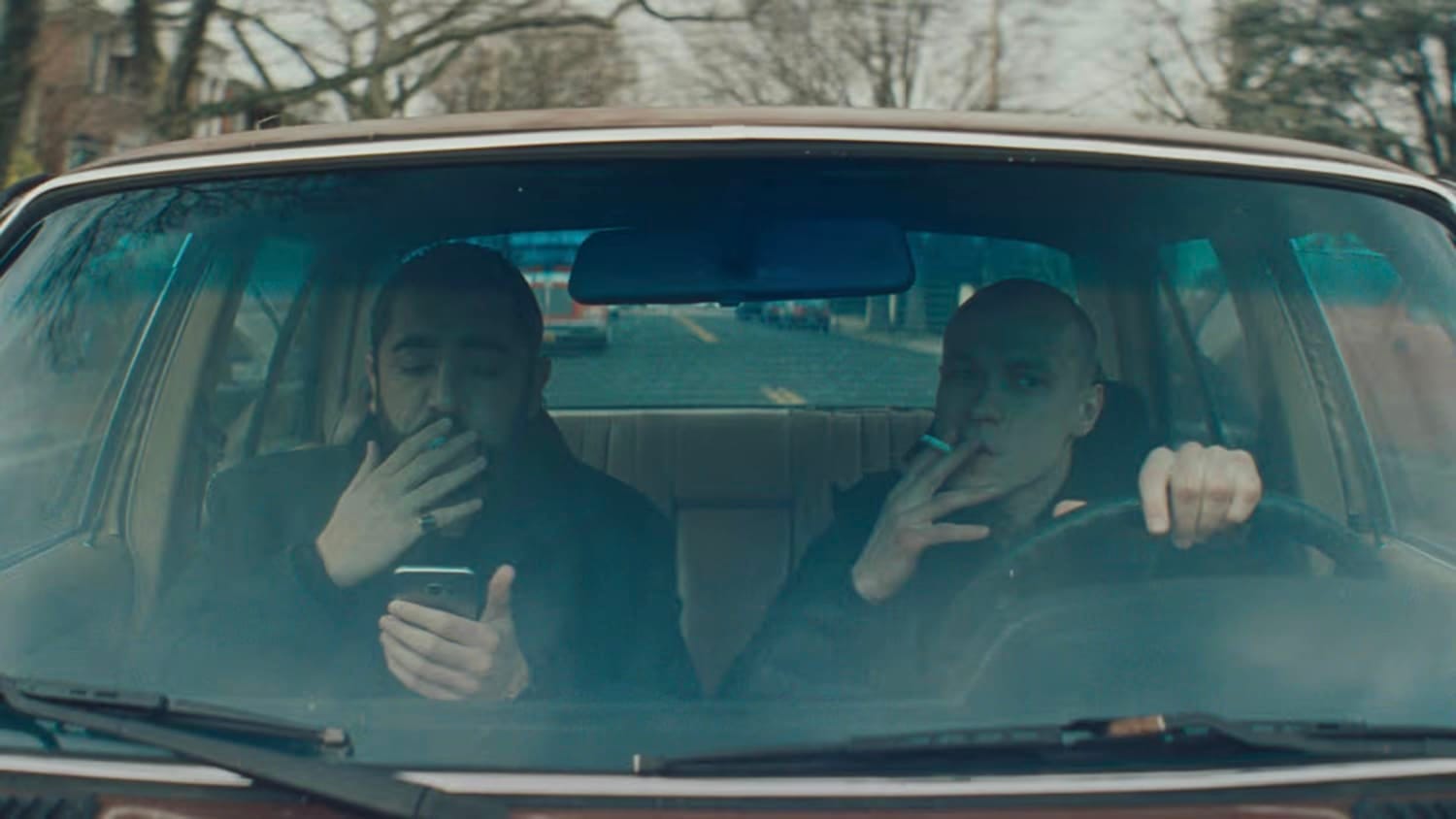
Toro (Vache Tovmasyan) and Igor (Yura Borisov) looking for Vanya around New York city © NEONAt the end of the film, Ani and Igor sit in his parked car—a 1983 Mercedes-Benz diesel sedan—outside her apartment. Snow falls softly, but firmly. In a moment that catches both Ani and the audience off guard, Igor returns the ring. Ani looks at him and says, “This car is very you.”
“Do you like it?” he asks.
She pauses. “No.”
He hesitates. “It was my grandmother’s.”
This moment recalls Bentley’s 2011 commercial in Russia—a five-minute music video tracing the love story between a young car mechanic and the glamorous owner of the Bentley he repairs (with a subtle dig at Ferrari). Everywhere—but especially in the developing world, and in the developing world within the developed one—cars function as status markers. They signify class, and often stand as barriers between lovers divided by it.
In the film’s final scene, Ani initiates sex—as if to thank Igor for his small gesture of kindness. But when he leans in to kiss her, she recoils, violently rejecting him, before collapsing into sobs in his arms.
This interaction lays bare the emotional toll of sex work: Ani can marry someone who pays for her company, but she cannot accept genuine affection. Yet what she recoils from isn’t just Igor and his old car, but something deeper: her own working-class, East European-immigrant self.
The film ends in a silent revelation: desire is never truly free of identity, class, or power.

Anora (Mikey Madison) looks at Igor (Yura Borisov) in the ending scene © NEONIt’s unclear which European first said, “Everything is about sex, except sex: sex is about power.” But if there’s truth to this claim, Anora’s over-the-top sexual dynamic between its two protagonists functions—likely beyond the director’s intention—as a dark meditation on the tragedy of great power politics.
When Ani gives Vanya a lap dance during their first encounter, he moans, “God bless America.” The allegory is hard to miss. Ani, an American girl, becomes America itself: brash, seductive, performatively welcoming. She falls into bed—and into a kind of love—with Vanya, a Russian “tourist” who embodies post-Soviet Russia: newly rich, volatile, recklessly experimenting. Each is unhinged in their own way.
The film’s sex-heavy first act evokes the Clinton-Yeltsin “bromance” era of the 1990s—a brief, topsy-turvy honeymoon between a chastened but eager post-Soviet Russia and a triumphant United States. Ani and Vanya’s champagne- and cocaine-laced Vegas wedding recalls Wall Street’s euphoric, phantasmagoric arrival in Red Square.
But the honeymoon is short-lived. Russia slips away, escaping America’s grip. And when it returns—bearing the cold emissary of patrimonial power—it is unrecognizable, unresponsive. America is left disillusioned, betrayed.
Look again, though. Ani is also Russia—the Russia that once fell for America, enchanted by its neoliberal advisors and their promises of democracy and prosperity. But much like Ani and Vanya’s doomed marital experiment, the fantasy of compatibility was built on profound asymmetry. Ani-Russia embraced Vanya-America with open arms, only to realize it would never become part of the family. An invitation to the EU or to NATO was never on the table.
Vanya—the rich foreigner who lavishly romances Ani, then dispassionately pulls away—becomes the West that courted post-Soviet Russia, but never proved willing to see it as an equal. Russia is left disillusioned, betrayed—and, like Ani, it lashes out.
Some might argue this is an overreading of the film. But in the context we now inhabit, overreading feels inevitable. Since its Oscar win, Anora has drawn sharp criticism from pro-Ukraine voices in the U.S., citing its silence on the ongoing war, its casting of what they call “Russian propaganda actors,” and what they see as an act of “cultural normalization amid Moscow’s aggression.”
And yet, for all the geopolitical weight projected onto it, Anora remains, at its heart, a deeply human story. So let’s set the nation-state metaphor aside, and peel back the allegory one last time. Ani, Vanya, and Igor are just ordinary people, swept up in forces larger than themselves—class, family, history, the clash of empires. Despite all the movement, all the drama, they each end up exactly where they started: Ani and Igor return to jobs that quietly deplete their humanity; Vanya returns to the parents he despises but depends on. Everyone tries to escape, but no one does.
The story resets. Anora’s dream dissolves—and with it, the temporary illusion of transformation, and transcendence.
No posts
Comments
Nothing yet. Say the first thing.
Sign in to join the conversation.