
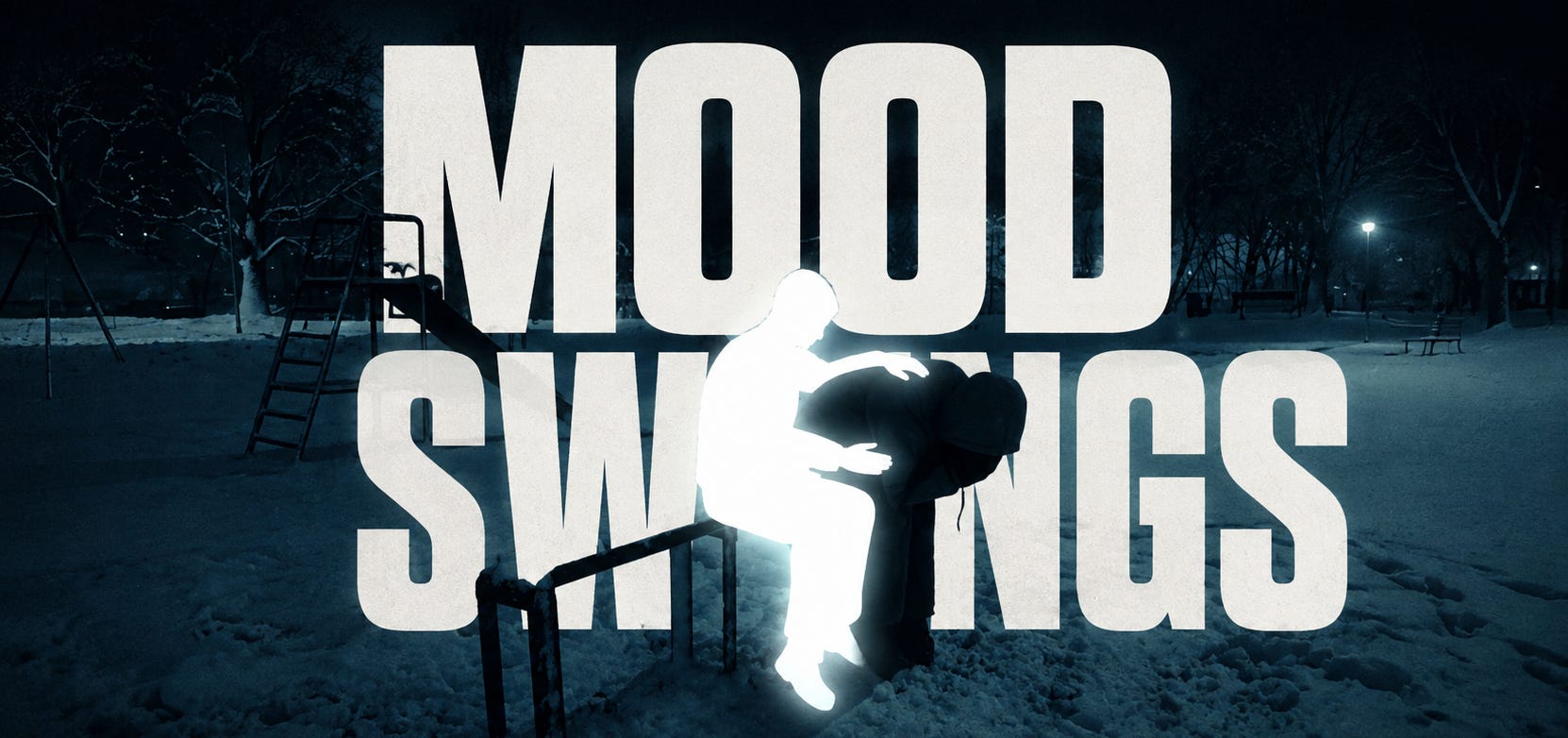
our mood is an important part of our daily lives and can dictate many of our actions in our day to day living.
and there are so many places where we feel like a completely different person based on our environment because it puts us in a certain mood.
think about it.
you have a certain way you act at work and a different way you act at home based on the different moods you’re in.
you’re a different person at school than you are with your family.
your family would not recognize the ‘you’ at school.
you act one way around your friends and another way around your family.
that alone changes your mood.
we all wear different masks in different rooms.
that’s one of the most important things to understand here. that constant switching and that constant mask we put on when we enter different rooms can destroy our moods.
but outside of that we also have day-to-day mood swings.
mood swings are a big part of everyone’s life.
that sudden flip in your mood that has you questioning where the good mood went, or where the bad mood came from.
you wake up in the morning and you feel so happy, ready to conquer the day.
you hit that good morning workout, you hit the work session, you eat healthy food, you drink your water, you take your vitamins.
you feel like the best person in the world, happy that you get to do everything you need to today, motivated like you can go get it done.
but then something happens at 8am. a text. a text from someone that makes everything dark and you just can’t understand why today sucks so much now.
or the exact opposite can happen. you wake up in the morning feeling like you got ran over by a truck. you feel like a zombie walking around and you have no idea what’s going on.
but then in the middle of the day something happens. you feel so good, you’re having the time of your life, you’re really in your skin and you want to do everything you need to get done.
you feel so good and can’t understand why earlier that day you were dead.
your mood is a swing. yes, it’s called a mood swing, and a swing is a swing, but a swing on a playground isn’t the same as a mood swing.
i did not mean for that to sound like a tongue twister. but you get the point.
when you’re on a swing on a playground you know when you’re going to stop or when you’re going to slow down.
you have control of it, or at least you can predict it. you know when you’re going to come back down and you feel it on the swing. you know your trajectory.
a mood swing is not that type of swing. they aren’t predictable. they’re not something you control, or even know when you’re going to change.
most of the time they just take you someplace you don’t expect or want to be, and leave you questioning when you’re going to get back.
let me explain to you why this happens and what the science behind it is.
it’s 9:48am as i write this very sentence.
black coffee with raw honey sits next to me, steaming up. i had half of it already before i’ve finished this intro, so i might need another glass before i can even finish.
my vanilla candle is burning, ambient music plays slow in the background. “long whale song” by sympho cat, probably one of my favorite ambient songs of all time.
sun peaks through the window right where my chair is, where i do most of my thinking.
i woke up today in a great mood. fitting for a post about moods, but we’ll see if it can survive writing this post.
who knows, if i hit a writer’s block somewhere i might not feel so good.
either way, let’s get into it.
"Feelings are much like waves. We can't stop them from coming, but we can choose which ones to surf." — Jonatan Mårtensson
so what’s the neuroscience and psychology of the day to day, hour to hour mood fluctuations that all of us experience?
your mood is entirely chemistry. neurotransmitters in your brain, chemicals of various kinds, released in your brain.
there is a whole set of neurochemicals and neurotransmitters that you’ve heard about endlessly, from dopamine to serotonin, endorphins, norepinephrine, and so on and so forth. the entire squad.
the relative levels of these, essentially, are the dials for your mood.
think of it like a dj with his soundboard and he has a hundred sliders on this mixing, and every single slider is a chemical.
there’s one for dopamine, one for serotonin, one for oxytocin, for whatever else you want to include.
your mood is whatever song is playing as a result of the mix. if the levels go up, you feel good. if the levels go down, you feel bad. this is essentially what it is.
the problem is, these dials often get messed with by the stupidest of things.
i think of it as a curse, really.
imagine that you skipped a meal. i’ve done posts on fasting before, on intermittent fasting and the benefits of it, autophagy and so on.
but let’s say that you skipped a meal, and your body was expecting three square meals a day. well, your mood is going to take a hit.
your fuel reserves are going to be low, you’re going to be lacking in nutrition, you’re going to be lacking in neurotransmitter production, which will induce feelings of depression, melancholy, irritability, rage.
but on the other hand, if you were able to engage in some outdoor activity, some nature exploring with your dog, then your dial is going to move upwards.
your mood is going to change in accordance with the dial.
if you played with your dog for four minutes, you’re going to have oxytocin released in your brain, which is going to move that particular dial upwards, and you’re going to feel happy.
you’re going to feel human.
if you didn’t get any sleep, if it was that time of the month, if you had gone out and gotten drunk the previous night, if the weather has sucked for the past three weeks, these are all things that are going to push your dial in various directions.
all largely not by your design or by your doing.
this is why we can have these unexplainable moments where we feel like shit for seemingly no reason.
we look outside and it’s like, “why do i feel this way? what is this all about?” because it’s not about anything in particular. it’s usually not one single thing.
it could be one thing, it’s possible. but it’s more often the case that it’s three little tiny things, little nudges in one direction that your brain doesn’t notice that accumulate.
then all of a sudden there’s this bad mood that you can’t explain, that seems to come out of nowhere.
the sky was grey outside, you got cut off in traffic, your coffee spilled on the floor.
three little things, things that wouldn’t be enough to make you feel like crap on their own, but when they add up, when they all happen at once they push you into a bad mood.
your brain is engaging in this ceaseless, continual chemical experiment on itself, and you are the subject of that experiment.
everybody does this, all of us, every single day.
ups and downs are an inevitable part of being a functioning human, a sentient creature.
but there is something in these ups and downs that most of us miss out on.

this will change everything about the way you view things.
mood is a thing that we like to think of as noise, but if you take a step back, your mood is literally data.
very important data, if you can read it and pay attention.
as i said in the intro, most of these are triggered unconsciously, from little day to day things.
and this is why we think of our emotions as weather.
it’s random and something that happens to us.
something we have to get through until it passes, like we’re standing in a grass field and the storm has to pass by us before we can leave it. instead of trying to get out of the storm and get inside.
here’s something to consider.
your mood can be your second brain.
it can act as an entirely different intelligence than your logical, conscious brain, because it’s constantly feeding you information that the logical part of your brain hasn’t processed yet.
how many times have you had your mood, or some sort of emotion, tell you something, or know something, before you actually knew it?
you meet someone new, and on paper they seem nice, they’re smiling, they’re saying all the right things. but for some reason your mood just doesn’t like them.
you can’t put your finger on why, and six months down the road you find out that they’re actually like a serial killer or something.
that’s a joke. but usually later down the line you find out what triggered that feeling had a reason behind it.
they did something, or they were something, or they are something that set off a little flag in you, and your body and mood sent a message to your conscious to be wary.
people call that intuition. it really is just that.
say you’ve got a job, or an opportunity, or a deal, and logically it all makes perfect sense.
you run through it in your head with your conscious and it’s just a solid, logical plan.
everything will benefit you, or help you out, and it seems great, but for some reason you just have this sort of gut feeling, this feeling of dread and unease about it in the pit of your stomach.
we’ve all seen those situations, and we’ve all felt that feeling.
it’s the reason they always say to trust your gut.
my mom is one of the best people i’ve ever known at this. she has some of the best intuition.
she could always sense something was up or something was wrong. she couldn’t always explain how, but whatever she said was usually always right.
that’s that same feeling of dread, of knowing something’s up.
that is your second brain being used as your second intelligence.
don’t ever discredit your intuition, or second brain, because most of the time it’s processing things your conscious mind could never process, and waving little flags down in your conscious that you just aren’t paying attention to.
that’s a pretty cool perspective to view those things in.
a bad mood that comes out of seemingly nowhere isn’t just something you try to distract yourself from, or numb yourself from, or sleep off.
it can be viewed as a check engine light. you should actually go look at it for a second.
look around at what happened, look around at what changed, what did i just see, what did i just avoid?
most people spend their entire lives just covering up the check engine light and never actually stopping for it.
next time you have a bad mood for no reason don’t just go distract yourself.
stop and analyze it for a second, and try to see what changed. why did i just get this way?
even something as simple as someone cutting you off in traffic, and the information is right there for you to work with.
you can’t let external factors dictate your mood.
usually the information is right there. your mood already processed it for you, and you just need to go up to it and be like, “hey, what’s up man.”
don’t just ignore the storm, don’t just sleep through it, and don’t just distract yourself from it. there’s usually something there, a root cause, and you just need to go acknowledge it.
“You don’t have to control your thoughts. You just have to stop letting them control you.”
— Dan Millman
saying that, i think it’s easy to sit here and overanalyze everything that happens to us, our moods and whatnot.
i don’t want you to get the impression from this post that every mood swing you have is something that needs to be analyzed, or something that you failed to solve, or a mask that you need to drop.
a lot of mood swings that we do get are very valid, and they’re just life giving you an uppercut to the jaw.
there’s nothing that you can really do to those that will help.
you can sit there and analyze them, or you can go to work and be authentic, or you could practice breathing.
in reality sometimes none of those will work. in the slightest.
say somebody you love dies. that’s a big thing that happens to all of us. that’s an external thing that will just fuck up all of our moods for a while.
for months, your mood is on that.
it’ll knock you flat the second you think you’re standing back up, especially for something that severe.
one day you’ll be fine and you’ll be chilling, and then you happen to come across a song or a picture or the handwriting of the person that passed away. it’ll feel like the floor gave up on you.
that’s not a sign to decode or wonder where your mood is changing.
i think discernment is really an important aspect of this skill.
to be able to decipher what is actual noise and what is actual data.
that is not noise but it’s also not something to go on top of and be like, “why can’t i control this?”
say you lose your job.
now your whole brain chemistry is going to be running on fear and uncertainty.
you’re going to be thrown into survival mode, because a job provides the security of the idea of putting food on your plate and having a shelter under your head.
if you lose that, you’re going to literally be thrown into survival mode. your amygdala’s probably going to be firing off as if a tiger was gnawing at your leg.
the message i want to get out with all this, is you don’t control every mood, and every mood is not something to analyze.
some of them are data, but some of them you just have to weather. they’re just things that you can’t control.
there are swings you can rig, the one we just talked about, where you can analyze, you can drop the mask, you can read the signal, and you can move the body. and
some swings you just can’t. they’re just the tide coming in like a tsunami.
some of those waves are tsunamis, and some of them are small.
the discernment and understanding is the real wisdom.
if a wave is coming, the only job you have is to not drown, and to not beat yourself up for getting wet, because you’re gonna get wet. just don’t drown.
trying to fix grief, or hormones that actually change your biological level, or a real loss, with a breathing exercise, is not gonna work.
some moods are meant to be decoded. some moods are just ones you’re gonna have to survive. there’s nothing you can really do about them.

so what are some small actionable things that you can do to help with the day-to-day mood swings?
realistically they’re not going to stop. you would have to bioengineer human emotion to a level that only some mad scientist in a lab could do.
but we don’t want them to stop. the end goal is just to have fewer, random mood swings.
so simple yet so effective. staying cooped up indoors all day is not good for you. nature does something to your nervous system that a room can’t.
something as simple as a walk in a park will lower your stress levels and reset your mood dials to a calmer level.
it’s ridiculous how effective this is for how easy it is.
daily walks. non negotiable.
just talked about it in my post on the art of training. i’ll preach it until the day i die.
working out creates mood-boosting endorphins and gets you to sleep better. that’s half the battle won right there.
a bad mood can sometimes just be a body that hasn’t moved in three days.
you don’t have to turn into a bodybuilder prepping for a show but you should watch your diet.
a steady diet of processed bullshit and sweets is going to keep your brain on a rollercoaster. lean proteins and colorful vegetables. as simple as it gets.
your whole mood is partly made of the food you eat.
short and inconsistent sleep is the number one way to wreck your mood dials before your day even starts.
science shows that one bad night can make you more reactive, irritable, and quicker to spiral over nothing.
get your hours in and while keeping it consistent and half your swings will never even show up.
and if winters get you down and you’re prone to seasonal depression, consider light. bright light boxes are a great tool to get your serotonin levels back up to par.
and finally the best thing that no article like this mentions.
stop pretending to be someone you’re not. every mask you need to take off and put on is a source of energy.
be the same person everyday. the best mood stabliizier available on the market. and it’s free.
your moods will always come and go my friend. that’s simply life. just learn the ability to read them versus fighting them and when to let them pass.
your mood has been trying to tell you that this whole time.
ps. quick heads up, the august special ends tomorrow.
i'll be posting consistently for the rest of the month, all the deeper stuff i save for the premium side.
if you've been on the fence, now's your chance. annual plan's 25% off till tomorrow. i'm sure you won't regret it.
click the button below if you’re looking to upgrade:
check out some premium posts:
No posts
Comments
Nothing yet. Say the first thing.
Sign in to join the conversation.