
Part one: The new book Speakeasies to Symphonies: The Jazz Genius of James P. Johnson by Scott E. Brown, and a reprint of the substantial interview of James P. Johnson by Tom Davin
Part two: Mike Lipskin on stride piano; two tracks from “The Beetle” and a session from Willie Gant; favorite tracks from a few other more famous names
Part three: A basic guide to the first two decades of James P. Johnson solo recordings, plus a couple of historical photos
Part four: In Search of “Carolina Shout”
Coda
Many of my otherwise talented jazz piano students are not skilled at reading sheet music on the grand staff. They can improvise on standards from a lead sheet, but they can’t sightread the original easy musical theatre scores. I frequently grumble to myself, “Chord symbols ruined everything!”
Back when the music was being created, just about every kind of ensemble played tunes and dances in the European idiom for all sorts of occasions. Opera overtures were important, as were light classics and “salon” piano pieces. A lot of this stuff has fallen out of fashion today, but at the time it was a form of popular music.
Depending on how many cartoons you watched as a kid, you may know more of these tunes than you realize.
Jelly Roll Morton said of hanging out in a St. Louis ragtime club around 1912:
So he decided to find out whether I could really read and play piano and he brought me different light operas like ‘’Humoresque,’‘ the overture from Martha, the “Miserere” from Il Trovatore and, of course, I knowed them all. Finally they brought me the Poet and the Peasant. It seems like in St. Louis, if you was able to play this piece correctly, you was really considered the tops. The man that brought it was the best musician in town and he hadn’t been able to master this piece. Well, I had played this thing in recitals for years…
James P. Johnson said of hanging out in Harlem in about 1914:
Ernest was a good classical pianist. Luckey [Roberts] used to ask him to play the William Tell Overture and the Light Cavalry Overture. These were considered tops in classical music amongst us…I did rag variations on William Tell Overture, Grieg’s Peer Gynt Suite and even a “Russian Rag” based on Rachmaninoff’s “Prelude in C Sharp Minor”…
Count Basie also mentions the Poet and Peasant Overture, although in this case Basie was unable to deliver. It is 1936, and his brand new band has landed in Chicago.
I also must have known that I was really pulling out of Kansas City for good after being out there for nine fantastic years…We were supposed to be at the Grand Terrace to rehearse with the new floor show a few times before we were due to open…We went in there for the rehearsal that next day, and I found out that the music we were supposed to play for the big number was a special arrangement of the Poet and Peasant Overture. All I had to do was just get one quick look at that thing…I said sheeoot, they better send to the union or somewhere and get somebody to play that, because damn if I can. So they finally sent and got some lady, and she came in there and played it…We caught hell trying to play that show…
For the St. Louis ticklers, Poet and Peasant was a supreme test, and the same work struck terror into the heart of Count Basie. Neither mentioned the composer, Franz von Suppé, who was also responsible for Light Cavalry Overture, one of the pieces James P. Johnson and Luckey Roberts considered “tops in classical music.”
An elite classical musician might not be so impressed with this rather undiscerning taste. Indeed, when complaining about James P. Johnson’s accompaniment for Bessie Smith, Gunther Schuller says that James P. “leaves the nagging impression that his interests in commercial music and a ‘classical’ repertoire closer to semi- or light classics had left its imprint on his playing.”
Although I dispute Schuller’s scolding tone, he is right about “semi- or light classics.” James P. Johnson and the rest of the early jazz masters didn’t talk about Bach’s Art of the Fugue or Beethoven string quartets.1 Instead, they talked about Poet and Peasant.
In my view, this is nothing to be snooty about. Poet and Peasant was there, it was embedded in the culture, and while von Suppé rarely makes anyone’s list of greatest composers today, he’s good enough. Von Suppé can teach you all you need to know about basic European harmonic motion and melodic shape. Chord symbols are not required. (In fact, chord symbols obscure the bass line and the movement of inner voices.)
A partial list of opera, operetta, and salon themes that a tickler like James P. Johnson would have been familiar with.
The Poet and Peasant Overture (von Suppé)
Light Calvary Overture (von Suppé)
William Tell Overture (Rossini) — has the driving Lone Ranger theme and the bucolic background to Bambi Meets Godzilla
Merry Widow Waltz (Lehár)
Sextet from Lucia Di Lammermoor (Donizetti)
Barcarolle from Tales of Hoffman (Offenbach)
Meditation from Thaïs (Massenet)
Élégie (Massenet)
Peer Gynt Suite (Grieg) — includes “Morning,” “Anitra’s Dance,” and “In the Hall of the Mountain King,” all frequently heard in silent movie accompaniments and cartoons
Melody in F (Rubinstein)
Tango in D (Albeniz)
Humoresque (Dvořák)
The king of “ragging the classics” is the great Donald Lambert, who recorded four examples for his lone studio session.
However, Lambert is sui generis, a genius, an astronaut. (As is Art Tatum in his transfigurations of Massenet’s “Élégie” and Dvořák’s “Humoresque.”) My point is less about such genius than about any regular whorehouse piano professor running through an overture or “Melody in F” during his nightly routine.
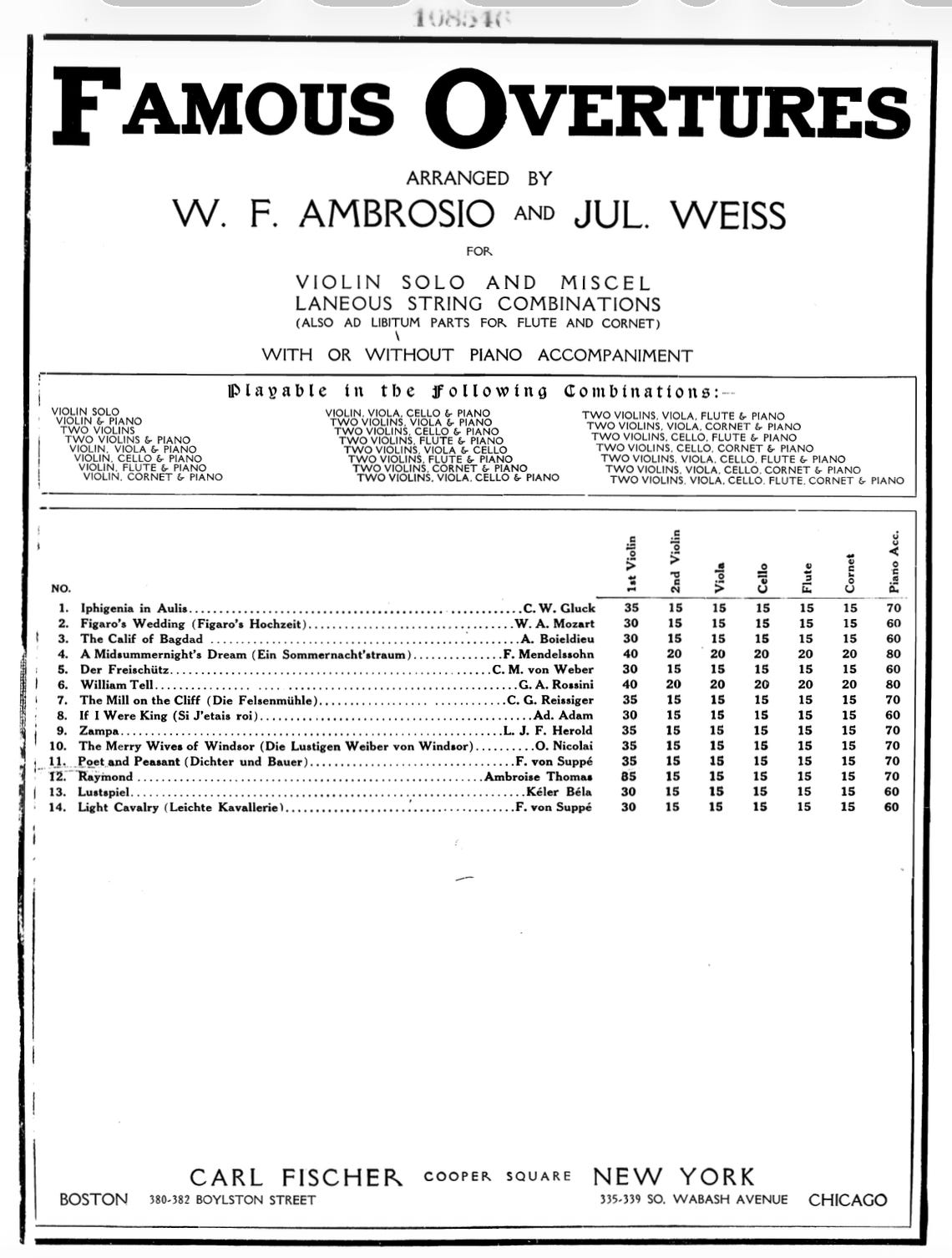
The topic is worthy of further investigation, both as Americana (including silent movie scores and Looney Tunes) and as the dawn of the jazz tradition — and not just for the pianists. The cover page of a Carl Fischer anthology of Famous Overtures offers a bewildering array of potential ensembles from the same template, with an optional cornet or flute part each costing an additional 15 cents. This is a pretty freewheeling approach to ensemble and orchestration! Sounds like jazz to me!
The 1913 recording of the second part of Poet and the Peasant by the American Symphony Orchestra is slightly out of tune and generally pretty raw. The conductor is unknown — although is there a slight chance there is no conductor, for the band clearly understands the argument on a folk music level.
I can hear nascent blues, rags, and even Ellington and Charlie Parker in this ancient piece of lacquer.
Later tickler Jim Turner — who has also made a good album of James P. Johnson music — plays Poet and the Peasant in 1986. Turner begins with the music “as is” before eventually turning it into a stride showpiece.
To be fair, few American musicians of any stripe during the circa-1910 era knew Bach’s Art of the Fugue or the Beethoven string quartets. You couldn’t buy a recording of any of this sort of repertoire yet, and I doubt the scores were common, either. The first American string quartet of note, the Kneisel Quartet of Boston and New York, made a turn-of-the-century impact partly because they actually programmed complete quartets by Haydn, Mozart, and Beethoven (instead of a variety show mishmash of more popular pieces). An amusing read is Richard Aldrich’s Concert Life in New York, 1902-1923, where a working critic responds to a kind of programming rather different than what we would find today. Of course, if the topic is black musicians and listeners, then questions of access also enter the picture.
Comments
Nothing yet. Say the first thing.
Sign in to join the conversation.