
Nicolás Maduro was on the ropes. On January 3, Donald Trump knocked him out.
To be more precise, Maduro was kidnapped to join Diddy, Luigi Mangione, Ghislaine Maxwell, El Chapo, and R.Kelly in the Brooklyn Metropolitan Correctional Center.
But what’s going to happen to Venezuela now that the US “runs” it?
That and a lot more is what I’ll analyze in this piece:
How Trump ousted Maduro: a recap of the last two months
Venezuela in January 2026: decoding acting president Delcy Rodríguez
Donald Trump’s (lack of a) Venezuela strategy
The role of oil: a pot of gold at the end of the rainbow?
The risks to Trump’s grand ideas
My conclusion and predictions what will happen
The TLDR: Trump’s daredevil strike has created a new equilibrium that’s structurally unstable but should hold for a while. It’s in everyone’s best interest to play nice for now, but long-term incentives point to this being a fragile peace.
In my first Venezuela deep dive in November, I wrote:
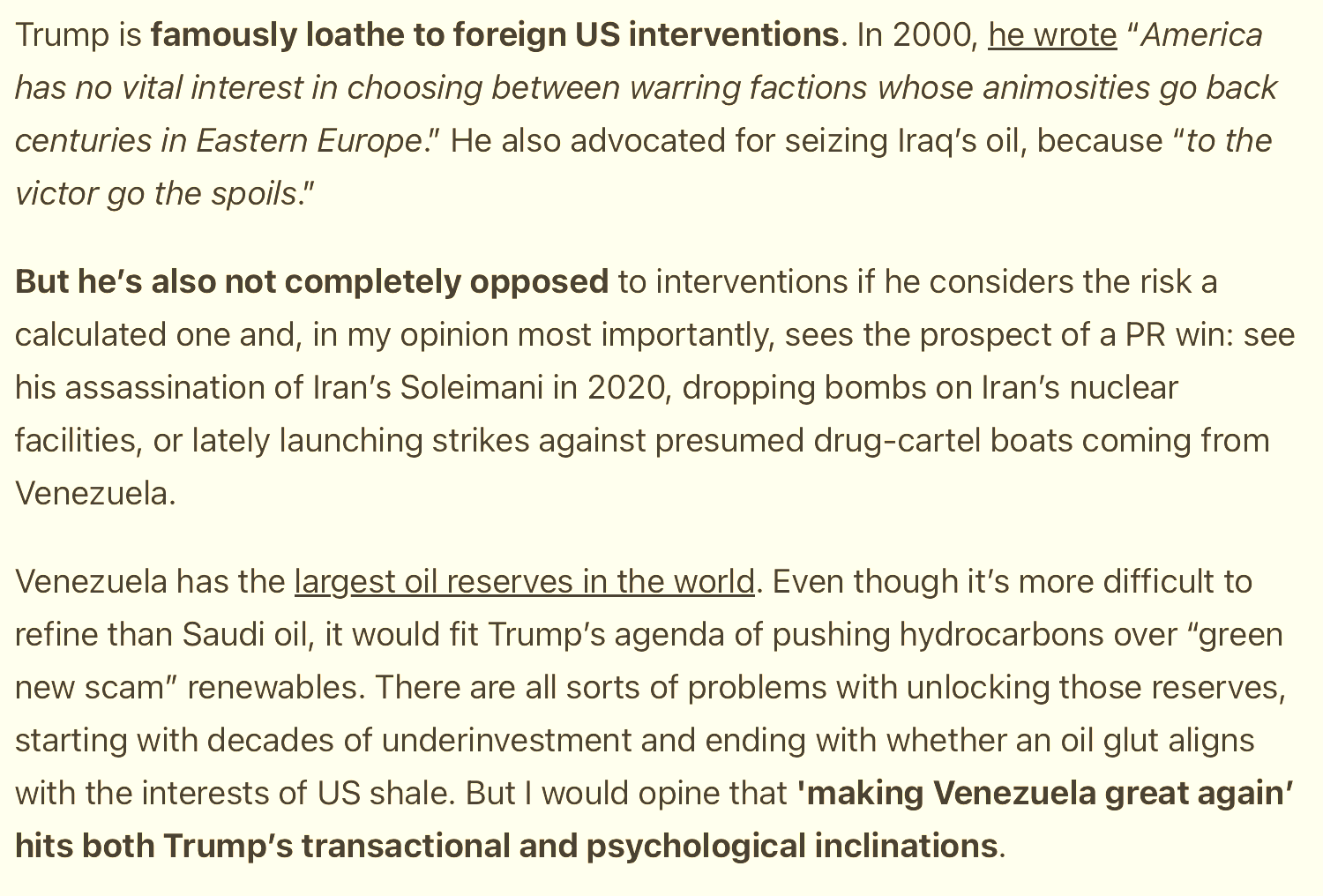
This analysis was spot on and played out perfectly.
The Wall Street Journal reported that Trump decided in December in favor of military action. Did Maduro’s dancing videos really tip the scales as word on social media has it? They were at least annoying enough for Trump to “privately express frustration.”
According to Axios, Plan A was for a long time to get Maduro to step down voluntarily. Trump reportedly even spoke to Maduro one week before the attack and almost greenlit the strike before the new year, but bad weather prevented it.
I was wrong with regards to the timing or the nature of the escalation. In November, I expected a limited escalation in the near future, and one that would be approved only if it was virtually guaranteed to suceed in the eyes of the public:
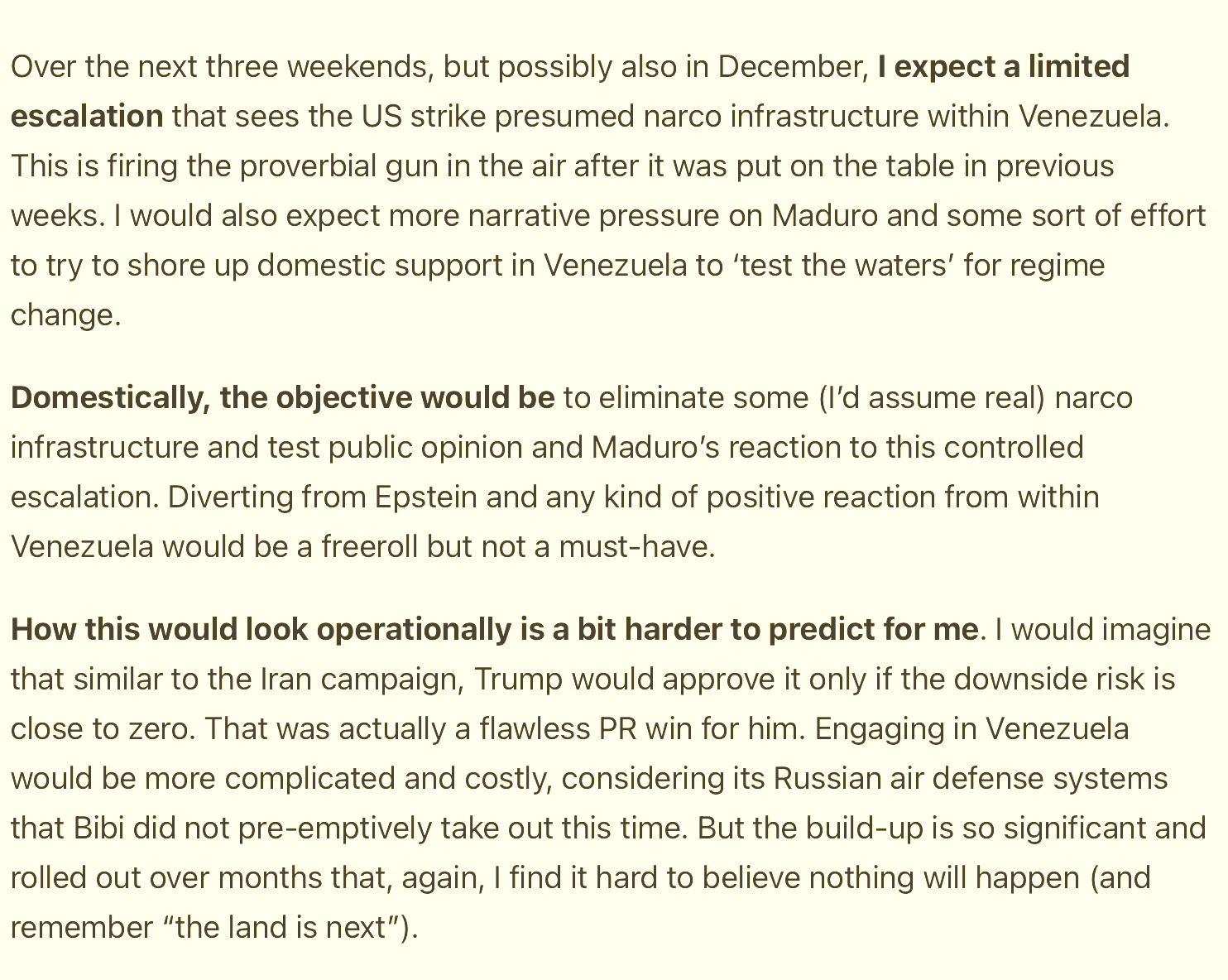
Quite the opposite, Trump approved a high-risk high-reward mission that could have easily gone wrong, regardless of whether Maduro was betrayed by allies or not. The NY Times detailed how one of the helicopter pilots was struck in the leg three times but still managed to land.
One of the main motivators was, as I predicted, Trump’s “fixation on the country’s resources.” Another was “Rubio's longtime antagonism toward Venezuela and its ally Cuba.” This comes as no surprise to anyone that’s been following the administration and their Venezuela policy. Here’s what I wrote about the role of Rubio in November:
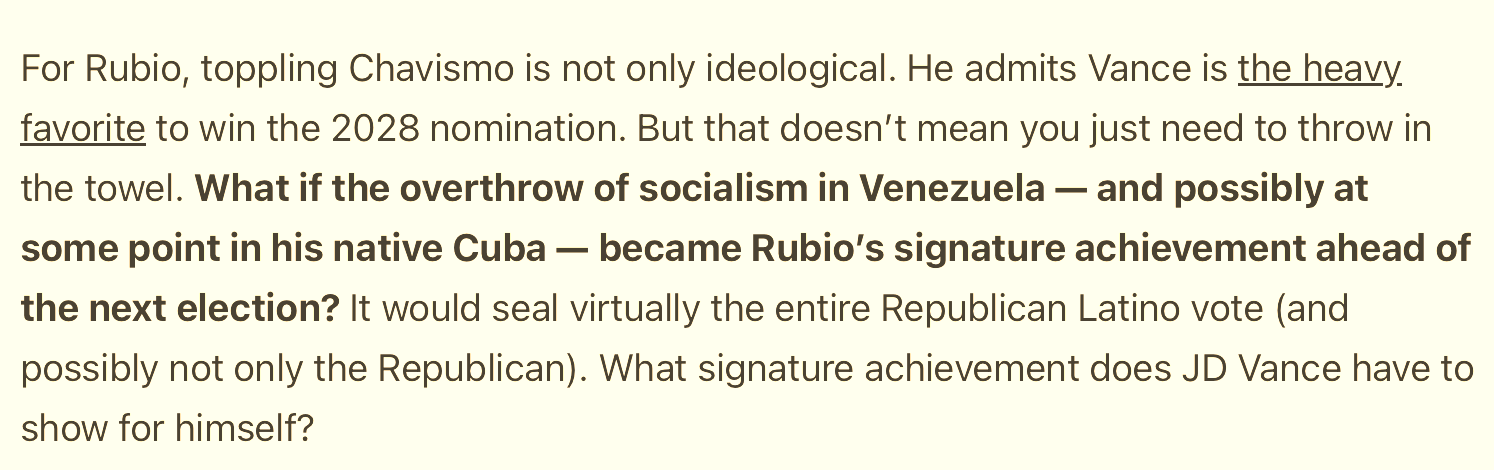
CNN reported that Rubio’s antipathy for Maduro stems from the “roots in his personal and political upbringing in South Florida.” No surprise there, unlike with the role of homeland security advisor Stephen Miller, who apparently was just as involved and “much more inclined to bomb” than Rubio. Well, maybe not all that surprising considering that Stephen Miller in 2003 advocated for torturing Saddam Hussein since that is a “celebration of human life and dignity.”
A prediction I got wrong was the role of Maria Corina Machado. In November, I had anticipated she’d become key to a transition:
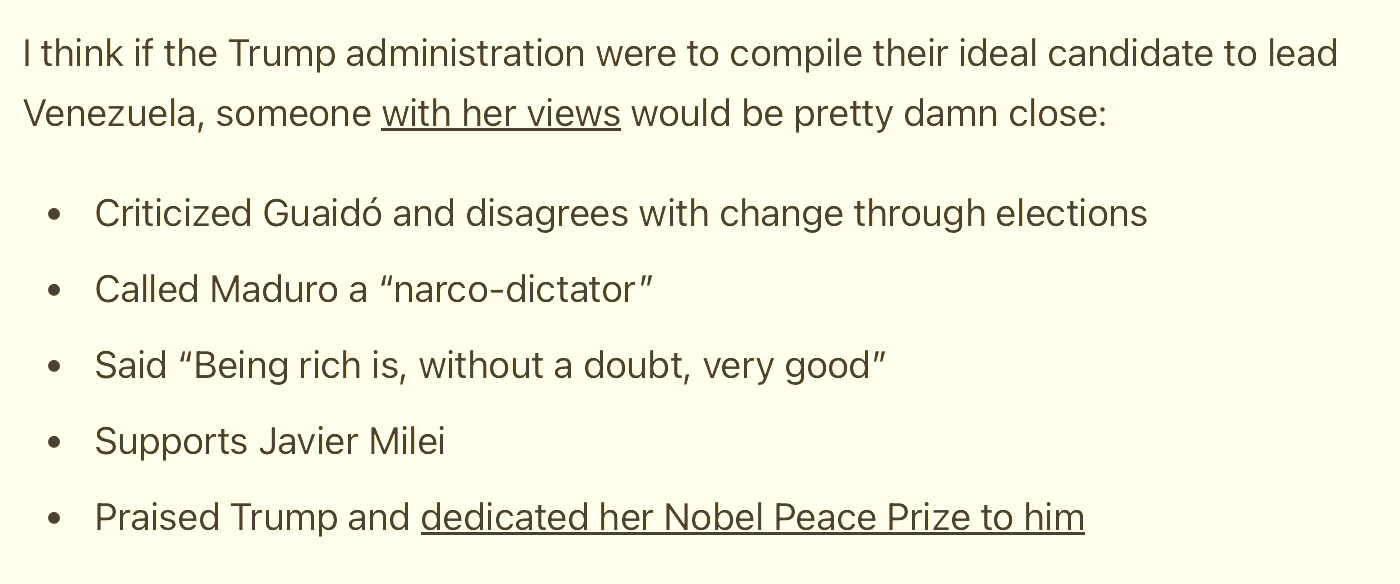
But apparently neither Trump nor Rubio seem convinced by the support she claims to have within Venezuela and have sidelined her for the time being. Machado is coming to the US in a few days to give Trump her Nobel Peace Prize for the “eight and a quarter” wars he “stopped.”
Initially, I was expecting Machado to make a swift return to the country, but odds on that collapsed. Her Fox interview saying she would return “as quickly as possible” did not sound all that convincing. However, now that the regime announced it would free a number of rather high-level political prisoners, I think a return in the next few months could be on the table again. I’ll be eyeing Q1 strikes if price dips back below 50%.
A final prediction that I was both right and wrong on was Maduro’s source of power. I wrote the following:
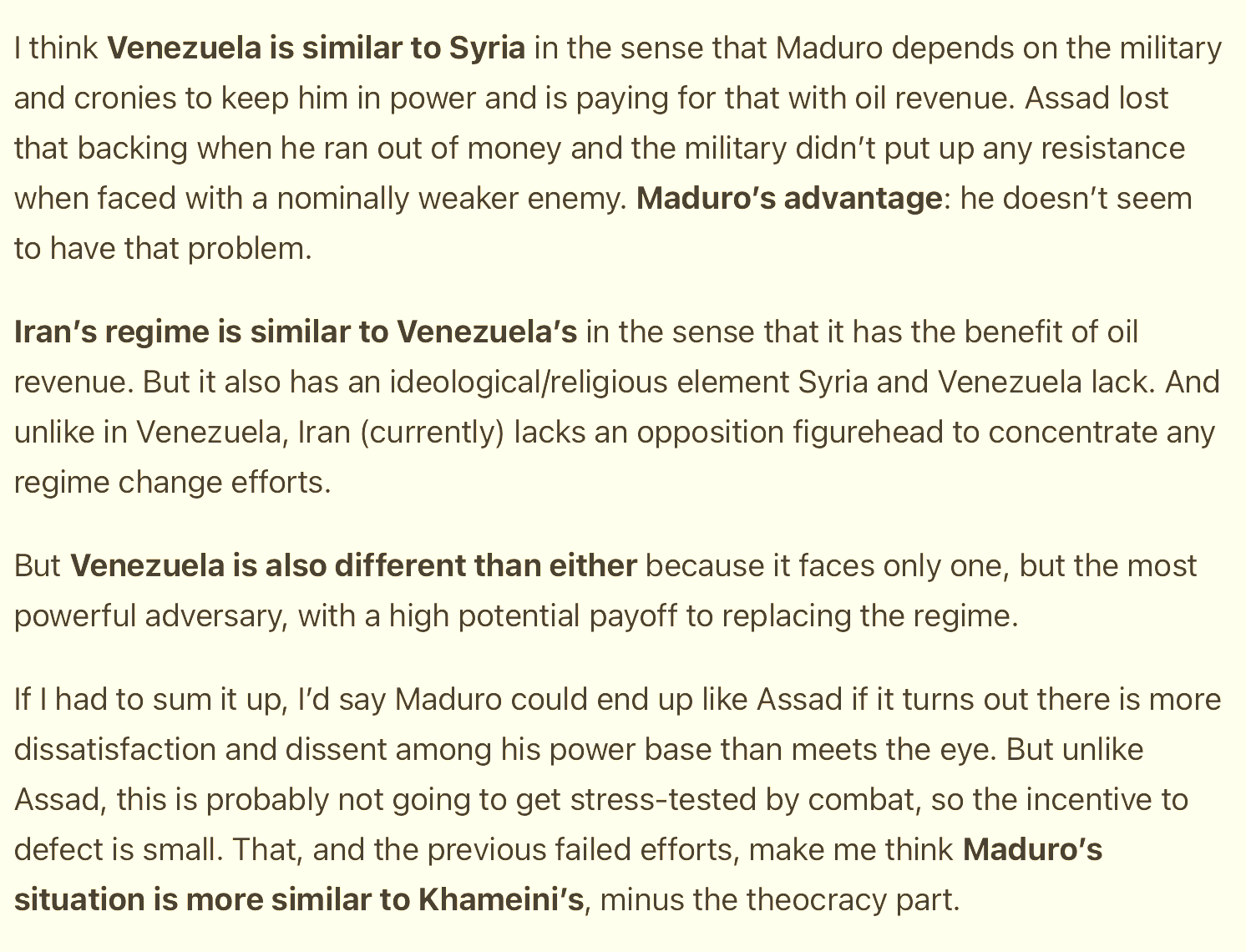
I was right on Maduro depending on his cronies for power and Maduro ending up like Assad if there is uncovered dissent. But I was wrong about there seemingly being no dissent. Whether this dissent came in the form of betrayal, as Belarussian president Lukashenko implies, or was just opportunism, we may find out down the road.
For now, it’s worth examining the person at the core of this unexpected transition of power.
Delcy Rodríguez is the daughter of Jorge Antonio Rodríguez, a leader of the Revolutionary Left Movement and kidnapper of a US executive in the 1970s. Her father died in captivity in connection to torture by security forces by the pro-U.S. Venezuelan government at the time. Delcy reportedly developed lifelong asthma after being teargassed while visiting her father in prison.
Nonetheless, she later learned English and French during her education in Europe and became a part of the Chávez regime. She got sidelined after a fallout with Chávez, but Maduro revived her career and she rose through the ranks to become Minister of Finance and Economy and eventually Maduro’s VP.
Across all the reporting I have read, she is described as a competent and pragmatic technocrat, albeit one with a staunch Marxist background that is almost certainly the result of childhood trauma:
The FT writes how she “impressed executives with her pragmatism and grasp of detail when she led talks with international oil companies” during the Biden administration. One former senior US official reportedly got the impression that she considers herself “part of a revolutionary family that had made the ultimate sacrifice for the greater good,” judging by a story she told about her father’s death.
The NYT writes how one of her advisers praised her “work ethic and openness to technical assistance”. Other businessmen were impressed by her “eloquence and wit” and noted how she was “always impeccably dressed” and a rather charming conversation partner.
But she also awarded oil contracts to cronies that circumvented sanctions and enriched people with a close relationship to some of her advisors.
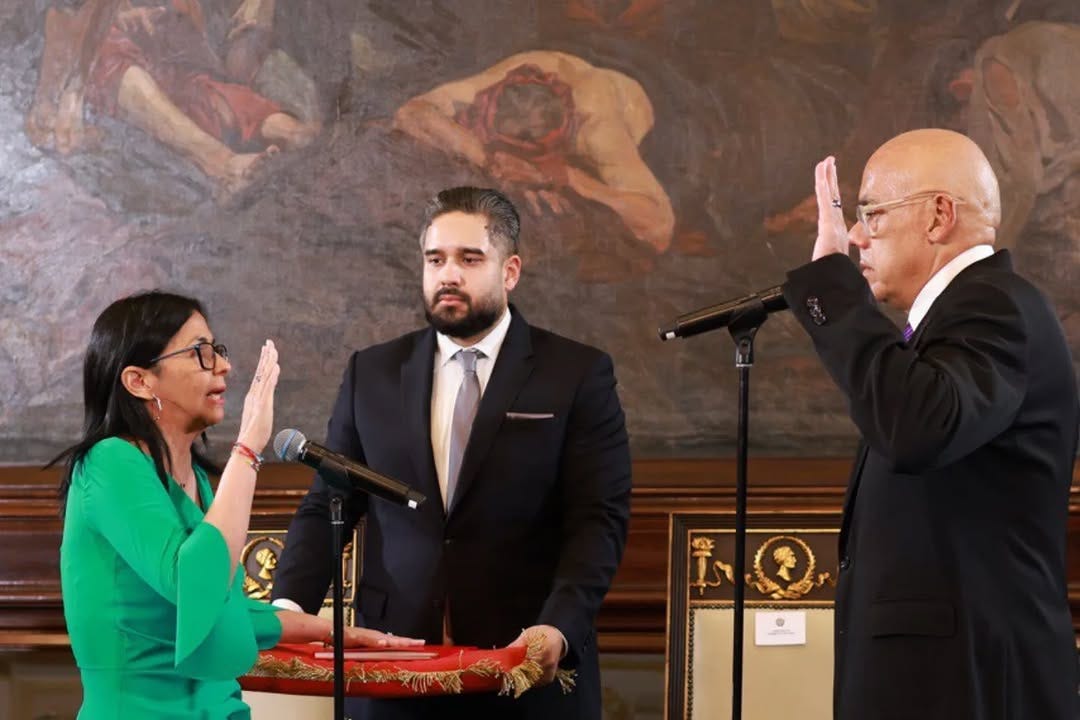
She has no kids and has never married, having dedicated her life to work. To me, this reads like the profile of a person that is willing to work across ideological fault lines — but not at the expense of sacrificing her core values and beliefs, which are the result of a deep-rooted childhood trauma.
The first part played no doubt no small role in her getting the nod by the US to take over after Maduro…
In a rather unsurprising reversal of fortunes, Donald Trump did not dismantle the deep state in his second term — he made it his own.
How else would you explain Trump listening to CIA intelligence that Delcy Rodríguez is the best person to lead a transition? It meant Trump’s own Director of National Intelligence Tulsi Gabbard became the latest winner of the coveted ‘fell for it again’ award.

Reportedly, (and correctly), Trump was still convinced that stability in Venezuela hinges on keeping the support of Venezuela’s elites and security forces. According to an investor cited by the FT, the transition has been being built around Delcy for a while. So even though the administration “doesn’t see her being a lapdog”, her pragmatic approach means she has tentative support.
On the other hand, the CIA came to the conclusion that the other two powerful figures, interior minister Diosdado Cabello and defense minister Vladimir Padrino López are hard-liners, both wanted by the US government, and probably not as cooperative and amenable to US proposals.
Delcy was the right person at the right time:
Just pragmatic enough to be at least worth a shot.
A Marxist, but one that’s a “boligarch” enriching herself and enjoying the finer things in life, which gives the US leverage over her private assets.
Not wanted and as former oil minister knowledgeable about and familiar with the assets the US wants to control.
However, Delcy will have to try to square the circle and keep everyone happy and distracted if she wants to survive, both metaphorically and literally.
For Trump, democracy is “not a concern”, which facilitates things. But oil is very much a concern. In fact it is the concern and will require changes to regulations to the domestic oil industry, which was gutted under Hugo Chávez. According to Cesar Mata, an energy consultant that has advised Venezuela on oil policy:
“They need to depoliticize PdVSA. There’s a lack of credibility and confidence. As much as you may be friends with Trump, there’s a bureaucratic procedure that has to be followed.”
I will talk about the “oil situation” in depth further below, but safe to say that shaking up a deeply corrupt and entrenched industry at virtual gunpoint is not a task I would want to take on.
And Delcy Rodríguez will have to do it without the assistance of the Cubans. According to a Western diplomat cited by The Economist, she is irritated by the Cubans and what she seemingly perceives to be ingratitude about Venezuelan oil keeping their economy (barely) alive. This may score her brownie points with Marco Rubio, the de-facto viceroy of Venezuela. But it might become problematic with regards to her internal opponents.
But what’s even more interesting is the fact that Cuban intelligence, whose 32 officers were literally the only ones standing between US special forces and Maduro, couldn’t prevent the US takeover of Venezuela. As Michael Weiss writes:
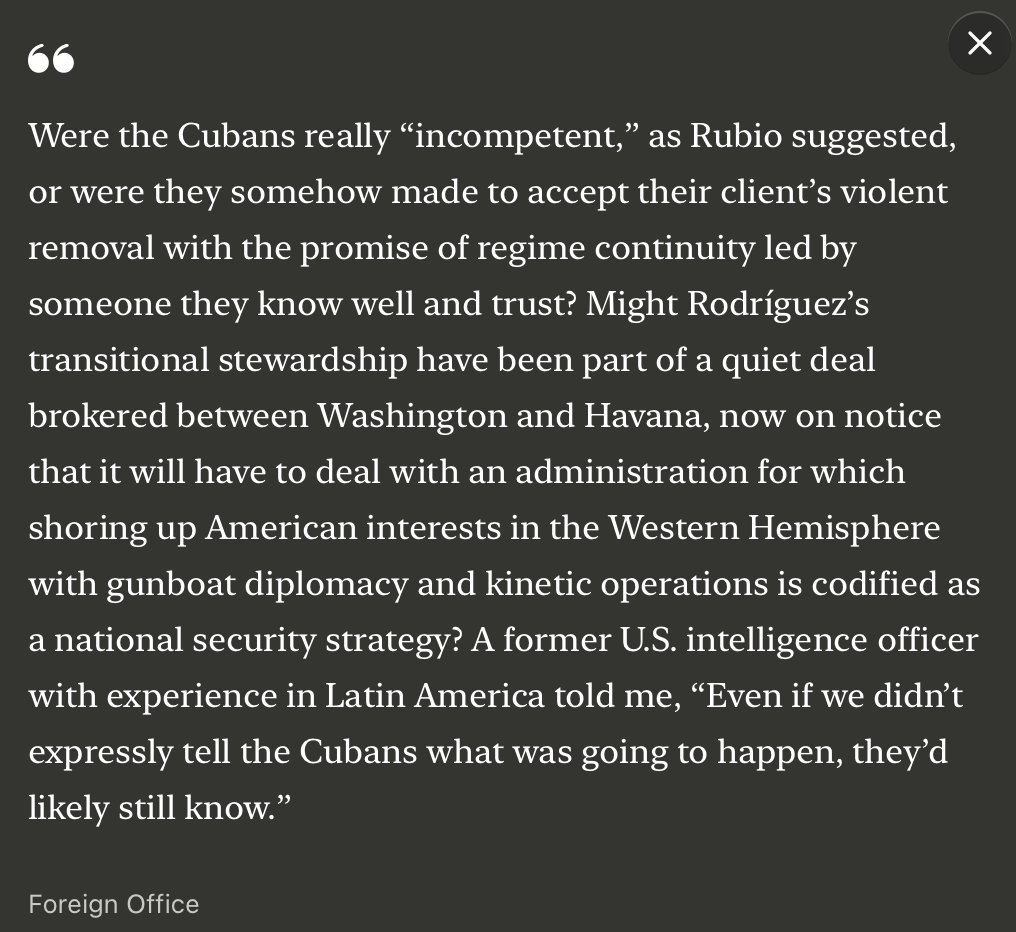
My impression is that Delcy will find herself dancing with several man pointing guns at her feet. How long can this work?
Delcy will need to keep a lid on the “unstable pit of vipers” at home. But at the same time, she will need to comply with the demands of the extortionist Donald Trump:
Cracking down on drug flows.
Kicking out Iranian, Cuban and other operatives of countries or networks hostile to Washington.
Stopping the sale of oil to US adversaries.
And all of that for the grand prize of being granted amnesty and eventually facilitating a democratic transition. That doesn’t sound too appealing. But then again, “if she doesn’t do what’s right, she is going to pay a very big price, probably bigger than Maduro.”
The US vision seems to be a replay of the sanctions removal-for-compliance mechanism that was tried with Iran. Visualpolitik published an excellent video on this, of which I summarized the main points:
Delcy needs oil revenue to survive.
The US controls whether that revenue flows.
Each reform earns partial sanctions relief.
Non-compliance risks renewed pressure or worse.
But lest you forget, Delcy can’t — and more importantly most likely doesn’t want to — turn Venezuela into a US satellite or puppet government. In that sense, I agree with the assessment of a Caracas-based analyst cited by the NYT that the Americans may underestimate the remaining ideological motivation and resolve.
In conclusion, I expect it all goes well for a while — a while being anywhere between weeks and possibly up to a year or two. Based on publicly available sources, it doesn’t seem like the US is in a hurry with a democratic transition. And nobody in Caracas should have an incentive to poke the hornet’s nest right away, because it would embolden Trump to double down and strike again. The potential ensuing chaos might disincentivize US boots on the ground, but it would probably only harden the US sea blockade.
With all the US military assets in the region, I think manipulation and deceit is a superior strategy if you’re a Venezolan would-be autocrat, as opposed to confronting the US outright. But at the latest when it’s time to relinquish power, and most likely beforehand, the knives will come out. Given their ideological background, I would imagine not all of Maduro’s potential successors would just sail off into exile.
And I’m not so sure the Trump administration really has a plan for when that day comes…
“We don’t expect troops on the ground. We don’t expect direct involvement in any other way beyond just coercing the … the interim government to get that going. I expect that there will be an election called in Venezuela. … It should happen in short order.
The way this is being described — this is not a regime change. This is a demand for change of behavior by a regime.”
Those were the words of House majority leader Mike Johnson after being briefed about the administration's plans in Venezuela. How inconvenient that the President told NBC News that he initially anticipated having to put boots on the ground and is prepared to do it. Because that is obviously the only logical course of action to credibly back your threat of ‘give us the oil or else.’
Isolationists who fell for it again can’t be happy about Trump enthusiastically applying his new “strike and coerce strategy” to threaten and extract resources from other countries. In Trump’s mind, America First is what makes ‘America great again’. If that requires repackaging neocon-like foreign policy — no problem!

True, Trump has yet to put boots on the ground in any of the countries he’s hit. But, in the words of Stephen Wertheim of the Carnegie Endowment for International Peace, Trump is "taking an overtaxed military and finding new ways to spread it even thinner." Small wonder he wants to increase the military budget for 2027 by a cool 50% to $1.5 trillion. Paid for by tariffs, of course.
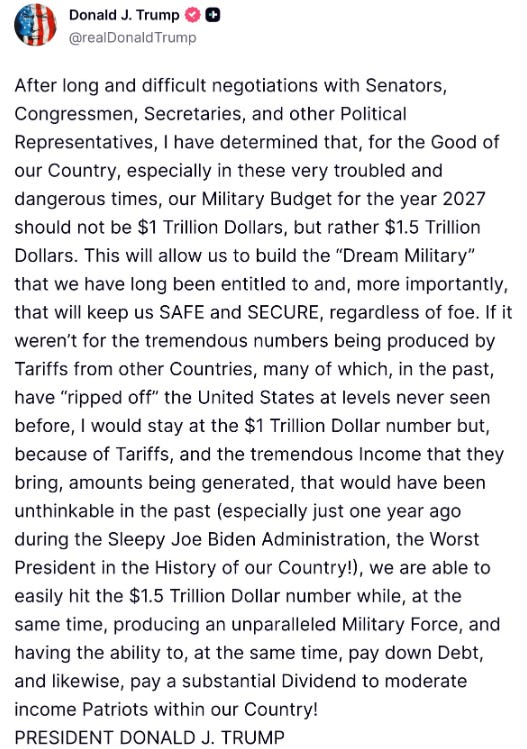
For the purposes of Venezuela this means that Trump considers the ‘difficult part’ of the job done. He told the NYT that the US will stay “much longer” than a year there. After all, the US will be “using oil and […] taking oil” as part of its “very profitable” rebuild of Venezuela. Any roadbumps can be proverbially flattened by the US military, so in Trump’s mind there is no way the interim government would not want to participate in this scheme.
The fact that there’s no day-to-day plan, as reported by The Telegraph’s sources is a feature not a bug. “Pull the trigger and then figure out how it works” has been Trump’s well-documented Modus Operandi for years, so I find it entirely plausible and highly likely Venezuela policy follows this approach.
Trump’s objectives are only in part ‘SMART’. We could call removing operatives from hostile countries and significantly raising Venezuela’s oil output — possibly but not necessarily to be sold mostly to the US — realistic and achievable. I wouldn’t call them specific and definitely not measurable or timely. But I also wouldn’t expect that from the guy who deployed the US military to kidnap a dictator that was mocking him with dances.
In any case, Trump will have mentally moved on from Venezuela after meeting Maria Corina Machado and Delcy Rodríguez in Washington. The actual work will fall to his project manager: Marco Rubio.
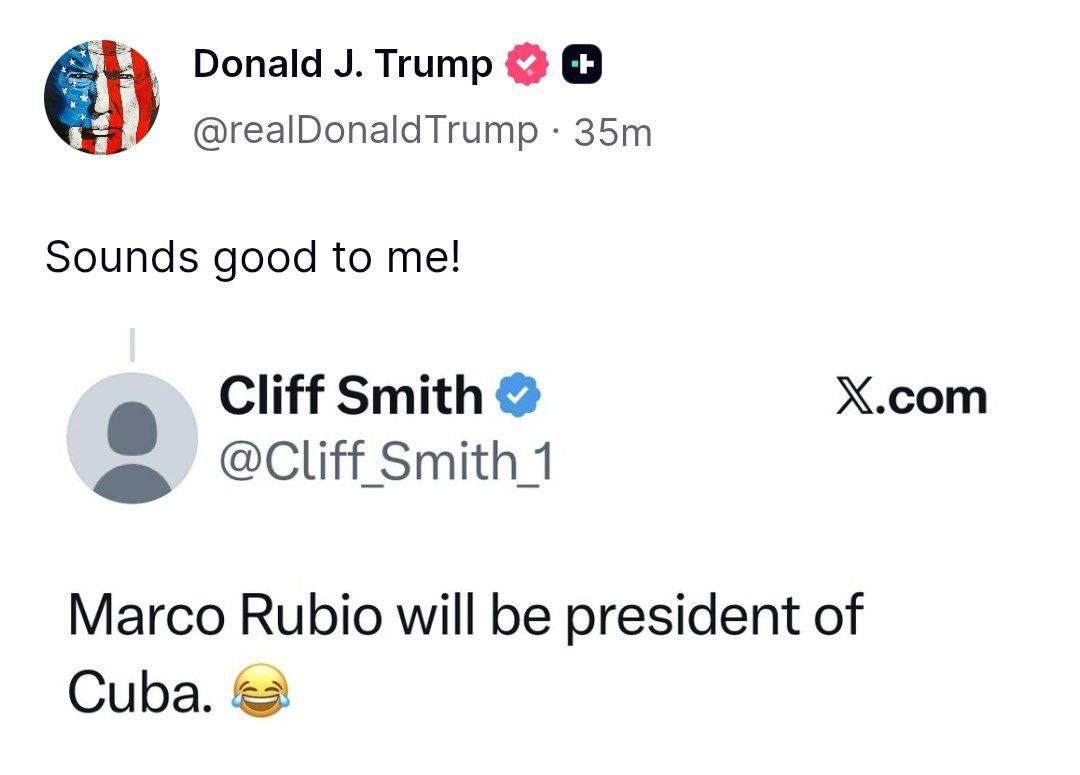
Marco Rubio’s “moment” has arrived and he will be able and obligated to do what I predicted: successfully conduct regime change in Venezuela — and possibly Cuba — and position that as his flagship policy achievement in the run-up to the 2028 GOP nomination.
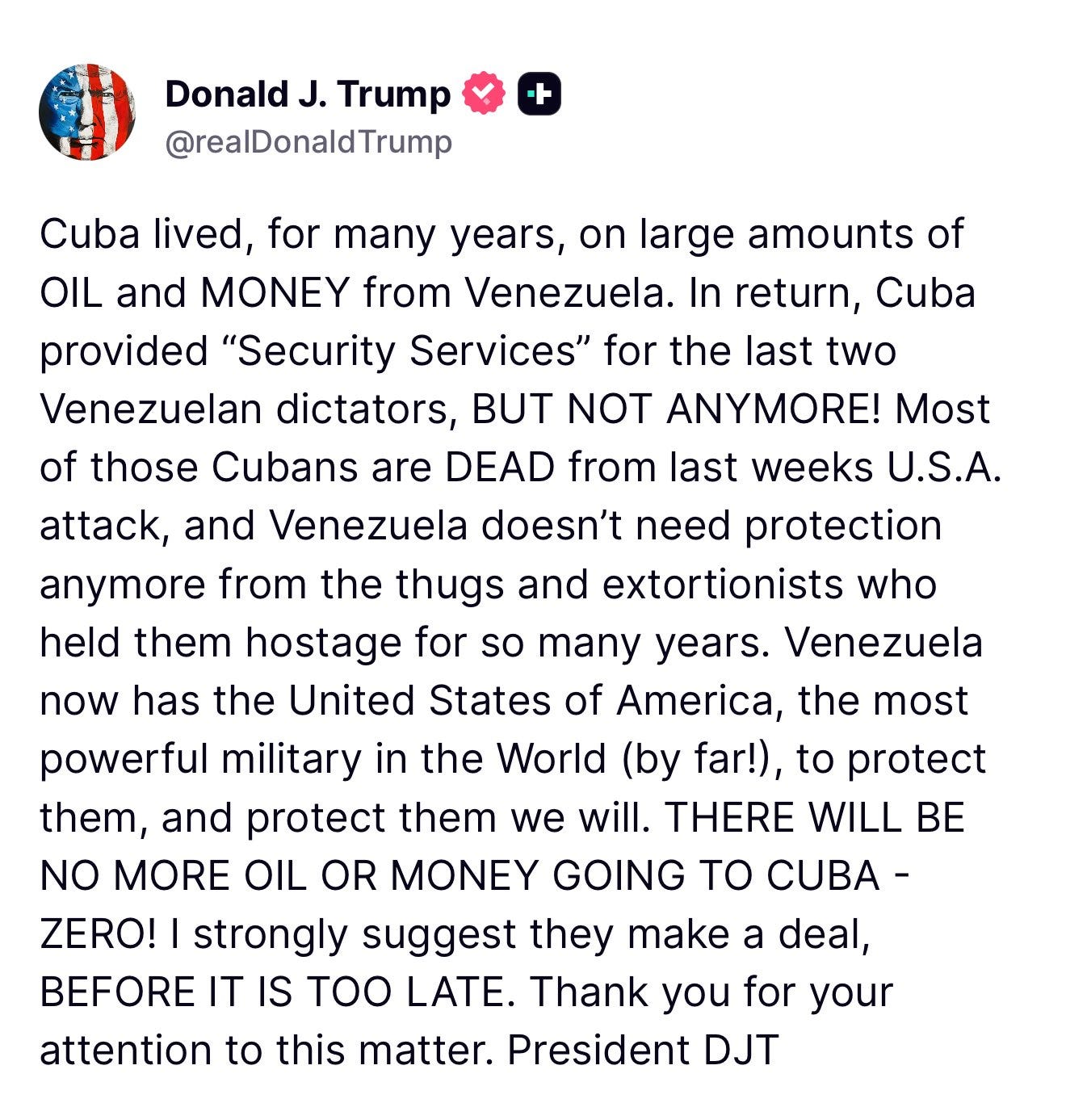
While Trump is fixated on Venezuela’s resources, Rubio in my opinion sees Venezuela as the key to freeing Cuba. And he is right about that since the political economy of the Cuba-Venezuela pact was a security and intelligence-for-oil trade. Trump announced a halt of Venezuelan oil deliveries to Cuba.
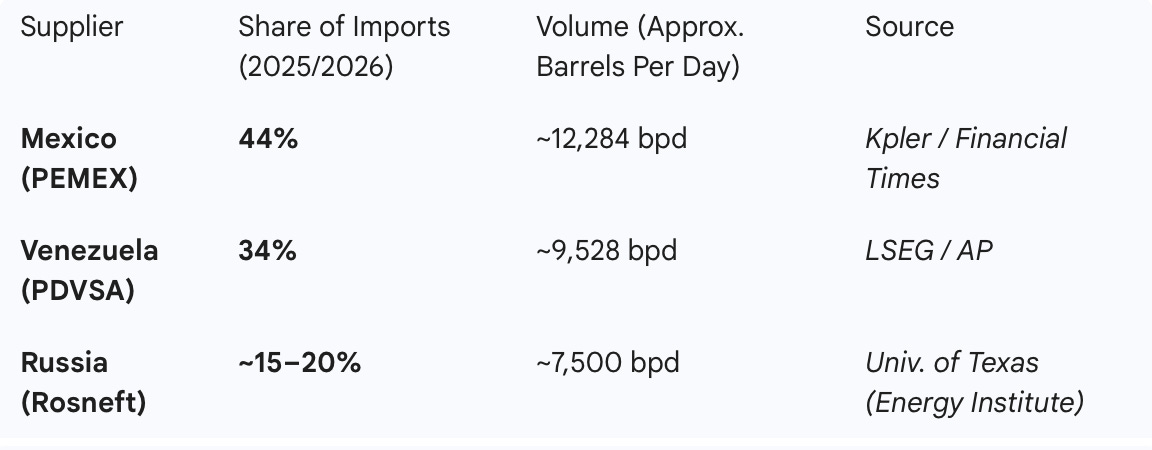
A quick Gemini search yielded that Cuba imports about a third of its oil from Venezuela and almost half from Mexico. You would expect both of these to fall drastically, de facto bringing Cuba’s already decrepit economy to a total standstill.
That’s why I think the Cuban regime is on borrowed time and will fall before the end of Trump’s turn. And that would also plausibly explain why Rubio chose Rodríguez as interim solution over Machado: forcing her at gunpoint to turn off the tap for Cuba is Rubio’s personal top priority and a lot simpler to achieve than ramping up oil production or cleaning Venezuela from foreign influence. And it’s a lot easier to do with a stable government in place, as opposed to one that is going through the machinations of an election, fighting armed militants and whatnot.
Thus, Rubio asking for “a little realism” over a transition is both correct and understandable but also politically opportune. I don’t know whether there really is “a process” in place as Rubio claims. But he does have his own ideas and motivation for as steady and stress-free a transition as possible.
Which, in turn, does not bode well for Maria Corina Machado.
The beautiful thing about analyzing and interpreting Donald Trump is that he is unpredictable, yet has a simple worldview. If you’re not strong, you’re weak and if you’re not a winner, you’re a loser. Winners are strong and vice versa. The same goes for losers and the weak.
That explains everything you need to know about why he shut down Machado’s ambitions about succeeding Maduro. According to first-term Latin American policy advisor Juan Cruz:
“Trump sees the opposition as losers, as they failed to deliver [..] It’s an opposition that he sees as unimpressive and having come up short, so why would you just turn it over to them?”
Add to that the CIA report assessing that Machado would “struggle to gain legitimacy as leaders while facing resistance from pro-regime security services, drug-trafficking networks and political opponents”, and it’s easy to retroactively explain Trump’s actions.

Based on the reporting I read, Machado also has herself to blame. The NYT writes that she had been a source of friction. She opted to call rather than meet with Richard Grenell, Trump’s special envoy that was a dove on Venezuela and pushed a non-military solution. Her team ignored a request for a list of political prisoners and had no concrete ideas of how to put Edmundo González — the stand-in candidate that won the last election — into power. But she reportedly did disapprove of Grenell not denouncing Maduro as illegitimate president.
All of that and her decision to reject talks with the Chavista regime has prevented her from building relationships and influence in Venezuela’s elite. In short, the NYT reporting concluded that she was de facto detached from the realities of people in Venezuela and alienated the elites whose support she’d need to take power.
That means without a free and fair election she does not have any sources of power or levers to pull. According to Javier Corrales, it also means her best bet is returning home to drum up support and poke the proverbial hornet’s nest. She needs to shake up the situation and show Trump and Rubio she has the support of the people and can deliver the results they need (and maybe more).
This was also my intuition and thinking behind betting on Machado to return to Venezuela in January. But after she told Fox that she’d return “as soon as possible”, I cooled somewhat and took a loss. It didn’t sound as specific or enthusiastic as I would have liked and is just the type of cookie-cutter statement that could mean this month or next year. However, she is visiting Washington in a few days and could travel onwards to Venezuela from there.
My intuition says that Rubio will advise against doing that. At this point, Machado can only create trouble in Venezuela and that’s the last thing Rubio needs. He can’t prevent her from doing that, but she is already reliant on the administration’s approval as her borrowed source of power. Acting against their wishes won’t improve her prospects, so I think she’ll opt to stay in Florida and build relationships with the diaspora there. She is also a middle-aged woman and mother of three and does not have a track record of daredevil actions like Alexey Navalny did before returning to Russia to get himself arrested.
I can absolutely see her getting frustrated and eventually opting to return without the explicit approval of Rubio. This will largely be a function of two things: first, how many relationships she can build and how quickly. Second, how calm the politicial situation in Venezuela remains and whether political prisoners actually get released or that’s just another policy that’s announced and never enacted.
But before we can talk about the chances of success of this whole endeavor, we have to address the elephant in the room: is this another oil-driven regime change?
Those of us who are old enough to remember the US invasion of Iraq in 2003 will be tempted to make an obvious comparison: it’s the oil, stupid!
Slovenia’s Objektiv magazine came to this conclusion when picking its latest cover, which depicts a Trump portrait with crude oil resembling a Hitler moustache.
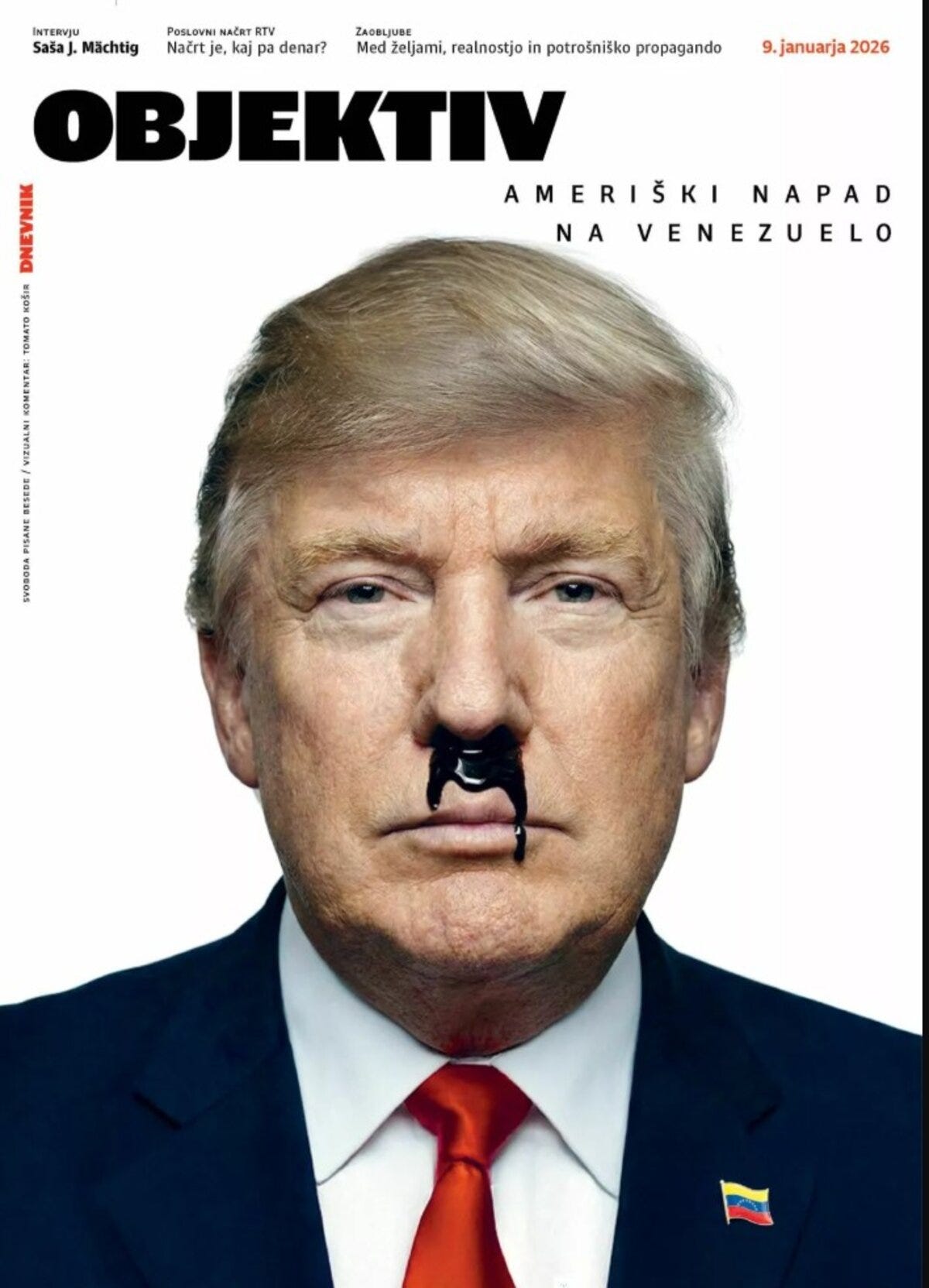
But ironically, the US 2026 is an entirely different hydrocarbons beast than the US in 2003 at the time of the Iraq invasion, let alone oil-free Nazi Germany. Over the past 23 years, the US has upped its crude production from 5.7 million barrels per day to 13.5 million barrels per day, making it a net exporter rather than a net importer.
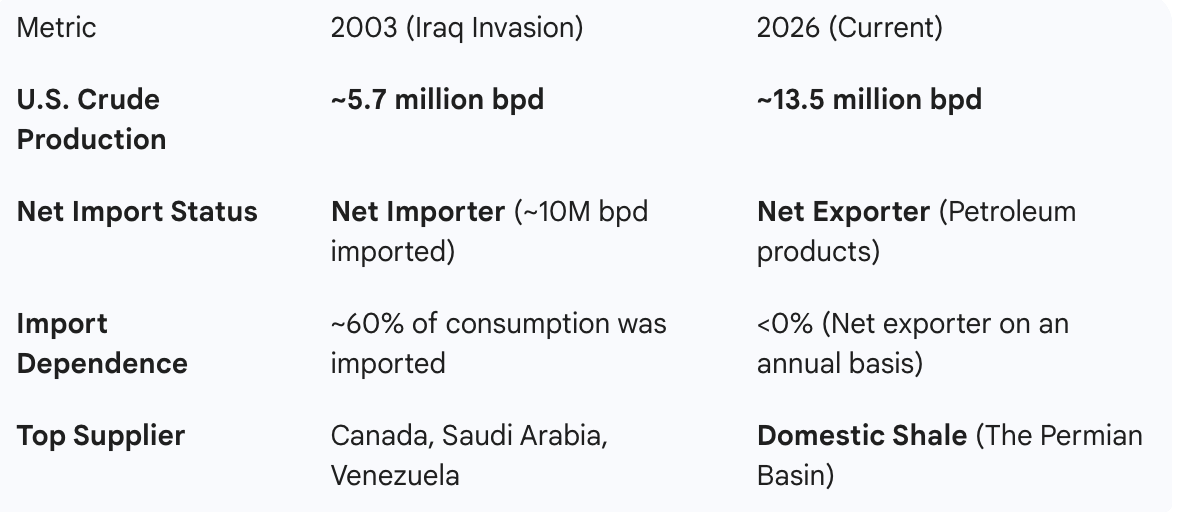
So, why is Trump so fixated on Venezuela’s oil reserves?
Because remember, Trump is volatile but operates according to simple mental models. One of those is there is no such thing as bad publicity. Donald Trump is eager to be appreciated, which explains his obsession with awards like the Nobel Peace Prize or putting his name on things, such as the “Trump-Kennedy Center.” It also includes daring actions, such as kidnapping dictators or bombing foreign nuclear facilities.
Bringing the world’s largest oil reserves under US control combines the best of both worlds: nobody’s done it before Trump, much less in such a daring manner. This gives Trump his very own “oil empire” and the US-controlled Western hemisphere about 40% of global crude production and 20% of global crude reserves:
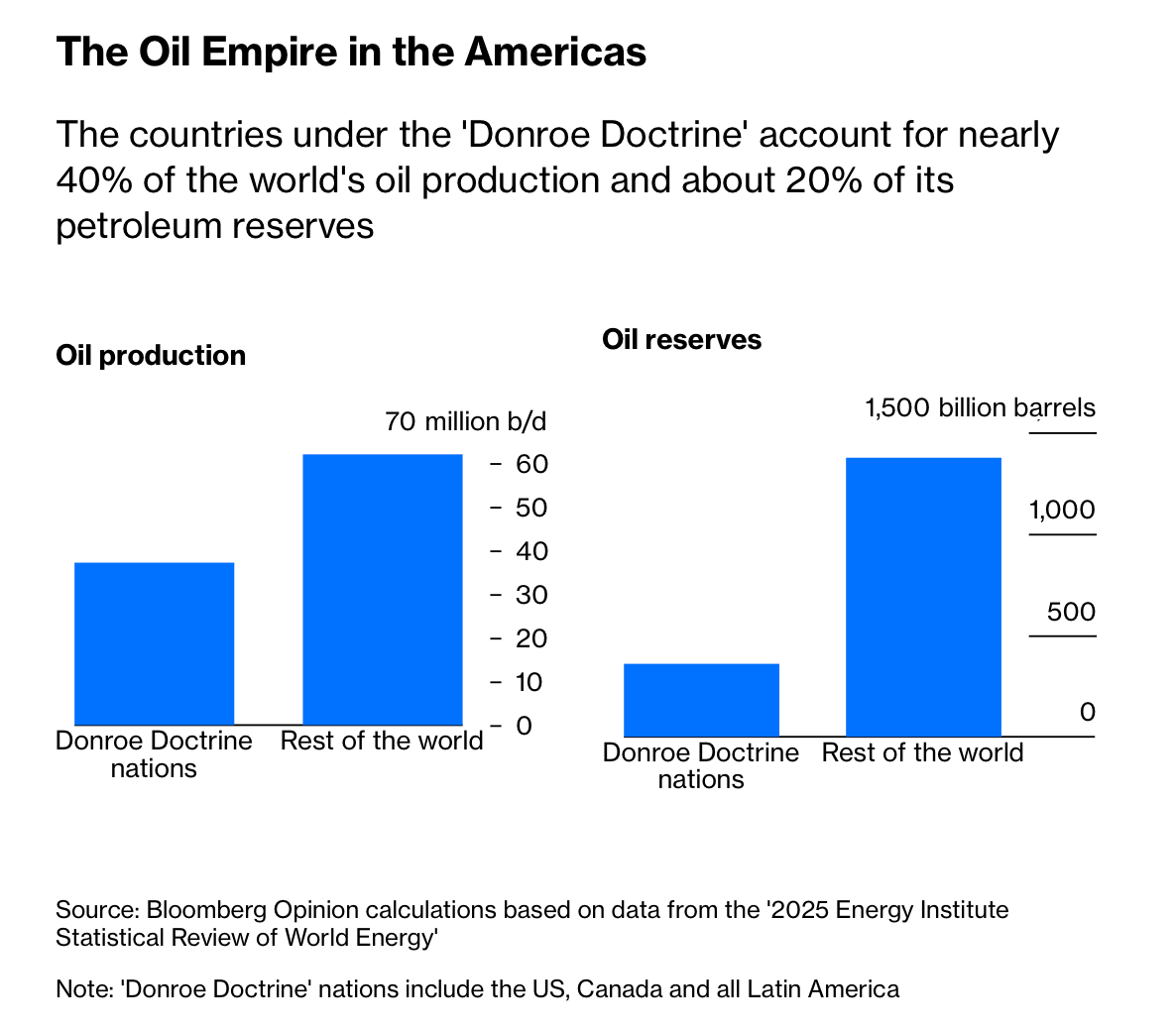
The only issue with that: how do you increase Venezuelan crude production — and do you even want to?
Venezuela currently produces 1 million barrels per day, give or take 100,000 depending on which source you cite. 85% of exports go to China and most of the rest to the US, with a tiny sliver going to Cuba. Or at least that was the case thus far.
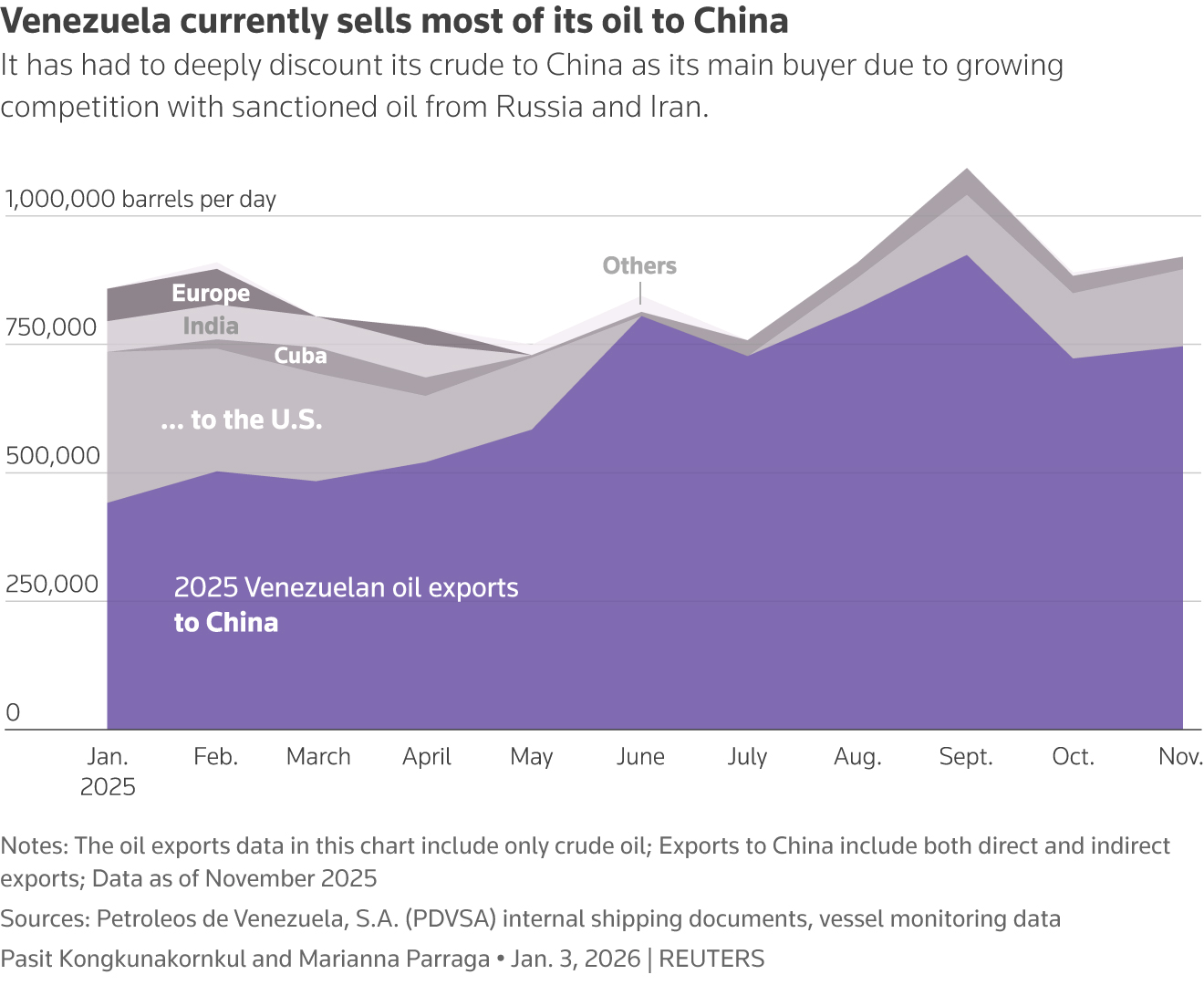
Bloomberg’s Javier Blas, a go-to source for energy and commodities, estimates that in the most optimistic scenario, 300,000-500,000 bpd can be brought online in the next 18 months. It would be way off the country’s peak production of 3.7 million bpd in the early 70s, but a three-fold increase from the bottom around the start of the decade.
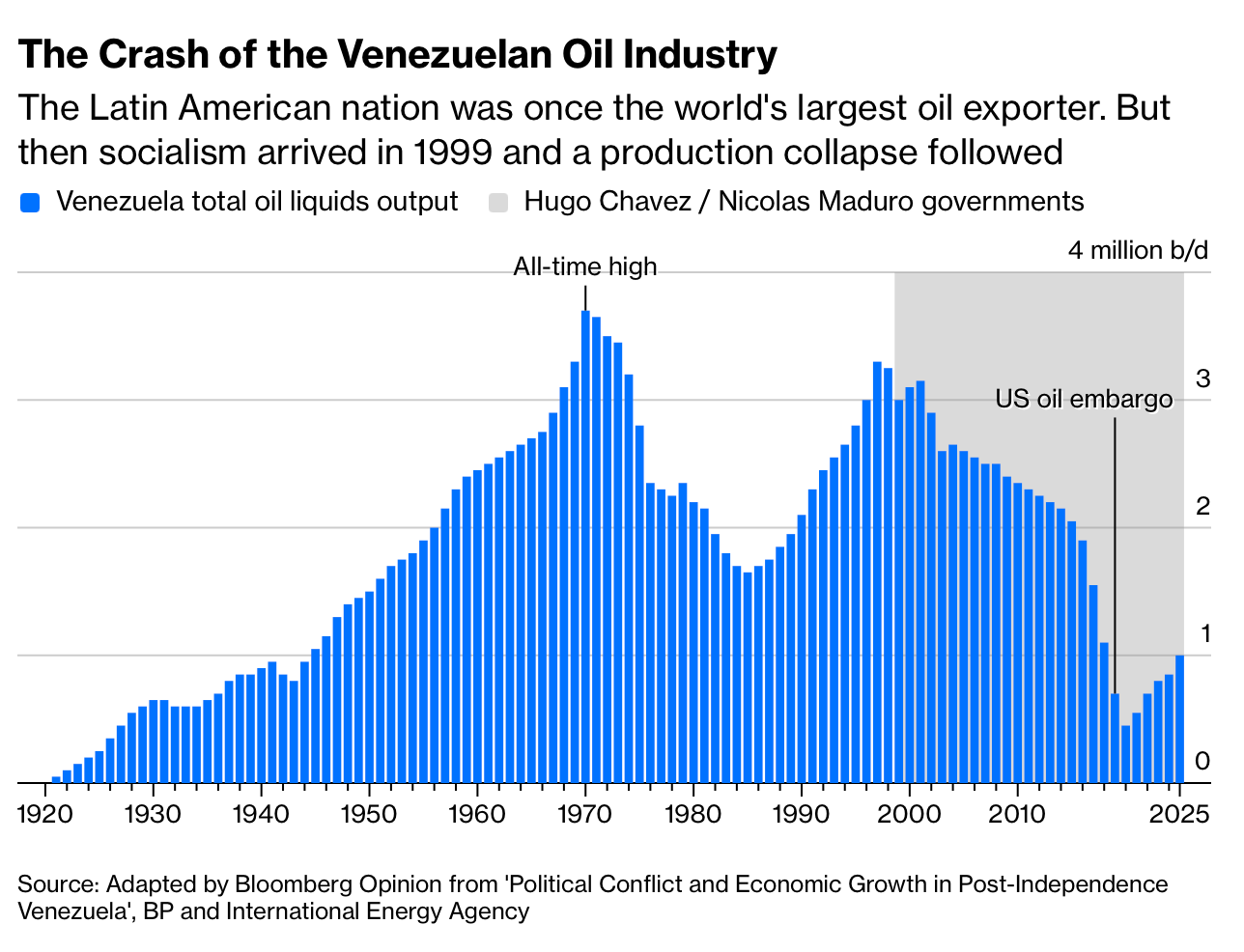
To unlock all of Venezuela’s reserves would take about $120-$180 billion until 2040, according to consulting firm Rystad. This echoes the magical minimum threshold of $100 billion Trump has touted as required investment in Venezuela. The government would provide “protection” but no financing.
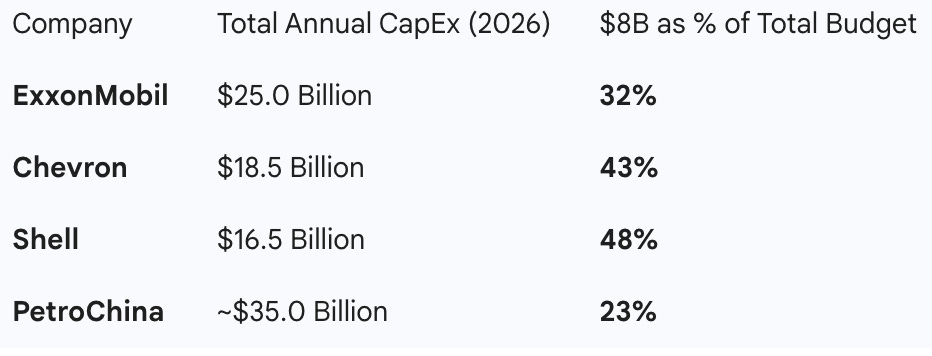
It also breaks down to about $8-$12 billion per year, roughly the same minimum amount needed to up production to Blas’ target of 1.5 million bpd by mid-2027, according to a Chevron executive. The only problem with that: oil executives are not falling over themselves to invest.
“We’ve had our assets seized there twice, and so you can imagine to re-enter a third time would require some pretty significant changes. Today it’s uninvestable.”
Darren Woods, Exxon Mobil CEO
Trump, who’s never been shy to bankrupt a company a start anew, told the executives they could harvest tax losses with their seized assets, to which another CEO replied they’d already done so. Chevron, the only US company currently operating in Venezuela, is reportedly already seeking $2 billion. Other companies are understandably more cautious, considering they’re still owed money by Venezuela and Trump effectively is saying ‘those were Biden’s expropriations’.
Annual capex of $8-$12 billion would be feasible as part of a consortium or joint venture. ExxonMobil, Chevron, and Shell have a $15 to $25 billion annual capex. All that’s needed are…incentives.
According to Javier Blas, Venezuelan oil breaks into two categories: easy or hard to extract.
The easy-to-extract stuff is located around Lake Maracaibo in western Venezuela and the Monagas basin in the east. The hard-to-extract crude is in the Orinoco belt in the southeast. Current production splits almost 50:50, but output for the higher-quality oil has dropped by over 1 million barrels in a decade. The lower-quality oil is apparently “viscous […] like marmalade and needs to be diluted with petrochemicals.”
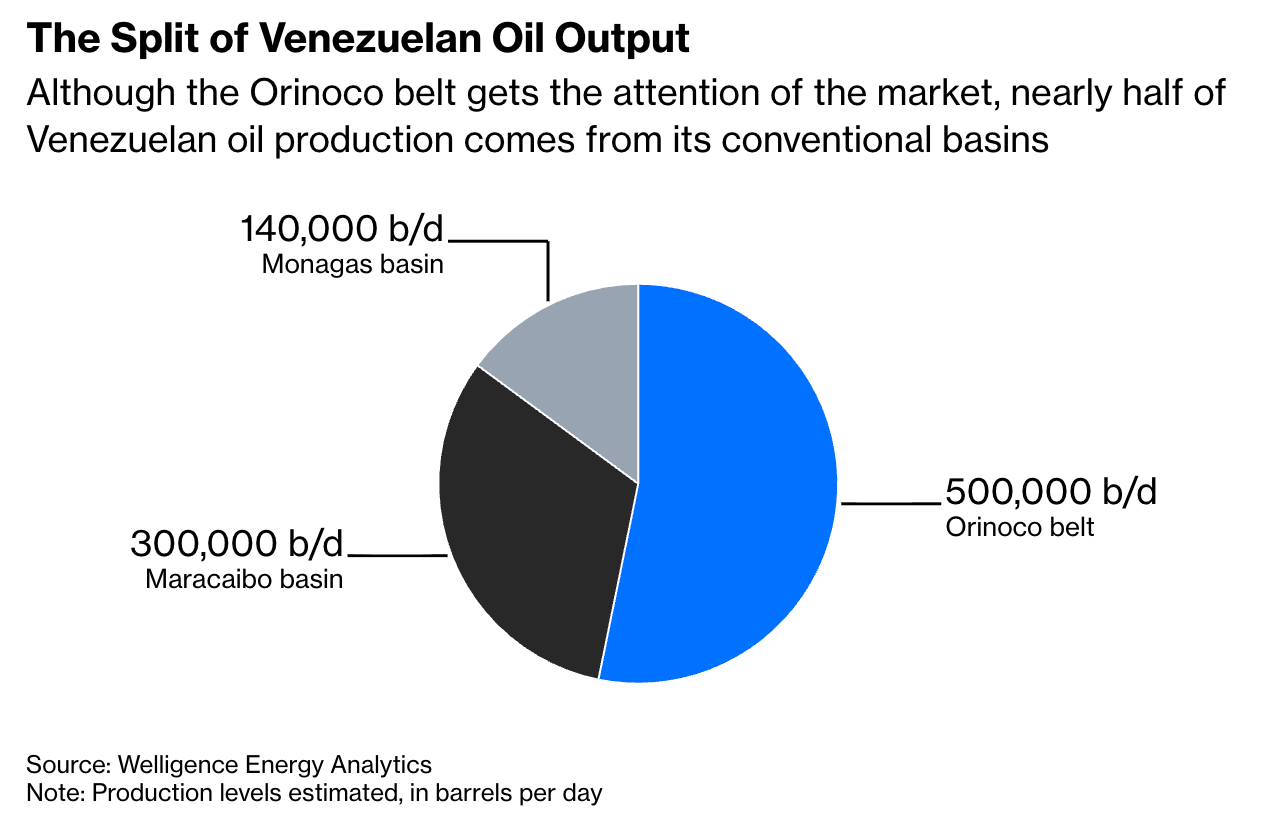
The low-hanging fruit would come from the easier-to-extract fields, but further boosting output will be more challenging. Based on his experience with previous cases of countries with big reserves and a history of plummeting crude production, Blas predicts that Venezuela will “surprise positively in the short term, and negatively in the long run.”
That sounds plausible to me, especially considering the incentives of US oil companies. In my last deep dive, I wondered whether US shale is all that interested in developing Venezuela’s oil industry. Judging the initial reaction, my intuition may prove right. While Trump wants to pump oil output, US shale has an average breakeven price of $41 for existing wells and $65 for new wells. Plus, in the words of Dan Pickering, chief investment officer at Pickering Energy Partners, “if you go into Venezuela you need protection from the Venezuelans and from a different US administration.”
That means there’s a misalignment of incentives between Trump and oil executives. Trump wants to flush the market with oil for his personal and geopolitical ambitions. Oil executives are wary of the financial risks, having been burned before, and don’t want to cannibalize existing business. In the middle of the two is the interim government, which will surely look to exploit this overlooked wedge.
This solidifies my assessment that things may go well at first but cannot work out under the current framework for structural reasons. And we haven’t even talked about the actual risks yet…
“Well, considering that I’m the one that developed ‘America First,’ and considering that the term wasn’t used until I came along, I think I’m the one that decides that.”
Who would have thought it’s so easy to change people’s minds on what ‘America First’ means? All it takes is one successful daredevil regime decapitation strike and you have the staunchest isolationists on board.
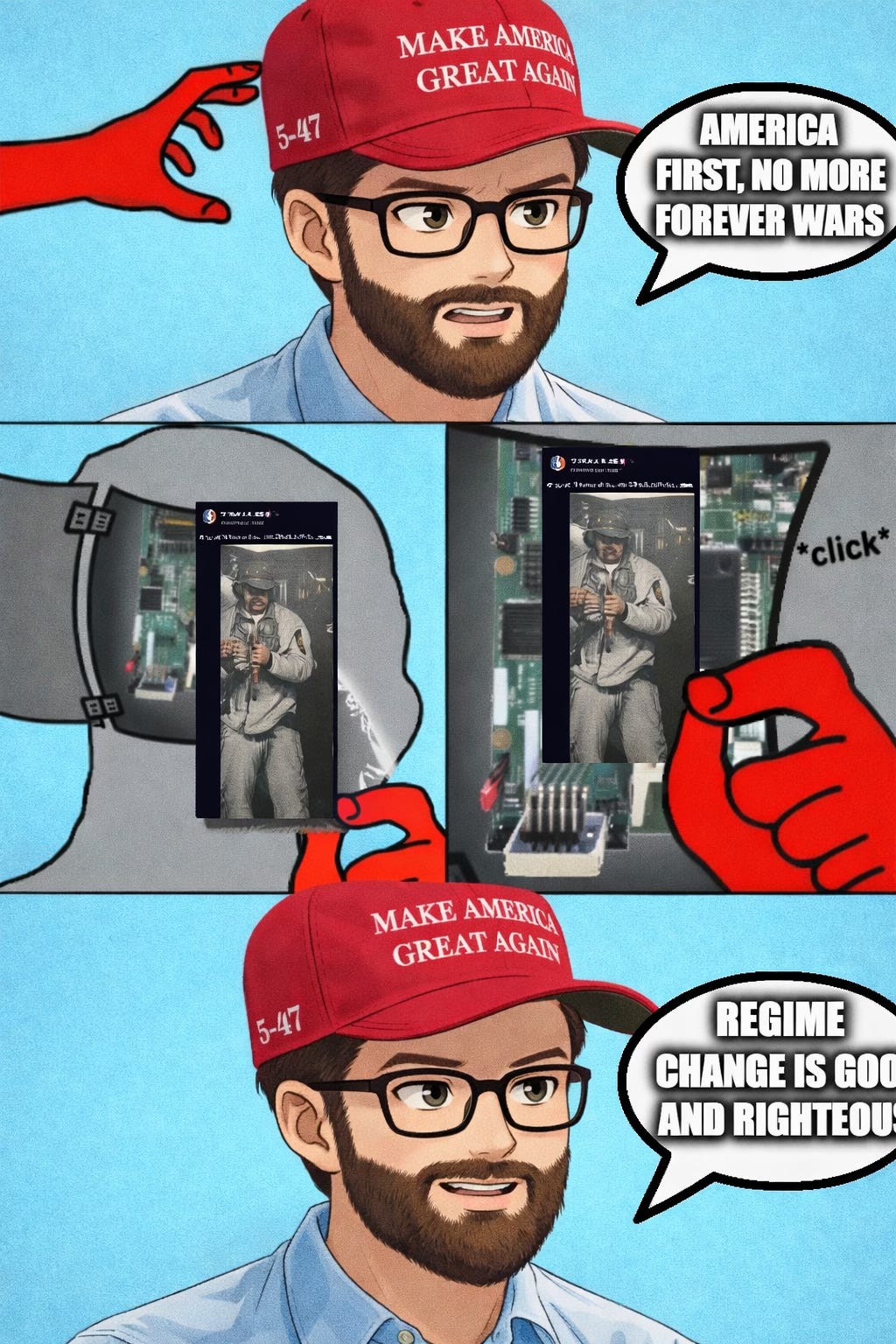
I will break down the risks to Trump’s Venezuela adventure into three points: potential backlash from MAGA, US public opinion, and the threat of internal instability in Venezuela.
MAGA hasn’t been impressed but has mostly kept its contenance over how Venezuela has been going so far. Steve Bannon was mildly critical, Candace Owens furious as usual, and Marjorie Taylor Greene pointed out how this only “serves the big corporations, the banks and the oil executives.” Which, as I made the case, may or may not be true.
But since the mission is yet to be derailed, the majority of MAGA has been doing the proverbial ‘NPC chip meme’ and found several explanations why Venezuela is, in fact, good and necessary:
The operation was law enforcement and not a military strike or regime change. The regime hasn’t really changed anyways and justice was delivered.
According to the ‘Donroe Doctrine’, the Western hemisphere is to be controlled by the US, making military interventions legitimate.
Even if it was regime change — which, as we noted, is still to be determined — it was regime change done the right way. No boots on the ground, badass optics, a total success.
Since ‘might makes right,’ the US can and should boss around smaller countries, all the more so if they’re dictatorships like Venezuela. After all, “international law is fake and gay.”
I have not much to add here beyond let’s see how this ages. People love a winner and history is written by the same. MAGA will not make or break the Venezuela mission but amplify how its outcome will be perceived.
Public opinion in the US is another testament to ‘people love a winner.’ The net approval for the military intervention went from -26 before the mission to a virtual tie afterwards. The split across party lines is what you’d expect with strong approval by Republicans, the opposite by Democrats, and Independents leaning slightly towards disapproval (-8).
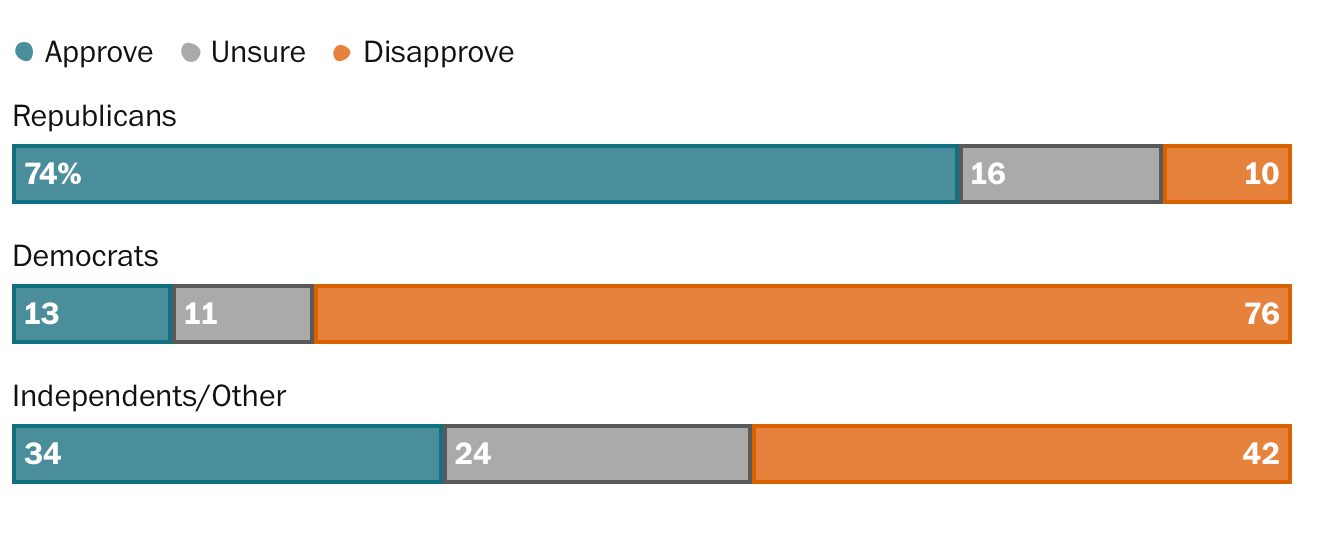
What’s more interesting though: Maduro being tried for drug trafficking enjoys strong approval (+36), but the US taking control of Venezuela and choosing a new government is the opposite (-21). 63% also think Trump should have sought congressional approval for the mission.
The most fascinating data point: the capture of Panama’s Manuel Noriega in 1989 was vastly more popular (+65).

Will Jordan@williamjordann
Amazing archive grab here. WaPo poll out this morning compares support for the Maduro grab (40% approval, -2 on net) to their polling on Noriega back in 1990 (82% approve, +65 on net)

2:13 PM · Jan 5, 2026 · 181K Views
30 Replies · 252 Reposts · 1.07K Likes
Polymarket has Maduro to not serve any prison time at 23%, which I find too high. Considering there is a precedent with Noriega, whose head-of-state immunity defense failed, I find it hard to believe the outcome for Maduro will be different. I would put the chances of this at below 10% and would not expect the jury to be unbiased, regardless of the precedent.
In any case, public opinion will likely also be driven by the perceived success of this endeavor. If Venezuela fades from the headlines, the public will likely forget about it since this was largely a pet peeve of Trump and Rubio. If something goes wrong though, the public will come down hard on Trump.
And whether something goes wrong seems to depend to a good degree on one man…
Diosdado Cabello is Venezuela’s minister of the interior and a long-time friend and ally of Hugo Chávez. The two became friends during their time on a baseball team in their military academy days. Cabello has good reason to dislike the gringos. In 2002, the US quietly supported a (failed) putsch against Chávez, which briefly made him head of state. He missed out again in 2013, when Maduro won Chávez approval as successor. But he still wields a lot of power and instills fear as commander of the country’s colectivos, armed motorcycle gangs that patrol the city as quasi-militias.
In other words, Cabello commands the guys with guns and has the reputation of a thug, a brilliant combination for a troublemaker. He wields influence over people that Delcy does not and since these people happen to be armed and likely not law-abiding, he is considered the biggest threat to any sort of calm transition.
The colectivos are already enforcing repression and searching for supporters of the US coup. I agree with this take that this is probably not going to end well:
Cabello’s “red lines” are reportedly “any kind of political opening,” which directionally contradicts the approach Delcy will have to take. He is also wanted for $25 million by the US government but is reportedly not interested in making a deal. Blowing him up by a drone seems an appealing prospect but risks setting the colectivo powder keg on fire, unless their loyalty could somehow be transferred. The US has warned its citizens to leave now that international flights have resumed, which is testament to how stable the situation is.
I’m not sure how the situation will unfold, but I agree with this assessment that both the US and Delcy have an interest in making Cabello disappear. That makes it likely to happen sooner or later, the question is when and how and what consequences it will have…
James Bosworth’s brilliant and highly recommend Boz Substack had this insightful matrix before Maduro’s ‘sudden departure’, breaking down the country’s options from ‘miracle democracy’ to ‘violent chaos’.
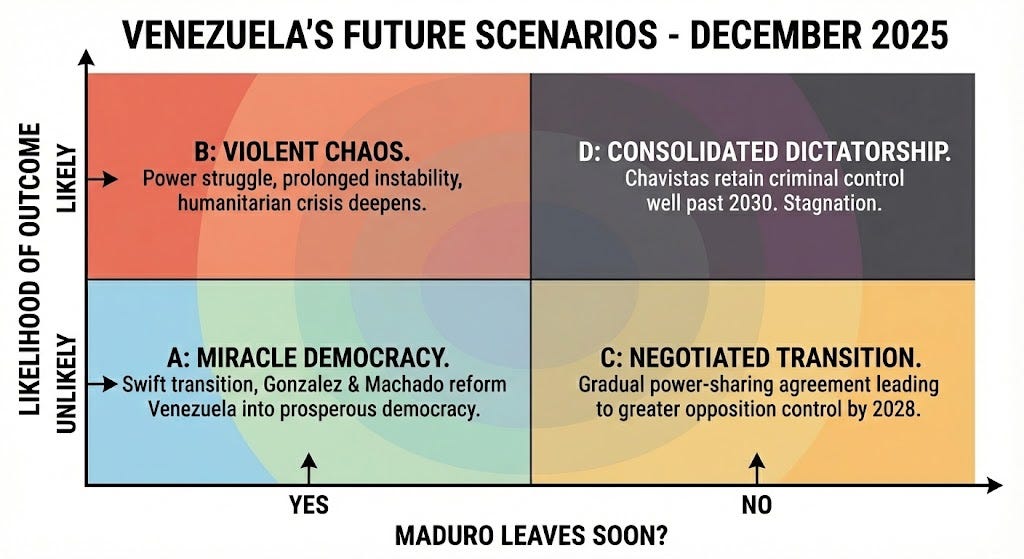
I paid for his Substack so you don’t have to in order to see the latest matrix. Venezuela’s scenarios now range from de facto occupation over becoming an ally to war or a consolidated dictatorship.
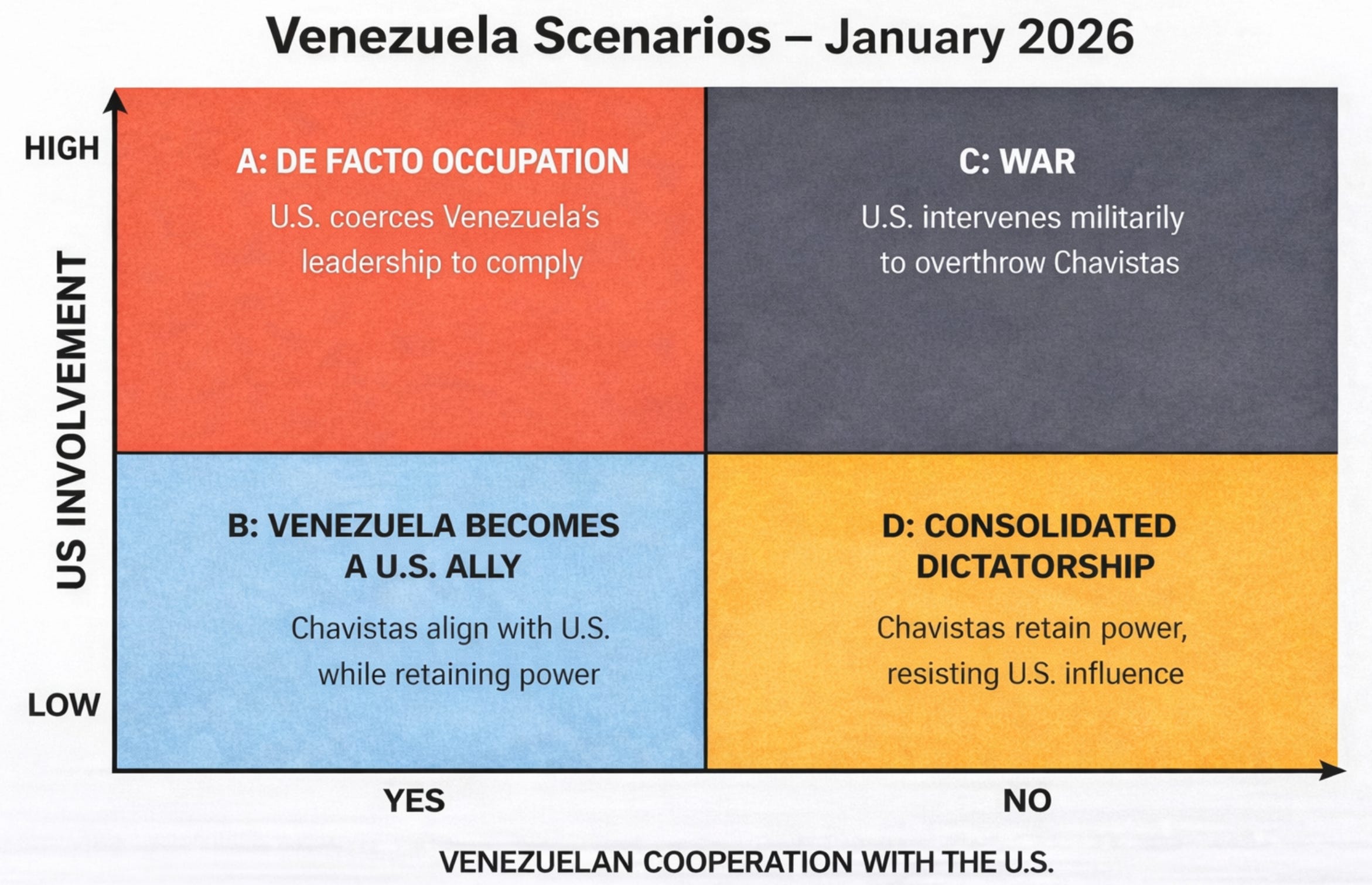
My personal opinion is that we’re in de facto occupation mode right now and will be for a while. A while could be anywhere between weeks and one to two years, which is how long I would expect the Cuban regime to last at best. For the moment, every player has an incentive to play nice:
Trump wants to see oil flow and no boots on the ground.
Rubio wants to see the Cuban regime out, which is simplest to achieve by coercing the existing government, who in turn keeps the internal situation stable.
Delcy Rodríguez wants to stay in power and stay alive and ideally stay in possession of her presumed stash of wealth in Qatar.
Maria Corina Machado wants to get into power but needs to stay on good terms with Rubio to help her with that.
Diosdado Cabello wants Delcy out of power and get back at the gringos but needs to stay alive to achieve any of those.
This is obviously a massive simplification, and there are other factors and players I have not talked about. But by and large, in the very short run, everyone is best served with the status quo, which I’d expect to hold for a few weeks to months. Hence why I’m bullish on Delcy’s chances to remain in power until further notice:
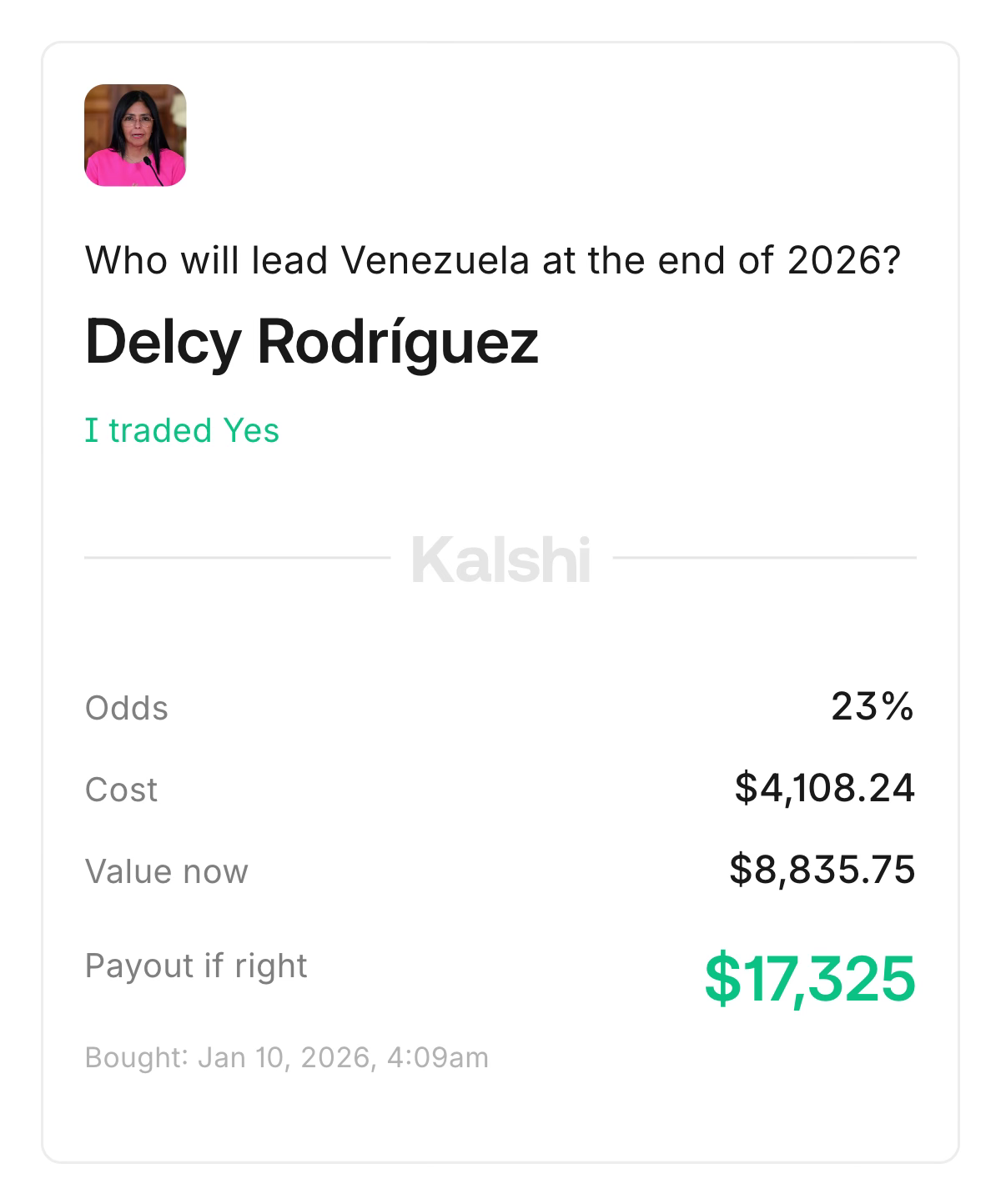
What would have an impact on my thesis:
Unrest in Venezuela, potentially fostered by Diosdado, would likely dip these odds. I would buy more in that case.
Delcy showing she is not complying with US demands. Doesn’t look likely at the moment but will become a problem down the line since interests and motivations are not aligned.
Machado returning to Venezuela in the near term would probably also dip her odds. I would probably decide on the fly based on how other players react to such a development.
I’m not sure Delcy actually sees the end of this year as president, but I do think the odds will first float higher before going lower. I would imagine Machado would make a swift return if Cabello gets taken out and no chaos ensues. It would put the administration in a seriously awkward position and give her leverage if she built good relationships beforehand.
US strikes or invasion markets look like good long-term hedges to me. The situation is structurally unstable and will remain so for as long as the regime is in power. Mafia tactics only work if you’re willing to behave like the mafia. Trump has shown he is, so I’d be surprised if we’ve seen the last of it for this year.
My next deep dives will be about the incoming Fed Chair and the uprising in Iran. Order is yet to be determined. Subscribe to not miss either:
Good luck and I’ll see you in the next one!

Comments
Nothing yet. Say the first thing.
Sign in to join the conversation.