
In AP Art History, the first thing that I learned about Roman sculpture was that Roman artisans “copied” Greek masters. The marble sculptures that decorated page after page of my ten-pound textbook were products of Greek geniuses, like Polykleitos and Praxiteles; it was almost like Roman craftsmen cowered in the corner, awestruck by their Greek counterparts’ perfection. While my undergraduate and graduate education have fractured that generalization, I find that museums and popular media tend to reinforce this troubled narrative. In this piece, thus, I have two goals:
To touch on the origins of this narrative, thinking about how ‘Greek’ genius became the epitome of perfection in early art historical scholarship
To problematize this narrative through and rethink the concept of the ‘copy’
The ‘Greek Ideal’ — referring to some inherent perfection in the idealistic naturalism of 5th-century Athens — is unsurprisingly a modern construct. Indeed, many of the value-laden maxims about ancient art are etic reflections of disciplinary traditions more so than emic ancient conceptions of art. This particular construction is the work of one Johann Joachim Winckelmann, the “founder” of art history and archaeology.
Winckelmann is considered the first author to move away from antiquarian modes of description and interpretation that focused on the value of particular objects. Instead, in his History of Art of Antiquity, the German scholar used visual evidence to construct a teleological history of the ancient world. “Teleological” describes a narrative that works towards a ‘peak.’ These tales are loaded with normative assumptions about what was ‘ideal’ or ‘perfect.’
Within his scholarship, Winckelmann develops a tripartite chronology of Greek Sculpture. In simple and short terms, he claims that the art of Archaic Greece is crude, the classical period is a zenith of sorts (divided into two subgroups), and Hellenistic art is gaudy. Winckelmann generally situated Roman sculpture in this final, undesirable, group.
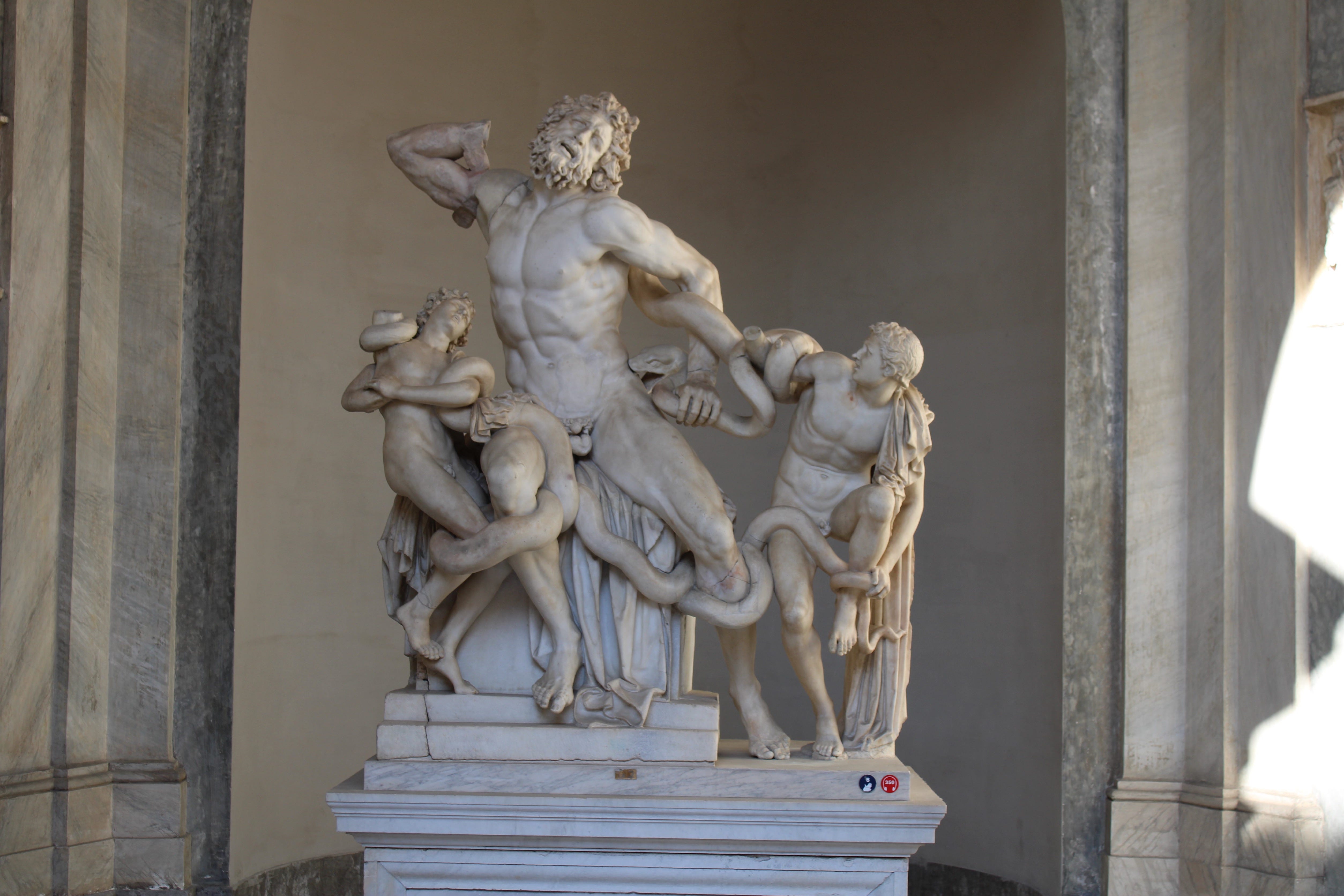
However, there are a few problems with Winckelmann’s work. His illustrative examples, like the infamous Laocoön Group, were often sorted into periods incorrectly. He claims that this perfect representation of controlled emotion was an accomplishment of the classical period. While the debate is by no means settled, the prevailing opinion today is that this work is a composition of the very early Roman Empire. In other words, Winckelmann was wrong. His argument was built on a house made of paper cards— at least that’s what current scholarship agrees.
146 BCE is an important year for the Romans. Both Corinth and Carthage were subdued. From this point onwards, the history books tell us, Rome controlled the Mediterranean. This is a story someone else can tell much more eloquently, but some background is needed to set the stage for our art historical endeavor.
In the interest of time, I will make a crude generalization. Rome, before its wave of chaotic conquest, considered itself an austere, pious, and restrained state. So then, the mos maiorum, or the customs of the ancestors, were rudely disturbed by these novel expressions of victory and wealth. We find these sentiments expressed by a number of writers in the latter half of the first century BCE, like Cicero, Cato the Elder, and Seneca.
After decades of military forays across Greece and Greek colonies (like those in Sicily), victorious generals returned home to Rome having experienced the ways and worlds of Hellenistic lands across the Mediterranean. As was Rome’s tradition, generals did not come home empty-handed. Riches, in the form of precious metals, sculpture, iconic objects, and enslaved labor, rushed into the capital city.
The import of Hellenistic visual and spatial ideas during this time is noticeable across genres of architecture in Rome. For example, the sudden proliferation of monumental tombs is often attributed to importations of Hellenistic practices. The term mausoleum comes from the name Mausoleus, a king of Caria who constructed one of the most ostentatious funerary structures in the ancient world in Halicarnassus. His multi-story tomb featured tons of statues, including portraits of his family and a chariot group.
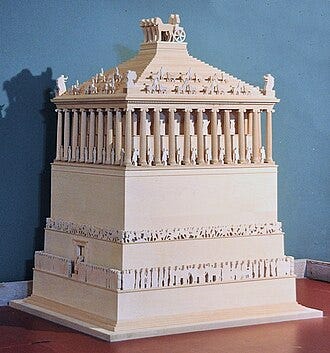
After Mausoleus builds his iconic tomb in the 4th century BCE, other rulers in the region follow suit. Soon, the landscape is defined by monumental graves, nearly temple-like in scale and grandeur. Such ostentatious displays of wealth would have been bizarre to a Roman in the early Republic.
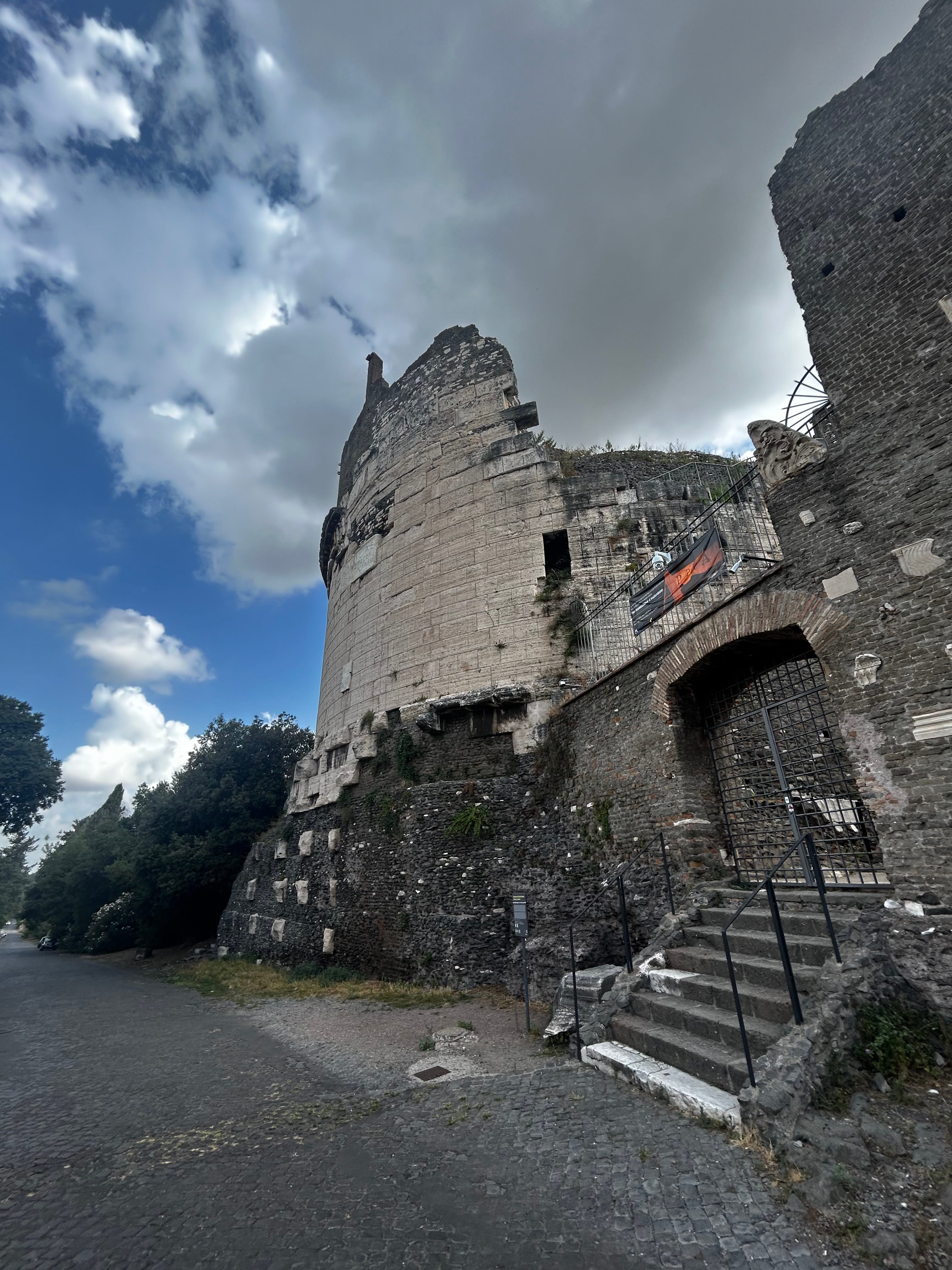
However, by the 1st century BCE, Rome’s patricians began to construct their own adaptations of monumental tombs. The most iconic example, I think, is the tomb of Caecilia Metella on the Appian Way. A large drum sits on a square foundation. It likely had minimal decorations, a mock austerity, but its sheer size was unmatched at the time of construction. Towering over the well-traveled road, the monument demanded attention— and still does!
The proliferation of monumental funerary architecture has counterparts in the public sphere. For example, Pompey’s infamous theatre and its associated porticos are also thought to derive from Hellenistic prototypes. The general kindly bestowed these ‘gifts’ upon Rome after his victories in Syria. It was dedicated in 55 BCE. However, Hellenistic kings had constructed public leisure spaces for centuries before Rome’s conquest of the region.
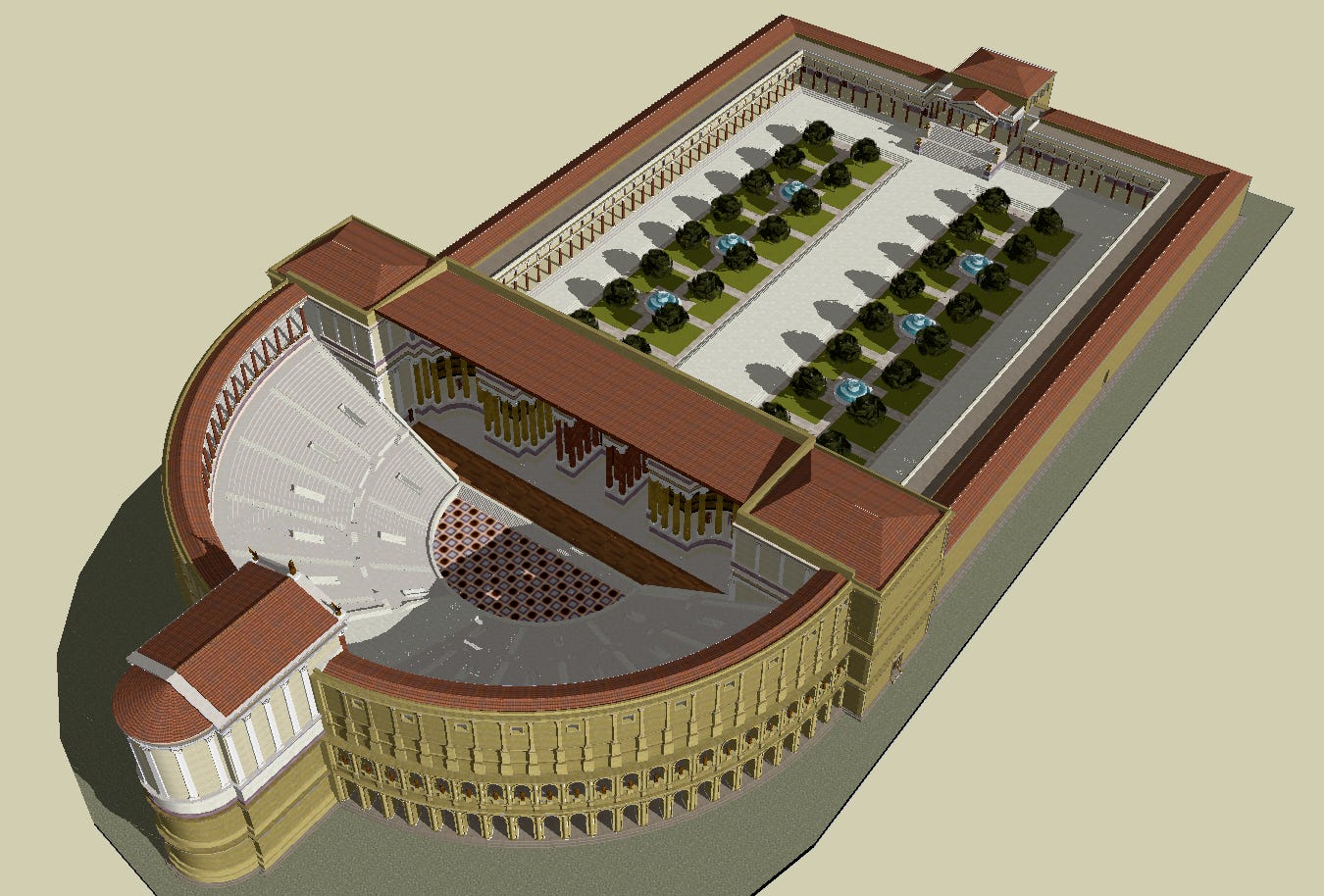
Military conquest and circulating ideas impacted the urban fabric of Rome. Before moving on the the question of imitation and sculptures, I want to problematize the Rome-Greek dichotomy that often defines contributions to this debate. When we say “Ancient Greek” we have a tendency to jump right to classical Athens, where naturalism was the star of the show. However, the objects, people, and ideas that are flowing into Rome are not only those from Attica. Rome conquers much of the eastern Mediterranean, including Syria and Western Anatolia. Of course these regions were themselves in constant conversation with mainland Greece through trade and travel over centuries. However, like I allude to earlier, they also had local traditions of their own which were imported into Rome; for example, the construction of grand public spaces, like the Theatre of Pompey discussed above.
Imports included much more than architectural ideas though. Sculpture and objects also came from the recently conquered kingdoms. Pliny the Elder gives us much insight in his Natural History. For example, he tells us about how Sulla brought columns from the Temple of Zeus Olympios in Athens (XXXVI, 45). Meanwhile Pompey brought back silver statues of Hellenistic Kings (XXXIII, 151) plus precious gems, golden goblets, gold portraits of gods, and luxurious furniture (XXXVII, 12-14).
Cicero’s Oration against Verres also shines light on the plundering of Greek art for personal collections. Verres, notoriously, sacked the legendary and ancient temples of Sicily which was (and continues to be) home to some of the oldest Greek settlements in Italy. Verres main crime was, however, taking this loot for his own private display instead of sharing it for a public audience, in say the city’s forum.
While this is obviously a small selection of evidence, it seems that conquest and public triumph created a market for outside art and sumptuous goods. In turn, Roman artisans began to issue “copies” of popular images to satiate demanding populace.
The phenomena of ‘copying’ has long preoccupied Art Historians. The generation of scholars after Winckelmann, lead by Adolph Furtwangler, championed kopienkritik (copy criticism). Inspired by philological endeavors for lost ancient texts, these early art historians studied “Roman copies” in order to identify the most original and most ancient original form. In other words, they sought an image that no longer existed.
More recently, art historians have questioned this narrative. An interest in “social art history” or understanding images and objects within the cultural milieu from which they came to be or were viewed has redirected scholarship on copies. Again, I will not offer a full historiography, just an overview of some thought provoking ideas.
Thanks for reading All About Ancient Art… please share this post with anyone who might want to learn more!
At first, scholars sought to identify various types of copy. Exact copies and free copies, for example, differentiated between true replicas and similar forms where artists took some liberties in a figure’s pose or attributes.
Ellen Perry’s The Aesthetics of Emulation in the Visual Arts of Ancient Rome suggests that any form of copy or emulation were responses to Roman cultural values. Copies were not merely a means to reproduce a Greek prototype, but to display certain ideas and ideals within the cultural context of the Roman world. Decorum or appropriateness deemed certain types and styles of images apt in certain settings, like a public Forum or a private garden. Or instead, aemulatio or improving upon known prototypes demanded a degree of both replication and innovation.
The sculptural groups from the Villa of the Papyri in Herculaneum offer an intriguing case study. Today in the Naples Museum, dozens of sculptures were unearthed across the sprawling property. Many of them are archaizing in nature, seemingly “copies” of older, Greek originals.
Let’s consider this image of Athena Promachos, or Athena, First in Battle. This type is the same thought to have been displayed after the entrance to the Athenian Acropolis by the hand of Phidias. This could be a version of that image, but we can never know with certainty. Stylistically, the figure falls in line with the very early classical period. She is stiff and a bit rigid, but not unnaturalistic. Her garment falls in straight, unfolding lines, unlike the later flowery drapery that comes for, the high classical period.
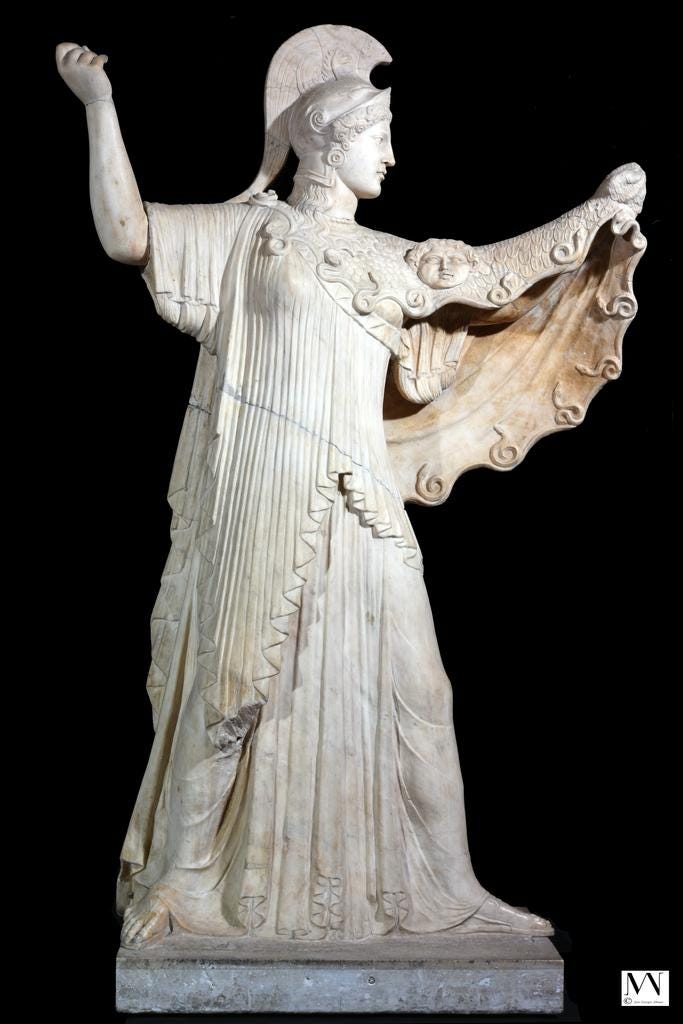
But why was this goddess depicted in this style in the tablinum or office, of a massive villa in a seaside resort town? The answer to this question, I think, is much more interesting that the potential of describing a long-lost original Athena Promachos.
The tablinum also functioned as a library. In addition to this Athena, the room was adorned with busts of philosophers and thinkers that are still on display in Naples today. The goddess of war strategy and wisdom seems appropriate for a space devoted to learning and working. In terms of style, this early classicizing image alludes to the fruitful period of Athenian hegemony. An era with which the Romans seemed to be enamored. Showing this figure in this style was means to display cultural learnedness while creating an environment appropriate for the function of the tablinum.
Sure, it might be a copy, but the image was deployed in a particularly Roman context to a unique end. So did the proprietor of the Villa want to be Greek? Did the Romans seek to transform themselves into a novel Greek empire? I think not.
The Romans sought to be just that Roman, but they deployed images and forms borrowed from afar to achieve that end.
The relationship between Greek and Roman art is not a simple, linear pathway. It is a heap of tangled ways, extending well beyond the two cultures and twisting through other cultures and the realities of individual patrons, artisans, and imperial conquerors. In other words, it’s quite complicated.
Plus, I hope to have pointed to how both modern and ancient cultural history shape our own perception of the relationship between the two ancient societies. We can never quite fully disentangle modernity from our approach to antiquity.
This newsletter offers a succinct overview of a series of complex cultural phenomena. If cultural and material exchange in the Ancient Mediterranean is of interest, stay tuned for next month’s newsletter looking at what we can gleam about luxury markets and trade networks through “sumptuous art”!
Flesh and the Ideal: Winckelmann and the Origins of Art History, Alex Potts
The Aesthetics of Emulation in the Visual Arts of Ancient Rome, Ellen Perry
The History of Ancient Art, J. J. Winckelmann (Free to Access)
Buried by Vesuvius: The Villa dei Papiri at Herculaneum, Kenneth Lapatin
No posts
Comments
Nothing yet. Say the first thing.
Sign in to join the conversation.