
Welcome to It’s A Shanda, one Northeastern Jew’s quest to find a decent bagel in Seattle (and beyond). Along with free bagel reviews every Sunday-ish, we also offer weekly bonus posts. If you’re already subscribed, I hope you’ll consider upgrading to a paid subscription! Thank you for reading. Follow me on IG, Bluesky, and TikTok for more bagel content, too.
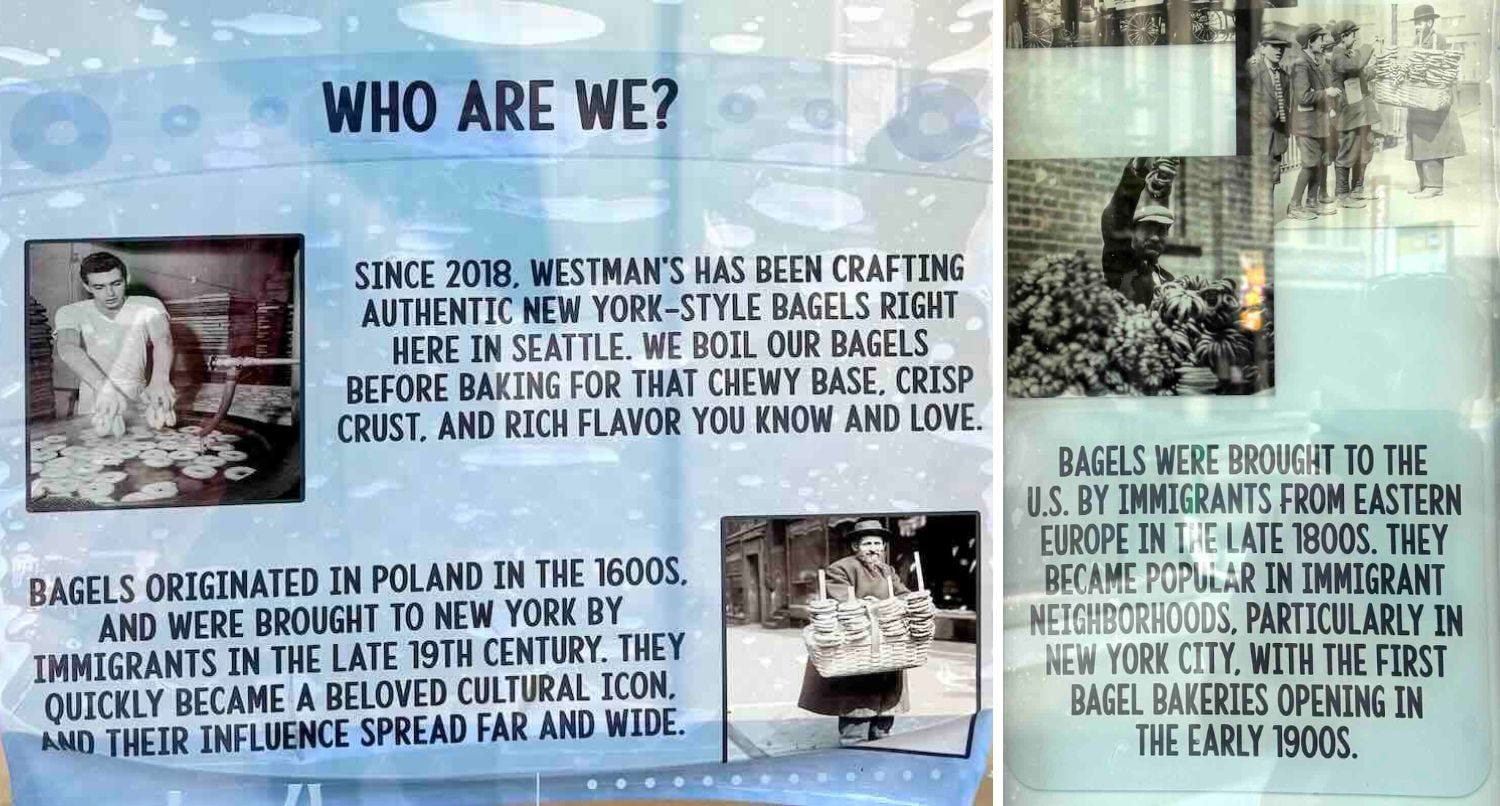
The news that Westman’s Bagel & Coffee is opening a new location near the Seattle waterfront nudged me to finally visit their downtown spot. I figured I’d find an experience similar to the one I’ve had at their Capitol Hill and U District shops. What I wasn’t expecting was a curious spin on the history of the bagel itself.
Westman’s can probably claim the title of having the most interesting bagel shops in Seattle. The Capitol Hill hole-in-the-wall is an iconic location, and the Downtown standalone storefront also stands out on the plaza at the corner of 3rd & Spring. I arrived on a typical Wednesday morning, a little after the morning rush. But there was still a steady stream of customers, most of whom appeared to be tourists making their way between Pike Place Market and Pioneer Square.
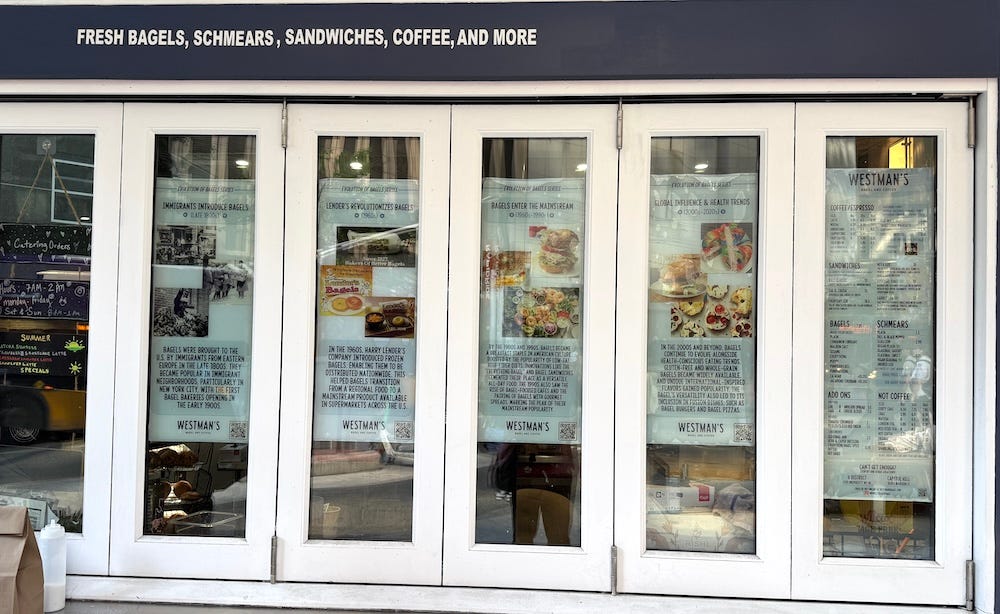
After placing my order, I started looking around at the building and noticed a montage of posters that appeared to tell the story of the humble bagel. They started with a question: “Who Are We?” It shared the abridged history of Westman’s, which started in 2018, and explained how they make their bagels. After that, it offered an even more abridged version of the bagel's history.
“Bagels originated in Poland in the 1600s, and were brought to New York by immigrants in the late 19th century,” it read. “They quickly became a beloved cultural icon, and their influence spread far and wide.”
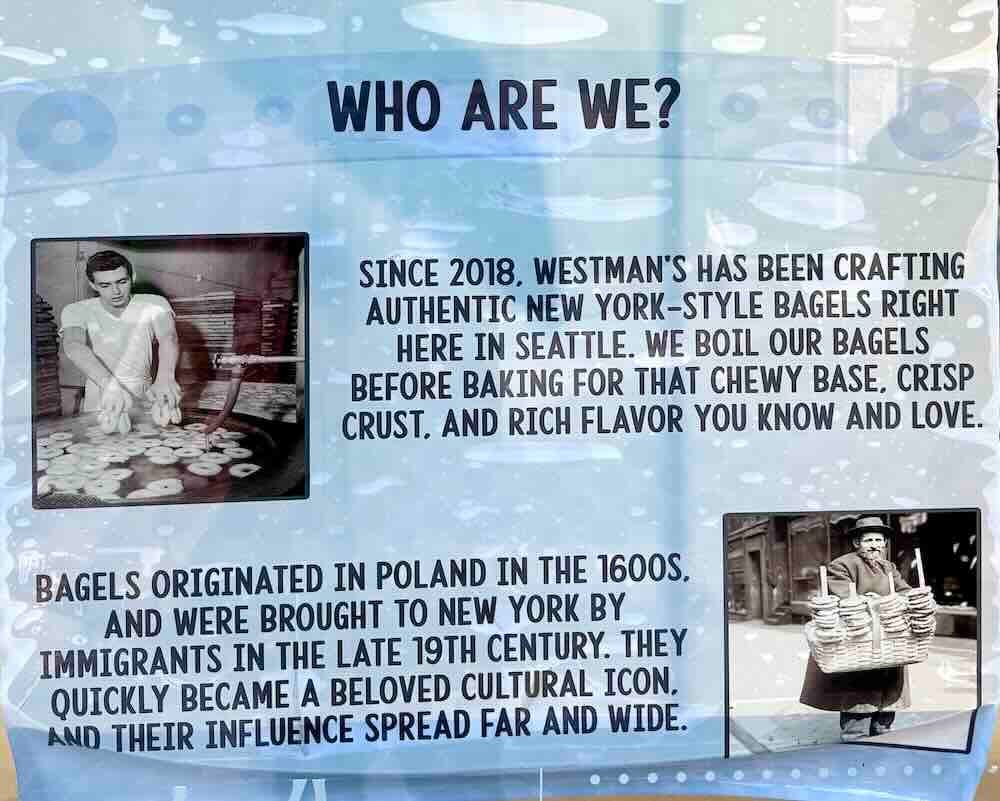
I was struck, not by what that brief write-up included, but what it hadn’t included. Yes, the bagel originated in Poland, but with a very specific group of Poles. And yes, immigrants brought the bagel to New York, but a very specific group of immigrants. And yes, the bagel became a beloved cultural icon, but it represented a very specific culture. One need only look at the photos included in the poster to get a sense of those specifics.
I moved on to the next section, which was a four-part series on the bready roll’s history. This time, the bagel’s origin was stripped of even more context.
“Immigrants Introduce Bagels,” reads the title of the first panel.
“Bagels were brought to the U.S. by immigrants from Eastern Europe in the late 1800s. They became popular in immigrant neighborhoods, particularly in New York City, with the first bagel bakeries opening in the early 1900s.”
Okay, but WHICH immigrants?
And WHICH immigrant neighborhoods?
I grabbed my order and set it aside so that I could do a fair review (coming soon), but I kept coming back to those posters and the linguistic hoops they jumped through.
It seemed odd to me.
I did a reverse-image search of some of the photos Westman’s used and found that they had been used in similar bagel history write-ups, but all of which were specifically calling out the Jewish role in these circular rolls.
It all gave me a feeling like it was obfuscating Jews from the history of the product they were now selling. And that was being done while using Jewish iconography at a business whose name is distinctly Jewish. (Westman’s is one of several Seattle bagel businesses doing so without being owned by a Jewish person. The company’s co-founder, Molly Westman, sold it to Monica Dimas, who recently sold it to Ankit and Sanya Sirmorya.)
Ed. Note - Dimas shared some insight and context from her time as owner of Westman’s and confirmed that the current window posters were not something she was a part of.
The whole thing kept nagging at me all day, and a fiery thinkpiece began to take shape in my mind. I realized, however, that I was struggling to make sense of these perceived choices because of the many similar ones that came before them. Part of my angst over what felt like a removal of the Jewishness from bagels is that Jews have already been doing that for decades.
The very next portion of Westman’s bagel history rundown explains that Murray Lender, the son of a Polish-Jewish immigrant, “revolutionized” bagels by freezing and shipping them to stores around the country. It’s true that Lender’s Bagels took them national, in part by de-Jewishing them. And in the years since, we’ve seen many other bagel businesspeople with big dreams making sure bagels were “not ethnic food anymore.” Bagel Ambassador Sam Silverman just so happened to make a video about this the other day.
“The bagel is a symbol of assimilation at any cost,” wrote Josh Ozersky in TIME in 2011.
In fact, stripping away one’s Jewishness in order to assimilate and succeed in America goes well beyond bagels. For decades, if you wanted to make it in showbiz, Kaminsky needed to become Brooks and Leibowitz needed to become Stewart. Jewish comic book writers turned their personal histories and experiences into iconic superheroes which, in turn, represented everything good and decent about mainstream (Christian-coded) American society.
I’d wrapped myself in a logic pretzel. How can I be mad at a bagel shop for erasing its connection to Jewish culture when so many Jews had already been doing that for years?
Ultimately, I landed on two thoughts.
One is what I call the Uncle Bob Corollary, which states that everyone in your family can make fun of Uncle Bob (or whoever that person is for you), but if anyone outside the family has a bad word to say about him, you look at them sideways. It’s just different when we do it.
Two, and probably more salient here, is the idea that there is a difference between Jews omitting their Jewishness in an attempt to thrive in a society that kept them at arm’s length, and what feels like purposeful omission of Jewishness from someone else in service of selling a product that is, by definition, Jewish.
That’s not to say that all bagel places need to wear the food’s Jewish origins on their sleeves. In fact, most modern bagel businesses don’t. It’s not a requirement. Most bagel shops remain centered on the present or look to the future. But if one is going to look to the past to inform its story, removing the specificity of its Jewish origins feels like a provocation, even if that was never the intention.
I reached out to Westman’s last week to see if they would shed light on their decision-making, but I haven’t received a response yet.
I don’t wish them ill, and I don’t want to assign reasoning or thought processes that I can’t know. Maybe there’s a good intention in there. An attempt to ride the good vibes of American immigrant ingenuity by Hamilton-izing the bagel.
Whatever the reason, I’m still left feeling uneasy. The story of a culture’s evolution isn’t linear. It’s jagged and jarring, based on the whims of history, oppressors, societal norms, and migrations. I’ve watched so many videos and read so many essays about how food connects people to their past and their culture. There’s a pride and love that goes into how they make the foods that their forebears made, even if they’re putting a modern spin on it. Evolution doesn’t remove connection.
When the Polish Jews fled Europe to escape systematic antisemitism and violent pogroms, they settled in New York City because that’s where the boats took them. They crowded into the tenements of the Lower East Side, filling it with pushcarts, storefronts, synagogues, and Yiddish theatres, making it feel like home. And they brought their food with them: pastrami, knishes, smoked fish, babka… and bagels. The rest is history.
Without all of that happening the way it did, no one is eating bagels in Seattle in 2026.
You don’t have to tell that whole story every time, but if you do tell the story, you can’t take those people, or their culture, out of it.
Even if they’re the ones who tried to assimilate it first.
Thanks for actually reading this far. If you enjoyed my bagel review and want to read more of them, make sure you’re subscribed to It’s A Shanda. Know someone in the Greater Seattle Area (or beyond) who would appreciate way-too-detailed reviews of local bagels? Please forward the link their way.
Comments
Nothing yet. Say the first thing.
Sign in to join the conversation.