
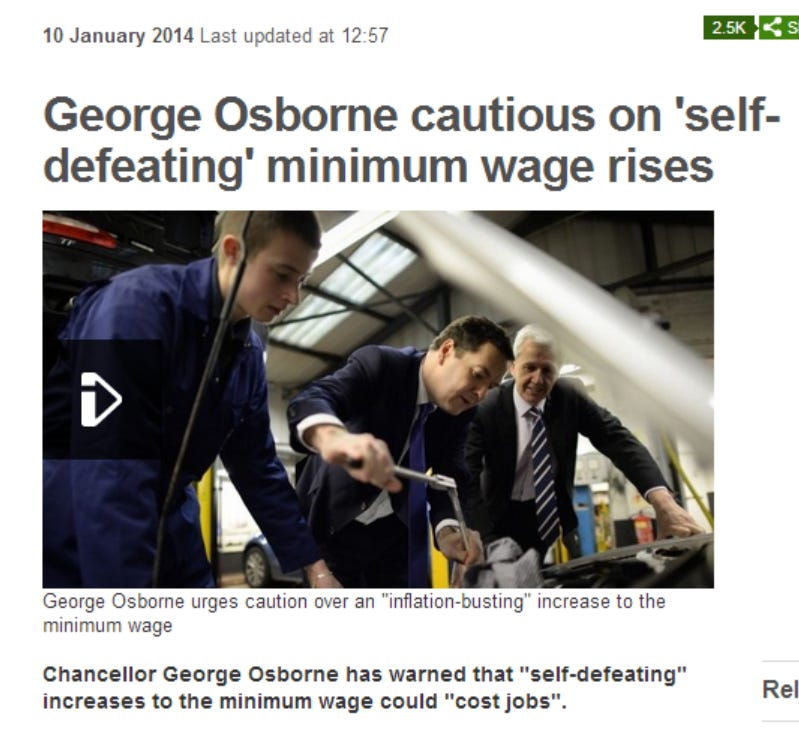
Eleven years ago I wrote my first of two articles for the The New Statesman, criticising criticising George Osborne’s increase of the National Minimum Wage above and beyond what the Low Pay Commission recommended to provide cover for his cuts to Working Tax Credits.
Whilst this moment is easily overlooked given it became in the brief moment of calm between Osborne and David Cameron’s triumphant re-election and their nemesis in the following year’s EU Referendum its importance cannot be overstated. It set a clear message to the Low Pay Commission that they were to look sympathetically on calls to further increase the minimum wage, something further encouraged by Chancellors longing to announce increases as an applause line in their budget speech.
The only problem with that it caused employing people on the minimum wage to become significantly more expensive. If the minimum wage for adults had risen in-line with inflation from the summer of 2015, it would by April of this year be £9.22. Instead that was the month it rose to £12.71.
The minimum wage has always risen slightly higher than what a basic inflation calcuation would suggest it should, but the gap keeps rising and becomes ever more burdensome for employers. Back in 2015, the increase since 1999 was £1.51 above what you would expect given inflation. That means despite moving past the minimum wage’s initial roll out and it becoming a mature part of the economy, the rate it is increasing has gone from 30% above inflation in its first seven years, to 38% in the eleven years since. And this despite the minimum wage was now a mature part of our society and at a time when the type of labour-intensive tasks that are typically done by people on low wages are becoming ever more expensive relative to other bits of the economy due to the productivity gains that automation unlocks.
And look, I don’t wan’t to decry the low paid their pay increase. Far from it. But the problem is that this isn’t actually working for them, nevermind anyone else. And it’s not working for two very simple reasons. Firstly someone has to actually pay the cost of these wage increases. Now to a certain extent that is done by employers making their workers work harder by reducing numbers, increasing duties or demanding more experience. All bad news of course for young people trying to make their way in the workplace. But equally the cost is passed onto customers who are asked to pay more for the goods or services provided by these better paid staff. So the result is that not only are their fewer low paid jobs around, but everyone’s money doesn’t go as far as it used to. What use is promising to pay people more by government dictact if that means at worst they’re unemployed and at best they’re worked harder despite their money going no further?
You see the same nonsensical approach when it comes to Income Tax. The personal allowance basically doubled between 2010 and 2021 before subsequent governments slammed the breaks with what is planned to be at least a seven year freeze. And it had already been increased significantly when Alistair Darling had to fix the mess that Gordon Brown left him with the botched abolition of the 10p Income Tax Band. Even now it still stands at more than £3,500 above what it would be if it had just increased in line with inflation from 2006. And again, no one wants to begrudge the low paid their tax cut, but haven’t they actually suffered the most from the resulting cuts to state provision that has flowed from this destruction of the tax base?
Much was made of Sir Tony Blair’s recent intervention despite it clearly being written to impress the American techbros and fascists who still indulge him. But it’s telling that he shares with Sir Keir Starmer the determination to pretend that chasing growth is the way to escape the structural issues that are holding Britain back as an economy. The reality is that if you disregard inflation, Britain’s recent growth has been fine. The problem is that inflation keeps cannibalising that growth.
Now obviously what you need to do to throttle inflation out of the economy is to move to running fiscal surpluses. And just so Labour MPs with fly coats and cool dogs don’t think I stuttered; yes, that includes capital spending! After all, there’s clearly no argument against the fact that by helping to keep interest rates high, government borrowing is actually crowding out the private investment that Labour needs to deliver its aspirations for housebuilding and urban renewal. Likewise given we are fast approaching negative net-immigration we need to not only abandon Shabana Mahmood’s far-right immigration changes but actually start liberalising rules to allow more foreign workers to enter shortage professions?
But we also need to start grappling with the fact that the experiment we’ve all played on relying on higher wages and lower taxes to support the poor has failed. Everyone’s miserable because low-paid work has become scarcer and less secure, and even secure jobs have become more intense while everything in the shops is more expensive. And that’s before you consider whole swathes of jobs have been ruled unviable meaning senior staff increasingly have to do their own admin and everyone finds their favourite shared spaces or pastimes are being shutdown as the fun crunch bites ever harder. Fundamentally for most things you buy, the main thing you are paying for is the cost of employing the people involved in producing and providing it. Those wages cannot meaningfully go up without firing people, making people work harder or increasing prices.
And then you need to consider that what the poor have received in return for this increased risk of being unemployed, of being made to work harder if they have a job, and either way their money not going as far as it once did, is at most a £60 cut to their monthly income tax bill. And then you have to factor in that they may be receiving less in benefits than they would have in 2016, nevermind 2006!
And that shows us the better way. We have to go back to what Tony Blair and Gordon Borwn once understood; that the minimum wage can only be a safeguard against the most grotesque forms of exploitation of workers, not a way to dragoon employers into providing welfare on behalf of the state. In addition to the fact that businesses will always find some way to minimise or pass on such costs, they just lack the capacity or leeway to target the support at those who need it most. Yes everybody working should have the money to live on, but what a teenager still living with their parents needs is very different to a fortysomething single mother of three children. An employer is legally forced to either pay the teenager far more than they need or leave the mother and her children to go hungry. This is absurd.
What we should do instead is cut the minimum wage back to the £9.22 it would be if we had not taken the wrong turn back in 2015. Likewise we should reduce the personal allowance to the £9,000 that it would be if it had kept growing with inflation from 2007. You could even slightly increase business taxes given that such measures are making it cheaper for them to employ people. And then use the money saved and the increased revenue to expand universal credit so that the welfare state can properly support those who are working hard but due to the type of work they do or their personal circumstances, are not earning enough to live on. If you have any change you can also do an updated version of New Labour’s New Deal to help young and inexperienced workers to enter the workplace.
This of course cuts completely against this government’s Old Labour ideology. Indeed, Rachel Reeves’s big idea was that she would turbocharge George Osborne’s drive off the economic cliff by reforming National Insurance Employer Contributions so that it taxed low paid work more harshly than before. She is now apparently horrified at the inevitable spike in youth unemployment. Well d’uh! There is dignity and worth in work, even low paid work, and its simply not true that every job which cannot command £12.21 an hour in the free market isn’t worth doing. Especially when there is a tried and tested way for the state to unintrusively correct this market failure.
And of course they’ll be those who say that cutting poor people’s wages and increasing their taxes will be incredibly unpopular. To which I ask, why if increasing the minimum wage and the personal allowance are such popular policies, why has every government that pushed this combination been rejected by the public? And have you noticed how unpopular this Government already is? For the love of God, the two major parties are barely polling 30% combined in many polls nowadays, and have done so for quite some time.
Eleven years ago, George Osborne made a massive gamble with our economic model. And Chancellors of both parties have kept doubling down, throwing good money after bad. Well as the advert says, when the fun stops, stop. These policies are just making everyone miserable and it’s long past time for someone in government to make a tough decision; cut the minimum wage and the personal allowance, and let’s actually get Britain working again.
No posts
Comments
Nothing yet. Say the first thing.
Sign in to join the conversation.