
It doesn’t say anything for the health of Doctor Who that its in the middle of its third prolonged hiatus in as many Doctors with the year long break it took after Peter Calpadi’s antepenultimate Christmas Special being surpassed by the 13-month break it took after Jodie Whittaker’s long planned depature which in turn will be surpassed by the current 18-month break that will only end with this year’s Christmas special. That much like the England Cricket Team we are back in the same bad spot despite putting a charismatic populist in charge suggests there are bigger structural issues at play.
It really is worth looking at those issues. Here are the consolidated viewing figures (taken a week after broadcast inclusive of Iplayer viewership) for the past five years of Doctor Who (Red is for Chibnall/Whittaker whilst Light Blue/Navy is Davies/Tennant and Light Green/Navy is Davies/Gatwa).
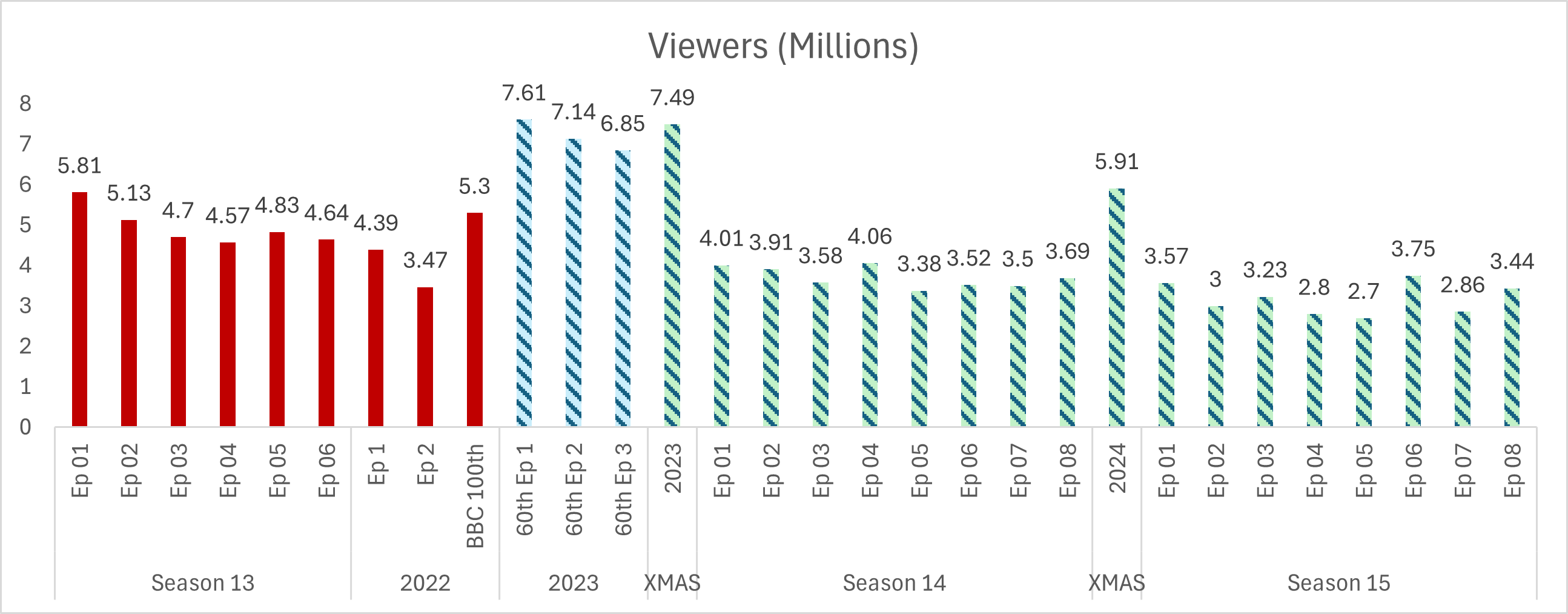
Russel T Davies initial return to the show managed to more than reverse the show’s decline in viewing figures since the start of Chibnal/Whittaker’s second season debut secured 6.89million viewers. The first 60th Anniversary Special was the most watched Doctor Who episode since November 2018 and even the third and least watched special had more viewers than anything since Chibnall’s first season. That momentum clearly carried onto the Christmas special with the 15th Doctor meeting Ruby Sunday for the first time coming within 200,000 votes of being Christmas Week’s most watched program.
And then nearly half the audience disappeared, seemingly never to return. Okay some did return for the 2024 Christmas Special (which unlike the previous, finished a poor sixth in the week’s viewership chart) but then nearly half the audience again didn’t return. In just over a year, Doctor Who went from panicking about only securing four million viewers to wondering whether it would ever be able to reach such heights again outside the festive period. Worse was happening stateside with the series never troubling weekly Nielsen’s streaming charts for original content.
He’s Not Conceited, He’s Convinced
The temptation when looking at these number is to ask what went wrong but a better question would be to ask what went right! The reality is that if you took the last episode of Season 13’s 4.64million viewers that gives you a nice clear line through to Season 14 debuting with just over 4million and Season 15 debuting with just over 3.5million. Other than a little watched and poorly received Easter 2022 special, the anomalies were the gigantic viewing figures that the 2023 Specials secured.
Davies had a clear vision as to how he was going to put Doctor Who back on its perch, and that was to unpick all the changes his predecessor had made to the show. Whereas Chibnall had a female Doctor lead an ensemble cast of companions on Sunday nights he would revert to the adventures of a male Doctor and female companion being broadcast the night before. He would bring back Murray Gold on music and even have Steven Moffat script a couple of very special episodes. This was not so much a revolution as a counter-revolution.
Now as someone who very much did not like the Chibnal-era of Doctor Who some of the changes were extremely welcome. The second Davies retakes control at the end of The Power of the Doctor the series feels more alive as the camera starts darting about again as opposed to the more dignified camerawork that defined the look of Chibnall’s series. And having a deliberately mumsy Doctor travel with a companion’s grandpa needlessly aged the character only for Chibnall to double down on his insistence the Doctor be sexless by needlessly adding John Bishop as a third wheel despite The 13th Doctor and Mandip Gill’s Yaz having the most natural chemistry of any couple since The 10th Doctor and Rose.
The three showrunners go to great lengths to stress what good friends they are but Davies clearly felt that Chibnall’s changes were badly mistaken and that simply reversing them would restore the show’s fortunes. This even applied to how the show was presented beyond the individual episodes with Davies once again being a loud promoter for the show, in contrast to Chibnall’s more reserved approach. This extended to being more liberal with spoilers about future developments and ramping up shoulder programming including a special concert attended by Davies, Moffat and Chibnall.
But what quickly became apparent is that fans had returned to see David Tennant and Catherine Tate, and would soon depart unless given a good reason to stay. This ironically is very similar to Chibnall who with his debut episode secured Who’s biggest overnight ratings for a regular season episode since Season 4’s Journey’s End only to lose three million live viewers during the course of Season 11. That two iterations who had in some sense deliberately defined themselves against each other had experienced the same steep, sharp decline suggests the problem is far more fundamental than the changes they did or didn’t make.
The One Constant Is Change
I selfishly hated Chris Chibnall’s change to Doctor Who’s scheduling for the very self-centred reason that my stepson would rarely be present on a Sunday evening to watch Doctor Who with me. But if you think about it for more than a second it actually made a lot of sense given that Top Gear had been a huge hit in the same timeslot on the basis that it gave families an excuse to extend the weekend by watching it together before the kids went to bed. By moving it to there, Chibnall was leaning into how television had changed in the years since Who returned to TV.
Davies did nothing like that when he came back. He insisted on a move back to not just Saturdays but the spring, despite both having become seriously crowded. Most tellingly he relaunched Doctor Who Confidential as a BBC3 magazine show focused on Behind the Scenes footage whereas Moffat had successfully moved the shoulder programming to YouTube where it could be designed for the show’s global fanbase, and placed less emphasis on DVD-style extras and more on YouTuber-style interview and reaction segments. Even more bizarrely he stuck to the 45minute running time he had introduced back in 2005, seemingly forgetting that with the show now being streamed overseas on Disney+, issues around the placement of adverts were much less relevant.
Even his new ideas seemed reheated. Davies rightly felt that by bringing together the casts of spin-offs The Sarah Jane Adventures and Torchwood as well as the previous seasons companions for the finale of his final full season as showrunner first time round, he anticipated the blockbuster crossover plotting that allowed Marvel to dominate cinema throughout the 2010s. Yet now with the awful “The Whoniverse” branding and frequent lore dumps it felt that he was desperately chasing superhero trends that many have long grown tired of.
More importantly Davies clearly struggles with matching the complex plotting of Moffat’s best episodes whilst making time for the fleshing out of secondary characters that had made his initial run so engaging. You best see this with the episode that introduced Varada Sethu as the new companion where we join the Doctor already embedded on the planet Missbelindachandra One and having built meaningful relationships with the local residents. The twist and turns in this one episode could have been a season of another streaming show, and what was sacrificed to make it fit into its running time was any note of nuance or empathy in the treatment of the characters other than the two leads. Which rendered all the narrative thrusts nothing but garbled nonsense.
Who is Who For?
Like a boxer whose punch is the last thing to desert him, Davies has not lost his ability to pick a cast. Ncuti Gatwa, Millie Gibson and Varada Sethu all gave the series the youthful energy it had long been lacking, arguably ever since Karen Gillan and Arthur Darvill left the series, and Matt Smith placed much more emphasis on the Doctor’s great age as he prepared to depart.
That was not nothing, but it was not enough. Indeed, Davies seemed to have no clear idea about who it was meant to be appealing to. For all the success in presenting a youthful core cast, the writing often seemed to hate the very young people it was meant to be appealing to; to this forty-year old Dot and Bubble was a hilarious satire of the try-hard yoof, but wasn’t the revamped show was to be appealing to them not me? Likewise Davies mortgaged the series future with the big Disney deal only to give them key episodes built around Davina McCall lifestyle programming and a Eurovision pastiche starring Rylan Clark. Furthermore rather than taking the time to slowly and simply introduce the Doctor to new audiences the series often seemed more determined to experiment with the format, as two men with dozens and dozens of episodes already under their belt, tried to entertain themselves with narrative games. Again, episodes like Boom or 73 Yards were my favourite of this era, but wasn’t the point to win over new fans?
Incidentally, whilst I’m here the increased emphasis on Kate Stewart and UNIT was another unforced error. It really struck me rewatching the initial Slitheen two-parter how much more energy and excitement the fact that Downing Street was flying by the seat of its paints gave to the story. The whole point of Doctor Who is that time travel allows it to be both a show with six decades of lore and one that is set in today’s world. That is fundamentally ruined by having some grey bureaucrat turn up and say, “ah yes, we’ve fought these aliens before in 1976”. Bringing UNIT back was a fun piece of nostalgia bait for the 50th Anniversary that has long worn out its welcome.
What Is Who For?
If Davies had a confused answer for who he imagined his return seasons were aimed at, he had no answer for what they were meant to achieve and if the format still worked. As we’ve already explained, he was clearly working on the premise that Who was working fine until Chibnal changed everything, ignoring that his predecessor had himself inherited a show whose audience had been consistently declining.
The big thing we learnt from the past three years is that the “adventure of the week” format that Davies invented just doesn’t work, even if you dramatically increase the funding. The list of casualities of the grinding schedule is as long as it is wide, beginning with Christopher Eccleston quitting over what he perceived as unprofessional behaviour in the very first season of the revival. Even if Moffat hadn’t been open about his struggles with managing the show the ever shifting broadcast schedule made that perfectly clear. Meanwhile Chibnal made the format work by leaning into an ensemble cast that didn’t particularly engage viewers. And there’s the extreme costs it imposes on production with nearly every episode requiring new sets, new costumes, and a new supporting cast.
But increasingly this tremendous burden placed on the production team is self-defeating. With the Disney+ deal, Doctor Who needed to succeed on a global streaming service but Davies delivered a show that is too exhausting to binge watch given its frenetic pace and wild changes in tone and genre. Meanwhile Davies bringing back his “child’s first cryptic crossword approach” to season long arcs just came across as an embarassing retread of his first stint as showrunner.
All the structural forces placed onto the show call for the storytelling to slow down by returning to serialised storytelling. Having to produce fewer stories would be cheaper because episodes could share sets, costumes and supporting casts. Producing longer stories would allow more time to be invested in the supporting cast, which reduces the pressure on the leads and provides time for sophisticated plotting and characterisation. Taken together this gives you a show that better suits the streaming service that overseas viewers will be watching Doctor Who on.
But what about the BBC?
Quicker but Slower
A growing problem the BBC faces with Doctor Who is keeping its profile high given its lengthy absences from our screens. This was something made worse by the sharply reduced number of episodes in each season which means even its brief period in the sun was fleeting. The mutterings from behind the scenes that Ncuti Gatwa didn’t understand the broader responsibilities are clearly a coded complaint that he wasn’t as willing as some previous Doctors to help mitigate this problem by throwing himself at the global rubber chicken circuit of light entertainment shows, fan conventions and press conferences.
A return to serialised stories offers a way forward. The BBC could turn Doctor Who into prestige programming that appears semi-regularly, keeping its profile high throughout the year. This would update the format to one where a single Doctor Who story is shown across a week as a strip. This would turn it into event programming that encourages younger audiences to watch live, so getting into habit of watching lineal television.
To me the way to proceed would be look at the three school half-terms within the year - middle of February, end of May and end October, with a one-off Christmas Special to round out the year. These are the obvious weeks to run Doctor Who as a prime time show, focused on winning a family audience. This could build on the precedent of The One Show taking time off during the summer holidays, by having The One Show take these weeks off to be replaced with 30minute episodes of Doctor Who. 7pm on weekday nights is not only the perfect timeslot for families to watch together but it also has the incredibly strong lead-in of the BBC local news, programs that would be perfectly suited for some timely visits from the show’s stars. It also gets Doctor Who out of the firing line of the ever more congested weekend schedule.
Creatively the great strength of moving to a 30minute is that it ensures the move to serialised storytelling isn’t an excuse for the type of flabby storytelling we got with the recent spin-off series The War Between the Land and the Sea. It hopefully strikes the balance between establishing a more consistent and sophisticated tone whilst not losing the sense of energy that has been Doctor Who’s greatest strength under both Davies and Moffat.
What’s more, a story of five 30minute episodes lasts 150minutes; perfect for those catching up on BBC Iplayer or whichever overseas streaming service replaces Disney+, where they could almost treat it as a movie. Indeed you could even offer an alternative edit that tweaks the program to smooth over the episode cliffhangers and tweak the pacing. Likewise the BBC could sell each individual story as its own DVD/Blu-Ray, rather than have to sell the whole series as a set, so increasing ancillary income.
It is fast approaching 21 years since Russel T Davies successfully relaunched Doctor Who, which means that by the time it returns this Christmas, the current format has lasted longer than the classic series did, before its first cancellation in 1985. It’s clearly time for change, not just because television has changed but also because the existing fans have gotten a bit tired of the show. They clearly want to watch, which is why they return in such large numbers whenever the show is rebooted. But they swiftly grow tired because its just more of the same. Implemented right, a new format can win these fans back by giving them something genuinely different whilst still telling simple, populist stories featuring the Doctor’s most charismatic villains that will appeal to new viewers.
No posts
Comments
Nothing yet. Say the first thing.
Sign in to join the conversation.