

There’s an increasing number of companies trying to build robots for homes — Figure, 1X Technologies, Weave, Sunday, and many more. One perennial debate that we see, again and again, is whether robots should have legs or wheels.
Personally, I am of the opinion that we’ll see some of both; that neither wheeled nor humanoid robots will dominate absolutely everything. But there are many passionate arguments on either side, from “wheels have no future” to “legs are pointless and dangerous.” Let’s go into the arguments in favor of each.
Your home is probably already full of robots, in a trivial way. A dishwasher or washing machine has an actuator, a motor, and sensors; it’s just stationary and not general-purpose. Your car may drive itself. You possibly have a Roomba-style robot vacuum.
None of these are what I am referring to. For the purposes of this article, a robot has these characteristics:
It is mobile. Else why would we care about legs vs wheels at all?
It has arms. It can pick something up.
It is multi-purpose — it can do more than one task, like fold clothes and look out a window.
There are many varieties of robots, but we’re particularly interested in the vision of a multi-purpose home helper robot.
Legs have some clear advantages. If you are on robotics and AI twitter you have likely seen many posts like this:
Basically, humans have legs, and so our environments often make strong assumptions about having legs. For example, legs allow you to go up and down stairs. They allow you to step over ground-level clutter. They let you go over uneven ground more easily while adjusting for balance.
Beyond this, legs have a few other advantages. A robot with legs can dynamically adjust its support polygon. It can take a wider stance when it needs to, bring its feet together to move through a narrow passageway, catch itself with a leg when it’s hit near the top. This means that, subject to good, reliable hardware and high-quality whole-body control model training, a robot with legs should be able to operate in a much wider range of environments and perform a wider range of tasks.
Legs have another advantage, less often discussed: redundancy. See this video by startup Light Origins: when it loses access to legs, it can hop or crawl to get around. More generally, as motors degrade, a legged robot can handle it more gracefully and not be fully disabled. This applies, too, to when the robot falls: it can stand back up, or fall intelligently, subject to robust knowledge of its environment.
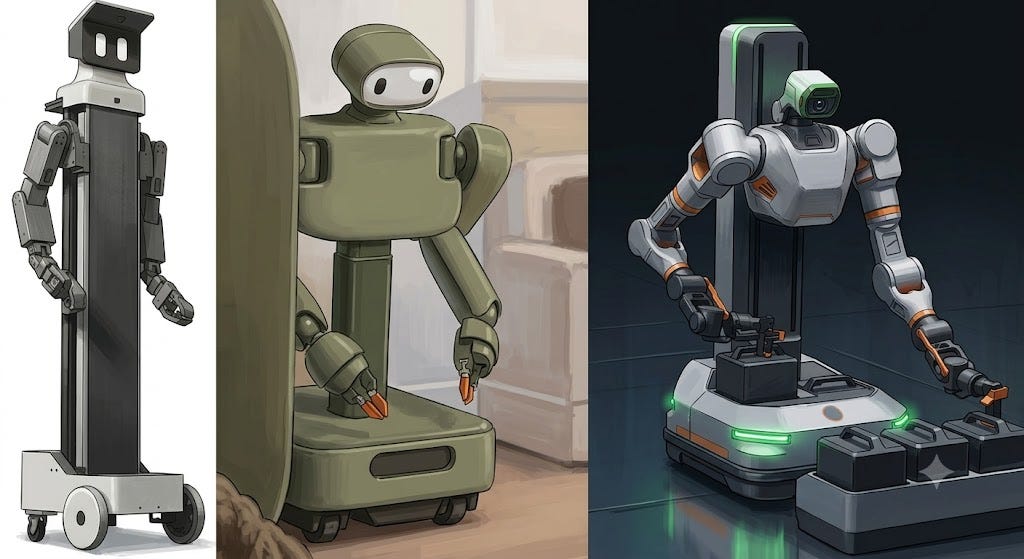
Wheels, on the other hand, are statically stable (they will not fall over if they lose power), and they are much, much cheaper. They also are able to carry much larger payloads.
This means we tend to see three kinds of wheeled robots: extremely cheap development and “home robot” platforms, mobile manipulation platforms with relatively lightweight arms but good quality arms, and extremely high-payload “heavy industry” stuff-carrying robots with large, very heavy bases.
The lightest wheeled bases are much less capable of carrying objects, and have a harder time reacting to disturbances (see previous section). But generally you’re assuming that these robots will not be making unexpected contact with the world while manipulating stuff. Incredibly heavy robots like the Galbot S1 (right, above) are basically impossible to knock over, but also not very portable.
These robots have far fewer actuators; for a given capability range, they can be much cheaper, as actuators are a huge part of the robot’s cost. They’re more reliable, more or less for the same reason but also because they’re less able to make unstructured contact with the world and that’s where robots tend to damage themselves or others (though this is because they’re less capable).
One understated advantage is that wheels are much, much easier to work with for developers. They can be plugged in more easily. They do not need a gantry. If you want to just push it over to a table and practice picking up cups all day, you can do that pretty easily. All of these steps have a lot more friction with legged robots.
This, to me, means that it’s likely that for a given task, if a wheeled robot can do it, it will likely be cheaper and smarter than the corresponding legged robot (at least in the near term). And the capability envelope for wheels, while lower than legs, isn’t so low it can’t provide value.
I am bullish on legs long-term. I think they’re clearly more capable, and will be safer, once the AI models to do perceptive whole-body control mature. I actually think that, eventually, legs may even be safer for the same capability level — a heavy-duty wheeled robot that can pick up a jug of milk would not be a good thing to have in your home, compared to a much more nimble humanoid,
I think the first robot in most peoples’ homes, though, will have wheels. I expect there will be an increasing number of decent, low-cost hardware options. A wheeled robot at $5,000 to $9,999 USD is something I can see many households purchasing — all it needs to do is, say, be smart enough to pick up toys off a floor, or fold some (not even all!) of the laundry.
That isn’t to say we won’t see legged robots in homes — we absolutely will — just that there will be room for both varieties going forward.
Comments
Nothing yet. Say the first thing.
Sign in to join the conversation.