
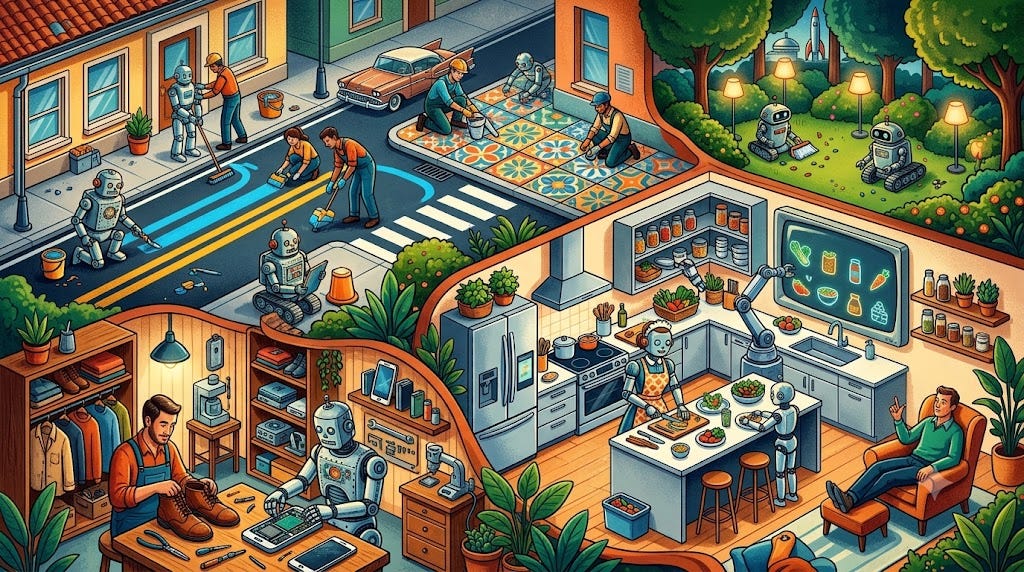
Inspired by a spate of recent announcements, I want to explore a thought experiment. If the price of robots keeps dropping, and their capability keeps going up, how would the world change?
The widespread success of coding models has made software easier to create than ever. You can now, with a modest investment, create your dream website or app — without being held back by years of software engineering experience. As we move towards a world where software is “free” — where frontier models like Fable 5 can one-shot a whole app — we must start wondering about what happens if we apply the same logic to robotics and, therefore, labor.
The fundamental premise of robotics is that we can automate large swathes of human manual labor and replace it with machine labor. In software engineering, abundance means more and better websites, easier data analysis, and more apps for niche applications. For robotics, universal automation — “free,” or really just radically discounted labor — means the “long tail” of jobs that just are not even worth automating right now.
What does this work look like?
To understand the sheer amount of work not being done, all you need to do is to look around.
Maintenance and cleaning are constantly postponed until the last possible minute. With infinite labor, we can do actually preventative maintenance: re-grout and re-caulk tiles, repaint road lines every month so they always look brand new. Gutters, roofs, and weatherstripping can be re-done before structural issues form.
Litter would vanish. Public spaces could be maintained, by robots, at the level of a boutique hotel. The world can be made clean and beautiful, with gardens and public art and clean streets everywhere.
And it goes past this - with free labor, homes can be de-cluttered and automatically organized, their contents entered into a contextual database, instantly queryable and searchable, accessible to AI agents to make sure that, for example, the ingredients for dinner are ready and prepped the second you get home.
Things can be made to last longer. We have a culture which consumes endless, disposable goods in part because of cost of labor: a modern industrial production line can mass produce new goods, but always the same goods. What’s worse, repairing old ones requires expensive human hands — so we just don’t do that. With “free” robotic labor available at scale, we might repair old shoes or upgrade old phones instead of throwing them out, reupholster old furniture, and patch worn clothes instead of consigning them to a landfill.
Food and goods can be made incredibly customizable. Every piece of clothing custom fit; every meal freshly-prepared from fresh ingredients.
Even care work can be made easier. Even if the human elements of teaching, childcare, and eldercare aren’t replaced, free labor makes the burdens of such jobs lighter — robots could reset classrooms, prepare activities, and help carry heavy weights.
One must then wonder if, in such a world, there will be less jobs.
Fundamentally, though, we must see that the demand for things is essentially infinite. With nigh-infinite labor, there is a massive amount of work that can be done, and therefore demand for labor will likely skyrocket.
This has been studied before, as Jevons Paradox, and it has occurred many times in human history. As travel got cheaper thanks to the automobile, people traveled more; as lighting got cheaper, thanks to the electric lightbulb, human societies generated more and more and more light.
The classic example of Jevons paradox in automation is the story of the bank teller and the ATM. Originally thought to replace bank tellers, the invention of the ATM actually saw the number of bank tellers increase until the 2010s. Human bank tellers could focus on more high-valued work, leading to the opening of new branches.
Likewise, we might think of this “free labor” as replacing not workers but enabling them — there will remain many decisions to be made, about what should be built and what work should be done. Doing the right thing — having taste — will become more important than rote labor.
Good, useful robots are getting much, much cheaper, something I have written about before here. The fundamental barrier is no longer cost, but intelligence: can we make these cheap robots reliable enough, at a wide range of tasks, so that we can make this explosion of labor actually useful to people.
Rise of the Cheap Robots
·
Jul 2
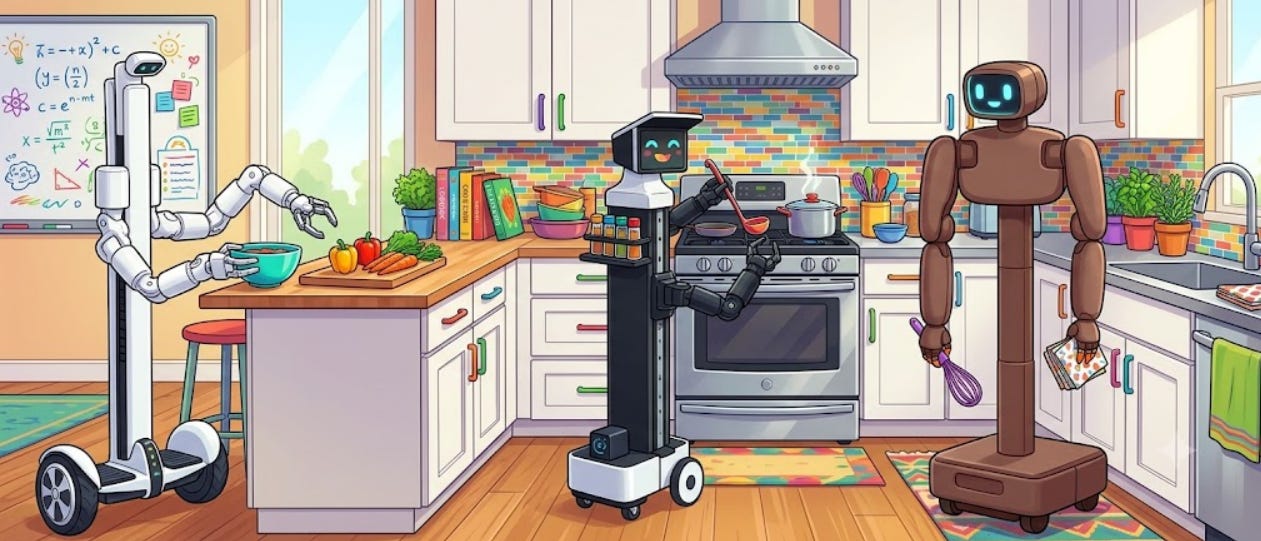
A couple startups have announced really exciting general-purpose robots in the sub-$10,000 range. These are finally, finally starting to look like something that could be made very capable.
The other thing worth considering is that this both builds upon, and enables, an expansion of agentic AI. Endless, cheap, robotic real-world labor will be the hands and eyes and mouths of cloud-based AI, accumulating data and creating the context for future decision making.
For all of this to happen, we just need current trends to continue to hold. Hardware needs to get cheaper, robots need to become more plentiful, and AI needs to continue to get more powerful and more general as it can ingest more data.
From my point of view, this is practically guaranteed.
Comments
Nothing yet. Say the first thing.
Sign in to join the conversation.