
The first time I witnessed Haiti losing a soccer game, I was around 7-8 years old.
Dave and a bunch of other friends carried me home stretcher-style, but without one. Emotionally disoriented, tears asphyxiating my lungs, Badio, a fan of Argentina who gifted me my first bicycle, sat me down and tried to explain to my 8-year-old brain why being a super fan is going to be a long road of disappointment. So I needed to man up.
Then in 1998, the French soccer team with their bald goalkeeper (Fabian something… don’t want to write his full name) beat the Brazil of Ronaldo, Taffarel, Rivaldo and Roberto Carlos 3-0 and won the World Cup. My mother had to chase me to go to school the following Monday. Broken-hearted by soccer, 11-year-old me started watching basketball and fell in love with Allen Iverson’s dexterity. He was shorter, so I also saw myself in him. Maybe that’s why I chose basketball one year in high school. Sure, I did make the team, but the guys never let me play. That’s for another time.
On June 15, 2001, I watched Iverson score 48 points and still lose to the Lakers in game 5. And that was my last sports heartbreak before retiring. I would watch sports once in a blue moon, like the 2004 Copa America final when Brazilian player Adriano helped Brazil win the Champion title at the 93rd minute mark, something I will never forget.
Where are you going with the Stories, Pierre? Stay with me
As you might have guessed, low-key, I still appreciate the game. So when Haiti qualified for the World Cup last year, that fan boy who died of sport-heartache rose like current gas prices on the world market. A feeling I described in one of my previous Substack posts.
Watching Haiti play the first World Cup game brought me so much pride. The second game made me sick (for real). My Whoop recovery score went down from the day we lost to Brazil and got backed up in the last game against Morocco, where the Grenadiers scored two magistral goals, with one ranked among the most beautiful goals of the tournament so far.
I screamed, cried and anmweyyed.
I recovered my voice two days later.
Even though we lost the game, Haitians all over the world gained something far greater, and that is what I want to talk about in this essay. As a Haitian who has lived 90% of his life in Haiti, I want to express what this means to me, my friends, and my people.
As Yuval Noah shared in his book Sapiens, what makes humans a unique species is our ability to create narratives. Tell stories. The FIFA World Cup is a global narrative avenue where each nation comes to tell or reclaim its own. Through their fans, customs, songs, and most importantly, through the imprint the players leave on the Zeitgeist. So while most Haitians love soccer, Brazil and Argentina, this year we had our team. On football’s biggest stage, in the world largest media market. Like all fans, we wanted our players to do well, we wanted to win, but all these are secondary to our deeper collective psychic need.
Reclaiming our humanity.
A moment in time to repaint the collective knowledge humanity holds about us in the physical and digital world.
An excuse to celebrate, come together, and feel the joy we used to feel during carnival.
Our country is at war with itself,
and the performance we delivered in the World Cup serves as a reminder that we are not just our worst.
This was a call to our better angels.
After our first game against Scotland, I could see the narrative shift in real time. When we first qualified, the Italian coach said we were not supposed to be there, but after the game, I see people all over the world saying “ wow, actually the Haitians are good,” or “I did not think the Haitian team would play that well”. This time, we were not begging anyone to look at us; we simply owned the moments with grace, pride, and gratitude.
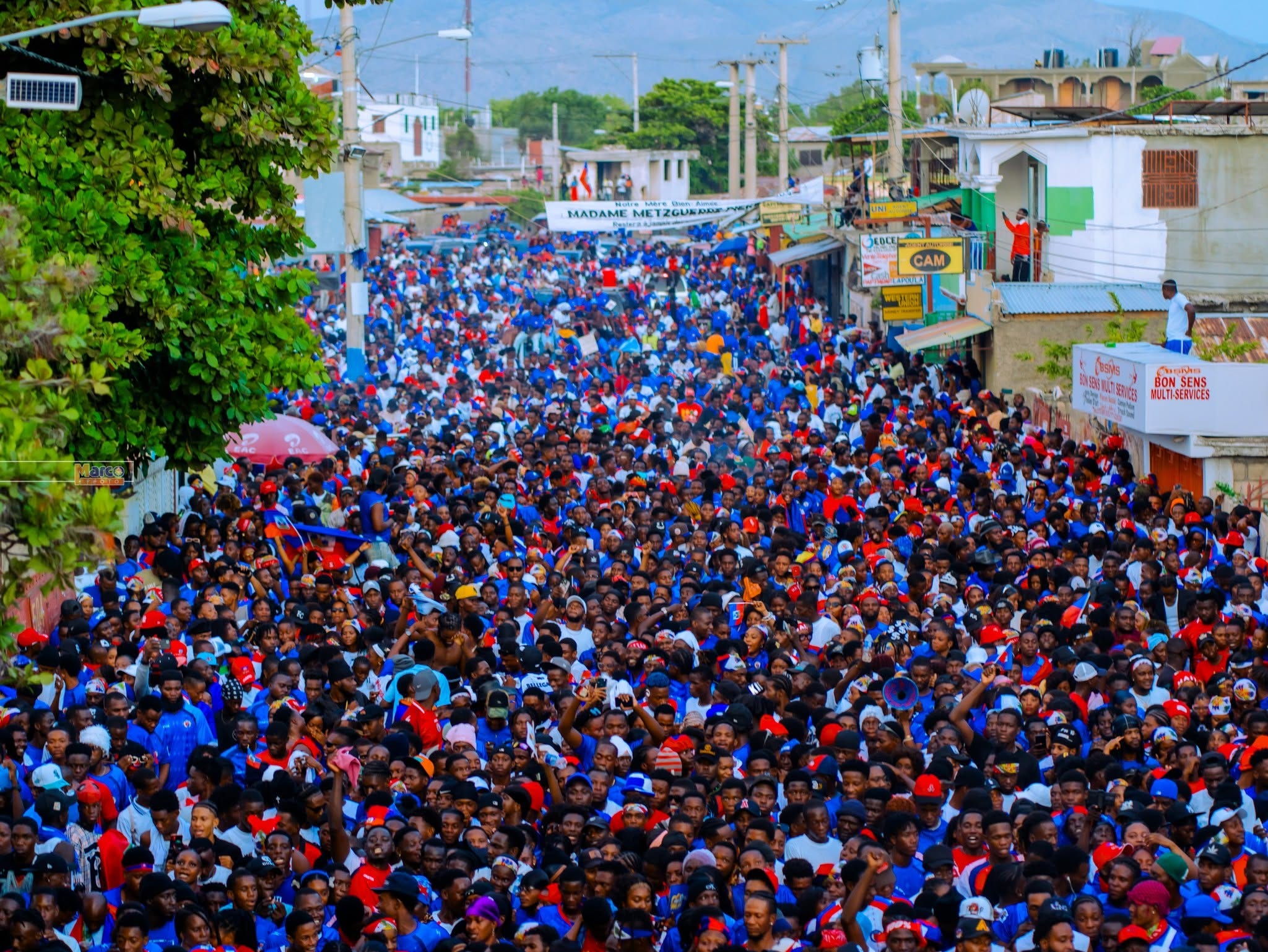
The sea of blue and red I saw in a photograph from Gonaïves is the best example that it was not about soccer, but the dormant “Lunion fait la force” (unity makes strength) spirit in the collective consciousness looking to realize itself.
As much as we have been influenced by other cultures, fleeing our home, or some of us destroying our own country, there’s one constant symbolism that we can’t escape. The one Joseph Campbell talks about when he stated:
It has always been the prime function of mythology and rite to supply the symbols that carry the human spirit forward, in counteraction to those that tend to tie it back.
I have not met a Haitian who does not think of 1804, that mythic achievement that birthed the first black republic in the world, whether in struggle or in success. It’s so ingrained in the psyche that we added an illustration of the last battle leading to the revolt to the official jersey which FIFA fairly rejected for being too political. But no matter how many years of political instability, gang violence, and discrimination, this symbol is buried so deep in our psyche, poking at us so violently, that it pulls stronger as we try to desecrate it.
I hear a lot of people say we should stop talking about 1804 because we’ve been doing worse ever since. I used to think that too. But that’s a flawed argument, as if the only people deemed to be proud of their ancestry are the ones who have succeeded by world standards. The better argument is that we shouldn’t solely be proud of it; we need to be inspired by it. Use it as fuel to build a happy nation.
Also, it’s more painful when you are called to greatness but cannot come up with the strategy to live up to that potential.
Entonces, the Grenadiers playing in the World Cup is a nudge, another cosmic wake-up call to rekindle that spirit.
For many of us, this was war.
War against our own inadequacies as a nation and war against the dominant narrative that we are simply victims.
In a way, 1804 is a blessing and a curse.A realization so grandiose that it captivates the worst among us and challenges the best of us.
Our World Cup euphoria is the last cheerful cry,
a cry for better lives,
a cry to our fellow Haitians to be better,
a cry to ourselves to be better citizens of the land that paid for freedom with their lives.
To the world, that was a re-introduction.
Yes, a lot of the bad things about us are true,
But the joie de vivre you saw in Haiti is contagious,
Our longing for greatness has not died.
Our rhythmic rara sounds still move the world.
Our tears of loss flow with patriotism.
The illusion of grandeur we get criticized for, is still alive.
And after all, our struggles don’t make us insignificant.
As the World Cup ends, what will Haitians do with this energy? That is the most important question.
Congratulations to the Spain team and fans. What a match !
Comments
Nothing yet. Say the first thing.
Sign in to join the conversation.