
Living in Jerusalem means living in very close proximity to your neighbors. With nearly one million people crowded into a city built for perhaps 100,000 residents, it sometimes feels a little too close for comfort.
Our houses are separated by trees, bushes, and maybe a shared stone retaining wall. You can’t always see one another, but you hear everything: children laughing, dogs barking, and, of course, Friday night singing.
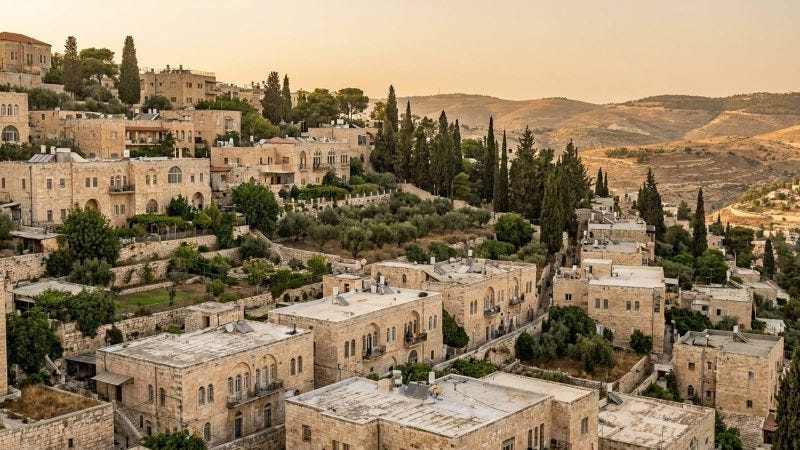
Jerusalem is also not famous for relaxed building regulations either. Around here, it sometimes feels like replacing a light fixture requires three permits and a committee meeting. Which is why, while we were rebuilding our backyard deck this summer, I became mildly obsessed with one question:
Was it actually legal?
Before construction began, I checked with a lawyer, who assured me we didn’t need municipal approval. I believed him, for the most part.
Still, I couldn’t completely shake the fear that something might go wrong. Part of the reason lived just beyond the hedge.
I had never met our next-door neighbor, but I knew who he was. He’s one of Israel’s best-known former State Attorneys. If my lawyer had somehow gotten this wrong, I wasn’t optimistic about my chances of survival.
But before I ever met him, something happened on that deck that reminded me why there is simply no place on earth quite like Jerusalem.
I had been looking forward to holding our family’s first Kabbalat Shabbat there, a kind of dedication for this new little corner of Jerusalem that had quickly become our favorite place to gather.
I never imagined someone else would beat me to it.
One morning, before construction had even finished, I walked outside and found one of the Muslim laborers who had been building the deck standing quietly in the corner, facing Mecca, praying.
Before we had ever sung a single verse of Lecha Dodi, before our family had offered a single Jewish prayer there, he had already turned the space into a place of worship.
I remember smiling at the irony. The first prayer ever offered on our brand-new deck wasn’t to Hashem. It was Allah.
Only in Jerusalem.
But a few days later, the deck finally hosted its first Kabbalat Shabbat.
As the sun disappeared behind the Judean Hills, family and friends gathered around as we sang Lecha Dodi, welcomed Shabbat, shared a meal, and celebrated our beautiful new backyard in our home in Jerusalem.
A few weeks later, I finally met that neighbor I’d been so worried about.
After introducing himself, he looked at me and asked, “Are you the family that’s been doing Kabbalat Shabbat on the deck?”
My stomach dropped. I was certain the next sentence would involve permits, municipal inspectors, or noise complaints.
“Yes,” I answered cautiously.
Instead, he smiled.
“It was beautiful.”
The relief was immediate.
Trying to recover, I thanked him and even said that he was welcome to join us sometime.
He looked at me, almost puzzled.
“What do you mean? I did join you. I was standing on the other side of the hedge singing with you the whole time.”
From abroad, Israel often appears divided into tidy camps: religious and secular, left and right, observant and non-observant. Living here has shown me those categories explain far less than we imagine.
Someone who rarely enters a synagogue may know every word of Lecha Dodi. Someone who passionately opposes the government and consistently votes for parties on the political left may instinctively begin singing Friday night melodies drifting over a backyard fence.
Jewish identity here rarely fits into neat categories. It is national and religious, historical and cultural, communal and personal, and often all at once. The boundaries constantly overlap.
As I’ve thought about these moments over the past week, I found myself remembering an idea from Rav Abraham Isaac HaKohen Kook, the first Chief Rabbi of the Land of Israel.
He believed that beneath all of our ideological disagreements lies something deeper: a single Jewish soul. The divisions are real, but they are not the deepest truth about the Jewish people. Beneath them, we remain bound together, even when we don’t always recognize it.
Tomorrow night, Jews around the world will begin Tisha B’Av.
Every year I return to one unsettling statement in the Talmud: any generation that does not merit seeing the Temple rebuilt is, in some sense, responsible for its continued absence.
Living in Jerusalem gives that teaching unusual immediacy. If the Temple still stood today, I could literally see it from my new backyard deck across the valley.
The Talmud teaches that the Second Temple fell because of sinat chinam, baseless hatred, because our internal divisions became stronger than our sense of shared destiny.
Every year, Tisha B’Av arrives and asks the same question:
Have we repaired what was broken?
I’m not pretending that one backyard connection answers a question that has confronted the Jewish people for nearly two thousand years. But I do know that redemption arrives so quietly that we almost miss it. Like when a religious family welcomes Shabbat with song while a “secular” former State Attorney is standing behind a hedge, singing Lecha Dodi.
The story isn’t about a deck.
It’s about one tiny patch of Jerusalem where, over the course of a few ordinary summer days, the labels that dominate so much of our public conversation faded away.
Redemption may not mean that our disagreements disappear. Israelis have never lacked opinions, and they’re not about to start now.
Perhaps “religious” and “secular,” while still useful sociological descriptions, become a little less important than the fact that we belong to the same people, rebuilding the same country and carrying the same story.
As we enter Tisha B’Av, that feels like a reason for hope.
Thanks for reading,
David
No posts
Comments
Nothing yet. Say the first thing.
Sign in to join the conversation.