
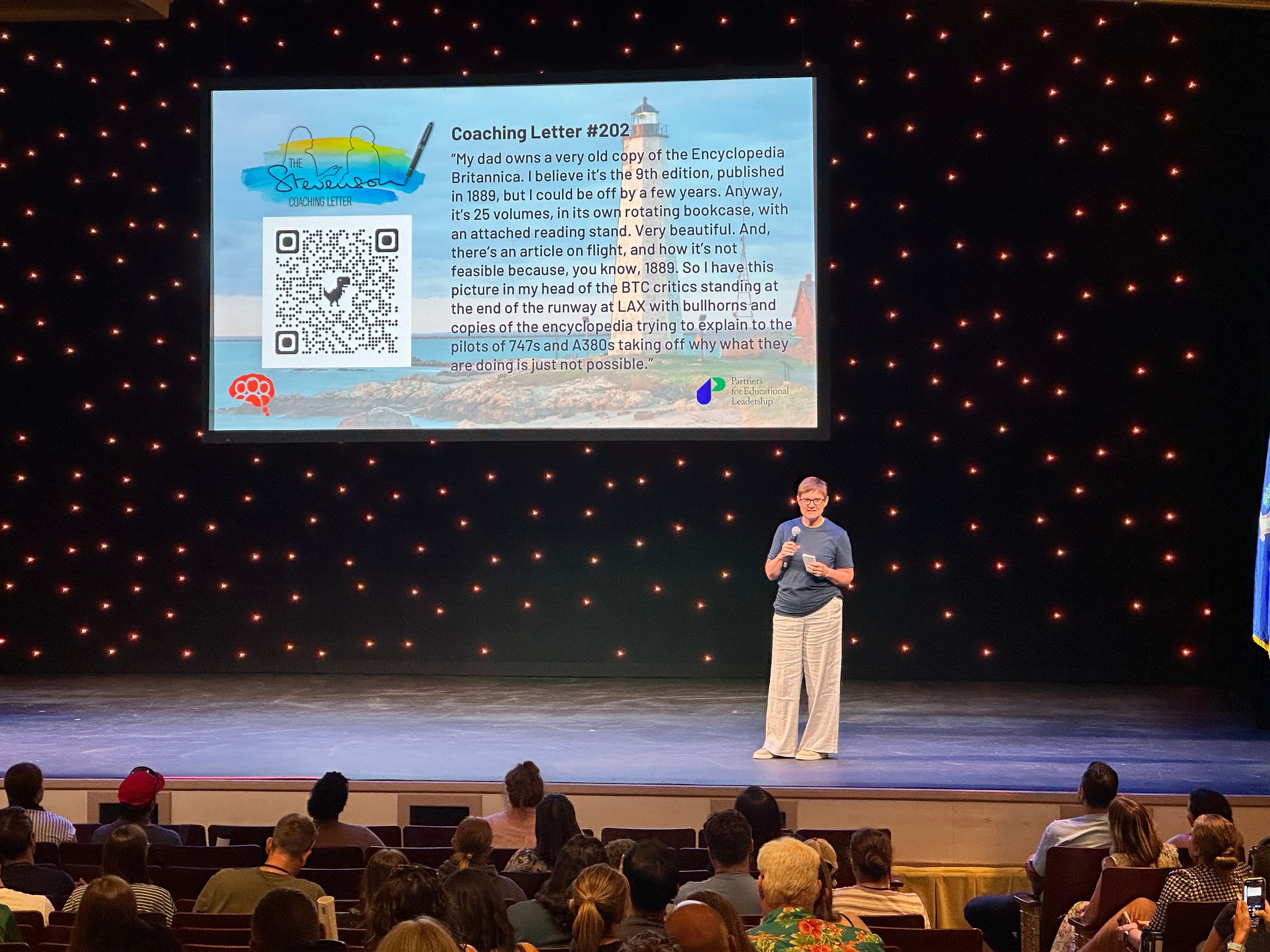
At the end of June, we hosted a conference about Building Thinking Classrooms, which was a huge success and very fun and the list of people I am grateful to is a whole Oscar speech by itself. My personal highlight was Rydell’s keynote—Rydell Harrison is my colleague, my co-author, and a brilliant human—and you can, and should, watch the speech here. Every conference should have a Rydell keynote.
One of my jobs was to introduce Peter Liljedahl, and I told people that if they had questions about the research, they should email me. And people did. Here’s a representative email—OK, maybe this one is particularly effusive:
WOW! I am writing to express my deepest gratitude for the incredible conference you put together. My colleague, Lynne, and I both attended, and we left feeling completely energized and transformed. The sessions and insights provided us with so much knowledge, practical strategies, new connections to ideas, connections to like minded humans, and most of all, a sense of community and belonging in all things BTC.
As we look to expand our current implementation, we face a few distinct hurdles. Our primary obstacle is overcoming the skepticism of doubters within our district, as well as some specific hesitancy from our curriculum director.
To help us advocate for this amazing work, could you share any research and/or data you may have compiled around BTC practices? Having strong evidence will be crucial for us to get our leadership on board and continue this journey beyond just our current scope.
Thank you for all that you did to make this conference what it was. Reading Peter’s book changed how I teach, but experiencing this conference changed who I am.
So this Coaching Letter is a response to that email and others like it. And one of my other jobs was to close the conference, which I did with a group sing-along. So if you want a laugh, watch this. But first, here’s the TL;DR.
I would not claim that BTC, as a named pedagogy, has a definitive research base proving long-term outcomes in every context. But I would say it is strongly aligned with decades of research on powerful instruction: worthwhile tasks, visible student thinking, collaboration, adaptive teaching, and maintaining cognitive demand. For skeptics, research alone is unlikely to be enough, because people interpret classrooms through their existing mental models. The better strategy is to let teachers and leaders experience what changes when a room is organized around student thinking. BTC is not the only way to protect cognitive demand or expand Opportunity to Learn, but it is a strong, practical, teacher-facing way to do it.
On the question of research and data, I think there are several different things worth separating. They often get collapsed into one question—“What is the evidence for BTC?”—but there are really at least three questions hiding inside that one.
Is Building Thinking Classrooms aligned with what we know from research about strong instruction? Are there particular BTC practices that have their own research base?
How do we persuade skeptical adults?
What is a responsible way for a district to try this without making a huge, irreversible commitment?
1. What does the research say? My short answer is this: I would not say that there is one single body of research proving that “BTC,” as a named pedagogy, produces specific long-term outcomes under all implementation conditions. That would be too strong a claim. BTC has not been around long enough, and the implementation variables are too significant: how much BTC, how well enacted, in what grades, with what tasks, over how many years, supported by what professional learning, and so on. But I do think we have “Thrilling Results”, and those are the kinds of outcomes that Peter talked about in his keynote—early indications that not only does BTC deliver better outcomes, but also that the more of the tools you use and the longer you use them for, the stronger the outcomes for students. [My colleagues and I are working on a separate blog called Thrilling Results to document these indicators of success, in math and other subjects, using BTC and not using BTC.]
I would also say, with a great deal of confidence, that BTC does not float free of research. Quite the opposite. This is the theme of Coaching Letter #221 that I talked about in my introduction to Peter’s keynote: almost every core move in BTC shows up in decades of scholarship, sometimes under different labels and sometimes buried in specialized research literatures. These are documented in CL #221. What is smart about BTC is that it pulls those strands together and makes them usable for teachers in a way that very few things have.
The common critiques of BTC tend to come from people who mistake it for minimally guided instruction, and this is the theme of Coaching Letter #198. They worry about cognitive load. They invoke the expert-novice distinction. They cite research on worked examples and argue that students should not be asked to think before they have been shown what to do. Those critiques are not irrelevant, but they often miss what is actually happening in a well-run thinking classroom. Students are not being abandoned. They are being given a carefully chosen task, a structure for collaboration, visible access to one another’s thinking, and a teacher who is monitoring, responding, sequencing, pressing, and maintaining the cognitive demand of the work.
It is an important distinction. BTC is a highly structured way of getting more students to engage in more mathematical thinking for more of the lesson. It is not “go figure it out, children, and may the odds be ever in your favor.”
I and two of my colleagues recently wrote a book called Maximizing Opportunity to Learn that explains, among other things, that equitable and ambitious instruction depends on increasing students’ actual opportunity to engage with grade-level ideas. That means paying attention to the task students are asked to do, the amount of time they spend doing meaningful work, and the teaching moves that either maintain or reduce the cognitive demand of the task. We also argue that students’ thinking has to become visible so the teacher can respond to it, and that classrooms need a holding environment strong enough for students to take intellectual risks without being rescued at the first sign of uncertainty.
BTC is a very strong enactment of that instructional vision. That’s why we got so involved with it in the first place. It gives teachers a concrete way to put students in relation to a worthwhile task, make their thinking visible, and create the conditions under which the teacher can respond adaptively without taking the thinking back from them. So, just to be clear, we are big fans of BTC because it enacts what the research says is most important in guaranteeing student opportunity to learn, not because it’s a fun way to spend a class period.
The research on cognitive demand is especially important here. Mary Kay Stein and Margaret Smith’s work on mathematical tasks showed that tasks often begin with high cognitive demand but lose that demand during implementation. In other words, a lesson can start with a rich task and still become procedural, over-scaffolded, or teacher-directed within minutes. That is not usually because teachers are lazy or careless. It is often because teachers are trying to be helpful. They explain, model, or scaffold more than necessary, and they anticipate frustration and lower the demand before students have had time to think. BTC gives teachers practical mechanisms for resisting that drift: a concise task launch, random groups, vertical non-permanent surfaces, visible thinking, and teacher moves that keep students responsible for sensemaking. The visible features are the boards and groups. The deeper function is maintaining thinking.
2. How do we persuade skeptical adults? Research is useful, but only if people are actually open to being persuaded. Often they aren’t really. People are invested in their existing mental models of instruction. When they visit classrooms, they filter what they see through the model they have in their head of what good teaching looks like. If they believe good teaching means clear explanation, quiet compliance, and students producing correct answers efficiently, then a thinking classroom can look messy, inefficient, or under-taught. The same classroom that one person sees as rich mathematical engagement, another person may see as insufficient teacher control. In particular, people often fail to understand that BTC is not the opposite of Direct Instruction, and it is not simply Inquiry. There is a LOT of teacher guidance in a BTC classroom, it just doesn’t look like what teacher guidance looks like in a non-BC classroom, and therefore it’s easy to misinterpret.
So I would be cautious about assuming that the best way to persuade skeptics is to send them a packet of research. Sometimes that helps. But often the stronger move is to give people an experience that gives them a new mental model.
One way we do this, for teachers and leaders, is through an exercise built around Ray Bradbury’s short story “All Summer in a Day.” We use it because it allows adults to experience a classroom structure in which everyone is asked to think, everyone’s thinking becomes visible, and the facilitator can respond to the room rather than simply deliver content. We often start with a non-math task because some adults, the moment they see numbers, retreat into “I’m not a math person,” despite the inconvenient fact that they have a degree that, presumably, ensures some level of math proficiency. A language arts task lowers that particular barrier.
The activity also does double duty. One theme of “All Summer in a Day” is about the limits of trying to talk people into believing something they have not experienced. It’s a nice bit of irony to be able to exploit in the consolidation. We have had administrators, coaches, teachers, and in some cases whole districts use this exercise. If you want to explore that route, I would be glad to talk with you about what you are trying to accomplish and help match the facilitation plan to the goal.
Another way to build support is to stop asking people to be persuaded and instead ask them to try something. For teachers, we make the initial ask very small, because we are trying to lower the stakes. Reading Peter’s book is enormously helpful because it gives the whole framework, but it can also make BTC feel like a lot of change all at once. Some teachers hear “Building Thinking Classrooms” and imagine they have to transform every aspect of their teaching by next Tuesday.
One way to make the ask small is to start with some of the first practices in the BTC book: random grouping, non-permanent vertical surfaces, defronting the room. And that is definitely one way to start small. The potential problem here is that, while the most visible form of BTC is students in random groups working at whiteboards, the function is students thinking together on a worthwhile task while the teacher maintains cognitive demand. So those practices are great if the teacher kinda gets it and wants to get started, however…
So as not to confuse form with function, another possibility is to start with task launch. Ask teachers to try launching a worthwhile task in five minutes or less, then giving students at least three minutes to think before the teacher starts circulating, questioning, checking, or rescuing. My team are a little obsessed with the research that shows that most tasks lose cognitive demand over the course of the lesson, and much of that loss happens in the first few minutes of class (Jackson et al., 2013, using Stein et al.’s 2000 work—same Stein as mentioned above). Asking teachers to launch a task in the first five minutes has multiple benefits: it allows more time for students to work on math, it makes is harder for teachers to lower the cognitive demand by giving them less time to explain, and it is a very small change for teachers to make, meaning that it requires very little in the way of commitment. And to make this even easier, we have a recipe for task launch that walks them through how to do it. You can find it here.
The line I often use is: I am not asking you to join a convent. I am asking you to try praying—for five minutes. The risk is very small. The worst thing that happens is that you lose three to five minutes of your life—or class. The best thing that happens is that students surprise you. And those surprises matter, because they begin to shift teachers’ mental models about what students are capable of doing.
3. What is a responsible way for a district to try this without making a huge, irreversible commitment? I once read that CEOs like Jeff Bezos are fond of thinking of changes in terms of one-way or two-way doors—in other words, is a decision reversible, or irreversible? For example, a district can spend tens or hundreds of thousands of dollars on a new curriculum program; larger districts can spend millions. The decision to purchase makes program adoption irreversible. Districts make similarly large commitments when they spend $5,000 per classroom on SmartBoards, or buy every kid a Chromebook. Those are one-way doors. By contrast, a small BTC test can begin with a few teachers, a few copies of the book, whiteboards, markers, erasers, and some time to learn together. We’re talking a couple of hundred bucks. That is not nothing, but it is not a massive one-way-door decision.
In the same spirit of “What’s the worst that can happen?” that we use when asking teachers to try launching a task in 5 minutes, I would not ask district leaders to “adopt” or “launch” or “roll out” BTC—or even imply that that’s what you’re hoping for. I would frame the ask as a responsible investigation of a pedagogy that is hugely popular with math teachers across the globe. Can we ask a few interested teachers to try one or two BTC-aligned practices? Can we visit classrooms where this is already happening? Can we look at what students are doing and saying? Can we learn what support teachers would need if we wanted to expand?
I would also say that your district’s vision/portrait of a graduate/mission statement, or whatever you’ve got, is likely very helpful here. Almost all of these statements talk about some version of critical thinking, collaboration, and self-directed learning. How are leaders expecting that those things are going to show up in classrooms? The answer to that question could look a lot like BTC…
The responsible thing is not to ignore BTC and not to mandate it wholesale. The responsible thing is to learn from it. Try it with a small group. Look closely at student thinking. Collect evidence from your own classrooms (we have forms for collecting teacher-generated data on that same website). Then use that evidence to decide what support, structures, and next steps would make sense. I wrote a series of Coaching Letters on scaling recently, and these could also be helpful:
And here’s where I sound like a Facebook reel—the part that no one’s talking about is that, however anyone feels about BTC, every school and district has a fundamental problem of practice, and that is ensuring that all students have Opportunity to Learn. One of the key ingredients of that is maintaining cognitive demand in all dimensions: across students, across classrooms, across schools, and from beginning to end of lessons, units, and school years. BTC offers a highly actionable pedagogy for maintaining cognitive demand, so if you’re not going to utilize that pedagogy, what is your plan?
Just to be clear, I’m not saying that BTC is the only way to maintain cognitive demand, nor am I saying that BTC guarantees that all students get Opportunity to Learn. I’m just saying that, all things considered, it seems to me to be a really good bet.
If you need anything else, including Rydell’s contact information, let me know. Best, Isobel
Comments
Nothing yet. Say the first thing.
Sign in to join the conversation.