
I started writing this and then it got so unwieldy that even I couldn’t follow my own writing. I’ve spent more time on book chapters. So this is part one of a mini-series on scaling, nested within a larger series launched in Coaching Letter #223 with this statement: My goal is to never have another leader ask me: “How do I get teachers to…” when the question should be “What conditions and structures should I create?”
This Coaching Letter has three parts. First, my twitchiness about conversations about scale. Partly because I do not always trust the assumptions that leaders bring to those conversations, and partly because the answer I want to give is harder to for me to explain than they are hoping for and that they deserve. Second, there are two different ways of thinking about scale. Yes, I know there are more than two, but for the purposes of simplifying my argument, I am going to call these Logic Alpha and Logic Phi. Third, I think it helps to understand the distinction between technical and adaptive challenges, because the extent to which a change requires not just learning new skills but a shift in mental model helps determine which approach to scale makes sense, and between tight and loose coupling. So now I’m back to where I started when I first started writing this Coaching Letter:
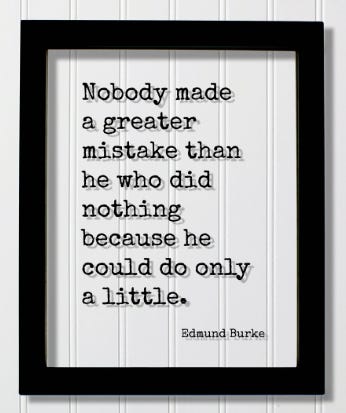
When I was studying for some test in high school, one of the practice questions was: ‘ “No one made a greater mistake than he who did nothing because he could only do a little.” (Edmund Burke). Discuss.’
Since then, I have Googled this quotation and know that it was highly unlikely that Burke ever wrote this, and I have forgotten who Burke was. Nevertheless, even though I never wrote the practice essay, I have thought about it a lot. And over 40 years later, I think I finally understand it. And the place where I see the greatest mistakes being made regarding doing nothing because a little doesn’t seem like enough is in conversations about scale.
Specifically: I hear leaders ask questions about scale (“I’m wondering how this works at scale”) that seem to be some sort of gatekeeper for them. I have several interpretations—and, therefore, responses—for this question, depending, I think, on what kind of day I’ve had. Sometimes I hear it just as a concern that they don’t want to invest in a line of work that is always going to be niche, when they have a whole organization to worry about—and therefore asking about scale is a legitimate question. Other times I feel like it’s just something that gets thrown at me to put the onus on me to prove that what I’m suggesting is going to fix the organization without much investment on their part. I do recognize that I’m being cynical and ungenerous and perhaps a little defensive when I make this interpretation. But it does feel sometimes like if they do not get an immediate answer to the question of how a particular practice can be taken up by everyone, everywhere, all at once, then the light dims from their eyes and they begin to relegate the idea to the dark corners of their strategic universe.
I do try to take the question at face value, but then I face the problem of not knowing exactly what they mean by scale. So this series of CLs is an attempt to lay out what you need to know about scale to be able to usefully have a conversation about it—and especially, let’s not be bashful, a conversation that won’t make me twitchy.
There are different approaches to scaling that can be usefully categorized into two logics for discussion purposes. Neither is wrong, but one is generally more likely to lead to success depending on where the initiative is on, let’s call it a technical-adaptive continuum. At this point I’d like to acknowledge that all the really useful parts of the discussion about the second approach, especially the language, come from my colleague Andrew.
Leaders are likely to think of scale as spreading a practice across an organization, which is measurable in numbers: x number of schools implementing, x number of teachers trained, x number of whiteboards purchased. Scaling in this way of thinking is top-down and success is quantitative. We’re going to call this Logic Alpha. Leaders use terms such as turnkey, launch, accountability, roll-out and buy-in. Pushback to this model is likely to use terms such as top-down, “cookie-cutter”, bureaucratic, “flavor of the month” and “one-size fits all.”
Logic Phi is different in that, instead of asking how to spread a practice everywhere all at once, it asks how to create the conditions under which a practice can take root, adapt, and spread through the organization over time. Scale is not measured primarily by how many people have been exposed to an idea, but by whether the idea is becoming deeper, more durable, and more self-sustaining. Leaders working from this logic use terms such as spread, propagation, fertile ground, kindling, networks, connectors, adaptation, iteration, ownership, and positive outliers. Pushback comes in the form of criticism such as slow, messy, unquantifiable, unpredictable, and the question, “what about accountability?”.
Steps taken differ based on the logic in play. Logic Alpha requires steps such as defining the initiative clearly and precisely, developing a plan for rollout including timelines and benchmarks, training everyone in the same materials and procedures, identifying barriers to implementation and removing them, building data-gathering tools and systems for reporting and monitoring, attending to calibration, taking action when procedures are not observed, and so on. I want to state very clearly that I am not against ANY of this. Indeed, there are places where you would be mad, and indeed in violation of the law, not to do it: fire drills, food preparation and service, transportation, budget… whenever safety is involved, you’d better be doing these things. And the more technical the procedure, the easier it is to apply Logic Alpha.
But our world is not always technical, although I wish it were more so. Honestly. I am not the “let a thousand flowers bloom” hippy chick that’s just interested in people getting to do “what works for them”. I just know that an approach that does not recognize the difference between adaptive and technical is on shaky ground--more on that in just a sec.
Logic Phi requires a different set of moves. Rather than beginning by defining the entire plan in advance, it starts by identifying where there is already energy, curiosity, credibility, and fertile ground. It looks for positive outliers, people with “spark,” and existing pockets of practice that can serve as seed crystals. It invests in helping those people deepen their understanding, connect to one another, and develop the capacity to explain, adapt, and spread the work.
Approaches in Logic Phi include: noticing where the work is already alive; cultivating small groups or teams rather than attempting organization-wide rollout; creating opportunities for people to see, try, and discuss the work together; helping practitioners develop a shared understanding of the underlying principles rather than a script; paying close attention to relationships, trust, and informal networks; connecting people who are doing similar work so they can learn from one another; supporting iteration, adaptation, and local experimentation; collecting “good enough” data to learn what is helping or hindering spread; amplifying stories, examples, and visible wins; protecting the conditions that allow the work to continue; being tight on the core principles and loose on everything else; looking for opportunities for one person or team to “double” by bringing in another; watching for patterns that are emerging and strengthening them; and gradually shifting ownership from a small number of champions to the wider system.
Logic Alpha is orderly, legible, and administratively satisfying, but the approach falls apart because it produces compliance more reliably than it produces learning. And that’s fine if learning is not the goal! But in an alarmingly high number of questions about classroom practice, we have to learn our way to the answers, because we have research and theory to guide us but not detailed guides to practice. And again, I’m in favor of detailed guides, protocols, and, dare I say it, scripts! Not saying anything against those! But if we don’t have them, then scaling using Logic Alpha is a technical approach to an adaptive challenge, and generally those don’t work well.
Crucially, Logic Phi is not structureless. It is not laissez-faire. But it does require being able to make the distinction between where you are tight and where you are loose. So just a word on that language—we are referring to Karl Weick’s ideas about tight and loose coupling. Karl Weick distinguished between tightly coupled and loosely coupled systems. In tightly coupled systems, the parts are closely linked: a change in one place produces a predictable change somewhere else. In loosely coupled systems, the parts are connected, but more flexibly and indirectly. Different people or parts of the organization may respond in different ways.
Schools are often more loosely coupled than leaders want to believe. A district can adopt a new initiative, but that does not mean classrooms will change in a predictable or uniform way. Logic Phi accepts this reality rather than fighting it. It is tight where tightness matters—around a small number of core principles, practices, and routines—and loose everywhere else, allowing people to adapt the work to their context while still staying connected to the underlying idea. We are tight on practice: instruction, specific moves, the requirement that teams work together, the use of practical data. We are loose on how, where, and through whom the work spreads. That is not a compromise between top-down and bottom-up. It is a design principle.
Logic Phi frequently benefits from identifying people who “grok” it and are willing to lean into the work—not sure how I feel about the language of “leaning in”, but it works in this circumstance. In one of the New York districts that we work with, there’s one particular person who is not senior in her district, Sarah, but she gets what we’re proposing, sees the value, and takes on the tasks of supporting, persuading, and coaching others—we don’t think that’s in her job description, necessarily, but leadership is not synonymous with title. So Andrew has taken to use the phrase “doubling Sarahs” as a shorthand for a Logic Phi technique: finding the Sarahs in the organization, supporting them directly, but also enlisting them in finding others who will fill the same function. Our friend Melissa was very good at that when she still worked for Bridgeport and was responsible for improving literacy—she drew other people in, and she was strategic about it.
And finally, for those not familiar with the terms technical and adaptive, I pulled this description from some of our old coaching training materials. You’ll recognize immediately how the distinction corresponds with Logic Alpha and Logic Phi:
Heifetz and Linsky argued that leaders frequently misdiagnose the nature of the problems they face. They distinguished between technical problems and adaptive challenges. Technical problems may be difficult, but they are amenable to existing expertise, known procedures, and authoritative solutions. Someone already knows, or can know, what to do. Adaptive challenges are different. They require changes in beliefs, values, relationships, habits, or ways of working. They cannot be solved through expertise alone because the people involved must themselves do the work of learning and changing.
A technical problem can often be addressed by applying established knowledge. If a district needs a new schedule, a new grading system, or training on a particular instructional routine, those are primarily technical matters. The challenge lies in execution, not in fundamentally rethinking the work.
An adaptive challenge arises when the underlying issue is not only a lack of knowledge but a need to change assumptions and behavior. If educators do not yet believe that all students are capable of engaging in grade-level, cognitively demanding work, then the central problem is adaptive. A district may adopt a new curriculum, rubric, or professional development sequence, but these technical responses will not by themselves address the deeper issue. The work requires a shift in mental models, expectations, and norms. The distinction is therefore:
Technical problems can often be solved for people.
Adaptive challenges can only be addressed with people.
The trap in educational leadership is to respond to adaptive challenges with technical solutions because technical solutions appear cleaner, faster, and more controllable. When the real challenge concerns beliefs about students, definitions of rigor, or assumptions about teaching and learning, leaders often respond with a new initiative, a checklist, a curriculum, or a workshop. These may be necessary, but they are not sufficient.
In The Strategy Playbook, Jennie and I argued that most educational problems contain both technical and adaptive dimensions. Improving instruction requires technical supports such as schedules, protocols, common language, tasks, and systems for collaboration. But those structures matter only insofar as they support the adaptive work of changing how educators think and act. I stole this line from someone else: what we do is create binders full of certainty sitting on shelves in buildings full of uncertainty. I carry around stickers in the back of my car that say “it’s not about the binder.” Send me your address and I’ll mail you however many you like.
More about scale next time. And please, don’t hesitate to reply with feedback or requests for more information. I am always very grateful to the people who respond to any given CL—the last two in particular generated a lot of discussion, and it’s super helpful to know what people are thinking when most of the time I’m trying to figure stuff out for myself. Thank you for subscribing to The Coaching Letter—I am beyond grateful. Isobel
Comments
Nothing yet. Say the first thing.
Sign in to join the conversation.